Category: Uncategorized

  • AI in Medical Diagnosis: How Artificial Intelligence Is Transforming Healthcare in 2026

    AI in Medical Diagnosis: How Artificial Intelligence Is Transforming Healthcare in 2026

    AI in Medical Diagnosis: How Artificial Intelligence Is Transforming Healthcare in 2026

    Artificial intelligence is rapidly changing the way healthcare professionals analyze medical information, detect diseases, and support clinical decision-making. From medical imaging to early disease detection, AI is becoming an important technology across hospitals, clinics, and healthcare organizations in the United States.

    In 2026, AI in Medical Diagnosis is attracting significant attention because it can help physicians process large amounts of medical data and identify patterns that may otherwise be difficult to detect. However, AI is designed to support healthcare professionals—not replace doctors.

    What Is AI in Medical Diagnosis?

    AI in Medical Diagnosis refers to the use of artificial intelligence, machine learning, and related technologies to analyze medical information and assist healthcare professionals in identifying possible diseases or health conditions.

    AI systems can process medical images, laboratory results, patient histories, and other structured or unstructured information. Based on patterns learned from data, these systems can provide predictions, highlight abnormalities, or help prioritize cases for further evaluation.

    The final diagnosis should still be made by qualified healthcare professionals using clinical judgment and appropriate medical evidence.

    How Does AI Help With Medical Diagnosis?

    AI in Medical Diagnosis works by analyzing large datasets and recognizing patterns. Machine learning models can be trained using medical information so they can identify features associated with particular conditions.

    For example, an AI system analyzing a medical image may highlight an area that requires additional attention from a radiologist. Similarly, AI software can analyze certain patient data and identify patterns that could indicate an increased risk of a health condition.

    This can give healthcare professionals another tool to consider when evaluating patients.

    Major Applications of AI in Medical Diagnosis

    1. Medical Imaging

    Medical imaging is one of the most important applications of AI in healthcare. AI systems can assist with the analysis of X-rays, CT scans, MRIs, ultrasound images, and other diagnostic images.

    AI in Medical Diagnosis can help identify suspicious areas, prioritize potentially urgent cases, and support image interpretation.

    For U.S. hospitals dealing with large volumes of medical images, AI-assisted workflows may help radiology departments manage workloads more efficiently.

    2. Early Disease Detection

    Early detection can be important for many medical conditions. AI can analyze patterns in medical data and help identify potential warning signs.

    AI in Medical Diagnosis may support early identification by analyzing information that could be difficult to evaluate manually at scale.

    Early detection does not mean that an AI prediction automatically represents a diagnosis. Healthcare professionals must review relevant evidence before making clinical decisions.

    3. Cancer Detection

    AI is being researched and implemented for different aspects of cancer care, including medical image analysis and identifying patterns associated with certain cancers.

    AI in Medical Diagnosis can assist clinicians by highlighting potentially abnormal findings and helping them focus their attention on areas that may require further investigation.

    The effectiveness of an AI system depends on factors such as the quality of its training data, validation, clinical environment, and intended use.

    4. Cardiology and Heart Health

    AI can also support cardiovascular healthcare. Machine learning systems can analyze certain medical measurements, images, and patient information to identify patterns associated with cardiovascular risks.

    AI in Medical Diagnosis may help healthcare professionals evaluate information more efficiently and identify patients who could require additional assessment.

    5. Neurological Conditions

    Researchers are also exploring AI for neurological healthcare. AI systems can analyze brain images and other clinical information to support research and diagnostic workflows.

    These technologies may eventually help clinicians detect subtle patterns associated with neurological conditions, although performance varies between systems and clinical applications.

    Benefits of AI in Medical Diagnosis

    The growing use of AI in Medical Diagnosis offers several potential advantages for U.S. healthcare providers.

    Faster Data Analysis

    AI can process large quantities of information quickly, helping healthcare professionals review relevant data more efficiently.

    Support for Doctors

    AI can provide additional information that physicians can consider alongside examinations, medical histories, laboratory results, and other evidence.

    Improved Workflow Efficiency
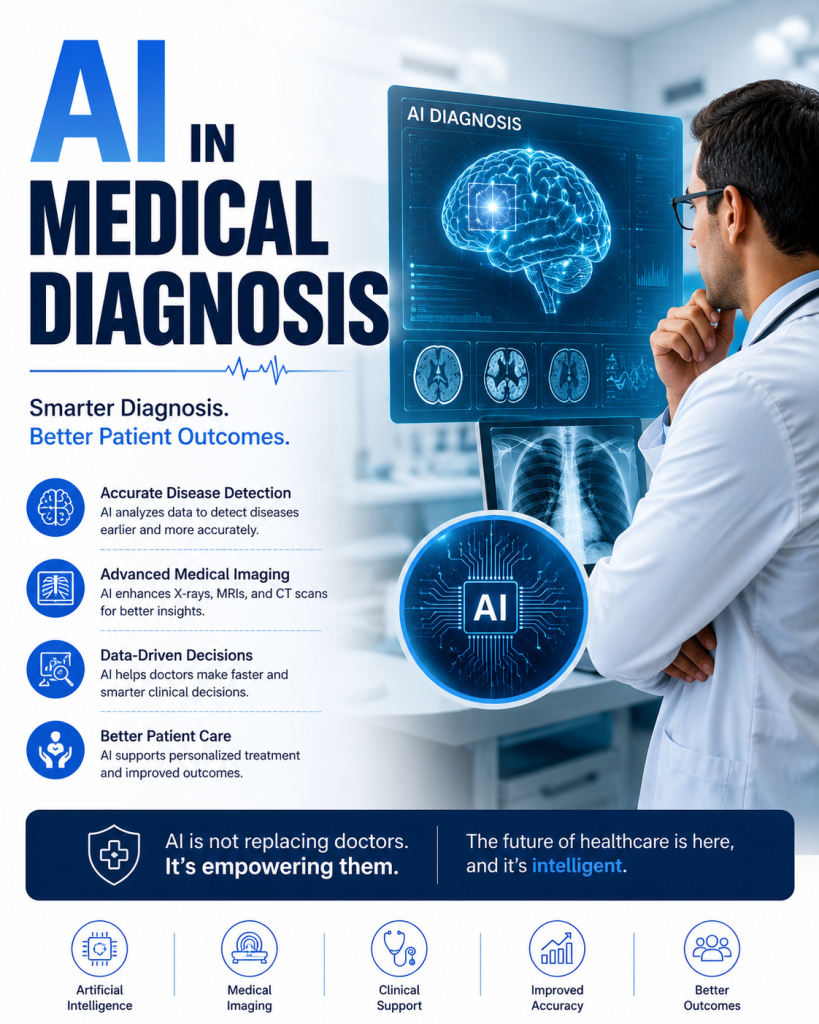
    A modern healthcare technology scene illustrating AI in Medical Diagnosis. The image shows a doctor analyzing AI-powered medical data and brain scans on digital diagnostic screens. Visual elements represent artificial intelligence, medical imaging, early disease detection, clinical decision support, improved diagnostic accuracy, and better patient outcomes. The clean blue-and-white medical design highlights how AI is supporting healthcare professionals and transforming medical diagnosis in 2026.

    AI can help automate certain repetitive analysis tasks, potentially allowing medical professionals to spend more time on patient care.

    Earlier Identification of Potential Problems

    When properly validated, AI systems may help highlight patterns that deserve further investigation.

    Challenges and Risks

    Despite its potential, AI in Medical Diagnosis also has limitations. AI systems can produce incorrect predictions, particularly when the data they encounter differs from their training data.

    Privacy is another important consideration. Healthcare organizations must protect sensitive patient information and follow applicable privacy and security requirements.

    Bias can also affect AI performance. If training datasets do not adequately represent different populations, an AI system may perform differently across patient groups.

    For these reasons, human oversight remains essential.

    Is AI Replacing Doctors?

    AI in Medical Diagnosis is generally being developed as a decision-support technology rather than a replacement for physicians.

    Doctors bring clinical experience, communication skills, ethical judgment, and an understanding of individual patient circumstances that an AI system cannot independently replicate.

    The strongest healthcare model is likely to combine AI’s ability to analyze large datasets with the expertise of qualified healthcare professionals.

    The Future of AI in Medical Diagnosis

    The future of AI in Medical Diagnosis will likely involve deeper integration with electronic health records, medical imaging systems, laboratory platforms, and other healthcare technologies.

    In 2026 and beyond, AI may become increasingly useful for clinical decision support, medical imaging, risk assessment, and personalized healthcare.

    However, successful adoption will require accurate models, reliable data, strong privacy protections, appropriate regulation, and continuous human oversight.

    Final Thoughts

    AI in Medical Diagnosis is transforming healthcare by helping medical professionals analyze information, identify potential abnormalities, and improve certain diagnostic workflows. Its applications range from medical imaging and cancer detection to cardiovascular and neurological healthcare.

    For U.S. healthcare organizations, the goal should not simply be to adopt the newest AI technology. Instead, providers should select appropriately validated systems and integrate them responsibly into clinical workflows.

    When combined with medical expertise and proper oversight, AI has the potential to make diagnostic processes more efficient while supporting better-informed healthcare decisions.

    Frequently Asked Questions

    What is AI in medical diagnosis?

    It is the use of artificial intelligence technologies to analyze medical data and assist healthcare professionals with detecting potential diseases or abnormalities.

    Can AI diagnose diseases?

    AI can assist with certain diagnostic tasks, but an AI result should not automatically be considered a medical diagnosis. Qualified healthcare professionals remain responsible for clinical evaluation and diagnosis.

    How is AI used in medical imaging?

    AI can analyze medical images such as X-rays, CT scans, and MRIs to identify patterns, highlight potential abnormalities, and assist healthcare professionals with image interpretation.

    Is AI safe for medical diagnosis?

    AI safety depends on the system, data quality, validation, intended use, and clinical oversight. Healthcare organizations should evaluate AI systems carefully before using them in patient care.

    Will AI replace doctors?

    AI is more likely to assist doctors with specific tasks than completely replace them. Human expertise remains essential for clinical judgment, communication, and patient-centered care.
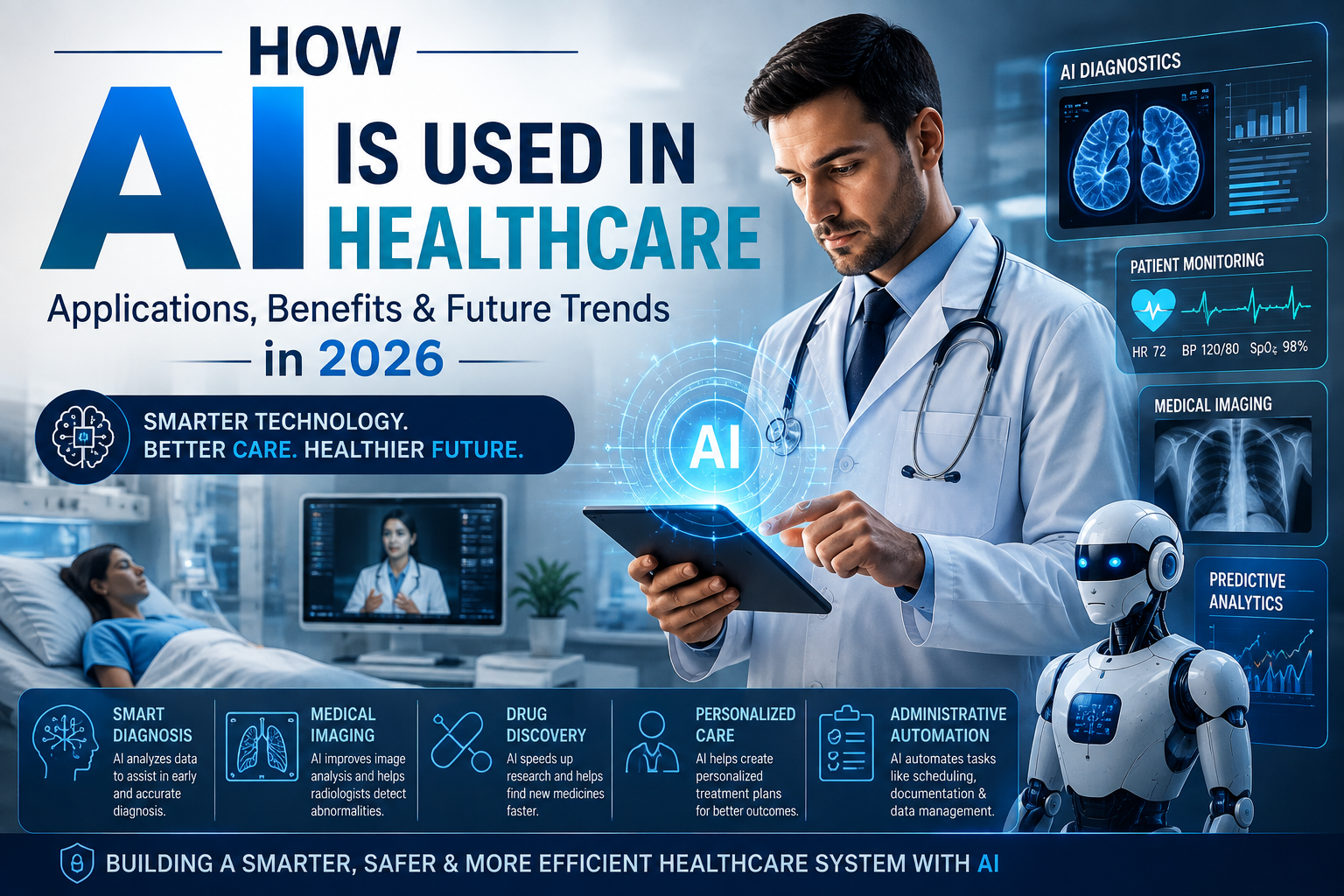
  • How AI Is Used in Healthcare: Applications, Benefits & Future Trends in 2026

    How AI Is Used in Healthcare: Applications, Benefits & Future Trends in 2026

    How AI Is Used in Healthcare: Applications, Benefits & Future Trends in 2026

    Artificial intelligence is changing how healthcare providers diagnose diseases, manage patient information, discover medicines, and deliver personalized care. In the United States, hospitals, clinics, medical researchers, and healthcare technology companies are increasingly adopting AI to improve efficiency and support better patient outcomes.

    Understanding How AI Is Used in Healthcare is important for patients, healthcare professionals, and businesses looking to understand the future of modern medicine.

    What Is AI in Healthcare?

    Artificial intelligence in healthcare refers to the use of computer systems and machine learning technologies to analyze medical data, recognize patterns, assist healthcare professionals, and automate certain tasks.

    How AI Is Used in Healthcare depends on the specific medical application. AI can analyze medical images, help identify potential health risks, summarize clinical information, support drug discovery, and assist doctors with decision-making.

    AI is designed to support healthcare professionals rather than replace them. Human expertise remains essential, particularly when making complex medical decisions.

    How AI Is Used in Healthcare in 2026

    In 2026, healthcare AI is being applied across many areas of the U.S. healthcare system. Some of the most important applications include:

    1. Medical Diagnosis

    AI can analyze large amounts of medical information and identify patterns that may be difficult to detect manually. Healthcare organizations can use AI-assisted systems to support the detection of certain diseases and abnormalities.

    For example, AI-powered medical imaging tools can help analyze X-rays, CT scans, MRIs, and other diagnostic images. These systems can flag areas that may require closer examination by qualified professionals.

    2. Medical Imaging

    Medical imaging is one of the most widely discussed applications of AI in healthcare. Machine learning models can examine images and identify patterns associated with certain conditions.

    How AI Is Used in Healthcare for medical imaging can include assisting radiologists with image analysis, prioritizing potentially urgent cases, and supporting more consistent evaluations.

    AI does not eliminate the need for radiologists. Instead, it can provide an additional layer of analysis that healthcare professionals can consider alongside clinical evidence.

    3. Drug Discovery and Development

    Developing new medicines can take years and require significant financial investment. AI can help researchers analyze biological data, identify potential drug candidates, and predict how certain compounds may behave.

    This can help pharmaceutical companies and researchers explore promising possibilities more efficiently.

    4. Personalized Medicine

    Every patient is different. AI can analyze information such as medical history, test results, and other permitted health data to help healthcare professionals understand individual patient needs.

    How AI Is Used in Healthcare for personalized medicine may support more individualized treatment strategies and risk assessments.

    The goal is to move toward healthcare approaches that consider the characteristics and needs of individual patients rather than relying only on generalized treatment models.

    5. Administrative Automation

    Healthcare professionals spend significant amounts of time on administrative work. AI can assist with tasks such as documentation, scheduling, information retrieval, and summarization.

    AI-powered tools can help organize information and reduce repetitive workloads, potentially allowing healthcare workers to spend more time interacting with patients.

    6. Virtual Health Assistants

    AI-powered virtual assistants can answer common health-related questions, provide general information, help patients navigate healthcare services, and support appointment-related tasks.

    How AI Is Used in Healthcare through virtual assistants can make basic information more accessible, especially outside traditional office hours.

    However, AI assistants should not be treated as substitutes for professional medical diagnosis or emergency care.

    Benefits of AI in Healthcare

    The growing adoption of AI offers several potential benefits for U.S. healthcare organizations.

    How AI Is Used in Healthcare can help organizations process information faster, automate repetitive tasks, support clinical workflows, and potentially improve operational efficiency.

    Other potential benefits include:

    • Faster analysis of large datasets
    • Assistance with medical image interpretation
    • Reduced administrative workload
    • Improved workflow efficiency
    • Support for medical research
    • More personalized patient experiences
    • Better access to healthcare information

    The actual benefits depend on the quality of the AI system, available data, implementation process, and level of human oversight.

    Challenges and Risks of Healthcare AI

    AI also creates important challenges. Healthcare organizations must consider privacy, cybersecurity, bias, accuracy, transparency, and regulatory requirements.

    How AI Is Used in Healthcare must be carefully managed because incorrect or incomplete AI-generated information could potentially affect patient care.

    Healthcare providers should validate AI systems, monitor performance, protect sensitive patient information, and maintain appropriate human oversight.

    Another major consideration is bias. If an AI model is trained on incomplete or unrepresentative data, its performance may not be equally reliable for every patient population.

    The Future of AI in Healthcare

    The future of healthcare AI is likely to involve deeper integration with electronic health records, medical devices, research platforms, and clinical workflows.

    How AI Is Used in Healthcare will continue expanding as AI models become more capable and healthcare organizations develop better ways to integrate them responsibly.

    In the coming years, AI may increasingly assist with early disease detection, clinical documentation, research, patient engagement, and healthcare operations. However, successful adoption will depend on combining advanced technology with medical expertise, ethical standards, and strong patient protections.

    Final Thoughts

    How AI Is Used in Healthcare is no longer simply a question about futuristic technology. AI is already becoming part of modern healthcare, particularly in areas such as medical imaging, research, administrative automation, personalized care, and clinical decision support.

    For U.S. healthcare organizations in 2026, the most effective approach is to use AI as a tool that supports qualified professionals while maintaining patient safety, privacy, and human oversight. As the technology develops, responsible implementation will be just as important as innovation.

    Frequently Asked Questions

    How is AI used in healthcare?

    AI is used to support medical diagnosis, medical imaging, drug discovery, administrative tasks, personalized medicine, research, and patient communication.

    Can AI replace doctors?

    No. AI can assist healthcare professionals with specific tasks, but doctors and other qualified professionals remain responsible for clinical judgment and patient care.

    Is AI safe for healthcare?

    AI can provide valuable support, but its safety depends on factors such as accuracy, validation, data quality, privacy protections, and appropriate human oversight.

    Why is AI important in healthcare?

    AI can help healthcare organizations analyze large amounts of information, automate repetitive tasks, support research, and improve certain clinical and administrative workflows.

  • AI Customer Service for E-Commerce: The Future of Online Support in 2026

    AI Customer Service for E-Commerce: The Future of Online Support in 2026

    AI Customer Service for E-Commerce: The Future of Online Support in 2026

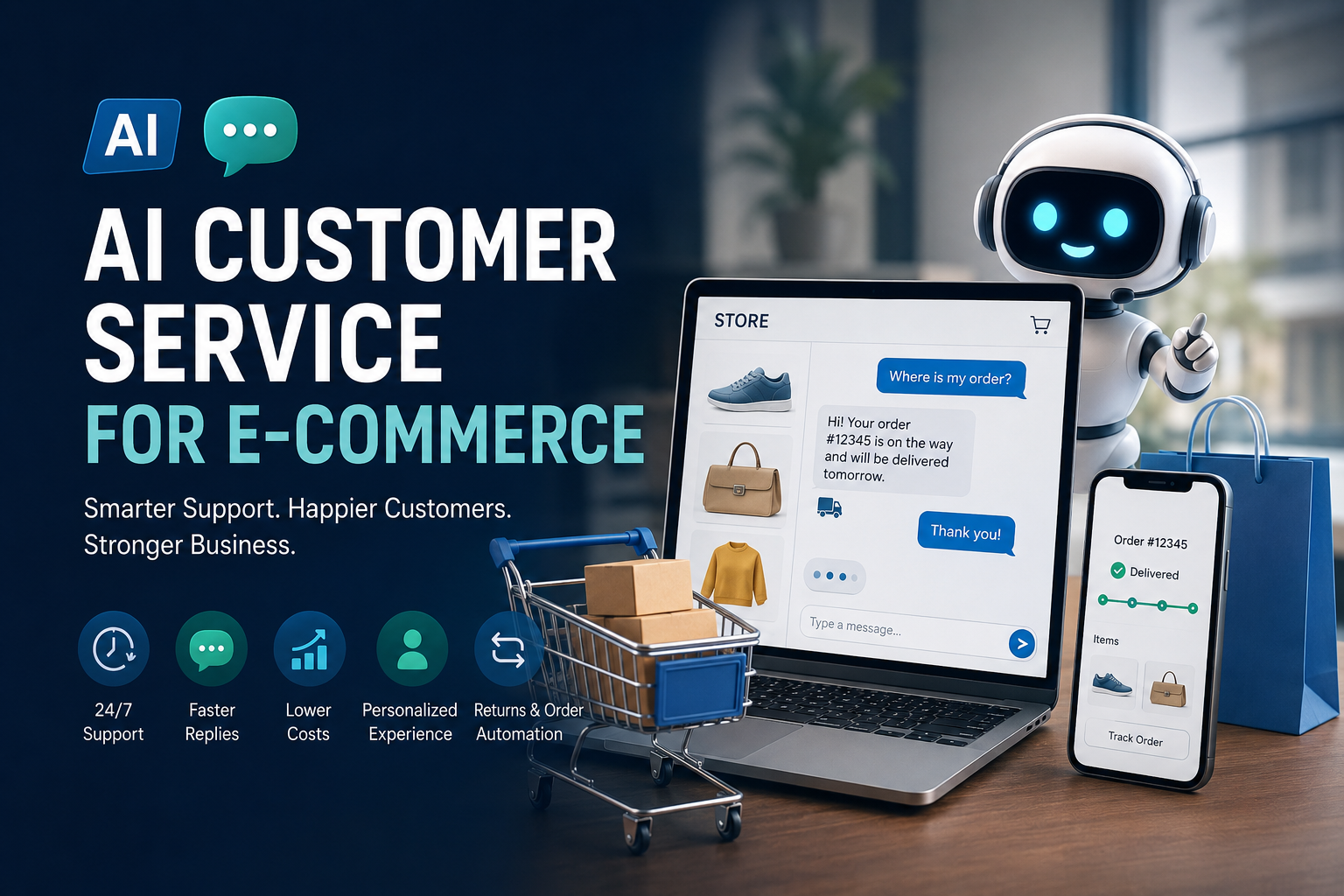
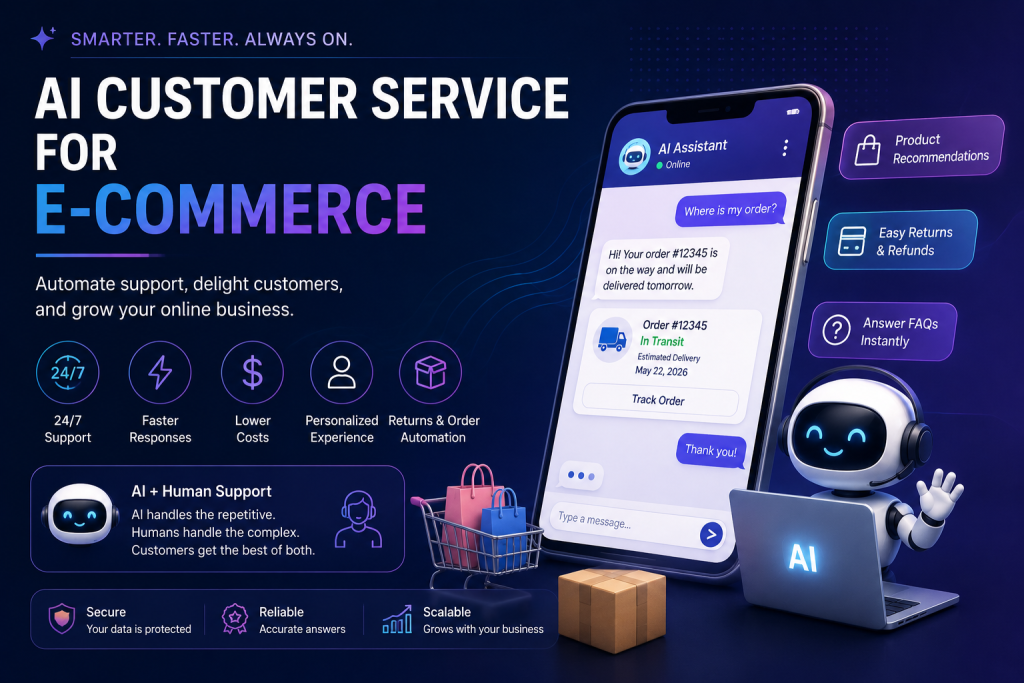
    Online shoppers expect quick answers, smooth returns, and helpful support at every stage of the buying journey. For U.S. e-commerce businesses, meeting these expectations can become difficult as order volumes grow. AI Customer Service for E-Commerce helps retailers automate routine questions, deliver faster responses, and provide support around the clock.

    In 2026, AI-powered support is becoming an important part of modern online retail. Shopify stores, direct-to-consumer brands, and large marketplaces can use AI chatbots and AI agents to improve customer experiences while reducing repetitive work.

    What Is AI Customer Service for E-Commerce?

    AI Customer Service for E-Commerce refers to artificial intelligence tools that communicate with customers, answer questions, solve common problems, and automate support workflows. These systems can understand natural-language questions and use approved information from product catalogs, order systems, shipping platforms, and customer accounts.

    Unlike traditional chatbots that rely on rigid scripts, modern AI tools can understand context, answer follow-up questions, and transfer complicated cases to human representatives.

    How Does AI Customer Service Work?

    AI Customer Service for E-Commerce combines technologies such as natural language processing, machine learning, knowledge bases, and business integrations. When a customer asks a question, the AI identifies the intent and retrieves relevant information before generating a response.

    For example, a shopper asking about an order can receive shipping information automatically. If the issue involves a refund dispute or another complex situation, the system can escalate the conversation to a human agent.

    Key Benefits for Online Stores

    1. 24/7 Customer Support

    One of the biggest advantages of AI Customer Service for E-Commerce is continuous availability. Customers can ask about products, shipping, returns, or order status even when a support team is offline.

    This is especially valuable for U.S. businesses serving customers across different time zones.

    2. Faster Response Times

    Customers do not want to wait hours for simple answers. AI can respond to frequently asked questions within seconds, reducing support queues and helping shoppers make purchasing decisions faster.

    3. Lower Support Costs

    AI Customer Service for E-Commerce can handle repetitive requests that would otherwise require employee time. Human representatives can focus on complex cases, complaints, and situations requiring judgment or empathy.

    This makes customer support easier to scale as an online store grows.

    4. Personalized Customer Experiences

    AI can use permitted customer and order information to create more relevant interactions. For example, an assistant can recognize an existing order and provide information specific to that purchase.

    Personalized assistance can reduce customer effort and make support conversations more useful.

    5. Automated Returns and Order Support

    Returns are a major part of online retail. AI Customer Service for E-Commerce can explain return policies, collect required information, provide status updates, and guide eligible requests through established workflows.

    AI can also assist with order changes, shipping questions, product availability, and common account requests.

    Common E-Commerce AI Customer Service Use Cases

    Retailers can use AI support throughout the customer journey. Common applications include:

    • Product questions
    • Order tracking
    • Shipping updates
    • Returns and exchanges
    • Refund status
    • Frequently asked questions
    • Product availability
    • Account assistance
    • Post-purchase support
    • Human-agent escalation

    These use cases allow businesses to automate repetitive tasks without removing access to human assistance.

    Best Practices for Implementation

    Businesses should treat AI Customer Service for E-Commerce as a customer-experience strategy rather than simply installing a chatbot. Start by identifying repetitive questions that are suitable for automation.

    Connect the AI system to reliable business data, establish clear escalation rules, and monitor conversations regularly. Businesses should also protect customer information, restrict access to necessary data, and test responses before launching the system widely.

    Human oversight is particularly important for refunds, complaints, account security, and other sensitive decisions.

    Challenges to Consider

    AI support is powerful, but it is not perfect. Systems can misunderstand questions, produce inaccurate information, or struggle with unusual situations. Poorly configured AI can frustrate customers instead of helping them.

    Businesses should monitor accuracy, update knowledge sources, provide easy access to human agents, and establish strong privacy and security practices.

    The Future of AI Customer Service

    The future of AI Customer Service for E-Commerce will move beyond simple question-and-answer chatbots. AI agents will increasingly handle multi-step tasks, connect with business systems, and support shoppers throughout the purchasing journey.

    A customer could eventually ask an AI assistant to find a product, compare options, place an order, track delivery, and start a return within one conversation.

    Final Thoughts

    AI Customer Service for E-Commerce is transforming how online retailers support shoppers. By combining automation, personalization, and intelligent workflows, businesses can provide faster assistance while allowing human teams to focus on higher-value interactions.

    For U.S. retailers in 2026, the best strategy is not necessarily to replace human support. Instead, businesses should use AI to handle repetitive work and give human agents better information and more time to solve complex customer problems.

    Frequently Asked Questions

    What is AI Customer Service for E-Commerce?

    It is the use of artificial intelligence to automate customer support tasks such as answering questions, tracking orders, handling returns, and providing personalized assistance.

    Can AI customer service improve e-commerce sales?

    Yes. Faster answers and personalized support can reduce buying friction, help customers find products, and improve the shopping experience.

    Is AI customer service suitable for small businesses?

    Yes. Small e-commerce businesses can use AI tools to handle common questions and provide support without building a large customer service department.

    Will AI replace customer service agents?

    AI is more likely to automate repetitive tasks than completely replace human representatives. Human agents remain important for complex, sensitive, and emotional customer situations.

  • AI Product Recommendations: How AI Is Transforming Online Shopping in 2026

    AI Product Recommendations: How AI Is Transforming Online Shopping in 2026

    AI Product Recommendations: How AI Is Transforming Online Shopping in 2026

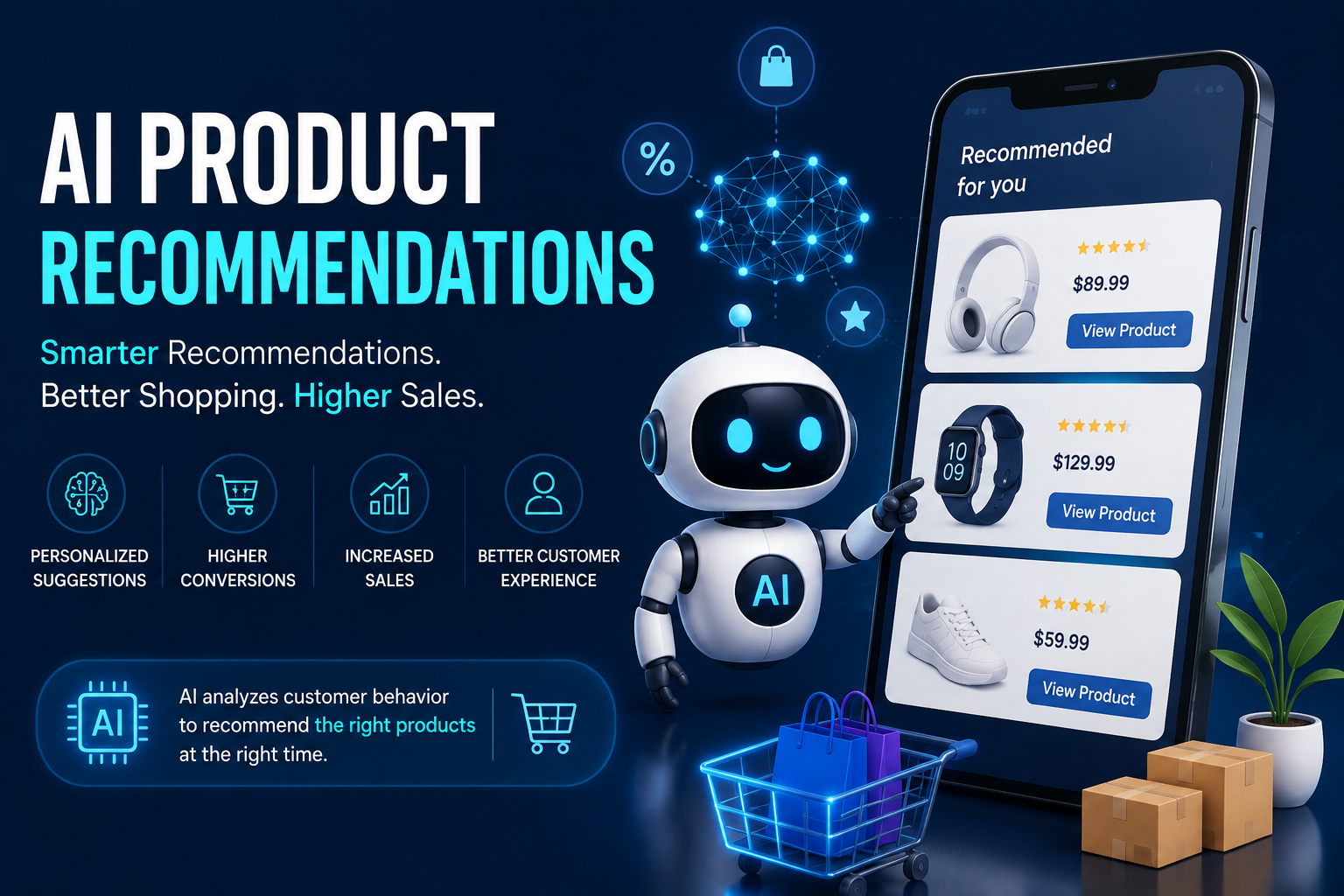
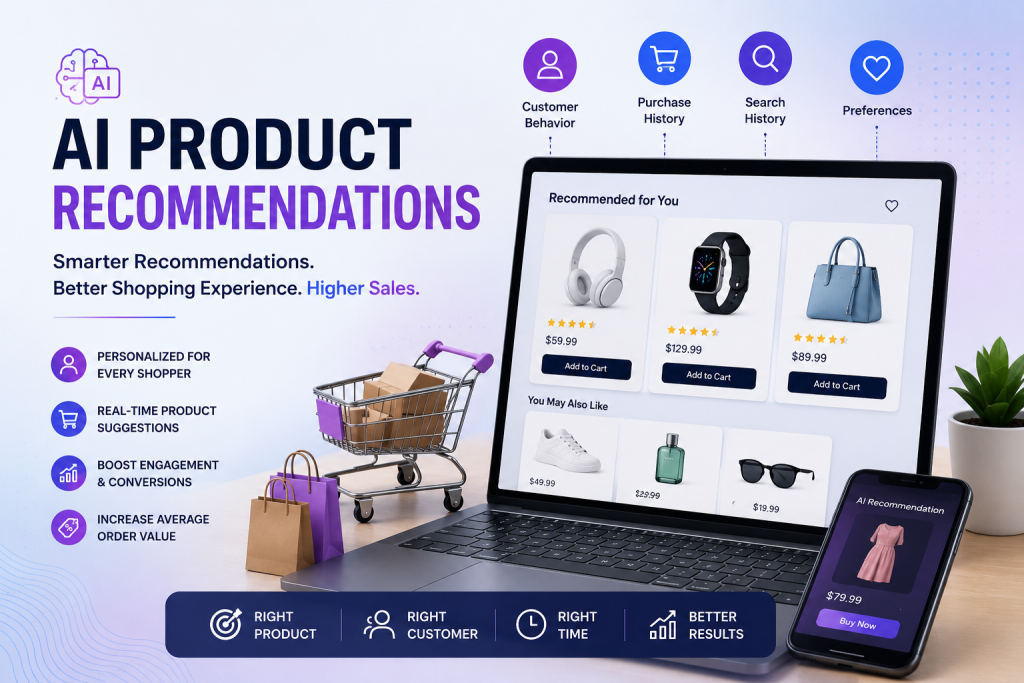
    Online shoppers today expect more than a basic product catalog. They want stores to understand their needs, show relevant products, and help them make purchasing decisions quickly. AI Product Recommendations are helping e-commerce businesses deliver this personalized experience by analyzing customer behavior and using artificial intelligence to suggest products that match individual interests.

    For U.S. e-commerce businesses, AI Product Recommendations can improve product discovery, customer engagement, and potentially increase average order value. From Shopify stores and Amazon sellers to large online retailers, AI-powered recommendation technology is becoming an important part of modern digital commerce.

    What Are AI Product Recommendations?

    AI Product Recommendations are personalized product suggestions generated by artificial intelligence and machine learning systems. Instead of showing every customer the same products, AI analyzes different signals to determine which products may be most relevant to each shopper.

    These signals can include:

    • Browsing history
    • Previous purchases
    • Search queries
    • Product views
    • Shopping cart activity
    • Customer preferences
    • Similar customer behavior
    • Product popularity

    The system uses these signals to create personalized recommendations in real time.

    How Do AI Product Recommendations Work?

    Modern AI Product Recommendations typically use machine learning algorithms to analyze large amounts of customer and product data.

    For example, if a shopper frequently views running shoes, fitness clothing, and sports accessories, an AI system may recommend related products such as running socks, fitness trackers, or workout apparel.

    The more relevant data the system receives, the better it can understand shopping patterns and generate useful recommendations.

    Why AI Product Recommendations Matter for E-Commerce

    One of the biggest advantages of AI Product Recommendations is personalization.

    Customers no longer have to scroll through hundreds of products to find something relevant. AI can automatically highlight products based on their interests.

    For businesses, this can lead to:

    • Better product discovery
    • Higher customer engagement
    • Increased conversion opportunities
    • Larger average order values
    • Improved customer experiences
    • More relevant marketing

    Personalization is especially important in the competitive U.S. e-commerce market, where shoppers have many choices.

    1. Personalized Product Discovery

    AI Product Recommendations help shoppers discover products they may not have found through traditional search.

    For example, an online fashion store can recommend matching shoes, accessories, or clothing based on the product a customer is viewing.

    This creates a more personalized shopping journey and helps customers discover complementary products.

    2. Increased Average Order Value

    Businesses can use AI Product Recommendations to suggest complementary or related products during the shopping process.

    For example, an electronics retailer selling a laptop could recommend:

    • Laptop accessories
    • Wireless mice
    • External storage
    • Laptop stands
    • Protective cases

    Relevant recommendations can encourage customers to add additional products to their carts.

    3. Better Customer Experience

    Shoppers want convenient experiences. AI Product Recommendations reduce the effort required to find relevant products.

    Instead of manually searching through different categories, customers can receive personalized suggestions based on their interests and previous interactions.

    This makes online shopping faster and easier.

    4. Smarter Email Marketing

    E-commerce businesses can also use AI Product Recommendations in email campaigns.

    Instead of sending identical product promotions to every subscriber, businesses can personalize emails based on individual shopping behavior.

    For example, a customer who recently purchased running shoes might receive recommendations for fitness accessories rather than unrelated products.

    5. Real-Time Recommendations

    One major advantage of AI is its ability to respond to changing customer behavior.

    If a shopper suddenly starts searching for home office equipment, the recommendation system can adjust its suggestions accordingly.

    This makes AI Product Recommendations more dynamic than traditional recommendation systems based only on static customer profiles.

    Benefits for Small and Large Businesses

    AI Product Recommendations aren’t limited to large technology companies. Small and medium-sized e-commerce businesses can also use AI-powered recommendation tools.

    Potential benefits include:

    • Automated personalization
    • Improved customer engagement
    • Better product discovery
    • Increased cross-selling opportunities
    • More efficient marketing
    • Data-driven customer insights

    As AI tools become more accessible, businesses of different sizes can incorporate recommendation technology into their online stores.

    Challenges of AI Product Recommendations

    Although AI Product Recommendations offer significant benefits, businesses must also consider privacy, data security, accuracy, and transparency.

    Recommendation systems depend on customer data, so companies should handle information responsibly and follow applicable privacy requirements.

    Businesses should also monitor recommendations to ensure AI systems do not repeatedly suggest irrelevant or unavailable products.

    Future of AI Product Recommendations in 2026

    The future of AI Product Recommendations is becoming increasingly intelligent. AI agents and shopping assistants may eventually understand customer preferences, budgets, product requirements, and purchasing intent in greater detail.

    Instead of simply recommending products, AI systems could help shoppers compare options, answer questions, identify alternatives, and guide them through the entire purchasing journey.

    For U.S. retailers, this creates an opportunity to build more personalized and efficient shopping experiences.

    Final Thoughts

    AI Product Recommendations are changing how online retailers connect shoppers with products. By analyzing customer behavior, preferences, and real-time interactions, AI can provide more relevant product suggestions while helping businesses improve engagement and sales opportunities.

    From personalized storefronts and email campaigns to cross-selling and intelligent shopping assistants, the technology has applications across almost every part of e-commerce.

    As competition in online retail continues to grow in 2026, businesses that use AI responsibly and focus on genuine customer value can create more convenient shopping experiences and build stronger relationships with their customers.

    Frequently Asked Questions

    What are AI Product Recommendations?

    AI Product Recommendations are personalized product suggestions generated using artificial intelligence and customer behavior data.

    How do AI recommendations increase sales?

    They can help customers discover relevant products, encourage complementary purchases, and create personalized shopping experiences that may improve conversion opportunities.

    Are AI recommendations useful for small businesses?

    Yes. Small e-commerce businesses can use AI recommendation tools to personalize product discovery, improve cross-selling, and automate parts of their marketing.

    Are AI Product Recommendations accurate?

    Accuracy depends on the quality of the data, algorithms, product catalog, and implementation. Businesses should continuously monitor and optimize their recommendation systems.

    What is the future of AI recommendations?

    AI recommendations are moving toward more conversational and intelligent shopping experiences, where AI assistants can understand customer intent and provide personalized product guidance.

  • How AI Is Changing E-Commerce: The Future of Online Shopping in 2026

    How AI Is Changing E-Commerce: The Future of Online Shopping in 2026

    How AI Is Changing E-Commerce: The Future of Online Shopping in 2026

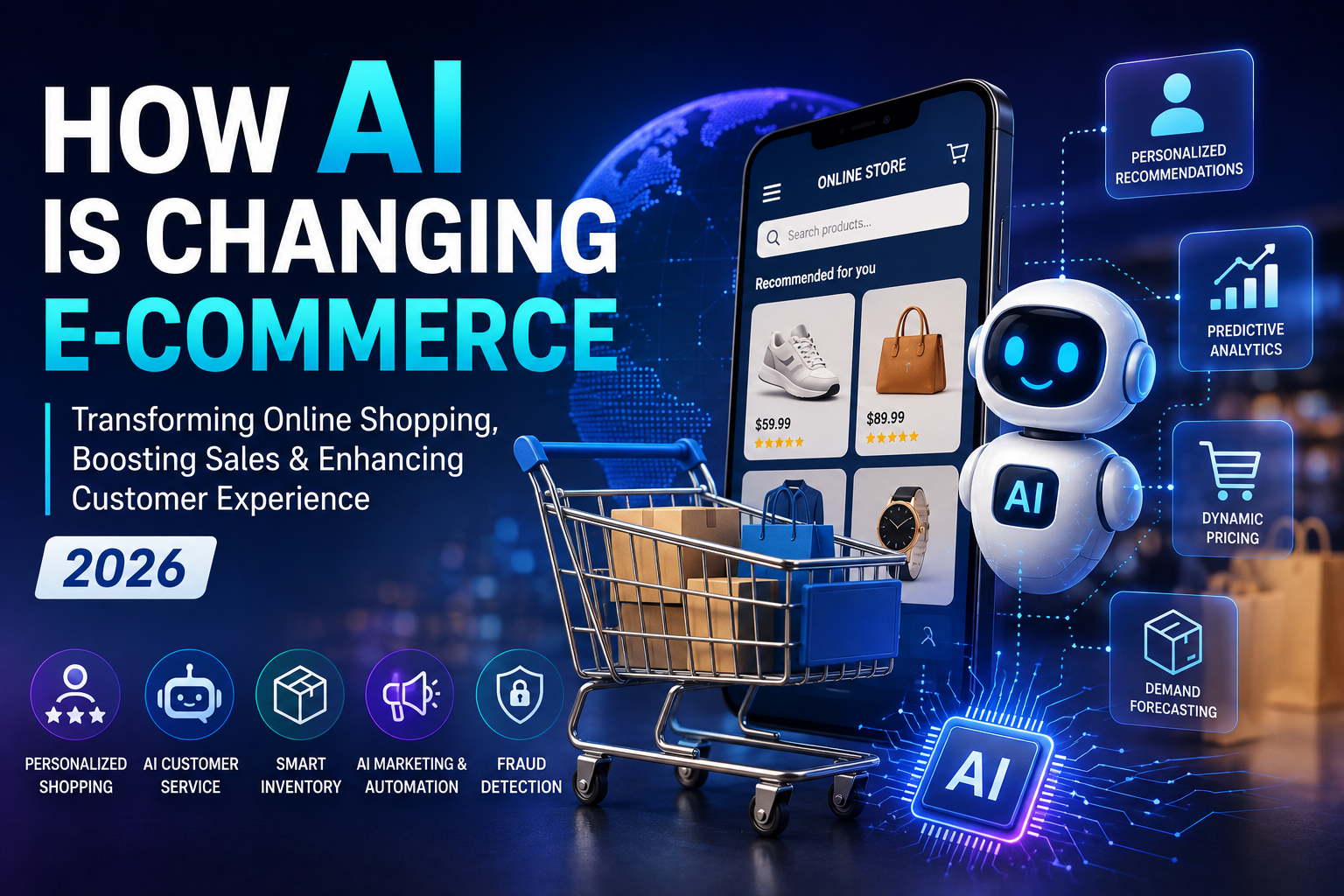
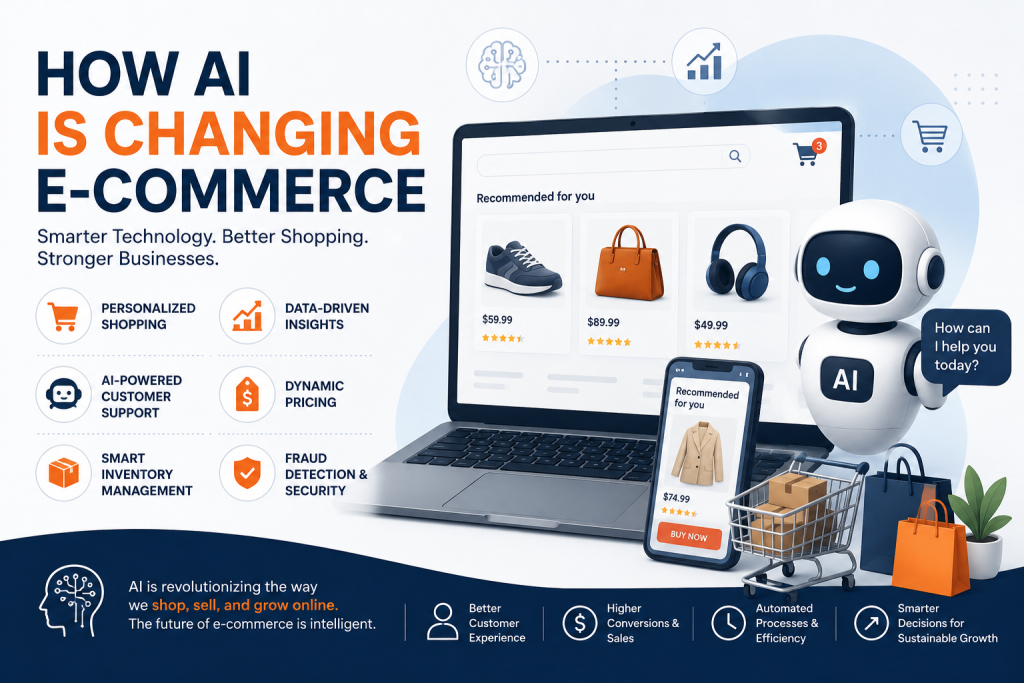
    Artificial intelligence is transforming the way people shop and the way online businesses sell products. From personalized recommendations to automated customer support, AI is helping e-commerce companies create faster, smarter, and more convenient shopping experiences.

    For U.S. retailers, understanding How AI Is Changing E-Commerce is becoming increasingly important. In 2026, businesses of all sizes—from small Shopify stores to large online marketplaces—are using AI to improve customer experiences, reduce operating costs, and increase sales.

    What Is AI in E-Commerce?

    AI in e-commerce refers to using artificial intelligence technologies to automate tasks, analyze customer data, predict trends, and improve online shopping experiences.

    Understanding How AI Is Changing E-Commerce starts with recognizing that AI can process large amounts of information much faster than humans. This allows online retailers to make data-driven decisions and respond to customer needs in real time.

    AI is now being used for product recommendations, inventory management, fraud detection, pricing, marketing, customer service, and more.

    1. Personalized Shopping Experiences

    One of the biggest ways How AI Is Changing E-Commerce can be seen is through personalization.

    AI analyzes information such as:

    • Browsing history
    • Previous purchases
    • Search behavior
    • Product preferences
    • Shopping patterns

    Based on this information, online stores can recommend products that are more relevant to individual shoppers.

    For U.S. consumers, personalized experiences can make it easier to discover products and complete purchases without searching through hundreds of options.

    2. AI-Powered Customer Service

    Customer support is another major area where How AI Is Changing E-Commerce is becoming visible.

    AI chatbots and AI agents can answer questions 24/7, help customers track orders, explain return policies, recommend products, and handle common support requests.

    Instead of waiting for a human representative, customers can receive immediate assistance. Complex issues can then be transferred to human support teams.

    3. Smarter Inventory Management

    Managing inventory can be challenging for online retailers. Too much inventory increases storage costs, while insufficient stock can result in lost sales.

    AI helps businesses forecast demand by analyzing historical sales, seasonal trends, customer behavior, and market conditions.

    This is another important example of How AI Is Changing E-Commerce, because businesses can use predictive insights to determine when to reorder products and how much inventory they may need.

    4. AI-Driven Marketing

    Digital marketing is also changing rapidly because of AI.

    E-commerce businesses can use AI to automate:

    • Email marketing
    • Customer segmentation
    • Product recommendations
    • Ad targeting
    • Content creation
    • Promotional campaigns

    AI can identify customer groups and help marketers deliver more relevant messages. This can improve engagement while reducing the amount of manual work required by marketing teams.

    5. Dynamic Pricing

    Another important example of How AI Is Changing E-Commerce is dynamic pricing.

    AI systems can analyze demand, inventory levels, competitor pricing, seasonal trends, and other market signals to help retailers adjust prices.

    For example, an online store may increase discounts when demand is low or adjust pricing when inventory levels change.

    Businesses should still establish clear pricing rules and monitor automated systems to ensure pricing decisions remain appropriate and transparent.

    6. Better Fraud Detection

    Online retailers face risks from payment fraud, account takeovers, and suspicious transactions.

    AI can identify unusual purchasing patterns and flag potentially fraudulent activity. Instead of relying only on fixed rules, AI systems can analyze multiple signals to identify transactions that may require additional review.

    This helps businesses protect customers while reducing potential financial losses.

    7. AI-Powered Product Search

    AI is making product search more conversational and intuitive.

    Instead of typing a short keyword, shoppers can increasingly describe what they want in natural language. AI can interpret the request and identify products that match the shopper’s needs.

    Visual search is another emerging capability, allowing shoppers to use images to discover similar products.

    These technologies demonstrate How AI Is Changing E-Commerce by making product discovery faster and more natural.

    8. Improved E-Commerce Operations

    AI can also automate repetitive back-office tasks, including order processing, customer segmentation, forecasting, and reporting.

    By automating routine workflows, employees can spend more time on strategy, product development, and customer relationships.

    This is particularly valuable for small and mid-sized U.S. businesses that need to scale without significantly increasing administrative workloads.

    Benefits of AI for E-Commerce Businesses

    Understanding How AI Is Changing E-Commerce also means recognizing its major business benefits.

    Companies can potentially achieve:

    • Higher conversion rates
    • Better customer engagement
    • Faster customer support
    • More accurate demand forecasting
    • Reduced operational costs
    • Improved inventory management
    • More effective marketing
    • Better fraud prevention
    • Increased employee productivity

    However, businesses should implement AI strategically rather than automating every process without oversight.

    Challenges of Using AI in E-Commerce

    Despite its advantages, AI also creates challenges. Businesses must consider data privacy, cybersecurity, inaccurate AI outputs, implementation costs, and employee training.

    Companies should establish clear AI policies, protect customer information, monitor automated systems, and maintain human oversight for important decisions.

    The Future of AI in E-Commerce

    The future of How AI Is Changing E-Commerce will involve increasingly intelligent shopping assistants, AI agents, predictive analytics, automated marketing, conversational commerce, and highly personalized customer journeys.

    In 2026 and beyond, AI will likely become an important part of the technology stack for competitive online retailers.

    Businesses that adopt AI responsibly can improve efficiency while delivering more convenient experiences to customers.

    Final Thoughts

    How AI Is Changing E-Commerce is no longer simply a future concept. AI is already transforming product discovery, customer service, marketing, inventory management, fraud prevention, pricing, and everyday retail operations.

    For U.S. e-commerce businesses, adopting the right AI technologies can create opportunities to improve customer satisfaction, reduce costs, and compete more effectively. The key is to combine automation with strong data protection, human oversight, and a clear business strategy.

    Frequently Asked Questions

    How is AI changing e-commerce?

    AI is changing e-commerce through personalized recommendations, automated customer service, smarter inventory forecasting, AI-powered marketing, fraud detection, dynamic pricing, and conversational shopping.

    How does AI improve online shopping?

    AI can help shoppers find relevant products faster, receive personalized recommendations, get instant customer support, and discover products through conversational or visual search.

    Is AI useful for small e-commerce businesses?

    Yes. Small businesses can use affordable AI tools for customer support, marketing, product recommendations, content creation, analytics, and inventory management.

    What is the future of AI in e-commerce?

    The future includes AI shopping assistants, autonomous AI agents, conversational commerce, predictive analytics, personalized experiences, and increasingly automated e-commerce operations.

  • How to Secure AI Applications: The Complete Guide for Businesses in 2026

    How to Secure AI Applications: The Complete Guide for Businesses in 2026

    How to Secure AI Applications: The Complete Guide for Businesses in 2026

    Artificial intelligence (AI) is transforming industries by automating workflows, improving decision-making, and enhancing customer experiences. However, as AI adoption grows, organizations also face increasing cybersecurity threats. Understanding How to Secure AI Applications is essential for protecting sensitive data, preventing cyberattacks, and maintaining customer trust.

    Whether you’re a startup, small business, or enterprise in the United States, learning How to Secure AI Applications will help you build safer, more reliable AI systems in 2026 and beyond.


    What Does It Mean to Secure AI Applications?

    How to Secure AI Applications refers to implementing security measures that protect AI models, training data, APIs, infrastructure, and users from cyber threats. AI applications process large volumes of sensitive information, making them attractive targets for hackers.

    Securing AI applications involves preventing unauthorized access, detecting vulnerabilities, protecting data privacy, and ensuring AI systems operate safely and reliably.


    Why AI Application Security Matters

    Organizations that ignore How to Secure AI Applications risk exposing confidential business data, disrupting operations, and damaging their reputation.

    Common AI security threats include:

    • Data breaches
    • Prompt injection attacks
    • AI model theft
    • Adversarial attacks
    • API vulnerabilities
    • Insider threats
    • Malware targeting AI systems
    • Unauthorized access

    Implementing strong AI security measures reduces these risks and supports long-term business success.


    Best Practices: How to Secure AI Applications

    1. Encrypt Sensitive Data

    One of the most important steps in How to Secure AI Applications is protecting sensitive data with encryption.

    Businesses should encrypt:

    • Customer information
    • Financial records
    • Training datasets
    • AI model outputs
    • Cloud storage

    Encryption keeps data secure even if unauthorized access occurs.


    2. Implement Strong Authentication

    Use robust authentication methods to limit access to AI systems.

    Recommended security controls include:

    • Multi-Factor Authentication (MFA)
    • Strong password policies
    • Single Sign-On (SSO)
    • Role-Based Access Control (RBAC)

    Only authorized users should access critical AI resources.


    3. Secure AI APIs

    Many AI applications communicate through APIs, making them common attack targets.

    Protect APIs by:

    • Using secure authentication tokens
    • Limiting API requests
    • Encrypting communications
    • Monitoring API traffic
    • Blocking suspicious activity

    API protection is essential when learning How to Secure AI Applications.


    4. Monitor AI Systems Continuously

    Real-time monitoring helps organizations detect threats before they become serious incidents.

    Monitor for:

    • Unusual login attempts
    • Unexpected AI outputs
    • Unauthorized model changes
    • Network anomalies
    • Data access patterns

    Continuous monitoring improves overall cybersecurity.


    5. Protect AI Models

    AI models represent valuable intellectual property.

    Organizations should:

    • Restrict model access
    • Prevent unauthorized downloads
    • Validate model integrity
    • Maintain secure backups
    • Monitor for model tampering

    Protecting AI models is a critical part of How to Secure AI Applications.


    6. Train Employees

    Human error remains one of the biggest cybersecurity risks.

    Provide training on:

    • AI phishing attacks
    • Prompt injection threats
    • Secure password practices
    • Responsible AI usage
    • Data privacy

    Well-trained employees strengthen organizational security.


    7. Perform Regular Security Audits

    Routine audits identify vulnerabilities before attackers exploit them.

    Businesses should:

    • Conduct penetration testing
    • Review access logs
    • Assess AI infrastructure
    • Update security policies
    • Verify regulatory compliance

    Regular assessments improve long-term resilience.


    This feature image represents How to Secure AI Applications with a modern cybersecurity and artificial intelligence theme. At the center, a glowing AI-powered security shield with a digital lock symbolizes strong protection against cyber threats. The shield surrounds an advanced AI neural network, representing secure machine learning and intelligent systems.

Around the central shield are key cybersecurity elements, including Encrypted Data, AI Model Protection, User Authentication, Secure APIs, Monitoring & Logging, Cloud Security, Threat Detection, and Compliance & Privacy. These components highlight the essential practices businesses should implement to secure AI applications and protect sensitive information.

The futuristic blue and neon color palette conveys trust, innovation, and enterprise-level security, making this image ideal for articles about AI application security, AI cybersecurity, machine learning security, data protection, secure AI development, and business AI best practices in 2026. It visually communicates the importance of protecting AI systems, safeguarding user data, and building resilient AI-powered applications against evolving cyber threats.

    Benefits of Securing AI Applications

    Organizations implementing How to Secure AI Applications gain significant advantages.

    Key benefits include:

    • Better data protection
    • Reduced cyber risks
    • Increased customer trust
    • Stronger regulatory compliance
    • Improved business continuity
    • Higher operational reliability
    • Enhanced AI performance
    • Lower financial losses

    Strong AI security creates a competitive advantage in today’s digital economy.


    Industries That Need AI Security

    Many industries rely heavily on AI and require robust protection.

    Examples include:

    • Healthcare
    • Banking
    • Financial Services
    • E-commerce
    • Retail
    • Manufacturing
    • Government
    • Education
    • Insurance
    • Technology

    Each industry processes sensitive information that must remain secure.


    Future Trends in AI Application Security

    As cyber threats evolve, businesses must continue improving How to Secure AI Applications using modern technologies.

    Emerging trends include:

    • Zero Trust Architecture
    • AI-powered threat detection
    • Privacy-preserving AI
    • Secure AI governance
    • Automated compliance monitoring
    • Explainable AI
    • Confidential computing

    These innovations will shape AI security throughout 2026 and beyond.


    Final Thoughts

    Understanding How to Secure AI Applications is essential for organizations adopting artificial intelligence. From encrypting sensitive data and protecting AI models to securing APIs and training employees, proactive security measures reduce cyber risks and improve business resilience.

    Businesses that prioritize How to Secure AI Applications will strengthen customer trust, meet compliance requirements, and confidently expand their AI capabilities in the years ahead.


    Frequently Asked Questions

    How to Secure AI Applications?

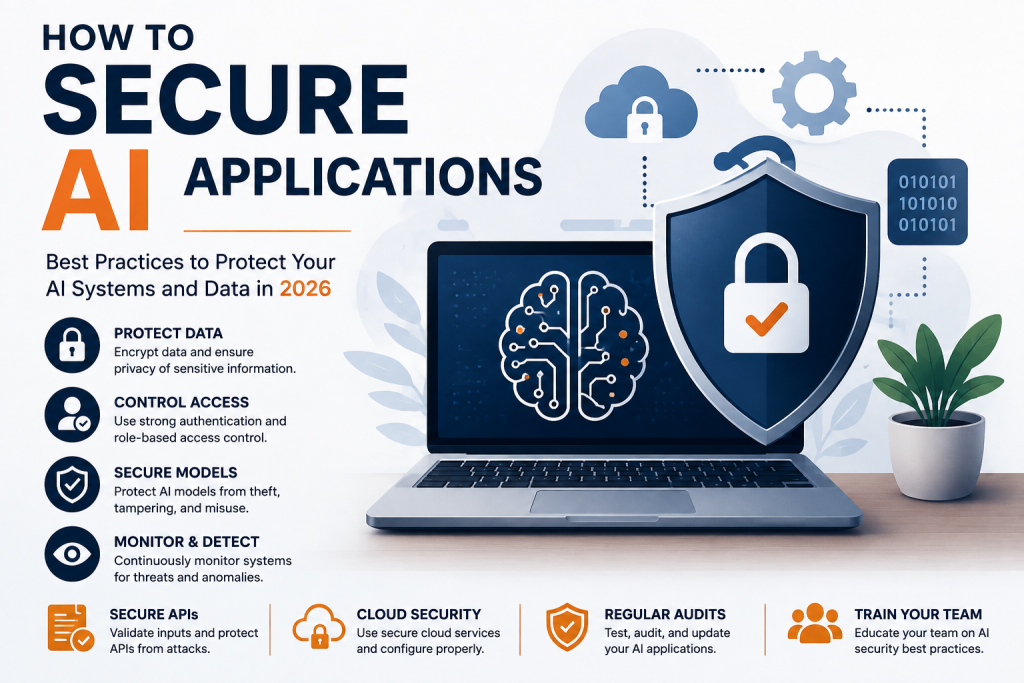
    Organizations can secure AI applications by encrypting data, implementing Multi-Factor Authentication, protecting APIs, monitoring AI systems, securing AI models, training employees, and conducting regular security audits.

    Why is AI application security important?

    AI application security protects sensitive data, prevents cyberattacks, ensures regulatory compliance, and maintains customer trust.

    What are common AI security threats?

    Common threats include data breaches, prompt injection attacks, adversarial attacks, API vulnerabilities, model theft, insider threats, and unauthorized access.

    Who should secure AI applications?

    Any organization using AI—including healthcare providers, financial institutions, e-commerce companies, government agencies, and technology firms—should implement strong AI security practices.

  • AI Privacy Risks for Businesses: How to Protect Sensitive Data in 2026

    AI Privacy Risks for Businesses: How to Protect Sensitive Data in 2026

    AI Privacy Risks for Businesses: How to Protect Sensitive Data in 2026

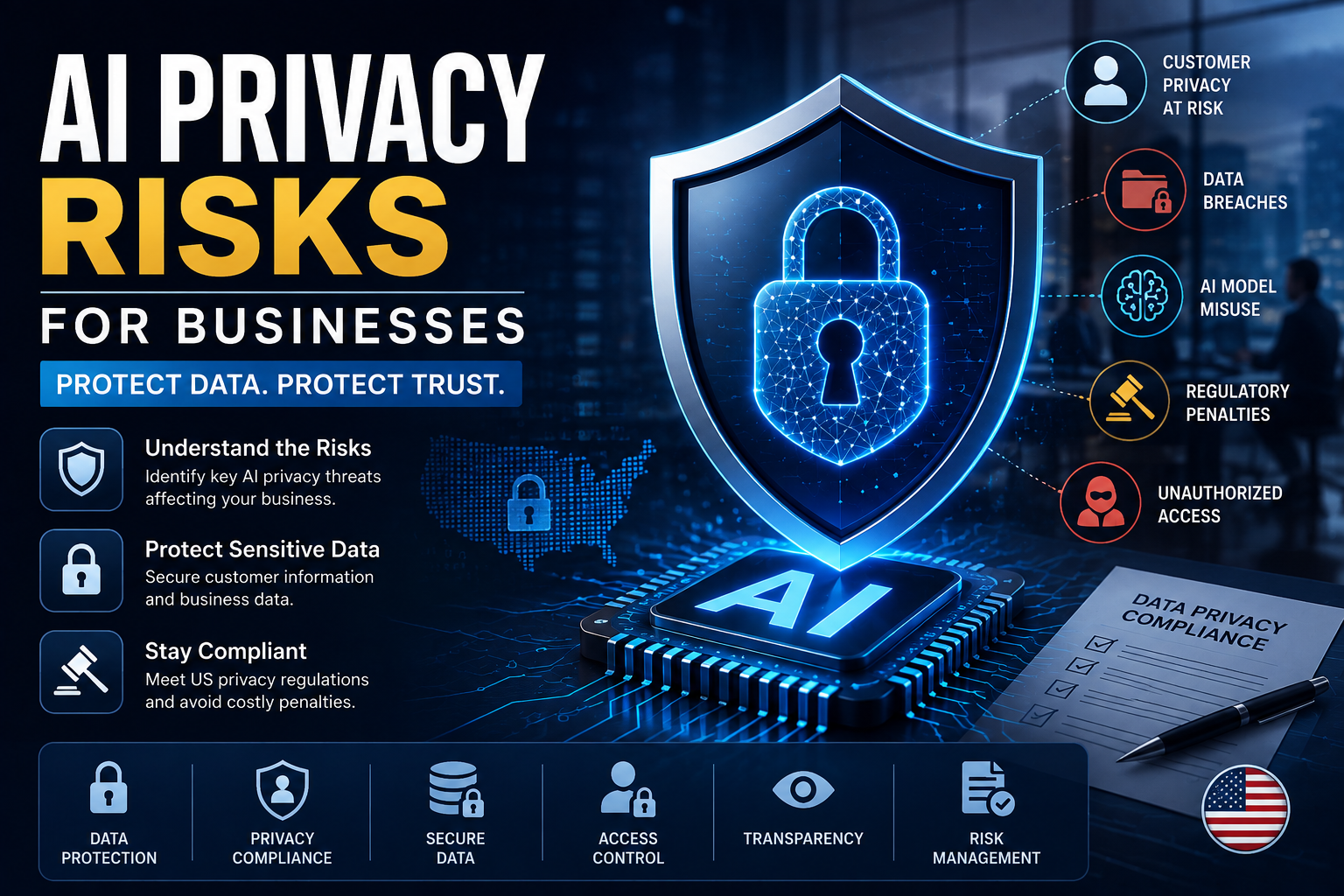
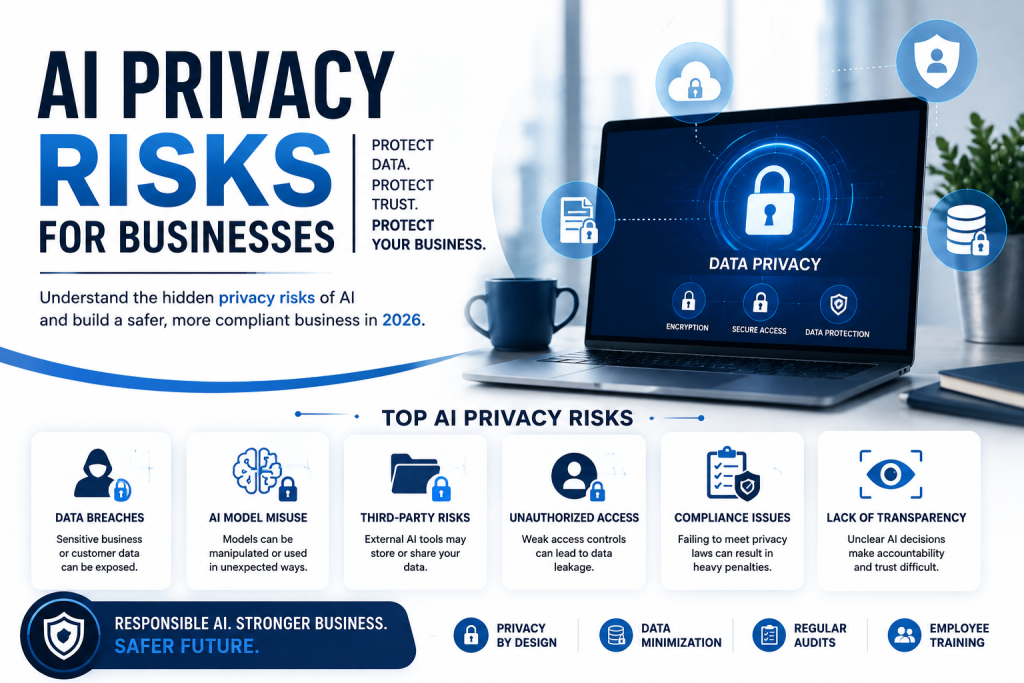
    Artificial intelligence (AI) is transforming how businesses operate, from customer service and marketing to data analysis and automation. While AI offers remarkable benefits, it also introduces significant privacy concerns. Understanding AI Privacy Risks for Businesses is essential for protecting customer information, maintaining regulatory compliance, and building trust in today’s digital economy.

    Whether you’re a startup, small business, or large enterprise in the United States, learning about AI Privacy Risks for Businesses can help you reduce security vulnerabilities and prepare for the future of AI in 2026.


    What Are AI Privacy Risks for Businesses?

    AI Privacy Risks for Businesses refer to the potential threats that arise when AI systems collect, process, store, or analyze sensitive personal and business data. AI models often rely on massive datasets to improve performance, making data privacy one of the biggest concerns for organizations.

    Without proper safeguards, businesses may expose confidential information, violate privacy laws, or suffer costly cyberattacks.


    Why AI Privacy Matters

    As organizations increasingly adopt AI technologies, protecting sensitive information has become a top priority. Ignoring AI Privacy Risks for Businesses can result in financial losses, legal penalties, and reputational damage.

    Some common privacy concerns include:

    • Unauthorized access to customer data
    • Data breaches
    • AI model misuse
    • Employee data exposure
    • Third-party data sharing
    • Identity theft
    • Compliance violations
    • Loss of customer trust

    Addressing these issues early helps businesses create a secure AI environment.


    Common AI Privacy Risks for Businesses

    1. Data Breaches

    One of the biggest AI Privacy Risks for Businesses is unauthorized access to sensitive data. Cybercriminals often target AI systems because they contain valuable customer information, financial records, and proprietary business data.

    Businesses should encrypt sensitive information and monitor access continuously.


    2. AI Model Data Leakage

    AI models can unintentionally reveal confidential information if they are trained on sensitive datasets without proper privacy controls.

    Organizations should carefully manage training data and remove personally identifiable information (PII) whenever possible.


    3. Third-Party AI Tools

    Many companies rely on external AI platforms to improve productivity. However, uploading confidential documents to third-party AI services can create additional AI Privacy Risks for Businesses.

    Always review vendor security policies before sharing sensitive information.


    4. Employee Misuse

    Employees may unknowingly expose confidential business information by entering proprietary data into public AI tools.

    Regular cybersecurity awareness training helps reduce human error and protects company assets.


    5. Regulatory Compliance Challenges

    Businesses operating in the United States must comply with privacy regulations such as state privacy laws and industry-specific standards.

    Following compliance requirements reduces legal risks and improves customer confidence.


    Best Practices to Reduce AI Privacy Risks

    Organizations can minimize AI Privacy Risks for Businesses by implementing strong privacy and security measures.

    Protect Sensitive Data

    Encrypt customer information both during transmission and while stored.

    Limit Data Collection

    Only collect the information necessary for business operations.

    Implement Access Controls

    Use Multi-Factor Authentication (MFA) and Role-Based Access Control (RBAC) to restrict access to sensitive systems.

    Audit AI Systems Regularly

    Monitor AI models for unusual behavior and review privacy controls on a routine basis.

    Train Employees

    Educate staff about AI privacy, phishing attacks, and responsible AI usage.

    Choose Trusted AI Vendors

    Partner with AI providers that prioritize security, transparency, and regulatory compliance.


    Benefits of Strong AI Privacy Protection

    Businesses implementing effective privacy strategies gain several competitive advantages.

    Key benefits include:

    • Increased customer trust
    • Better regulatory compliance
    • Reduced risk of data breaches
    • Stronger cybersecurity
    • Improved brand reputation
    • Lower financial risks
    • Safer AI adoption
    • Enhanced business resilience

    These advantages make privacy protection a critical investment for organizations using AI.


    Industries Most Affected

    Several industries face higher AI Privacy Risks for Businesses because they process sensitive customer information.

    These industries include:

    • Healthcare
    • Financial Services
    • E-commerce
    • Insurance
    • Education
    • Legal Services
    • Government
    • Human Resources
    • Retail
    • Technology

    Businesses in these sectors should implement advanced privacy controls to protect sensitive information.


    The Future of AI Privacy in 2026

    As AI technology continues to evolve, organizations must strengthen their privacy strategies. Future trends related to AI Privacy Risks for Businesses include:

    • Privacy-preserving AI
    • Federated learning
    • Zero Trust security
    • AI governance frameworks
    • Automated compliance monitoring
    • Secure AI model development
    • Advanced encryption technologies

    Companies that invest in responsible AI practices today will be better prepared for tomorrow’s regulatory and cybersecurity challenges.


    Final Thoughts

    Understanding AI Privacy Risks for Businesses is essential for any organization using artificial intelligence. From protecting customer information and preventing data breaches to maintaining regulatory compliance, strong privacy practices help businesses safely adopt AI technologies.

    As AI becomes more integrated into everyday operations throughout 2026, organizations that prioritize privacy, transparency, and cybersecurity will earn greater customer trust and achieve long-term success.


    Frequently Asked Questions

    What are AI Privacy Risks for Businesses?

    AI Privacy Risks for Businesses are threats related to the collection, storage, processing, and sharing of sensitive information by AI systems, potentially leading to data breaches, compliance issues, and unauthorized access.

    Why is AI privacy important?

    AI privacy protects customer information, ensures compliance with regulations, prevents cyberattacks, and helps businesses maintain trust and credibility.

    How can businesses reduce AI privacy risks?

    Businesses can encrypt sensitive data, limit data collection, implement access controls, audit AI systems regularly, train employees, and use trusted AI vendors.

    Which industries face the highest AI privacy risks?

    Healthcare, finance, e-commerce, education, legal services, government, retail, and technology organizations often handle sensitive data and require stronger AI privacy protections.

  • AI Security Best Practices: The Ultimate Guide to Protecting Your Business in 2026

    AI Security Best Practices: The Ultimate Guide to Protecting Your Business in 2026

    AI Security Best Practices: The Ultimate Guide to Protecting Your Business in 2026

    Focus Keyword: AI Security Best Practices

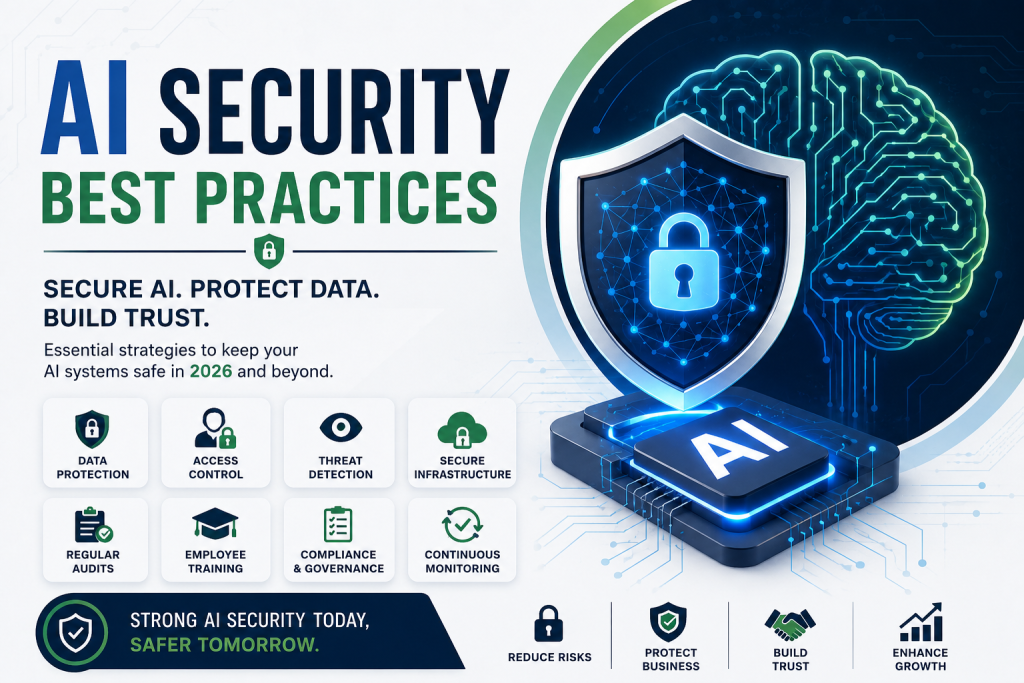
    Artificial intelligence (AI) is transforming businesses across the United States by improving productivity, automating workflows, and enhancing customer experiences. However, as AI adoption grows, so do cybersecurity risks. Understanding AI Security Best Practices is essential for organizations that want to protect sensitive data, AI models, and business operations from evolving cyber threats.

    In this guide, you’ll learn the most effective AI Security Best Practices, common AI security risks, and actionable strategies to secure your AI systems in 2026 and beyond.


    What Are AI Security Best Practices?

    AI Security Best Practices are a set of guidelines and strategies designed to protect AI systems, machine learning models, and sensitive data from cyberattacks, unauthorized access, and misuse. These practices help businesses build secure, reliable, and trustworthy AI applications while complying with industry regulations.

    As organizations increasingly rely on AI for decision-making and automation, implementing strong security measures has become a business necessity.


    Why AI Security Matters

    Cybercriminals are constantly developing new techniques to exploit AI systems. Businesses that ignore AI Security Best Practices may face data breaches, financial losses, legal penalties, and reputational damage.

    Some of the biggest AI security threats include:

    • Data breaches
    • Model theft
    • Prompt injection attacks
    • AI-generated phishing scams
    • Adversarial attacks
    • Insider threats
    • Malware powered by AI
    • Unauthorized access

    Following AI Security Best Practices helps organizations reduce these risks while maintaining customer trust.


    Top AI Security Best Practices

    1. Protect Sensitive Data

    Data is the foundation of every AI model. Encrypt sensitive customer information both in transit and at rest to prevent unauthorized access.

    Businesses should also implement strict data access controls and regularly audit their databases.


    2. Implement Strong Access Controls

    One of the most important AI Security Best Practices is limiting access to AI systems.

    Use:

    • Multi-Factor Authentication (MFA)
    • Role-Based Access Control (RBAC)
    • Strong password policies
    • Least privilege access

    Only authorized users should be able to modify AI models or access confidential data.


    3. Regularly Update AI Models

    AI software should never remain outdated.

    Regular updates help:

    • Patch vulnerabilities
    • Improve model accuracy
    • Enhance security
    • Prevent exploitation

    Keeping AI models current is one of the simplest yet most effective AI Security Best Practices.


    4. Monitor AI Systems Continuously

    Continuous monitoring helps organizations detect unusual behavior before it becomes a major security incident.

    Use AI monitoring tools to identify:

    • Suspicious user activity
    • Unauthorized access attempts
    • Model manipulation
    • Abnormal outputs

    Real-time monitoring strengthens overall cybersecurity.


    5. Secure APIs

    Many AI applications rely on APIs to communicate with other systems.

    Protect APIs by:

    • Using authentication tokens
    • Encrypting API traffic
    • Limiting API requests
    • Monitoring API activity

    API security is a critical part of AI Security Best Practices.


    6. Validate AI Outputs

    Generative AI can occasionally produce inaccurate or misleading responses.

    Organizations should:

    • Review AI-generated content
    • Verify important information
    • Test outputs regularly
    • Maintain human oversight

    Human review significantly reduces operational risks.


    7. Train Employees on AI Security

    Employees are often the weakest link in cybersecurity.

    Provide regular training on:

    • AI phishing scams
    • Prompt injection attacks
    • Safe AI usage
    • Password security
    • Data privacy

    Employee awareness is one of the most effective AI Security Best Practices for reducing human error.


    8. Conduct Regular Security Audits

    Routine security assessments help identify weaknesses before attackers exploit them.

    Businesses should:

    • Perform penetration testing
    • Audit AI infrastructure
    • Review access logs
    • Assess compliance requirements

    Regular audits improve long-term AI resilience.


    Benefits of AI Security Best Practices

    Organizations implementing AI Security Best Practices enjoy numerous advantages.

    Key benefits include:

    • Stronger cybersecurity
    • Better customer trust
    • Reduced risk of data breaches
    • Improved regulatory compliance
    • Secure AI deployments
    • Higher business continuity
    • Lower financial losses
    • Increased operational confidence

    These benefits make AI security a strategic investment for businesses of all sizes.


    Common AI Security Challenges

    Despite rapid advancements, organizations still face several challenges.

    Common issues include:

    • Data poisoning attacks
    • Prompt injection vulnerabilities
    • AI hallucinations
    • Model inversion attacks
    • Third-party software risks
    • Privacy concerns
    • Regulatory compliance

    Understanding these risks helps businesses improve their AI security posture.


    The Future of AI Security in 2026

    The future of AI Security Best Practices will focus on proactive defense strategies rather than reactive security measures.

    Emerging trends include:

    • AI-powered threat detection
    • Zero Trust security architecture
    • Privacy-preserving AI
    • Explainable AI
    • Secure AI governance
    • Automated incident response
    • Advanced identity verification

    Businesses adopting these technologies will be better prepared for increasingly sophisticated cyber threats.


    Final Thoughts

    As AI becomes an essential part of modern business, implementing AI Security Best Practices is no longer optional. Organizations must secure their AI systems, protect sensitive data, monitor AI models, and educate employees about evolving cyber risks.

    Whether you’re a small business, enterprise, or startup in the United States, investing in AI Security Best Practices will help safeguard your operations, maintain customer trust, and ensure long-term success in the AI-driven future.


    Frequently Asked Questions

    What are AI Security Best Practices?

    AI Security Best Practices are strategies that protect AI systems, machine learning models, and sensitive data from cyber threats, unauthorized access, and misuse.

    Why is AI security important?

    AI security helps prevent data breaches, model theft, cyberattacks, and compliance violations while protecting business operations and customer information.

    What are common AI security risks?

    Common risks include prompt injection attacks, data poisoning, adversarial attacks, AI phishing, model theft, insider threats, and unauthorized access.

    How can businesses improve AI security?

    Businesses should encrypt sensitive data, implement multi-factor authentication, monitor AI systems, secure APIs, update AI models regularly, conduct security audits, and train employees on cybersecurity best practices.

  • How Generative AI Works: A Complete Beginner’s Guide (2026)

    How Generative AI Works: A Complete Beginner’s Guide (2026)

    How Generative AI Works: A Complete Beginner’s Guide (2026)

    Artificial intelligence has rapidly evolved from simple automation to creating human-like text, images, videos, music, and even software code. If you’ve ever wondered How Generative AI Works, you’re not alone. Millions of people across the United States are exploring this revolutionary technology to improve productivity, creativity, and business operations.

    In this guide, you’ll learn How Generative AI Works, the technology behind it, its real-world applications, benefits, challenges, and why it will continue transforming industries in 2026 and beyond.


    What Is Generative AI?

    Before understanding How Generative AI Works, it’s important to know what generative AI actually is.

    Generative AI is a branch of artificial intelligence that creates original content instead of simply analyzing existing information. It can generate articles, emails, images, videos, computer code, music, and more by learning patterns from massive datasets.

    Unlike traditional AI systems that predict or classify information, generative AI creates entirely new content based on user prompts.


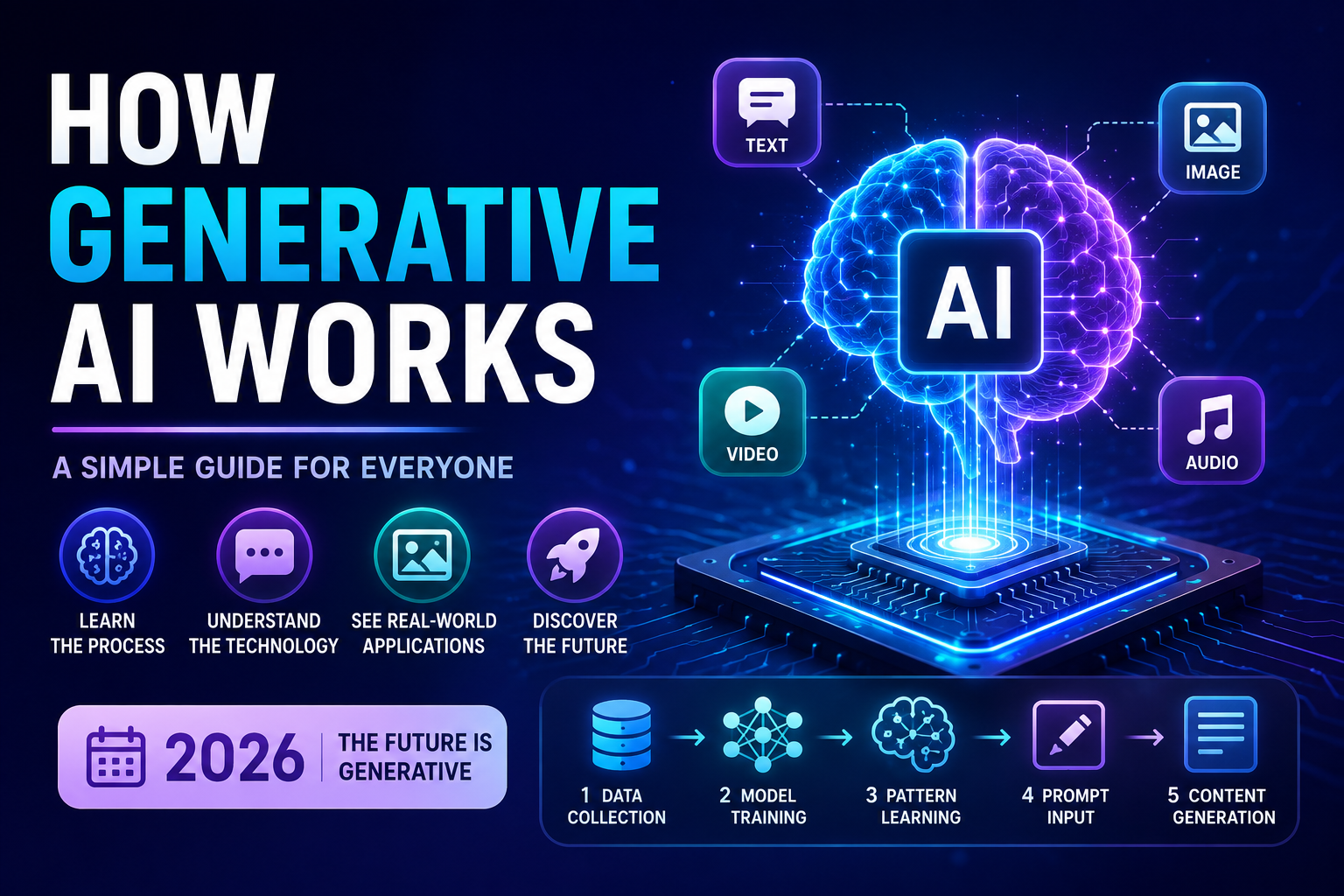
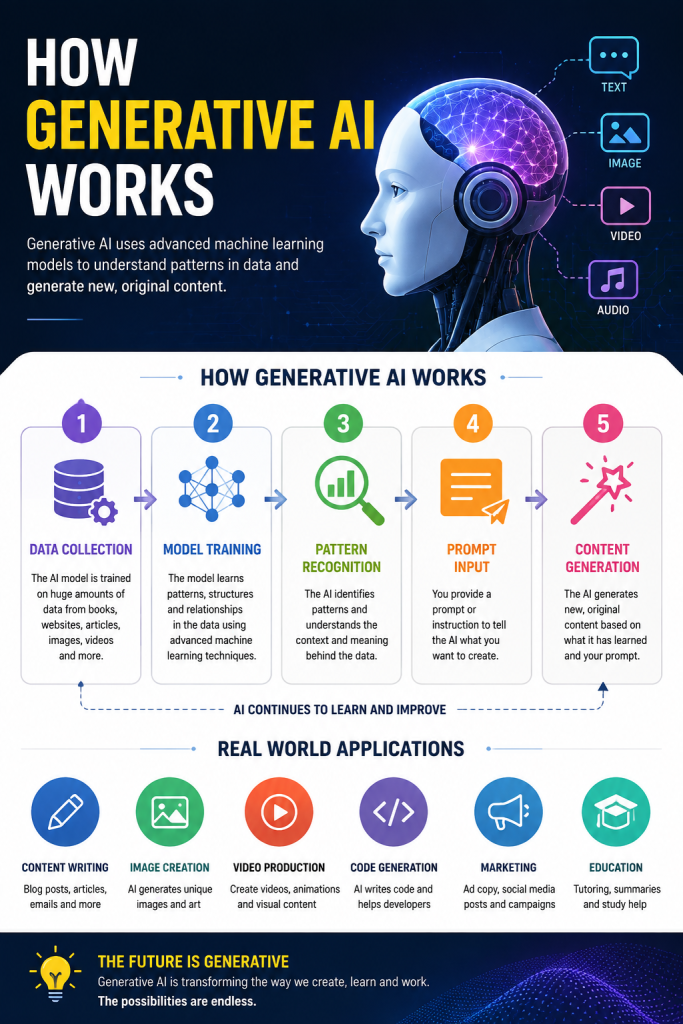
    How Generative AI Works

    Understanding How Generative AI Works begins with machine learning and deep learning technologies.

    Generative AI models are trained using billions of pieces of data collected from books, websites, research papers, images, videos, and public information. During training, the AI learns relationships between words, images, sounds, and patterns.

    When a user enters a prompt, the AI processes the request by:

    • Understanding the user’s instructions
    • Analyzing learned patterns
    • Predicting the most appropriate response
    • Generating new content in real time
    • Improving accuracy through advanced AI models

    This entire process happens within seconds, making AI-powered tools incredibly efficient.


    The Technology Behind Generative AI

    To fully understand How Generative AI Works, it’s important to know the core technologies involved.

    Large Language Models (LLMs)

    Large Language Models are trained on enormous datasets and help AI understand language, answer questions, summarize information, and generate human-like conversations.

    Deep Learning

    Deep learning uses neural networks that mimic the human brain to recognize patterns and improve decision-making over time.

    Neural Networks

    Neural networks allow AI systems to process complex relationships between words, images, and data, enabling highly accurate content generation.

    Transformer Architecture

    Most modern AI systems use Transformer models, which allow AI to understand context instead of processing words individually.


    Step-by-Step Process of How Generative AI Works

    Here’s a simple explanation of How Generative AI Works:

    Step 1: Training

    The AI learns from billions of examples.

    Step 2: Pattern Recognition

    It identifies relationships between different types of information.

    Step 3: Prompt Analysis

    The AI understands what the user is asking.

    Step 4: Content Generation

    It predicts the best possible output based on its training.

    Step 5: Response Delivery

    The AI delivers human-like responses almost instantly.


    Real-World Applications

    Businesses across the United States use generative AI every day.

    Popular applications include:

    • Writing blog articles
    • Email marketing
    • Customer support
    • Software development
    • Image generation
    • Video creation
    • Product descriptions
    • Medical research
    • Financial analysis
    • Education and tutoring

    These practical examples make it easier to understand How Generative AI Works in everyday life.


    Benefits of Generative AI

    Learning How Generative AI Works also means understanding its advantages.

    Major benefits include:

    • Faster content creation
    • Increased productivity
    • Lower business costs
    • Improved customer experiences
    • Personalized recommendations
    • Better marketing campaigns
    • Enhanced creativity
    • Faster software development
    • Business automation
    • Time savings

    Organizations adopting AI can streamline workflows while delivering higher-quality services.


    Challenges and Limitations

    Although impressive, understanding How Generative AI Works also requires recognizing its limitations.

    Some common challenges include:

    • AI hallucinations
    • Copyright concerns
    • Data privacy risks
    • Biased outputs
    • Security issues
    • Ethical considerations
    • Inaccurate information

    For these reasons, AI-generated content should always be reviewed by humans before publication or business use.


    Popular Generative AI Tools in 2026

    Several AI platforms demonstrate How Generative AI Works in practical ways.

    Popular tools include:

    • ChatGPT
    • Google Gemini
    • Claude AI
    • Microsoft Copilot
    • GitHub Copilot
    • Adobe Firefly
    • Midjourney
    • Runway AI

    These tools help businesses and individuals automate tasks while boosting creativity and efficiency.


    The Future of Generative AI

    Experts predict that generative AI will become even more powerful in 2026 and beyond.

    As AI models improve, How Generative AI Works will continue evolving with:

    • More accurate responses
    • Better reasoning abilities
    • Faster content generation
    • Personalized AI assistants
    • Advanced business automation
    • Smarter healthcare solutions
    • Improved education technologies

    Businesses that embrace AI early will have a competitive advantage in the digital economy.


    Final Thoughts

    Understanding How Generative AI Works is becoming increasingly important for professionals, students, entrepreneurs, and businesses. By combining machine learning, deep learning, neural networks, and advanced language models, generative AI can create original content in seconds while helping organizations improve productivity and innovation.

    As AI technology continues advancing throughout 2026, learning How Generative AI Works will empower individuals and businesses to use these tools responsibly, efficiently, and creatively. Whether you’re creating content, writing code, designing graphics, or automating workflows, generative AI is shaping the future of work and digital transformation.


    Frequently Asked Questions

    How Generative AI Works?

    Generative AI works by training on massive datasets, recognizing patterns, understanding user prompts, and generating original content using advanced machine learning and deep learning models.

    What technologies power generative AI?

    Generative AI uses Large Language Models (LLMs), neural networks, transformer architecture, and deep learning to create human-like content.

    Can generative AI create original content?

    Yes. It can generate text, images, videos, music, software code, presentations, and much more based on user prompts.

    Is generative AI safe to use?

    Yes, when used responsibly. Users should verify AI-generated content for accuracy, privacy, copyright, and ethical considerations before using it professionally.

    Which industries benefit from generative AI?

    Generative AI is widely used in healthcare, education, marketing, finance, e-commerce, software development, entertainment, and customer service.

  • What Is Generative AI? Amazing Benefits & Real-World Uses (2026)

    What Is Generative AI? Amazing Benefits & Real-World Uses (2026)

    What Is Generative AI? Amazing Benefits & Real-World Uses (2026)

    Focus Keyword: What Is Generative AI

    Artificial intelligence is changing the way people work, learn, and create. One of the fastest-growing areas of this technology is What Is Generative AI. From writing articles and creating realistic images to generating code and videos, generative AI is transforming industries across the United States.

    If you’ve been wondering What Is Generative AI, this beginner-friendly guide explains everything you need to know. We’ll cover how it works, its benefits, real-world applications, popular tools, challenges, and why it will continue shaping the future in 2026 and beyond.

    What Is Generative AI?

    What Is Generative AI? It is a type of artificial intelligence that can create new content instead of simply analyzing existing information. Unlike traditional AI systems that classify or predict outcomes, generative AI produces original text, images, videos, music, code, and other digital content based on user prompts and learned patterns.

    The technology is powered by advanced machine learning models trained on massive datasets. These models recognize relationships in data and generate responses that closely resemble human-created content.

    How Does Generative AI Work?

    To better understand What Is Generative AI, it’s helpful to know how the technology operates. Generative AI models are trained using billions of examples collected from books, websites, images, videos, and other digital sources.

    Once trained, the AI can:

    • Generate written content
    • Create realistic images
    • Build software code
    • Produce videos
    • Answer questions
    • Summarize documents
    • Translate languages
    • Brainstorm creative ideas

    As users continue interacting with these systems, developers improve their performance through ongoing model updates and fine-tuning.

    Key Benefits of Generative AI

    Businesses and individuals across the United States are adopting generative AI because it offers significant advantages.

    Some of the biggest benefits include:

    • Faster content creation
    • Improved productivity
    • Lower operational costs
    • Personalized customer experiences
    • Better marketing campaigns
    • Smarter business automation
    • Enhanced creativity
    • Faster software development
    • Improved customer support

    These benefits explain why discussions around What Is Generative AI have become increasingly common in nearly every industry.

    Real-World Applications of Generative AI

    Learning What Is Generative AI becomes easier when you look at practical use cases.

    Content Creation

    Writers, bloggers, marketers, and businesses use generative AI to create articles, product descriptions, emails, social media posts, and advertising copy within minutes.

    Graphic Design

    AI-powered image generators help designers produce logos, illustrations, social media graphics, and marketing visuals more efficiently.

    Software Development

    Developers use AI coding assistants to write code, debug applications, generate documentation, and improve programming productivity.

    Customer Support

    Many companies now deploy AI assistants that provide 24/7 customer support, answer frequently asked questions, and resolve common issues instantly.

    Education

    Students and educators use AI for tutoring, research assistance, personalized learning, and educational content creation.

    Healthcare

    Healthcare organizations leverage AI to assist with medical documentation, patient communication, and research support while helping professionals save valuable time.

    Popular Generative AI Tools in 2026

    Several AI platforms have become industry leaders.

    Popular tools include:

    • ChatGPT
    • Google Gemini
    • Claude AI
    • Microsoft Copilot
    • Midjourney
    • Adobe Firefly
    • GitHub Copilot
    • Runway AI

    These tools demonstrate how rapidly the market has evolved and why understanding What Is Generative AI is becoming essential for professionals and businesses.

    Challenges and Limitations

    Although the technology is impressive, there are still challenges associated with What Is Generative AI.

    Some limitations include:

    • AI-generated misinformation
    • Copyright concerns
    • Bias in training data
    • Privacy and security risks
    • Hallucinated responses
    • Ethical considerations

    Organizations should always review AI-generated content before publishing or making business decisions.

    Why Generative AI Matters for Businesses

    Companies across the U.S. are investing heavily in AI-powered automation. Understanding What Is Generative AI helps business owners identify opportunities to reduce costs, improve customer experiences, and streamline workflows.

    From e-commerce and healthcare to finance and education, organizations are integrating AI into daily operations to stay competitive in an increasingly digital economy.

    The Future of Generative AI

    The future looks incredibly promising. As technology advances, What Is Generative AI will become an even more important topic for businesses and consumers alike.

    By 2026 and beyond, AI is expected to deliver more accurate responses, create increasingly realistic media, automate complex business tasks, and support professionals across nearly every industry.

    Experts also predict tighter AI regulations, greater transparency, and stronger security measures that will make AI systems more reliable and trustworthy.

    Final Thoughts

    Understanding What Is Generative AI is no longer optional in today’s digital world. Whether you’re a student, entrepreneur, content creator, marketer, or business owner, generative AI offers countless opportunities to improve productivity and unlock new levels of creativity.

    As AI technology continues evolving, those who learn and adopt it early will be better prepared for the future of work, business, and innovation. By understanding What Is Generative AI, you can confidently explore AI-powered tools and use them responsibly to achieve personal and professional success.

    Frequently Asked Questions

    What Is Generative AI?

    Generative AI is a branch of artificial intelligence that creates original content such as text, images, videos, music, and code using advanced machine learning models.

    How is generative AI different from traditional AI?

    Traditional AI analyzes, predicts, or classifies data, while generative AI creates entirely new content based on patterns learned during training.

    Is generative AI safe?

    Generative AI can be safe when used responsibly. Users should always verify AI-generated information and follow privacy, security, and copyright best practices.

    What industries use generative AI?

    Generative AI is widely used in marketing, education, healthcare, finance, software development, e-commerce, entertainment, and customer service.

    What are the best generative AI tools in 2026?

    Some of the leading tools include ChatGPT, Google Gemini, Claude AI, Microsoft Copilot, Midjourney, Adobe Firefly, GitHub Copilot, and Runway AI.