Category: Uncategorized

  • AI Evaluation Tools: 10 Best Solutions for Testing AI in 2026

    AI Evaluation Tools: 10 Best Solutions for Testing AI in 2026

    AI Evaluation Tools: 10 Best Solutions for Testing AI in 2026

    Artificial intelligence is becoming part of customer service, software development, healthcare, finance, marketing, and enterprise operations. But building an AI application is only the beginning. Businesses also need to know whether their models are accurate, reliable, safe, relevant, and consistent.

    This is where AI Evaluation Tools become valuable. They help developers and AI teams test model outputs, compare prompts, detect hallucinations, evaluate RAG applications, measure agent performance, and identify quality problems before they affect users.

    In 2026, AI evaluation is moving from basic experimentation toward continuous testing throughout the AI development lifecycle. Google Cloud, for example, describes evaluation as a way to assess generative AI models using metrics, rubrics, datasets, and model comparisons.

    What Are AI Evaluation Tools?

    AI Evaluation Tools are software platforms and frameworks designed to measure the quality and performance of artificial intelligence systems.

    Traditional software testing often checks whether an application produces an expected output. AI applications are more complicated because an answer can be technically valid while still being inaccurate, irrelevant, unsafe, or poorly written.

    Evaluation systems can measure factors such as:

    • Accuracy
    • Relevance
    • Groundedness
    • Hallucination
    • Safety
    • Helpfulness
    • Instruction following
    • Response consistency
    • Tool-call accuracy
    • Agent performance

    Modern evaluation services can use predefined metrics, custom criteria, adaptive rubrics, deterministic calculations, and model-based scoring.

    Why AI Evaluation Matters in 2026

    AI models can change behavior after a prompt update, model migration, retrieval change, or system modification. A response that looked excellent during development may perform poorly with real-world queries.

    This makes continuous evaluation essential.

    For example, a company might change its language model to reduce costs. The new model may be faster and cheaper but produce more hallucinations. Without a proper evaluation process, the business may not discover the problem until customers complain.

    Evaluation gives teams measurable evidence instead of relying entirely on manual inspection or subjective opinions. Current industry comparisons emphasize the importance of repeatable evaluations for detecting regressions and validating AI applications before production.

    Key Features to Look For

    1. Automated Testing

    One of the most useful capabilities is automated testing. Teams can create a dataset containing questions, expected behaviors, or reference answers and repeatedly test their AI system.

    Automated evaluation makes it easier to compare different prompts, models, and application versions.

    2. LLM-as-a-Judge Evaluation

    Some platforms use another language model to evaluate an AI-generated response according to predefined criteria.

    For example, an evaluator can score whether an answer is relevant, helpful, factual, or aligned with instructions.

    This approach is particularly useful when there is no simple mathematical answer. However, teams should validate evaluator reliability and avoid treating automated scores as perfect ground truth.

    3. Hallucination Detection

    Hallucinations remain an important concern for generative AI applications.

    An evaluation workflow can test whether responses are supported by provided information and whether the system invents unsupported claims.

    This is particularly important for RAG applications, enterprise knowledge assistants, and customer-support systems.

    4. RAG Evaluation

    Retrieval-augmented generation introduces multiple potential failure points. The system might retrieve irrelevant documents, miss important information, or generate an incorrect response from otherwise useful context.

    AI Evaluation Tools can assess retrieval quality and response groundedness separately, helping developers determine whether the problem originates in retrieval or generation.

    Google Cloud’s evaluation documentation specifically includes evaluation workflows for generative AI systems and supports datasets created from production logs, uploaded examples, and synthetic data.

    5. AI Agent Evaluation

    AI agents are more difficult to evaluate than simple chatbots because they can perform multiple actions.

    An agent may search a database, call an API, use a calculator, retrieve documents, and then generate a final response.

    Evaluation should therefore examine not only the final answer but also the agent’s intermediate actions, tool calls, and overall task completion.

    Recent evaluation platforms increasingly support agent and multi-step workflow testing.

    6. Prompt Testing and Regression Testing

    Prompt changes can unexpectedly improve one scenario while damaging another.

    A strong evaluation workflow allows developers to compare prompt versions against the same test dataset. This makes it easier to identify improvements and prevent regressions.

    For production teams, evaluation can become part of CI/CD so that significant quality problems are detected before a new version is released.

    Popular AI Evaluation Tools in 2026

    The market includes open-source frameworks, managed platforms, RAG-focused solutions, and tools designed for production monitoring.

    Popular options include:

    • DeepEval — useful for open-source LLM evaluation and metric-based testing
    • Promptfoo — useful for prompt testing, regression testing, and security-oriented evaluations
    • Ragas — focused strongly on RAG evaluation
    • LangSmith — useful for evaluation and testing within LangChain-based workflows
    • Braintrust — designed around evaluation workflows and experiments
    • Arize Phoenix — combines observability, tracing, and evaluation
    • Comet Opik — supports evaluation and monitoring of LLM applications
    • Confident AI — provides evaluation capabilities for RAG, agents, and conversational systems
    • Google Cloud Gen AI Evaluation — provides model evaluation using metrics, rubrics, datasets, and comparisons

    Current 2026 comparisons show that these platforms differ in their focus, including open-source development, RAG testing, agent evaluation, production workflows, and managed evaluation.
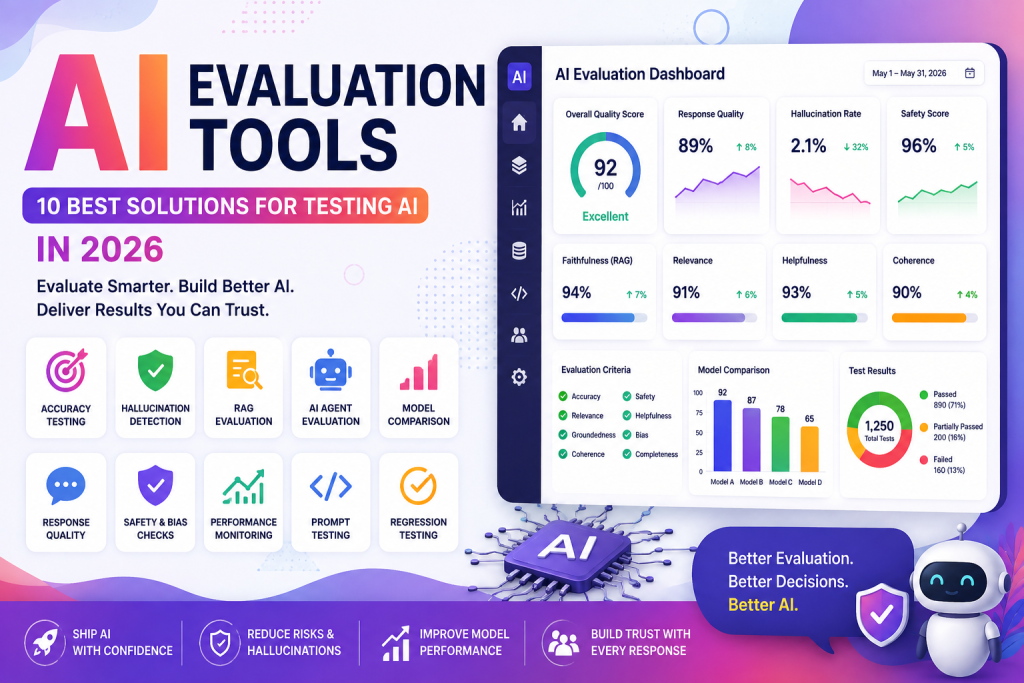
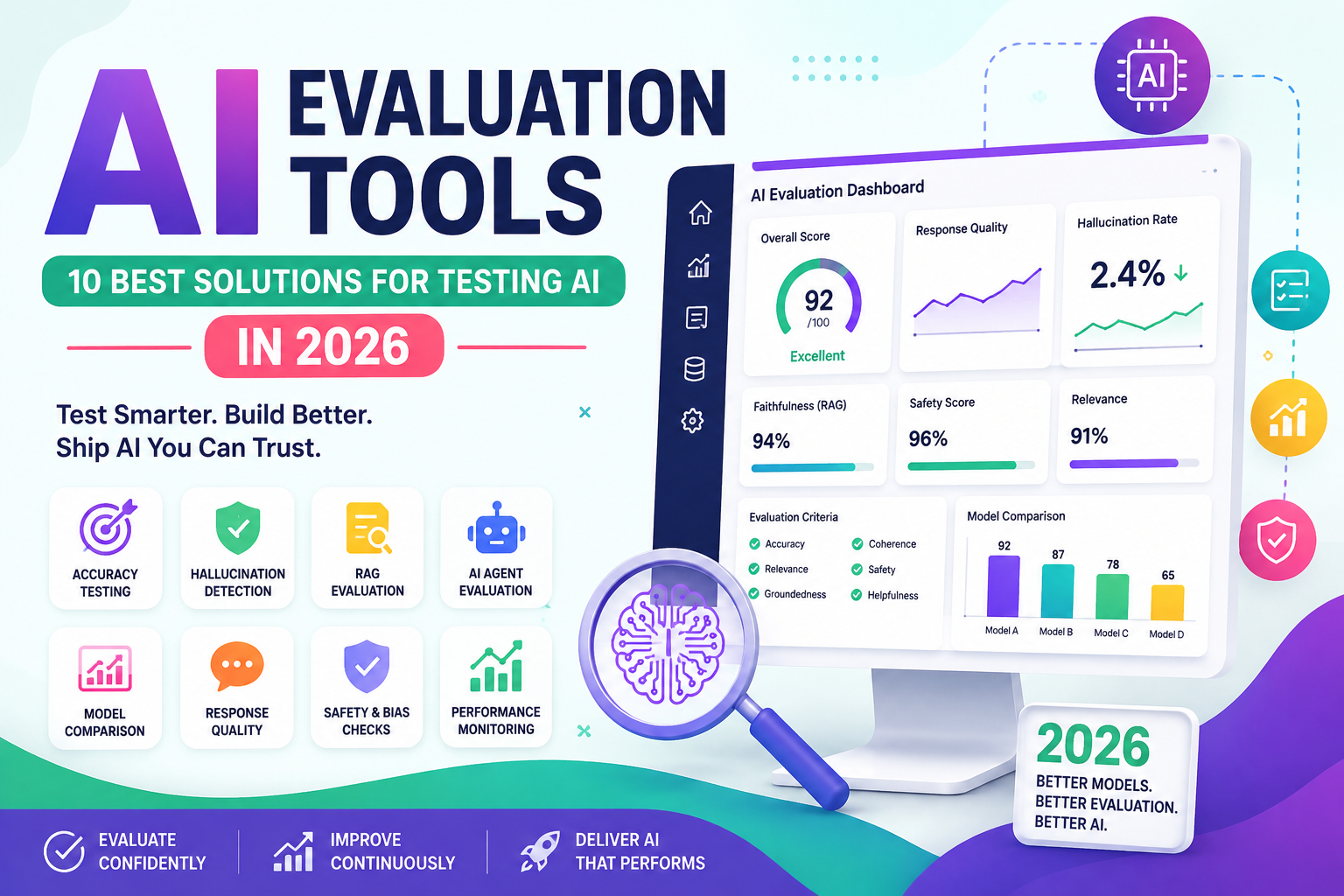
    A modern, colorful AI Evaluation Tools infographic designed for 2026. The image features an AI evaluation dashboard with overall quality scores, response quality, hallucination rate, safety score, RAG faithfulness, relevance, helpfulness, coherence, model comparison, and test results. It also highlights key AI testing capabilities including accuracy testing, hallucination detection, RAG evaluation, AI agent evaluation, model comparison, response quality, safety and bias checks, performance monitoring, prompt testing, and regression testing. The purple, pink, blue, green, and orange color scheme creates a professional and engaging technology aesthetic, making the image suitable as a feature image for an AI and machine-learning blog article

    Benefits for Businesses

    Using AI Evaluation Tools can provide several advantages:

    • More reliable AI responses
    • Faster testing
    • Better model selection
    • Reduced hallucinations
    • Improved RAG performance
    • Safer AI applications
    • Easier prompt optimization
    • Automated regression detection
    • Better development workflows
    • Measurable AI quality

    For organizations serving large numbers of customers, these benefits can translate into better user experiences and fewer costly AI failures.

    How to Choose the Right Tool

    Before selecting an evaluation platform, consider your specific application.

    If you are building a RAG chatbot, prioritize retrieval and groundedness metrics. If you are developing an autonomous agent, look for multi-step tracing and task-completion evaluation.

    For teams working with several models, model comparison and experiment management can be particularly valuable.

    Also consider:

    • Open-source vs. managed deployment
    • Integration with your existing stack
    • Custom evaluation metrics
    • Human review capabilities
    • Dataset management
    • CI/CD integration
    • Production monitoring
    • Privacy and security
    • Pricing and scalability

    The best platform is not necessarily the one with the longest feature list. It is the one that fits your development workflow and produces useful evidence about AI quality.

    Future of AI Evaluation

    The future of AI Evaluation Tools will move toward continuous, automated, and application-specific testing.

    Instead of evaluating a model only before launch, organizations will increasingly evaluate AI systems throughout their entire lifecycle. Production data, user feedback, automated judges, human reviewers, and specialized metrics can work together to provide a more complete picture.

    Google’s current evaluation service supports model comparisons, prompt optimization, custom criteria, adaptive rubrics, and evaluation datasets, demonstrating how evaluation is becoming integrated into the broader AI development process.

    Conclusion

    AI Evaluation Tools are becoming essential for teams that want to build dependable AI applications in 2026. They help developers measure accuracy, relevance, safety, groundedness, hallucinations, agent behavior, and overall application quality.

    The most effective strategy is to combine automated testing with carefully designed datasets, meaningful metrics, human review, and continuous monitoring.

    As AI applications become more complex, businesses will need more than impressive demos. They will need measurable evidence that their AI systems work reliably in real-world situations.
  • AI Observability Tools: 10 Best Solutions for Monitoring AI in 2026

    AI Observability Tools: 10 Best Solutions for Monitoring AI in 2026

    AI Observability Tools: 10 Best Solutions for Monitoring AI in 2026

    Artificial intelligence applications are becoming more complex, especially as businesses adopt large language models (LLMs), AI agents, retrieval-augmented generation (RAG), and generative AI. Traditional application monitoring can show whether a request succeeded, but it may not explain why an AI response was inaccurate, expensive, slow, or unsafe.

    That is why AI Observability Tools are becoming an important part of modern AI development. They help engineering and product teams monitor AI behavior, trace model requests, measure latency and token usage, evaluate response quality, identify failures, and control operating costs.

    In 2026, AI observability is increasingly focused not only on whether an AI application is running, but also on whether it is producing reliable and useful results.

    What Are AI Observability Tools?

    AI Observability Tools are platforms that provide visibility into the behavior and performance of AI applications.

    Traditional observability typically focuses on metrics such as uptime, errors, CPU usage, memory, and response time. AI applications require additional information, including prompts, model responses, tool calls, token consumption, retrieval steps, evaluation scores, and agent workflows.

    This additional visibility helps developers understand what happened inside an AI application when something goes wrong.

    For example, an AI chatbot might return a successful HTTP response while providing incorrect information. Traditional monitoring may report the request as successful, while an AI observability system can help identify the problematic prompt, model response, retrieval step, or tool call.

    Why AI Observability Matters in 2026

    The growing complexity of AI systems makes monitoring more challenging. An AI agent may make multiple model calls, retrieve information from databases, use external tools, and make several decisions before returning a final response.

    Without detailed tracing, debugging these workflows can become difficult.

    Modern AI Observability Tools help teams answer questions such as:

    • Why did an AI response fail?
    • Which model generated the response?
    • How many tokens were used?
    • What did the request cost?
    • How long did the model take to respond?
    • Did the AI application hallucinate?
    • Which tool call caused the problem?
    • Is response quality declining?
    • Are users receiving consistent results?

    These capabilities are especially useful for companies running customer-facing AI applications.

    Key Features to Look For

    1. AI Tracing

    Tracing is one of the most important features of AI Observability Tools. It records the steps involved in an AI request and can show prompts, responses, model calls, retrieval operations, and tool interactions.

    For AI agents, tracing becomes even more important because one user request may involve multiple connected operations.

    2. Performance Monitoring

    AI applications need to be monitored for latency, errors, throughput, and reliability.

    Teams can use AI monitoring platforms to identify slow model responses, API failures, unusual traffic patterns, and performance bottlenecks.

    This allows developers to investigate problems before they significantly affect users.

    3. Token and Cost Tracking

    AI models can become expensive when applications generate large numbers of requests.

    AI Observability Tools can track token consumption and estimate model costs. This helps teams determine which applications, users, prompts, or models are generating the highest expenses.

    Cost visibility is especially valuable when organizations use multiple AI providers or models.

    4. Output Quality Evaluation

    Monitoring whether an application responds is not enough. Teams also need to determine whether the response is actually useful.

    AI evaluation features can score responses for factors such as accuracy, relevance, toxicity, hallucination risk, and adherence to predefined requirements.

    Current AI observability platforms increasingly combine tracing with evaluation so teams can connect a poor-quality result with the specific execution steps that produced it.

    5. AI Agent Monitoring

    AI agents introduce another layer of complexity because they can make decisions and call tools independently.

    An agent might retrieve information, call an API, perform calculations, ask another model for information, and then produce a final response.

    AI Observability Tools can provide visibility into these multi-step workflows, helping developers identify where an agent became inefficient or made an incorrect decision.

    Comet notes that modern agent observability increasingly requires multi-step trace visualization and evaluation at individual stages of an agent workflow.

    6. RAG Monitoring

    Retrieval-augmented generation allows AI applications to retrieve information from external databases before generating a response.

    RAG systems can fail when the wrong information is retrieved, relevant information is missing, or the model incorrectly interprets the retrieved content.

    AI observability solutions can trace retrieval steps and evaluate whether the retrieved context contributed to an accurate response.

    This is particularly useful for enterprise chatbots, knowledge bases, customer-support systems, and internal AI assistants.

    7. Prompt Monitoring

    Prompts can have a major impact on AI performance.

    Development teams can monitor prompt versions, compare responses, and identify which instructions produce better results.

    Prompt monitoring can also help teams detect unexpected changes after a model, application, or prompt is updated.

    Best AI Observability Tools in 2026

    There is no single platform that is best for every organization. Different tools focus on different needs.

    Popular options in 2026 include:

    • Langfuse — strong open-source and self-hosting option
    • LangSmith — particularly useful for LangChain and LangGraph applications
    • Arize Phoenix — strong for tracing, evaluation, RAG, and OpenTelemetry workflows
    • Braintrust — focused on evaluation-driven development
    • Comet Opik — useful for high-volume AI and agent monitoring
    • W&B Weave — useful for teams already working with Weights & Biases
    • Datadog LLM Observability — suitable for organizations already using Datadog
    • MLflow — useful for broader machine-learning lifecycle workflows
    • Galileo — focused on AI quality and evaluation
    • SigNoz — useful for teams wanting AI monitoring alongside broader application observability

    Recent 2026 comparisons show that these platforms differ considerably in areas such as tracing, evaluation, open-source support, agent monitoring, and integration with existing infrastructure.

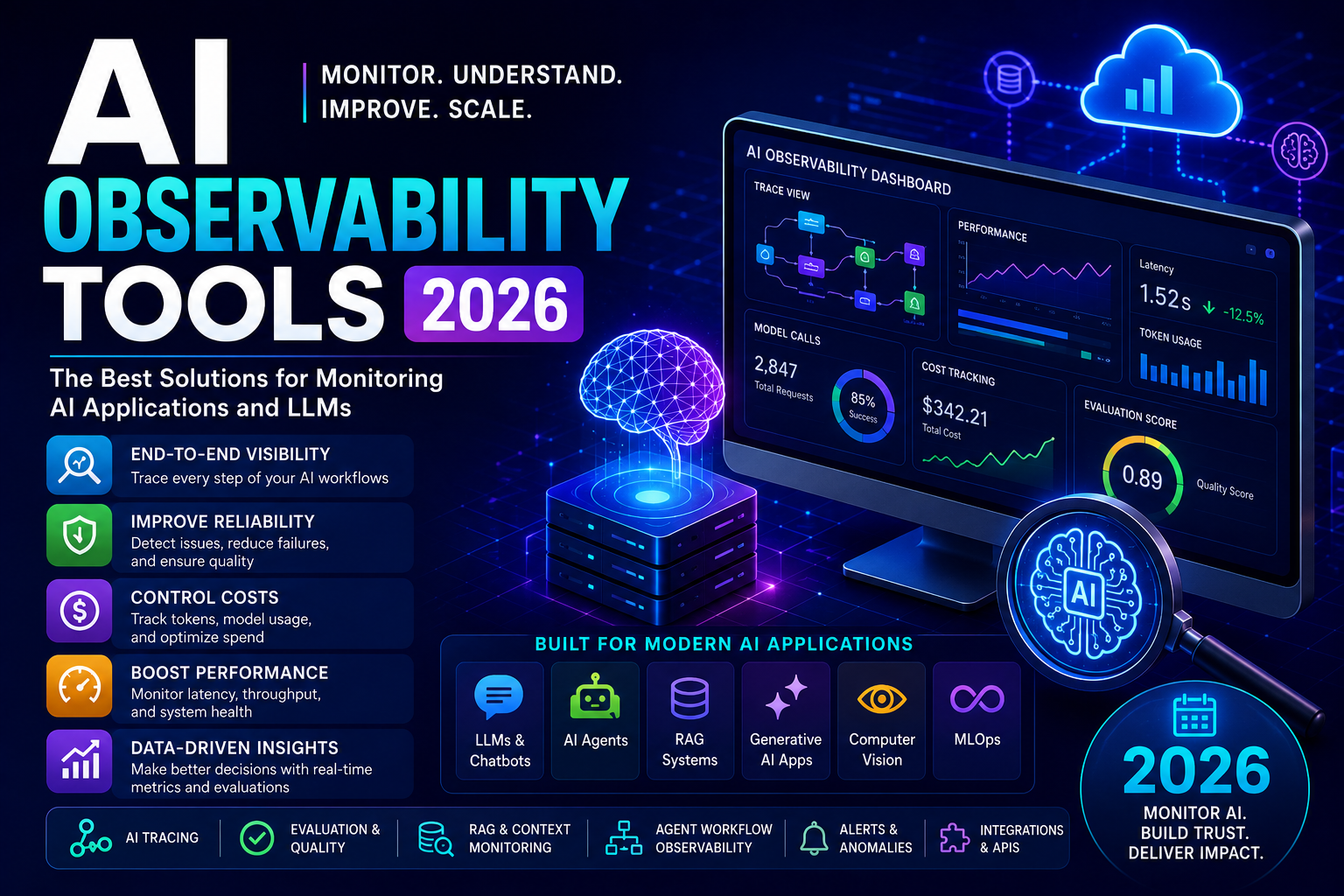
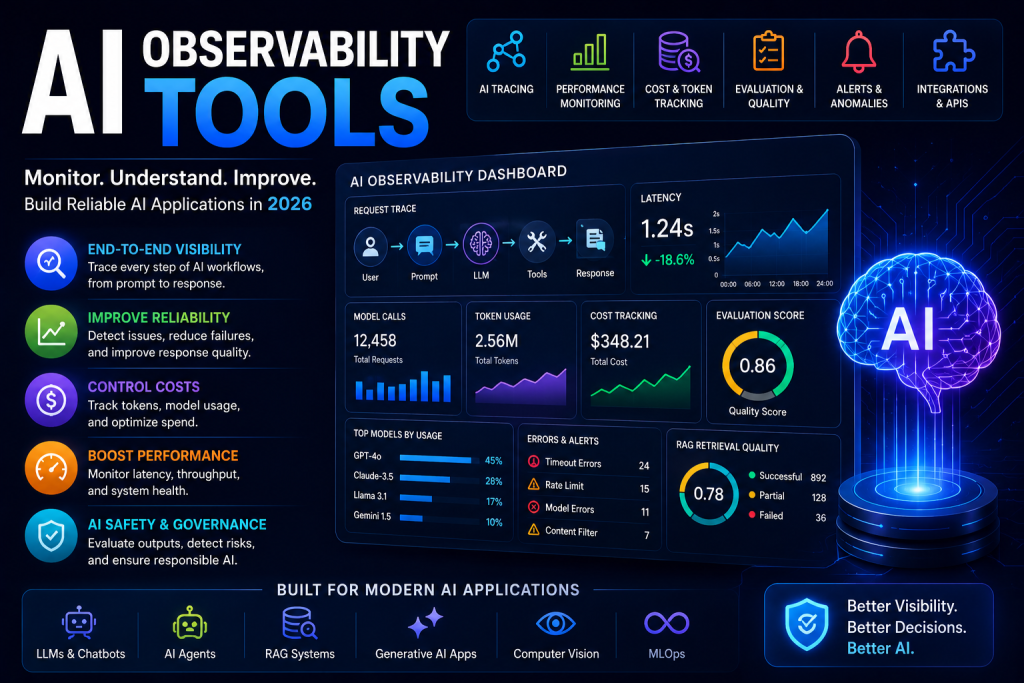
    A futuristic AI Observability Tools infographic showcasing advanced AI monitoring and performance management in 2026. The image features a detailed AI observability dashboard with request tracing, latency monitoring, model calls, token usage, cost tracking, evaluation scores, error alerts, RAG retrieval quality, and model usage analytics. It also highlights AI tracing, performance monitoring, cost optimization, evaluation, anomaly detection, security, and API integrations. The glowing AI brain and digital infrastructure represent modern LLMs, AI agents, RAG systems, generative AI applications, computer vision, and MLOps. The dark blue background with vibrant cyan, purple, green, orange, and pink accents creates a professional, high-tech visual suitable for an AI technology blog feature image.

    How to Choose the Right Platform

    Before selecting AI Observability Tools, businesses should identify their most important monitoring requirements.

    Consider:

    AI framework: Does the platform integrate with your existing development stack?

    Tracing: Can you inspect individual model calls and complete agent workflows?

    Evaluation: Can you measure response quality rather than just technical performance?

    Cost monitoring: Does it track tokens and model expenses?

    Security: How does it handle prompts, responses, customer information, and sensitive data?

    Scalability: Can it support your expected production workload?

    OpenTelemetry: Does it work with standardized telemetry and existing observability infrastructure?

    Deployment: Do you need cloud hosting, self-hosting, or both?

    The right choice should be based on your actual production requirements rather than simply choosing the platform with the largest feature list.

    Benefits for Businesses

    Implementing AI Observability Tools can provide several advantages:

    • Faster debugging
    • Better AI reliability
    • Improved response quality
    • Lower model costs
    • Easier incident investigation
    • Better visibility into AI agents
    • Improved RAG performance
    • More reliable production deployments
    • Better monitoring of model changes
    • Stronger AI governance

    These benefits can help companies move from experimental AI projects toward dependable production systems.

    Challenges to Consider

    AI observability also creates challenges. AI systems can generate sensitive prompts and responses, so organizations must consider privacy, access controls, retention policies, and security.

    Another challenge is data volume. Large AI applications can generate huge numbers of traces, making storage and analysis expensive.

    Teams should also avoid collecting unnecessary sensitive information and should carefully determine what telemetry needs to be retained.

    Future of AI Observability

    The future of AI Observability Tools is moving beyond basic logging toward intelligent monitoring and automated evaluation.

    As AI agents become more autonomous, observability platforms will increasingly need to understand entire workflows rather than individual model requests.

    Organizations will also place greater emphasis on quality, safety, cost efficiency, and reliability. In other words, the key question is shifting from “Did the AI system respond?” to “Did it respond correctly, efficiently, safely, and at an acceptable cost?”

    Conclusion

    AI Observability Tools are becoming essential for organizations deploying AI applications in production. They provide visibility into model performance, prompts, responses, costs, latency, retrieval systems, and agent workflows.

    In 2026, the strongest observability strategies combine traditional infrastructure monitoring with AI-specific tracing and evaluation.

    For businesses building AI chatbots, copilots, RAG applications, or autonomous agents, investing in the right observability approach can make it easier to detect problems, improve quality, manage costs, and build more reliable AI products.

  • AI Inference Platforms: Powerful AI Deployment Solutions for 2026

    AI Inference Platforms: Powerful AI Deployment Solutions for 2026

    AI Inference Platforms: Powerful AI Deployment Solutions for 2026

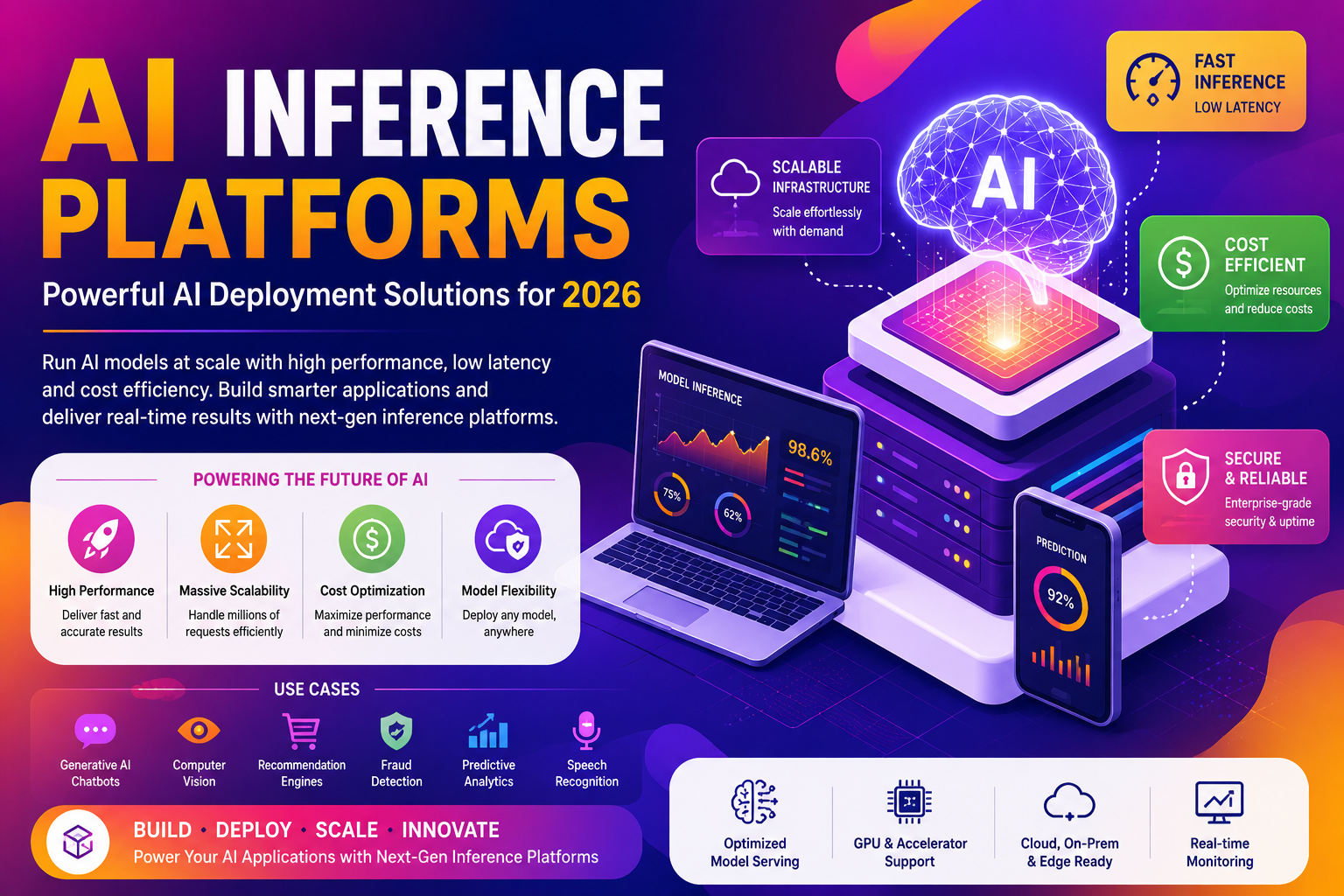
    Artificial intelligence is moving from experimentation into real-world applications across businesses, healthcare, finance, retail, manufacturing, and software. As AI models become more sophisticated, organizations need reliable infrastructure to process requests quickly and efficiently. This is where AI Inference Platforms are becoming increasingly important.

    In 2026, companies are looking for AI infrastructure that can deliver fast responses, manage large workloads, reduce computing costs, and support production applications. From generative AI chatbots to recommendation engines and computer vision systems, inference infrastructure plays a critical role in turning trained AI models into useful business applications.

    What Are AI Inference Platforms?

    AI Inference Platforms are software and infrastructure solutions designed to run trained artificial intelligence models and generate predictions or responses from new data.

    Training teaches an AI model how to recognize patterns. Inference is what happens when that trained model is used to answer a question, classify an image, generate text, detect fraud, or make a prediction.

    For example, when someone enters a question into an AI chatbot, the underlying model processes that request and generates a response. The infrastructure responsible for efficiently handling that request is part of the inference ecosystem.

    Why AI Inference Matters in 2026

    The growth of generative AI is increasing demand for fast and scalable model deployment. Businesses cannot simply train an AI model and expect it to automatically perform efficiently in production.

    They need infrastructure capable of handling:

    • High volumes of AI requests
    • Low-latency responses
    • Large language models
    • Real-time predictions
    • GPU and accelerator workloads
    • Data privacy requirements
    • Multiple AI models
    • Variable traffic levels

    Modern AI Inference Platforms help organizations manage these requirements while improving the performance and reliability of AI applications.

    How AI Inference Platforms Work

    A typical inference workflow begins with a trained model. The model is deployed to specialized computing infrastructure, where incoming requests are processed.

    Depending on the application, the platform may use GPUs, CPUs, or specialized AI accelerators. Optimization techniques such as model quantization, batching, caching, and hardware acceleration can improve performance.

    When a user submits a request, the system sends the input to the deployed model. The model processes the information and produces an output. The platform then delivers that output to the application or user.

    This process may happen thousands or millions of times per day for large-scale applications.

    Key Benefits of AI Inference Platforms

    1. Faster AI Responses

    Speed is critical for applications such as AI assistants, search engines, recommendation systems, and real-time analytics. AI Inference Platforms can optimize model execution to reduce response times.

    Lower latency creates a better experience for users who expect AI applications to respond almost instantly.

    2. Better Scalability

    AI workloads can change dramatically throughout the day. A business may experience a sudden increase in chatbot requests or application traffic.

    Scalable inference infrastructure allows organizations to increase or decrease computing resources according to demand.

    3. Lower AI Computing Costs

    Running large models can be expensive because they often require powerful GPUs or specialized accelerators. Model optimization and efficient resource management can help reduce the cost of serving AI applications.

    Businesses can select appropriate hardware and optimize models according to their performance requirements.

    4. Easier Model Deployment

    Deploying an AI model manually can require significant engineering work. Modern inference solutions provide tools for packaging, deploying, monitoring, and updating models.

    This can help development teams move AI applications from testing to production more efficiently.

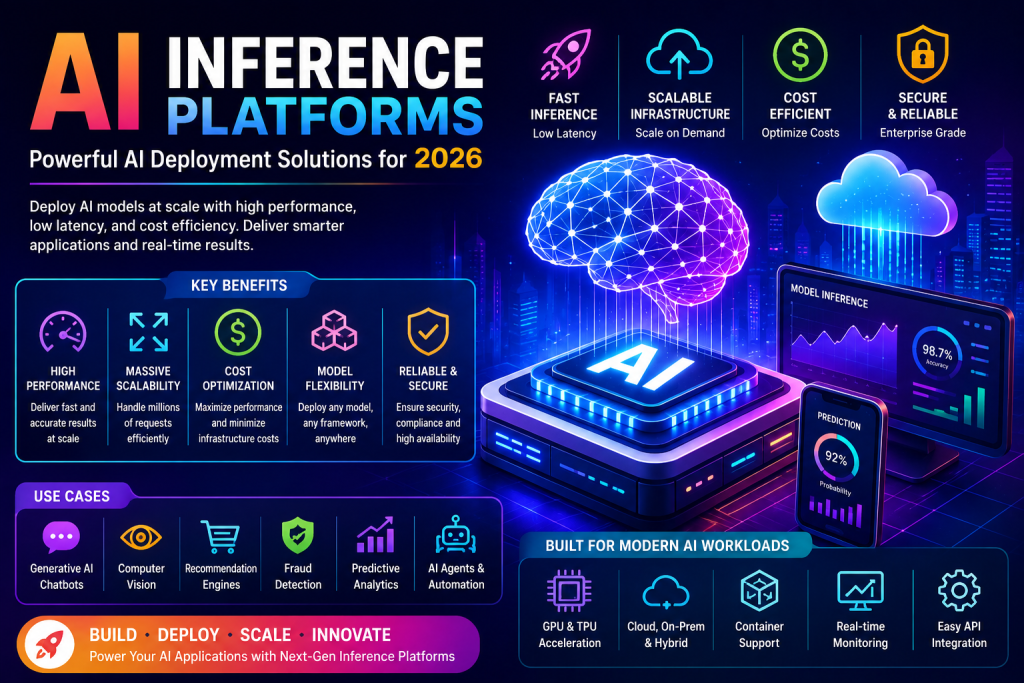
    A futuristic AI Inference Platforms illustration showcasing next-generation AI deployment solutions for 2026. The image features a glowing AI brain and processor, cloud infrastructure, model inference dashboard, prediction analytics on a smartphone, and advanced computing technology. It highlights fast inference, low latency, scalable infrastructure, cost optimization, model flexibility, security, GPU and TPU acceleration, cloud and hybrid deployment, container support, real-time monitoring, and API integration. The vibrant blue, purple, cyan, pink, green, and orange color palette creates a modern technology-focused theme representing high-performance AI computing and scalable model deployment.

    AI Inference Platforms for Generative AI

    Generative AI is one of the biggest drivers of inference demand. Large language models need significant computational resources when generating text, code, images, or other content.

    AI Inference Platforms can help developers serve these models efficiently by supporting techniques such as continuous batching, caching, quantization, and optimized model runtimes.

    For companies building AI assistants, search tools, coding applications, and enterprise copilots, efficient inference can directly affect user experience and operating costs.

    Cloud vs. On-Premise AI Inference

    Organizations generally have several options for deploying AI inference infrastructure.

    Cloud-based solutions provide flexibility and access to powerful computing resources without requiring companies to purchase and maintain physical hardware.

    On-premise infrastructure can provide greater control over data, hardware, and networking. This may be particularly useful for organizations handling sensitive information or requiring strict infrastructure controls.

    Some companies use a hybrid approach, combining cloud infrastructure with private computing environments.

    AI Inference Platforms and Edge Computing

    Inference does not always need to happen in a centralized cloud environment. Edge AI allows models to run closer to where data is generated.

    For example, an intelligent camera can analyze video locally instead of sending every frame to a remote server. Similarly, smartphones, vehicles, industrial machines, and connected devices can perform AI inference directly on local hardware.

    Edge inference can reduce latency, lower bandwidth requirements, and improve privacy for certain applications.

    Important Features to Look For

    When evaluating AI Inference Platforms, businesses should consider several technical and operational factors:

    • Model compatibility
    • GPU and accelerator support
    • Low-latency inference
    • Autoscaling capabilities
    • Monitoring and observability
    • Security controls
    • Data privacy
    • API integration
    • Model version management
    • Cost optimization
    • High availability
    • Deployment flexibility

    The right solution depends on the model type, application requirements, expected traffic, budget, and security needs.

    Challenges of AI Inference

    Despite its advantages, AI inference can present technical challenges. Large models may require significant computing resources, while high traffic can increase infrastructure costs.

    Latency can also become an issue when applications depend on real-time responses. Poorly optimized models may consume excessive memory or computing power.

    Security is another consideration. Organizations should protect model endpoints, APIs, credentials, customer information, and infrastructure from unauthorized access.

    Monitoring is equally important because model performance can change as workloads and user behavior evolve.

    The Future of AI Inference Platforms

    The future of AI Inference Platforms will likely focus on greater efficiency, specialized hardware, intelligent workload scheduling, and increasingly sophisticated AI applications.

    As organizations deploy more AI agents and generative AI systems, inference infrastructure will become an essential part of enterprise technology stacks.

    Developers will increasingly need solutions that can serve multiple models, automatically scale resources, optimize computing costs, and provide reliable performance.

    The evolution of AI hardware will also influence inference. Specialized accelerators designed for AI workloads can provide improved performance and energy efficiency compared with traditional computing infrastructure.

    Conclusion

    AI Inference Platforms are becoming a critical foundation for deploying artificial intelligence applications at scale in 2026. They help businesses transform trained models into practical services capable of delivering predictions, recommendations, generated content, and real-time decisions.

    From generative AI and enterprise assistants to edge computing and predictive analytics, efficient inference can improve application speed, scalability, reliability, and cost management.

    Organizations choosing an inference solution should evaluate performance, scalability, security, model compatibility, infrastructure flexibility, and total operating costs. With the right architecture, businesses can build AI applications that are faster, more reliable, and ready for growing demand

  • AI FinTech Use Cases: 10 Powerful Applications Transforming Finance in 2026

    AI FinTech Use Cases: 10 Powerful Applications Transforming Finance in 2026

    AI FinTech Use Cases: 10 Powerful Applications Transforming Finance in 2026

    The financial technology industry is moving beyond basic automation. In 2026, artificial intelligence is being integrated into fraud prevention, customer support, credit decisions, compliance, payments, risk management, and financial operations. AI FinTech Use Cases are becoming increasingly important as financial companies look for faster processes, better customer experiences, stronger security, and more efficient decision-making.

    Recent research from Cambridge Judge Business School shows that financial-services organizations are using AI heavily for process automation, data visualization, customer support, fraud detection, and credit-risk modeling.

    What Are AI FinTech Use Cases?

    AI FinTech Use Cases refer to practical ways artificial intelligence is applied within financial technology products and services. These applications can involve machine learning, generative AI, natural-language processing, predictive analytics, computer vision, and AI agents.

    Rather than using AI for only one task, modern financial organizations are connecting AI with existing banking, payment, lending, and compliance systems. This allows companies to automate repetitive work while giving employees better information for important decisions.

    1. AI Fraud Detection

    One of the most established AI FinTech Use Cases is fraud detection. AI systems can analyze transactions, account activity, device information, and behavioral patterns to identify suspicious activity.

    Unlike traditional systems that may rely heavily on fixed rules, machine learning models can recognize unusual patterns across large volumes of transactions. This can help financial institutions detect payment fraud, account takeover attempts, and other suspicious activity more quickly.

    Mastercard reported in 2026 that AI-powered tools using real-time data can help financial institutions prevent payment fraud while reducing false positives.

    2. AI-Powered Customer Service

    Customer support is another major AI FinTech Use Case. Financial companies can use AI chatbots and virtual assistants to answer common questions, explain transactions, help customers navigate applications, and route complex cases to human representatives.

    Generative AI can also summarize customer conversations and provide employees with relevant information during support interactions. This can reduce response times while allowing human agents to focus on more complicated issues.

    Google Cloud identifies customer engagement and operational efficiency among the major areas where AI is being applied across banking.

    3. AI Credit Scoring and Underwriting

    Lending is another area where AI FinTech Use Cases can have a significant impact. Machine learning can help analyze financial information, repayment behavior, cash flow patterns, and other permitted data to support credit-risk assessment.

    AI-powered underwriting can also automate document processing and reduce repetitive work. Instead of manually reviewing every piece of information, employees can receive structured insights and focus on cases requiring additional attention.

    Because lending decisions can significantly affect consumers, organizations need strong model governance, explainability, fairness controls, and human oversight.

    4. Automated Compliance and KYC

    Compliance teams handle large amounts of documentation, monitoring, and regulatory checks. AI FinTech Use Cases in compliance can help automate parts of Know Your Customer (KYC), Anti-Money Laundering (AML), transaction monitoring, and document review.

    AI can identify unusual patterns, extract information from documents, and prioritize cases for investigation. This does not eliminate compliance responsibilities, but it can make workflows more efficient.

    5. Personalized Financial Services

    Another growing AI FinTech Use Case is personalization. AI can analyze customer behavior and preferences to help financial companies provide more relevant products, educational information, and service experiences.

    For example, a digital financial platform could identify spending patterns and provide budgeting insights or personalized financial education. Organizations must still handle personal financial data responsibly and maintain appropriate privacy and security controls.

    6. AI-Powered Risk Management

    Risk management is essential for banks, lenders, insurers, and fintech companies. AI FinTech Use Cases can help organizations monitor market conditions, customer behavior, transaction activity, and operational risks.

    Predictive models can identify patterns that may indicate emerging risks, allowing teams to investigate potential problems earlier.

    The value of AI is particularly strong when large volumes of information need to be analyzed continuously rather than periodically.

    7. Intelligent Payments and Transaction Monitoring

    Payments generate enormous amounts of data, making them a natural application for AI. AI FinTech Use Cases can support payment authorization, transaction monitoring, fraud prevention, and risk scoring.

    AI can evaluate transactions in real time and identify activity that differs from expected behavior. This can help financial platforms balance security with a smoother payment experience.

    The growing use of real-time payments also makes fast fraud detection increasingly important. Mastercard notes that the expansion of real-time payment networks creates both opportunities and new fraud challenges.

    8. Document Processing and Financial Data Extraction

    Financial organizations process contracts, statements, applications, invoices, tax documents, and identification records. AI-powered document intelligence can extract information from these documents and organize it automatically.

    This is an important AI FinTech Use Case because employees can spend less time entering data manually and more time reviewing exceptions.

    Optical character recognition, natural-language processing, and computer vision can work together to convert unstructured documents into useful financial information.

    9. AI Agents for Financial Operations

    AI agents are becoming an important emerging AI FinTech Use Case in 2026. Unlike basic chatbots, AI agents can potentially perform multi-step tasks using approved tools and systems.

    Financial organizations are exploring agents for customer service, fraud investigations, operations, compliance workflows, and internal knowledge management.

    However, agentic systems introduce additional security and governance requirements because they may interact with sensitive information and business applications. Financial institutions therefore need strong authorization, monitoring, testing, and human oversight.

    10. AI for Investment and Wealth Management

    Investment platforms can use AI for portfolio analysis, financial research, market-data summarization, risk analysis, and customer education. AI FinTech Use Cases in wealth management can help investors organize large amounts of information more efficiently.

    AI can summarize financial documents and identify relevant information, but investors should not treat AI-generated predictions as guaranteed outcomes. Investment decisions still involve uncertainty and risk.

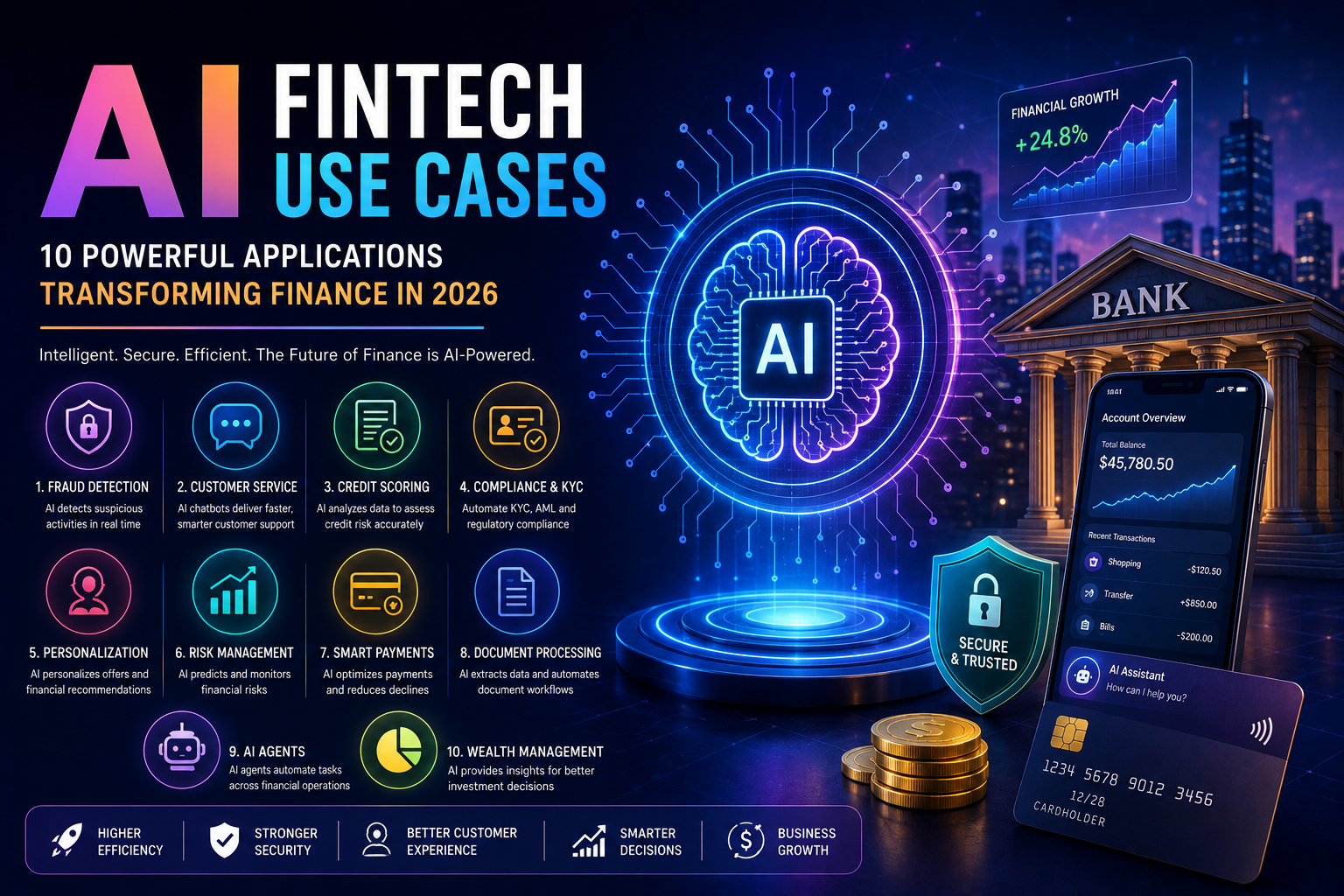
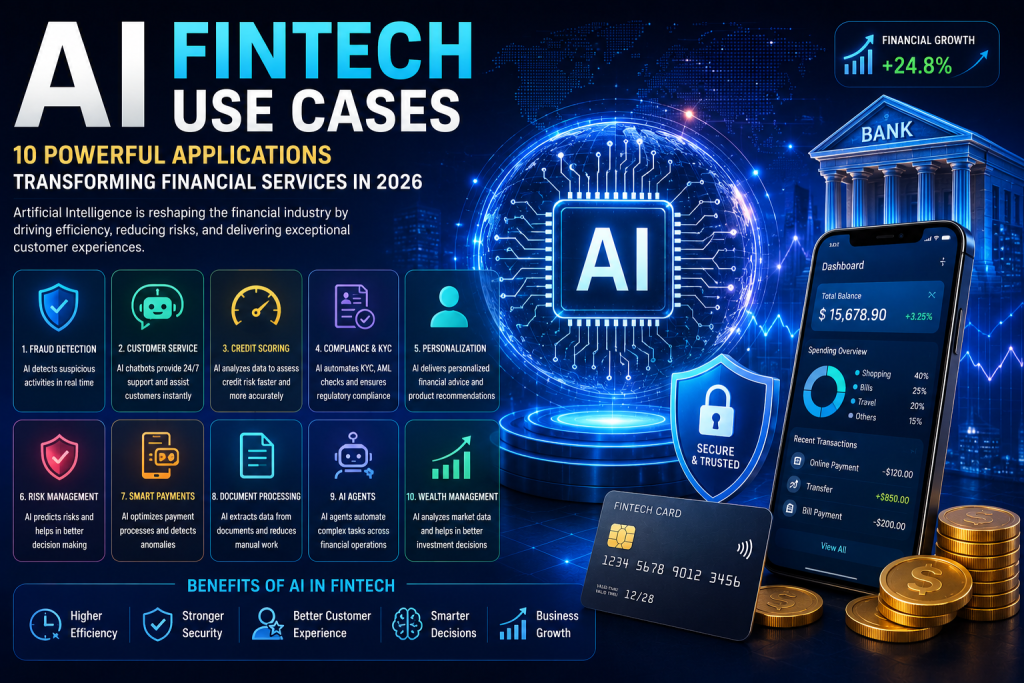
    A futuristic AI FinTech Use Cases infographic illustrating how artificial intelligence is transforming financial services in 2026. The design features a glowing AI chip and digital brain, a modern bank, smartphone banking dashboard, secure payment card, financial growth chart, security shield, and digital finance elements. It highlights fraud detection, AI customer service, credit scoring, compliance and KYC, personalization, risk management, smart payments, document processing, AI agents, and wealth management. The professional blue, cyan, purple, green, and gold color theme represents innovation, security, efficiency, smarter financial decisions, and business growth.

    Benefits of AI in FinTech

    The growing adoption of AI FinTech Use Cases is driven by several potential benefits:

    • Faster financial processes
    • Reduced manual workloads
    • Improved fraud detection
    • More personalized customer experiences
    • Faster risk analysis
    • Automated document processing
    • Better operational efficiency
    • More responsive customer support
    • Improved data analysis
    • Scalable digital services

    At the same time, successful implementation depends on high-quality data, system integration, cybersecurity, governance, and responsible AI practices. Current industry research indicates that organizations often face challenges moving from AI experiments to large-scale deployment.

    Challenges of AI FinTech Use Cases

    AI adoption also creates important challenges. Poor-quality data can produce unreliable results, while biased historical information can influence model outcomes. Complex models may also be difficult to explain.

    Cybersecurity is another concern because attackers can target AI systems, data pipelines, APIs, and connected applications. Organizations should therefore use access controls, continuous monitoring, model testing, privacy protections, and human review.

    Financial companies also need to consider regulatory requirements when AI affects lending, fraud investigations, customer decisions, or other high-impact financial processes.

    The Future of AI FinTech Use Cases

    The future of AI FinTech Use Cases will likely involve deeper integration between AI agents, real-time analytics, financial platforms, and automated workflows.

    In 2026, the focus is shifting from simply experimenting with AI toward deploying it in practical business processes. Research from the Cambridge Centre for Alternative Finance shows that internal process automation, data management, customer support, fraud detection, and credit-risk modeling are already among the leading areas of financial AI adoption.

    The biggest opportunity may not be replacing financial professionals. Instead, AI can augment employees by handling repetitive analysis, identifying patterns, summarizing information, and prioritizing work.

    Conclusion

    AI FinTech Use Cases are transforming how financial companies operate and serve customers in 2026. From fraud detection and AI underwriting to customer service, compliance, payments, risk management, and investment analysis, artificial intelligence is becoming part of the modern financial technology ecosystem.

    The most successful organizations will combine AI capabilities with strong data foundations, cybersecurity, human oversight, transparent governance, and responsible implementation. As the technology continues to mature, practical AI applications can help financial companies become faster, more efficient, and more responsive while maintaining customer trust.

  • AI FinTech Security: Powerful Ways AI Protects Digital Finance in 2026

    AI FinTech Security: Powerful Ways AI Protects Digital Finance in 2026

    AI FinTech Security: Powerful Ways AI Protects Digital Finance in 2026

    Financial services are becoming more connected, automated, and digital. As banks, fintech companies, payment platforms, and financial technology providers process enormous amounts of data, cybersecurity has become a core business priority. AI FinTech Security is emerging as a powerful approach for detecting threats, monitoring transactions, protecting customer accounts, and responding to cyber incidents faster.

    In 2026, the challenge is more complex because artificial intelligence can strengthen cyber defenses while also giving attackers new capabilities. The Office of the Comptroller of the Currency has highlighted sophisticated cyber threats and fraud as ongoing concerns for banks and noted the importance of understanding both the benefits and risks of advanced AI cybersecurity tools.

    What Is AI FinTech Security?

    AI FinTech Security combines artificial intelligence, machine learning, behavioral analytics, automation, and cybersecurity controls to protect financial systems and digital transactions. Instead of relying only on static rules, AI-powered security systems can analyze large volumes of activity and identify patterns associated with suspicious behavior.

    For example, a security platform can evaluate login behavior, device signals, transaction patterns, authentication attempts, and network activity. When activity differs significantly from normal behavior, the system can generate an alert or trigger additional security checks.

    Why AI FinTech Security Matters in 2026

    AI FinTech Security matters because financial organizations are attractive targets for cybercriminals. Banks and fintech platforms manage sensitive information, payment credentials, financial accounts, and valuable digital assets.

    The OCC’s Spring 2026 risk assessment states that cyber threats and fraud remain concerns for the federal banking system and that cybercriminal groups targeting financial institutions are becoming increasingly sophisticated.

    Artificial intelligence can help security teams analyze threats at a scale that would be difficult to achieve through manual review alone. However, automation should complement experienced security professionals rather than eliminate human oversight.

    How AI Detects Financial Cyber Threats

    A major strength of AI FinTech Security is continuous analysis. Machine learning models can examine large volumes of activity and identify unusual patterns.

    Behavioral Analytics

    Behavioral analytics establishes a baseline for normal activity. If an account normally logs in from one device and suddenly shows unusual access behavior, an AI system can assign a higher risk level for investigation.

    Anomaly Detection

    AI-powered anomaly detection looks for activity that does not fit established patterns. This can help identify unusual payment behavior, account takeovers, suspicious logins, and other potential threats.

    Real-Time Monitoring

    Real-time monitoring allows security teams to evaluate activity as it occurs. This is particularly useful for digital payments, online banking, and high-volume financial platforms where a delayed response can increase potential losses.

    Identity and Access Protection

    AI can support identity verification and access control by analyzing authentication patterns and device information. When risk signals increase, systems can require stronger authentication before allowing access.

    AI FinTech Security and Fraud Prevention

    Fraud prevention is closely connected to cybersecurity. AI FinTech Security can analyze transaction behavior and identify potentially suspicious activity before or during a transaction.

    A modern fraud detection system may consider transaction amount, frequency, location-related signals, device characteristics, account history, and other indicators. Instead of treating every transaction equally, risk-based systems can prioritize unusual activity for additional review.

    This approach can improve customer protection while reducing unnecessary friction for legitimate users.

    Protecting AI Systems Themselves

    AI FinTech Security is not only about using AI to defend financial networks. Financial institutions must also secure the AI systems they deploy.

    NIST’s 2026 research on AI agent security notes that AI agents introduce novel security threats and that traditional cybersecurity practices may need to be adapted. NIST also emphasizes appropriate identity and authorization controls for AI agents that interact with data, tools, and applications.

    Organizations should protect training data, model inputs, outputs, APIs, credentials, and connected systems. Access should follow least-privilege principles so an AI system receives only the permissions it actually needs.

    Key Benefits of AI FinTech Security

    AI FinTech Security can provide several important benefits:

    • Faster threat detection: AI can process large amounts of activity quickly.
    • Continuous monitoring: Automated systems can operate around the clock.
    • Better threat prioritization: AI can help security teams focus on higher-risk events.
    • Reduced manual workload: Routine analysis can be automated.
    • Adaptive protection: Machine learning systems can respond to changing patterns.
    • Improved response: Automated workflows can trigger alerts and predefined actions faster.
    A premium AI FinTech Security illustration showcasing how artificial intelligence protects modern financial services in 2026. The image features a glowing AI-powered shield and lock, digital banking technology, a secure smartphone transaction, credit card, and financial security interface. It highlights AI-powered threat detection, fraud prevention, identity and access protection, real-time monitoring, data privacy, encryption, cloud security, risk analysis, compliance, and automated response. The green and gold theme creates a professional, trustworthy, and sophisticated fintech appearance, representing a safer and smarter future for digital finance.

    Challenges and Risks

    Despite its advantages, AI FinTech Security also creates new risks. AI models can produce false positives, miss previously unseen attacks, or generate inaccurate conclusions when data quality is poor.

    Attackers can also target AI systems through techniques such as prompt injection, data poisoning, model manipulation, credential theft, and abuse of connected tools.

    NIST explains that AI security concerns can involve confidentiality, integrity, availability, training data, output data, and the underlying software and hardware supporting AI systems.

    For this reason, financial organizations need continuous monitoring, model testing, access controls, incident-response procedures, and strong governance.

    Best Practices for Financial Organizations

    A strong AI FinTech Security strategy should combine artificial intelligence with established cybersecurity practices.

    Organizations should:

    • Maintain strong identity and access management.
    • Encrypt sensitive information.
    • Monitor AI systems and connected applications continuously.
    • Test models for accuracy and security weaknesses.
    • Keep software and dependencies updated.
    • Establish human review for high-impact decisions.
    • Maintain incident-response and recovery plans.
    • Limit AI permissions using least-privilege access.
    • Regularly assess third-party AI and cloud providers.

    NIST’s Cybersecurity Framework 2.0 provides a structured approach for managing cybersecurity risk, while the AI Risk Management Framework helps organizations address risks associated with artificial intelligence.

    The Future of AI FinTech Security

    The future of AI FinTech Security will likely involve greater use of AI agents, automated security operations, behavioral analytics, real-time fraud detection, and integrated identity protection.

    NIST launched its AI Agent Standards Initiative in February 2026 to support secure and interoperable adoption of AI agents. The initiative focuses on helping organizations use increasingly autonomous systems with appropriate security and standards.

    For financial organizations, this development is important because autonomous systems may eventually interact with customer data, payment platforms, accounts, and internal applications.

    The strongest security strategies will not rely on AI alone. They will combine advanced technology with skilled security teams, strong governance, continuous monitoring, and clear authorization controls.

    Conclusion

    AI FinTech Security is becoming an essential part of modern financial cybersecurity. Artificial intelligence can help organizations detect suspicious activity, analyze threats, protect identities, and respond to incidents more efficiently.

    At the same time, financial institutions must secure the AI systems they deploy and understand the new risks created by increasingly autonomous technology.

    In 2026, the most effective approach is a balanced one: use AI to improve speed and scale while maintaining strong cybersecurity fundamentals, human oversight, risk management, and continuous testing. This combination can help financial organizations build more resilient digital services and protect customers in an increasingly complex threat environment.

  • AI Investment Tools: How Artificial Intelligence Is Transforming Investing in 2026

    AI Investment Tools: How Artificial Intelligence Is Transforming Investing in 2026

    AI Investment Tools: How Artificial Intelligence Is Transforming Investing in 2026

    Investing has become increasingly digital, data-driven, and accessible. In 2026, investors can use artificial intelligence to research companies, analyze market information, build portfolios, monitor risk, and automate parts of their investment process. AI Investment Tools are becoming useful for both beginners and experienced investors who want faster access to financial insights.

    For American investors, these technologies can be particularly useful for researching stocks, ETFs, retirement portfolios, and other financial products. However, AI should be viewed as a research and decision-support technology—not a guarantee of investment success.

    What Are AI Investment Tools?

    AI Investment Tools are software platforms that use artificial intelligence, machine learning, natural-language processing, or related technologies to assist with investing and financial research. Depending on the platform, these tools may summarize financial information, identify market trends, compare securities, analyze portfolios, generate research reports, or provide automated investing features.

    Some tools are designed for education and research, while others connect to investment accounts or provide portfolio-management services. The SEC explains that robo-advisers use computer algorithms to provide online investment advisory services, and investors should consider factors such as fees, the information used, investment approach, and level of human interaction.

    How AI Investment Tools Work

    Modern AI Investment Tools process large amounts of financial information much faster than a person could manually review. A platform might analyze company filings, earnings information, historical price data, economic indicators, portfolio allocations, and other permitted data sources.

    Machine learning can identify patterns in historical information, while natural-language processing can help organize and summarize financial documents. Generative AI can also turn complex financial information into easier-to-understand explanations.

    However, speed does not guarantee accuracy. Investors should treat AI-generated information as a research aid rather than automatically assuming that every recommendation is correct.

    Key Benefits of AI Investment Tools

    One of the biggest benefits of AI Investment Tools is efficiency. Investors can spend less time collecting information and more time evaluating whether an investment fits their goals.

    1. Faster Investment Research

    AI can quickly summarize financial documents, compare companies, organize market information, and highlight potentially relevant data. This can make investment research more efficient, particularly when an investor needs to examine multiple companies or industries.

    2. Portfolio Analysis

    Some platforms can examine asset allocation, diversification, historical performance, and potential risk. These insights can help investors understand how different holdings interact within a portfolio.

    3. Personalized Financial Insights

    AI can analyze information supplied by an investor and produce personalized educational insights based on goals, risk preferences, and time horizons. However, personalization should not be confused with guaranteed investment advice or returns.

    4. Automation

    Robo-advisory platforms can automate parts of portfolio construction and management. This can make investing more convenient, particularly for people who prefer a structured, automated approach.

    A futuristic AI Investment Tools illustration showing how artificial intelligence is transforming modern investing. The image features an AI-powered investment dashboard with portfolio performance, asset allocation, top holdings, risk analysis, and market sentiment, alongside a smartphone displaying AI stock analysis. The blue and teal technology theme represents AI-powered analytics, smart portfolio management, risk management, automated investing, real-time market analysis, and data-driven investment decisions in 2026.

    AI Investment Tools for Stock Research

    For investors researching individual stocks, AI Investment Tools can help organize information about companies, industries, financial performance, and market developments.

    An AI research assistant may summarize an earnings report, explain financial terminology, compare business metrics, or help generate questions for further research. These capabilities can be especially helpful when investors need to review large quantities of information.

    Still, investors should verify important claims against original company filings and reliable financial sources before making decisions.

    AI Investment Tools for Portfolio Management

    Portfolio management is another major use case for AI Investment Tools. Some platforms can evaluate diversification, asset allocation, portfolio risk, and investment objectives.

    Automated investment platforms may also rebalance portfolios according to predetermined strategies. The appropriate approach depends on the investor’s objectives, time horizon, financial circumstances, and risk tolerance.

    For retirement investors, AI-assisted analysis can also help organize information about accounts such as 401(k) plans and IRAs, although investors should understand the limitations and fees of any technology they use.

    Risks and Limitations

    Although AI Investment Tools can make investing more efficient, they also introduce risks.

    AI systems can produce inaccurate information, misunderstand financial context, rely on incomplete data, or generate confident-sounding conclusions that are wrong. Investors should therefore verify important information independently.

    There is also a growing risk of AI-related investment scams. FINRA warned in 2026 that criminals are using deepfakes and voice phishing to make fraudulent investment communications appear more convincing.

    FINRA has also warned about unregistered automated trading services that claim to use AI and sometimes promote unrealistic or risk-free returns.

    How to Choose AI Investment Tools

    When evaluating AI Investment Tools, investors should look beyond flashy AI features.

    Consider:

    • Transparency: Does the platform explain how its recommendations or analysis work?
    • Fees: Understand subscription, management, trading, and other charges.
    • Security: Review account protection, privacy practices, and authentication options.
    • Regulatory status: Check whether an investment adviser, broker, or platform is appropriately registered.
    • Human support: Determine whether qualified human assistance is available when needed.
    • Data quality: Find out what information the system uses and how frequently it is updated.

    The SEC recommends that investors research investment professionals and firms through its Investment Adviser Public Disclosure resources before relying on investment recommendations.

    AI Investment Tools and the Future of Investing

    The role of AI Investment Tools is likely to expand as financial technology becomes more sophisticated. Future platforms may combine portfolio analysis, financial education, document analysis, risk monitoring, and personalized planning in a single experience.

    Generative AI and AI agents could also make financial interfaces more conversational. Instead of searching through multiple dashboards, an investor might ask questions in natural language and receive explanations based on available account or market information.

    At the same time, investors should remain cautious about claims that AI can predict markets with certainty. No technology can remove investment risk, and past performance does not guarantee future results.

    Best Practices for Investors

    Using AI Investment Tools responsibly means combining technology with independent judgment. Investors should verify important information, understand the risks of each investment, review fees, and avoid platforms that promise guaranteed profits.

    Before using an automated investment service, understand its investment strategy and the role of human oversight. A technology-driven approach can be useful, but it should support—not replace—sound financial decision-making.

    Conclusion

    AI Investment Tools are changing how investors research, analyze, and manage investments in 2026. They can improve efficiency, simplify complex information, support portfolio analysis, and automate selected investment tasks.

    The most effective use of these tools is not to blindly follow AI-generated recommendations. Instead, investors can use AI to accelerate research while verifying important information through reliable sources and maintaining control over their financial decisions.

    As AI continues to evolve, investors who understand both its capabilities and limitations will be better prepared to use technology responsibly in a rapidly changing financial environment.

  • AI Credit Scoring: How Artificial Intelligence Is Transforming Lending in 2026

    AI Credit Scoring: How Artificial Intelligence Is Transforming Lending in 2026

    AI Credit Scoring: How Artificial Intelligence Is Transforming Lending in 2026

    The lending industry is changing rapidly as banks, fintech companies, and digital lenders adopt artificial intelligence to evaluate credit risk. AI Credit Scoring is becoming an important part of modern lending because it can analyze large amounts of financial information, identify patterns, and support faster credit decisions.

    In 2026, American lenders are increasingly focused on combining automation with responsible lending. Instead of relying only on traditional credit scores, advanced models can help lenders evaluate broader financial signals while improving the speed and efficiency of underwriting.

    What Is AI Credit Scoring?

    AI Credit Scoring uses artificial intelligence and machine learning to assess the likelihood that a borrower will repay a loan. Traditional scoring models generally depend on established credit-report information and predefined statistical methods. AI-powered credit models can analyze additional structured data, identify complex relationships, and update risk assessments as new information becomes available.

    The objective is not simply to replace a traditional credit score. Instead, artificial intelligence can support credit risk assessment by giving lenders additional insights into an applicant’s financial profile.

    How AI Credit Scoring Works

    AI Credit Scoring typically combines data collection, machine learning models, risk analysis, and decision-support systems.

    A lender may provide a model with information such as payment history, outstanding debt, income-related information, loan characteristics, and other legally permissible data. The model analyzes relationships within the data and produces a risk estimate that can support underwriting.

    Machine learning credit scoring can identify patterns that traditional rule-based systems may not capture. For example, an algorithm can evaluate many variables simultaneously and detect relationships between repayment behavior and financial risk.

    However, lenders need strong controls around data quality, model validation, monitoring, and human oversight.

    Benefits of AI Credit Scoring for Lenders

    One of the biggest advantages of AI Credit Scoring is speed. Automated models can process large volumes of applications quickly, helping lenders reduce manual work and shorten underwriting timelines.

    AI can also improve consistency by applying the same analytical process across applications. For lenders handling thousands of applications, this can streamline operations and allow employees to focus on more complex cases.

    Another advantage is improved credit risk assessment. AI models can evaluate multiple variables simultaneously, potentially helping lenders identify applicants who may have been difficult to evaluate using limited traditional data.

    For fintech companies, automated credit decisioning can also reduce operational costs and create faster digital lending experiences.

    AI Credit Scoring and Financial Inclusion

    Another important application of AI Credit Scoring is expanding access to credit. Some consumers have limited traditional credit histories, including younger borrowers and people who have had fewer opportunities to use conventional financial products.

    Alternative credit scoring models may evaluate additional financial information to create a broader view of creditworthiness. When used responsibly, this approach may help lenders consider applicants who could otherwise receive limited access to financial products.

    However, broader data does not automatically mean fairer decisions. Lenders must carefully evaluate whether alternative data creates unintended disadvantages for particular groups.

    Fairness, Explainability, and Regulation

    AI Credit Scoring introduces important compliance considerations because credit decisions can affect access to mortgages, personal loans, credit cards, and other financial products.

    The Consumer Financial Protection Bureau says creditors using complex algorithms must still comply with adverse-action requirements. When credit is denied or terms are changed, applicants generally must receive specific and accurate reasons for the action; using a complex or “black-box” model does not remove that responsibility.

    In April 2026, the CFPB issued a final rule amending provisions of Regulation B under the Equal Credit Opportunity Act. Lenders should monitor applicable requirements and obtain appropriate legal and compliance guidance when deploying automated credit decisioning.

    Challenges of AI Credit Scoring

    Despite its potential, AI Credit Scoring is not risk-free. Poor-quality data can produce unreliable predictions, while historical data may contain patterns that contribute to unfair outcomes.

    Complex models can also be difficult to interpret. This makes explainability, model governance, documentation, and human review especially important for lenders.

    Model drift is another concern. Borrower behavior and economic conditions can change over time, meaning a model that performs well today may become less accurate later. Regular testing, monitoring, validation, and retraining can help organizations identify performance problems.

    AI Credit Scoring vs. Traditional Credit Scoring

    Traditional credit scoring remains an important part of lending, but AI Credit Scoring can provide additional analytical capabilities.

    Traditional systems are often easier to understand and manage, while machine learning models can identify more complex relationships across large datasets. A modern lender may therefore combine established credit information with AI-driven analysis rather than completely replacing traditional methods.

    The strongest approach can involve traditional credit scoring, machine learning, human review, and clear governance working together.

    The Future of AI Credit Scoring in 2026 and Beyond

    The future of AI Credit Scoring will likely involve more advanced machine learning, explainable AI, real-time financial data, automated underwriting, and stronger model governance.

    Generative AI may also assist with underwriting workflows by summarizing documents, organizing financial information, and helping employees review applications. However, generative AI should not automatically be treated as a substitute for validated credit-risk models. Research published in 2025 found limitations in using generative AI directly for credit-risk estimation, reinforcing the need for careful testing before deployment.

    For American banks, fintech companies, and lenders, the opportunity is significant. Faster decisions, improved operational efficiency, and better risk insights can create a stronger lending experience when technology is deployed responsibly.

    Conclusion

    AI Credit Scoring is reshaping how modern lenders evaluate credit risk. By combining machine learning, financial data, automation, and risk analytics, it can help lenders make faster and potentially more informed decisions.

    However, successful implementation requires more than sophisticated algorithms. Data quality, fairness, explainability, cybersecurity, regulatory compliance, human oversight, and continuous model monitoring are all essential.

    As lending technology evolves throughout 2026, organizations that balance innovation with responsible credit decisioning can be better positioned to build efficient, transparent, and trustworthy financial services.

  • AI Fraud Detection: How Artificial Intelligence Is Preventing Financial Fraud in 2026

    AI Fraud Detection: How Artificial Intelligence Is Preventing Financial Fraud in 2026

    AI Fraud Detection: How Artificial Intelligence Is Preventing Financial Fraud in 2026

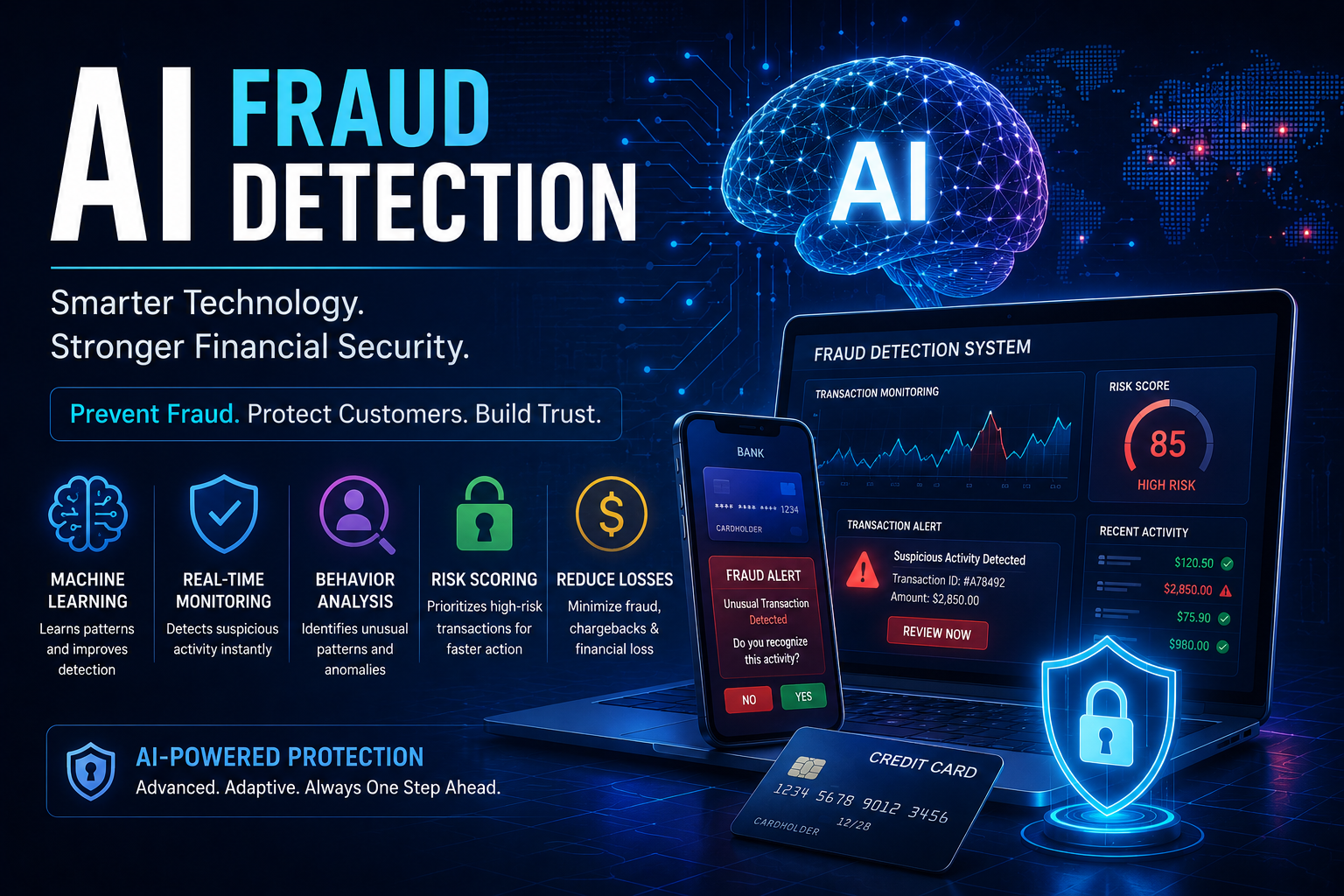
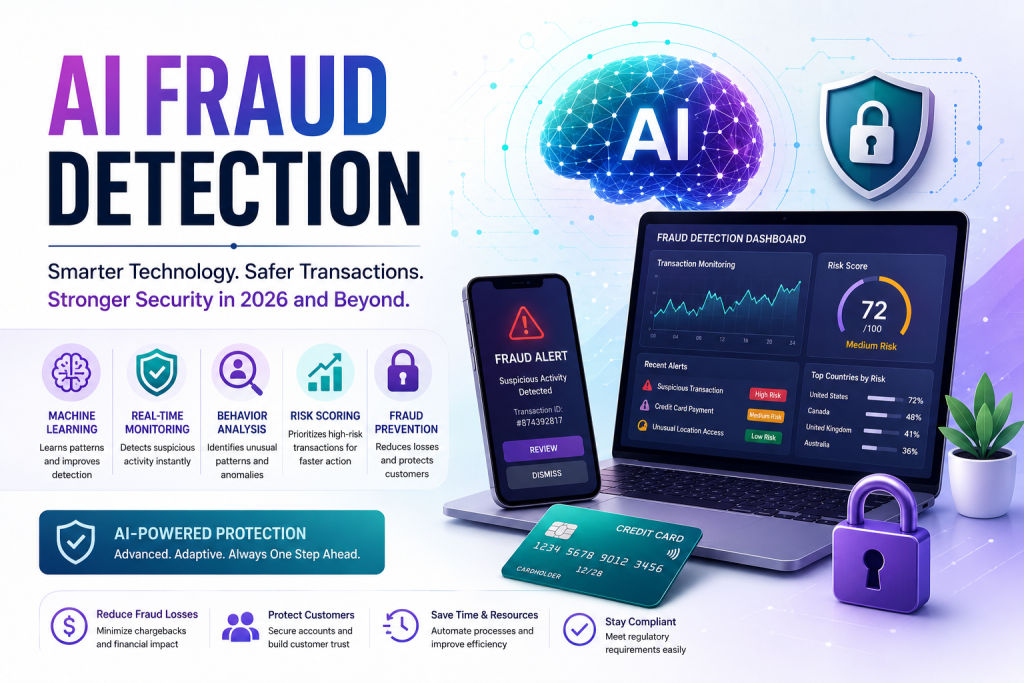
    Financial fraud is becoming more sophisticated as criminals use automation, social engineering, stolen credentials, and increasingly convincing digital scams. At the same time, financial institutions are using artificial intelligence to identify suspicious activity faster and protect customers. AI Fraud Detection has therefore become an important technology for banks, fintech companies, payment providers, insurers, and other financial organizations.

    In 2026, fraud prevention is no longer only about reviewing transactions after something goes wrong. Modern systems can analyze patterns in real time, identify unusual behavior, and help security teams respond before suspicious activity causes significant losses.

    What Is AI Fraud Detection?

    AI Fraud Detection uses artificial intelligence and machine learning to identify potentially fraudulent financial activity. Instead of relying entirely on fixed rules, AI systems can analyze large volumes of transactions and recognize patterns that may indicate fraud.

    For example, a system can evaluate transaction amount, location, device information, transaction frequency, account behavior, and other signals. When several unusual signals appear together, the system can assign a risk score or send the transaction for additional review.

    This approach can be particularly valuable because fraud patterns constantly change.

    Why Financial Fraud Prevention Matters in 2026

    The need for stronger fraud prevention continues to grow. Federal Reserve research published in 2026 reported that two in 10 adults surveyed experienced financial fraud or scams involving their money, with credit card fraud among the reported categories.

    The Office of the Comptroller of the Currency also identified increasingly sophisticated fraud and scams as an ongoing concern for the banking sector.

    These developments make AI Fraud Detection increasingly relevant for organizations looking to strengthen financial security without creating unnecessary friction for legitimate customers.

    How AI Detects Suspicious Transactions

    One of the biggest advantages of AI Fraud Detection is its ability to examine multiple signals simultaneously.

    Behavioral Analysis

    Machine learning models can learn normal customer behavior and identify deviations. If an account suddenly performs transactions that are significantly different from its usual activity, the system can assign a higher risk score.

    Real-Time Transaction Monitoring

    Traditional fraud reviews may happen after transactions are completed. AI-powered transaction monitoring can evaluate activity as it happens, helping organizations identify suspicious payments more quickly.

    Anomaly Detection

    AI can detect unusual patterns that may not match predefined rules. This is important because criminals frequently change their methods to avoid conventional fraud detection systems.

    Device and Identity Analysis

    Modern financial security systems can also evaluate device information, login behavior, IP-related signals, authentication patterns, and other indicators to determine whether an interaction appears legitimate.

    AI Fraud Detection for Banks and FinTech Companies

    For banks and fintech platforms, AI Fraud Detection can support several areas of financial security.

    Payment providers can use machine learning fraud detection to analyze card payments and digital transactions. Banks can monitor account activity for suspicious behavior. Lending platforms can evaluate applications for potentially fraudulent information, while insurance companies can analyze claims for unusual patterns.

    AI can also support anti-money-laundering monitoring by helping analysts prioritize potentially suspicious activity for further investigation.

    In June 2026, FinCEN issued updated guidance clarifying how financial institutions can share information about suspected fraud under Section 314(b), reinforcing the importance of collaboration in identifying financial crime.

    Benefits of AI Fraud Detection

    The advantages of AI Fraud Detection go beyond simply identifying suspicious transactions.

    Faster detection: AI can analyze transactions in milliseconds and identify potential risks quickly.

    Better scalability: Automated systems can review enormous transaction volumes without requiring humans to examine every transaction manually.

    Improved accuracy: Machine learning can identify complex patterns that may be difficult to capture using basic rules.

    Reduced operational workload: Security analysts can focus their attention on higher-risk cases instead of reviewing every transaction equally.

    Adaptive protection: Models can be updated as new fraud patterns emerge.

    Together, these capabilities can make fraud prevention more proactive and responsive.

    AI Fraud Detection and Customer Experience

    Security is important, but financial institutions also need to avoid blocking legitimate customers unnecessarily. AI Fraud Detection can help organizations create more risk-sensitive security processes.

    For example, a low-risk transaction may proceed normally, while an unusual transaction may trigger additional authentication. This approach can reduce unnecessary interruptions while still providing stronger protection for potentially risky activity.

    The objective should be to balance security with convenience rather than treating every unusual transaction as confirmed fraud.

    Challenges and Risks

    Although AI Fraud Detection offers significant benefits, it is not perfect.

    AI models can produce false positives, incorrectly flagging legitimate transactions. They can also miss new forms of fraud if the available training data does not adequately represent emerging threats.

    Privacy, cybersecurity, model governance, explainability, and data quality are also important considerations. Financial institutions should establish appropriate monitoring and human-review processes rather than relying blindly on automated decisions.

    In April 2026, federal banking agencies issued updated model risk management guidance emphasizing risk-based and proportionate practices for institutions using models.

    The Future of AI Fraud Detection

    The future of AI Fraud Detection will likely involve more advanced machine learning, behavioral analytics, real-time monitoring, generative AI, and intelligent security agents.

    Financial institutions may increasingly connect fraud monitoring with identity verification, cybersecurity systems, payment platforms, and customer authentication tools.

    At the same time, criminals are also adopting AI to create more convincing scams. FinCEN has highlighted threats including deepfake-related fraud schemes targeting financial institutions, showing why security technology must continue evolving.

    Conclusion

    AI Fraud Detection is becoming a critical component of modern financial security. By combining machine learning, behavioral analysis, anomaly detection, and real-time transaction monitoring, financial organizations can identify suspicious activity faster and improve fraud prevention.

    For banks, fintech companies, payment providers, and insurers, the strongest strategy is not to rely on AI alone. Combining intelligent technology with skilled analysts, strong cybersecurity, effective governance, and appropriate regulatory controls can create a more resilient financial ecosystem.

    As fraud continues to evolve in 2026 and beyond, AI Fraud Detection will play an increasingly important role in protecting financial transactions, customer accounts, and digital financial services.

  • How AI Is Changing FinTech: A Complete Guide for 2026

    How AI Is Changing FinTech: A Complete Guide for 2026

    How AI Is Changing FinTech: A Complete Guide for 2026

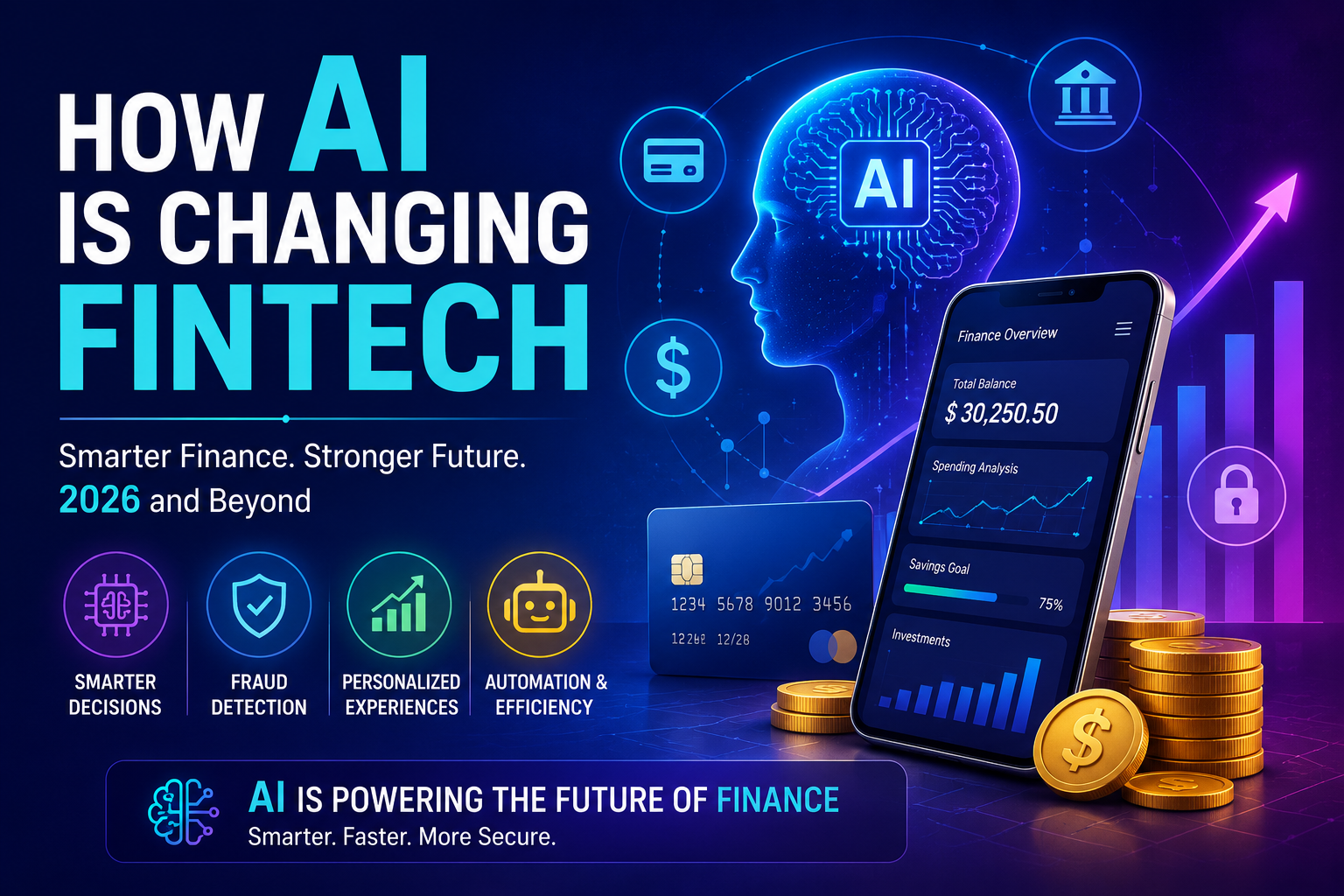
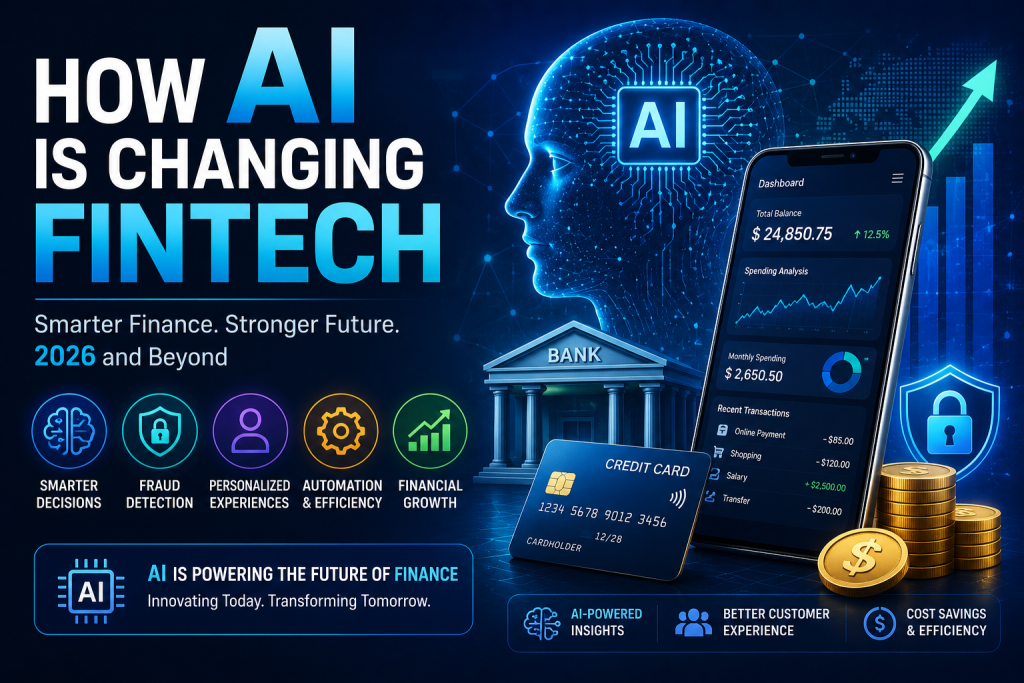
    Artificial intelligence is moving from experimental technology into everyday financial services. How AI Is Changing FinTech is now a key question for U.S. banks, fintech startups, payment companies, lenders, and consumers.

    What Is AI in FinTech?

    How AI Is Changing FinTech starts with understanding how artificial intelligence is used across financial technology. AI can analyze large amounts of financial data, recognize patterns, automate repetitive tasks, and generate insights. Machine learning, natural language processing, generative AI, and agentic AI are increasingly used in banking, payments, lending, insurance, wealth management, and customer service.

    McKinsey’s 2026 fintech research describes AI as a major force shaping the next phase of fintech, helping companies build products faster, serve new customer segments, and improve operating models.

    1. AI Is Improving Customer Service

    One of the clearest examples of How AI Is Changing FinTech is customer support. AI-powered chatbots and virtual assistants can answer common questions, explain transactions, provide general account assistance, and guide customers through financial services.

    For U.S. financial companies, this can mean faster responses and lower pressure on customer service teams. AI assistants can handle routine requests while human representatives focus on more complex customer issues.

    2. Smarter Fraud Detection

    Financial fraud remains a major challenge for banks and fintech companies. How AI Is Changing FinTech is especially important as institutions modernize fraud monitoring.

    AI-powered systems can analyze transactions and identify unusual patterns much faster than traditional manual processes. This can help financial institutions detect suspicious activity and protect customers. However, criminals are also using AI for sophisticated phishing and deepfakes, making continuous security improvements essential.

    3. AI Is Transforming Lending

    Another important example of How AI Is Changing FinTech is lending. AI can help lenders process applications, analyze financial information, identify risk patterns, and streamline underwriting workflows.

    Lenders must still consider fairness, transparency, explainability, privacy, and regulatory requirements when AI influences credit decisions. PwC’s 2026 research found that AI is already influencing how borrowers research loans, while many consumers still want human involvement in important lending decisions.

    4. Personalized Financial Services

    How AI Is Changing FinTech also includes personalization. AI can tailor financial services around spending behavior, financial goals, risk preferences, and individual needs.

    AI-powered financial assistants can help users create budgets, identify recurring expenses, compare products, or organize financial information. Human oversight remains important when recommendations could significantly affect a person’s finances.

    5. Faster Financial Operations

    How AI Is Changing FinTech is also visible behind the scenes. Financial companies can use AI to automate document processing, customer onboarding, compliance workflows, reconciliation, reporting, and internal support.

    Agentic AI is an emerging development. Instead of simply answering a question, an AI agent can potentially complete multiple workflow steps under defined permissions and controls. Financial institutions are exploring these systems to improve efficiency, but governance and human oversight remain essential.

    Benefits for U.S. FinTech Companies

    How AI Is Changing FinTech creates several potential advantages for U.S. businesses. AI can reduce repetitive work, improve response times, support personalization, strengthen fraud monitoring, and help companies use data more effectively.

    McKinsey reports that AI-enabled fintech companies are using the technology to accelerate product development and reshape operating models.

    Challenges and Risks

    Despite its benefits, How AI Is Changing FinTech is not only a story of automation. Financial companies must address cybersecurity, data privacy, model risk, bias, inaccurate AI outputs, regulatory compliance, and customer trust.

    Financial institutions should establish strong governance, secure data practices, testing procedures, monitoring systems, and human escalation processes before deploying AI at scale.

    The Future of AI in FinTech

    The future of How AI Is Changing FinTech will likely involve deeper connections between AI agents, banking platforms, payment systems, lending applications, and personal finance tools.

    For U.S. fintech companies, successful AI adoption will require more than technology. Companies that combine AI innovation with responsible governance, security, compliance, and customer trust may be better positioned for the next era of financial technology.

    Conclusion

    How AI Is Changing FinTech is already visible across customer service, fraud detection, lending, personalization, payments, and financial operations. In 2026, artificial intelligence is moving beyond basic automation toward systems capable of supporting more complex financial workflows.

    For U.S. fintech companies, the biggest opportunity is to adopt AI strategically while maintaining security, transparency, human oversight, and customer trust. Companies that balance innovation with responsible implementation may be best positioned for the future of financial technology.

  • AI Healthcare Chatbots: How AI Is Transforming Patient Care in 2026

    AI Healthcare Chatbots: How AI Is Transforming Patient Care in 2026

    AI Healthcare Chatbots: How AI Is Transforming Patient Care in 2026

    Healthcare in the United States is becoming increasingly digital, and artificial intelligence is playing a major role in changing how patients interact with healthcare providers. From answering common questions to helping patients navigate appointments, AI Healthcare Chatbots are making healthcare communication faster, more accessible, and more convenient.

    In 2026, hospitals, clinics, telehealth companies, and healthcare organizations are increasingly exploring AI-powered solutions to improve patient experiences while reducing pressure on administrative staff. But what exactly are these chatbots, and how can they benefit the U.S. healthcare industry?

    What Are AI Healthcare Chatbots?

    AI Healthcare Chatbots are software applications that use artificial intelligence, natural language processing, and machine learning to communicate with patients through text or voice. Unlike traditional chatbots that rely mainly on predefined responses, modern AI systems can understand conversational questions and provide relevant information based on the user’s request.

    For example, a patient may ask about appointment availability, medication instructions, symptoms, insurance information, or preparation for a medical test. Depending on how the chatbot is designed, it can provide general information, guide the patient to appropriate resources, or connect them with a healthcare professional.

    How AI Healthcare Chatbots Help U.S. Healthcare Providers

    The U.S. healthcare system handles millions of patient interactions every day. AI Healthcare Chatbots can help organizations manage some of these routine interactions more efficiently.

    1. 24/7 Patient Support

    Patients do not always need assistance during traditional business hours. AI Healthcare Chatbots can provide automated support around the clock, allowing patients to get answers to common questions at night, on weekends, or during holidays.

    This can be particularly useful for healthcare organizations that receive a high volume of repetitive questions.

    2. Appointment Scheduling

    Scheduling appointments can take valuable time for both patients and administrative teams. AI Healthcare Chatbots can assist users with finding available appointment times, collecting basic information, and directing them to the appropriate scheduling system.

    This can create a smoother digital experience while reducing the workload associated with routine scheduling requests.

    3. Patient Education

    Healthcare information can sometimes be difficult for patients to understand. AI Healthcare Chatbots can explain general health information in simpler language and direct users toward trusted healthcare resources.

    However, chatbots should not replace qualified medical professionals when patients require diagnosis, treatment decisions, or emergency care.

    4. Symptom Guidance

    Some AI Healthcare Chatbots can help users understand what type of healthcare service may be appropriate based on symptoms they describe. For example, a chatbot might recommend contacting a primary care provider, visiting an urgent care facility, or seeking emergency assistance when appropriate.

    These tools should be designed with strong safety measures and clearly communicate their limitations.

    A modern healthcare technology banner featuring AI Healthcare Chatbots and their role in transforming patient care in 2026. The design uses a navy blue and teal color scheme with a smartphone displaying an AI healthcare assistant chatbot, alongside a friendly medical robot. Healthcare elements such as a stethoscope, heart/EKG icon, medical cross, and digital interface emphasize AI-powered healthcare services. The image highlights 24/7 support, smart appointment scheduling, patient engagement, secure communication, and improved efficiency, representing the future of AI-powered healthcare.

    Benefits of AI Healthcare Chatbots

    There are several potential benefits associated with implementing AI Healthcare Chatbots in healthcare organizations.

    First, they can improve accessibility by giving patients another way to interact with healthcare providers. Second, they can reduce repetitive administrative work, allowing staff to focus on more complex patient needs. Third, automated systems can provide consistent responses to frequently asked questions.

    For patients, the biggest advantage may be convenience. Instead of waiting on hold or searching through multiple pages of a healthcare website, patients can interact with an AI-powered assistant using natural language.

    Privacy and Security Considerations

    Healthcare organizations must take privacy and security seriously when implementing AI Healthcare Chatbots. Patient information can be highly sensitive, so organizations need appropriate safeguards for data collection, storage, access, and transmission.

    For U.S. healthcare providers, compliance considerations such as HIPAA can be particularly important when protected health information is involved. Organizations should carefully evaluate how an AI chatbot handles patient data and whether appropriate security controls are in place.

    The Future of AI Healthcare Chatbots in 2026 and Beyond

    The future of AI Healthcare Chatbots is likely to involve deeper integration with digital healthcare platforms, patient portals, telehealth services, and electronic health record systems.

    As AI technology becomes more capable, healthcare organizations may use chatbots for increasingly sophisticated administrative and informational tasks. However, successful implementation will depend on balancing automation with human oversight.

    The goal should not be to eliminate human interaction. Instead, AI Healthcare Chatbots can help healthcare professionals spend less time on repetitive tasks and more time providing personalized care.

    Are AI Healthcare Chatbots Right for Your Organization?

    For hospitals, clinics, telehealth companies, and other healthcare businesses, AI Healthcare Chatbots can be a valuable addition to a broader digital healthcare strategy. They can improve communication, provide faster support, and help streamline routine processes.

    However, healthcare organizations should choose solutions carefully. Security, accuracy, integration capabilities, patient experience, compliance, and human escalation options should all be considered before implementation.

    Conclusion

    AI Healthcare Chatbots are becoming an important part of the digital healthcare landscape in the United States. In 2026, these AI-powered assistants can help patients access information, manage routine interactions, and navigate healthcare services more conveniently.

    While they cannot replace doctors, nurses, or other healthcare professionals, AI Healthcare Chatbots can complement human care by handling repetitive tasks and providing patients with accessible digital support. As technology continues to evolve, healthcare providers that adopt AI responsibly may be better positioned to deliver faster, more convenient, and patient-centered experiences.