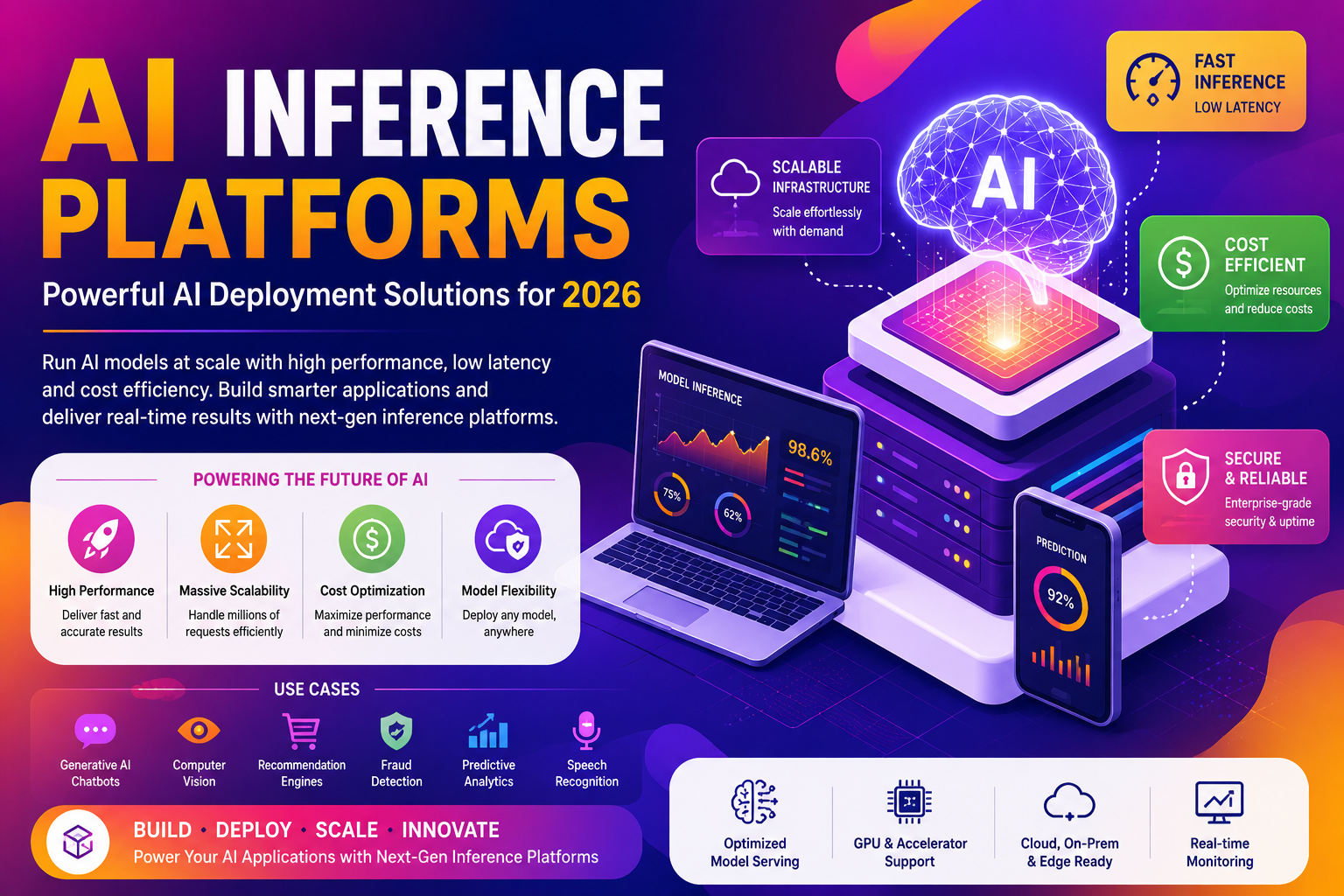
AI Inference Platforms: Powerful AI Deployment Solutions for 2026
Artificial intelligence is moving from experimentation into real-world applications across businesses, healthcare, finance, retail, manufacturing, and software. As AI models become more sophisticated, organizations need reliable infrastructure to process requests quickly and efficiently. This is where AI Inference Platforms are becoming increasingly important.
In 2026, companies are looking for AI infrastructure that can deliver fast responses, manage large workloads, reduce computing costs, and support production applications. From generative AI chatbots to recommendation engines and computer vision systems, inference infrastructure plays a critical role in turning trained AI models into useful business applications.
What Are AI Inference Platforms?
AI Inference Platforms are software and infrastructure solutions designed to run trained artificial intelligence models and generate predictions or responses from new data.
Training teaches an AI model how to recognize patterns. Inference is what happens when that trained model is used to answer a question, classify an image, generate text, detect fraud, or make a prediction.
For example, when someone enters a question into an AI chatbot, the underlying model processes that request and generates a response. The infrastructure responsible for efficiently handling that request is part of the inference ecosystem.
Why AI Inference Matters in 2026
The growth of generative AI is increasing demand for fast and scalable model deployment. Businesses cannot simply train an AI model and expect it to automatically perform efficiently in production.
They need infrastructure capable of handling:
- High volumes of AI requests
- Low-latency responses
- Large language models
- Real-time predictions
- GPU and accelerator workloads
- Data privacy requirements
- Multiple AI models
- Variable traffic levels
Modern AI Inference Platforms help organizations manage these requirements while improving the performance and reliability of AI applications.
How AI Inference Platforms Work
A typical inference workflow begins with a trained model. The model is deployed to specialized computing infrastructure, where incoming requests are processed.
Depending on the application, the platform may use GPUs, CPUs, or specialized AI accelerators. Optimization techniques such as model quantization, batching, caching, and hardware acceleration can improve performance.
When a user submits a request, the system sends the input to the deployed model. The model processes the information and produces an output. The platform then delivers that output to the application or user.
This process may happen thousands or millions of times per day for large-scale applications.
Key Benefits of AI Inference Platforms
1. Faster AI Responses
Speed is critical for applications such as AI assistants, search engines, recommendation systems, and real-time analytics. AI Inference Platforms can optimize model execution to reduce response times.
Lower latency creates a better experience for users who expect AI applications to respond almost instantly.
2. Better Scalability
AI workloads can change dramatically throughout the day. A business may experience a sudden increase in chatbot requests or application traffic.
Scalable inference infrastructure allows organizations to increase or decrease computing resources according to demand.
3. Lower AI Computing Costs
Running large models can be expensive because they often require powerful GPUs or specialized accelerators. Model optimization and efficient resource management can help reduce the cost of serving AI applications.
Businesses can select appropriate hardware and optimize models according to their performance requirements.
4. Easier Model Deployment
Deploying an AI model manually can require significant engineering work. Modern inference solutions provide tools for packaging, deploying, monitoring, and updating models.
This can help development teams move AI applications from testing to production more efficiently.
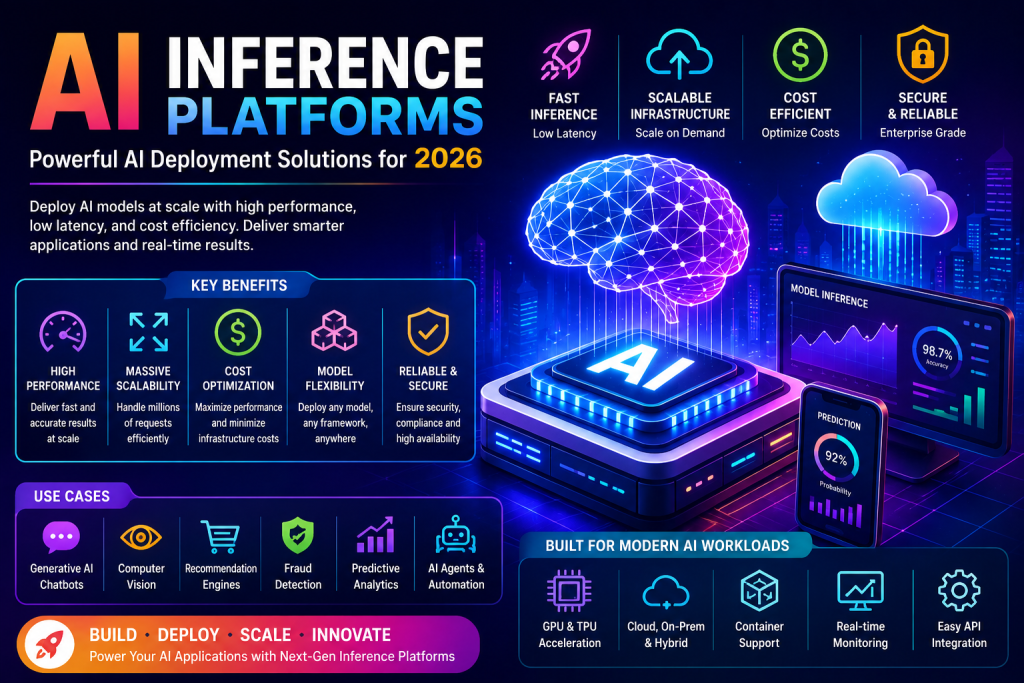
AI Inference Platforms for Generative AI
Generative AI is one of the biggest drivers of inference demand. Large language models need significant computational resources when generating text, code, images, or other content.
AI Inference Platforms can help developers serve these models efficiently by supporting techniques such as continuous batching, caching, quantization, and optimized model runtimes.
For companies building AI assistants, search tools, coding applications, and enterprise copilots, efficient inference can directly affect user experience and operating costs.
Cloud vs. On-Premise AI Inference
Organizations generally have several options for deploying AI inference infrastructure.
Cloud-based solutions provide flexibility and access to powerful computing resources without requiring companies to purchase and maintain physical hardware.
On-premise infrastructure can provide greater control over data, hardware, and networking. This may be particularly useful for organizations handling sensitive information or requiring strict infrastructure controls.
Some companies use a hybrid approach, combining cloud infrastructure with private computing environments.
AI Inference Platforms and Edge Computing
Inference does not always need to happen in a centralized cloud environment. Edge AI allows models to run closer to where data is generated.
For example, an intelligent camera can analyze video locally instead of sending every frame to a remote server. Similarly, smartphones, vehicles, industrial machines, and connected devices can perform AI inference directly on local hardware.
Edge inference can reduce latency, lower bandwidth requirements, and improve privacy for certain applications.
Important Features to Look For
When evaluating AI Inference Platforms, businesses should consider several technical and operational factors:
- Model compatibility
- GPU and accelerator support
- Low-latency inference
- Autoscaling capabilities
- Monitoring and observability
- Security controls
- Data privacy
- API integration
- Model version management
- Cost optimization
- High availability
- Deployment flexibility
The right solution depends on the model type, application requirements, expected traffic, budget, and security needs.
Challenges of AI Inference
Despite its advantages, AI inference can present technical challenges. Large models may require significant computing resources, while high traffic can increase infrastructure costs.
Latency can also become an issue when applications depend on real-time responses. Poorly optimized models may consume excessive memory or computing power.
Security is another consideration. Organizations should protect model endpoints, APIs, credentials, customer information, and infrastructure from unauthorized access.
Monitoring is equally important because model performance can change as workloads and user behavior evolve.
The Future of AI Inference Platforms
The future of AI Inference Platforms will likely focus on greater efficiency, specialized hardware, intelligent workload scheduling, and increasingly sophisticated AI applications.
As organizations deploy more AI agents and generative AI systems, inference infrastructure will become an essential part of enterprise technology stacks.
Developers will increasingly need solutions that can serve multiple models, automatically scale resources, optimize computing costs, and provide reliable performance.
The evolution of AI hardware will also influence inference. Specialized accelerators designed for AI workloads can provide improved performance and energy efficiency compared with traditional computing infrastructure.
Conclusion
AI Inference Platforms are becoming a critical foundation for deploying artificial intelligence applications at scale in 2026. They help businesses transform trained models into practical services capable of delivering predictions, recommendations, generated content, and real-time decisions.
From generative AI and enterprise assistants to edge computing and predictive analytics, efficient inference can improve application speed, scalability, reliability, and cost management.
Organizations choosing an inference solution should evaluate performance, scalability, security, model compatibility, infrastructure flexibility, and total operating costs. With the right architecture, businesses can build AI applications that are faster, more reliable, and ready for growing demand
Leave a Reply