Author: sadiqjaveria40@gmail.com

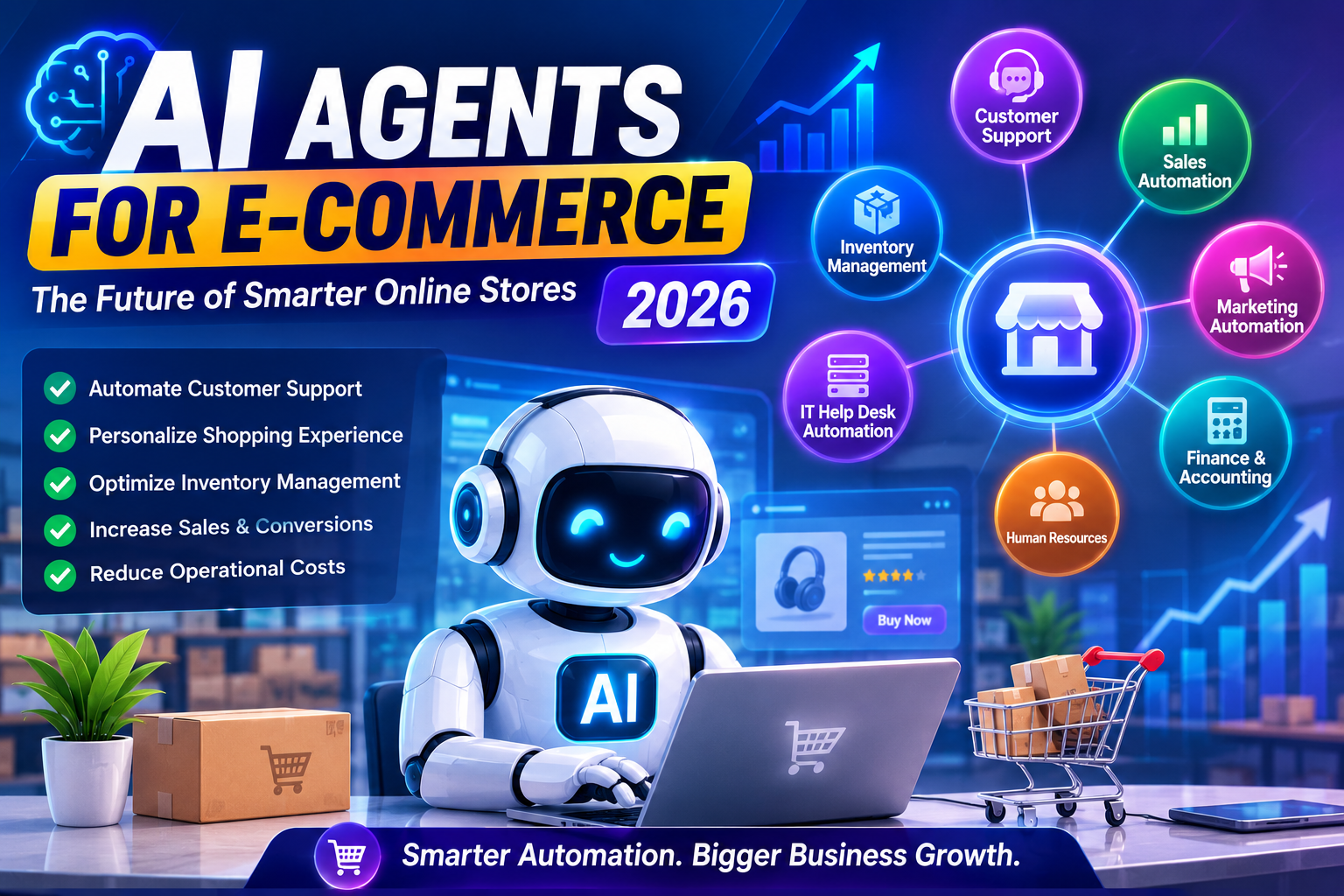
  • AI Agents for E-Commerce (2026): How AI Is Transforming Online Stores

    AI Agents for E-Commerce (2026): How AI Is Transforming Online Stores

    What Are AI Agents for E-Commerce?

    AI Agents for E-Commerce are intelligent software systems designed to automate business processes, make decisions, and perform tasks without constant human intervention. Unlike traditional chatbots, AI agents can analyze customer behavior, interact with multiple business systems, learn from previous actions, and execute complex workflows.

    They help online retailers reduce manual work while delivering faster and more personalized shopping experiences.


    Why Businesses Are Investing in AI Agents for E-Commerce

    Many U.S. businesses are adopting AI Agents for E-Commerce because they improve efficiency and customer satisfaction.

    Major benefits include:

    • 24/7 customer support
    • Faster order processing
    • Personalized shopping experiences
    • Reduced operational costs
    • Better inventory management
    • Increased conversion rates
    • Automated marketing campaigns
    • Improved business scalability

    These advantages make AI agents one of the fastest-growing technologies in online retail.


    Top AI Agents for E-Commerce Use Cases

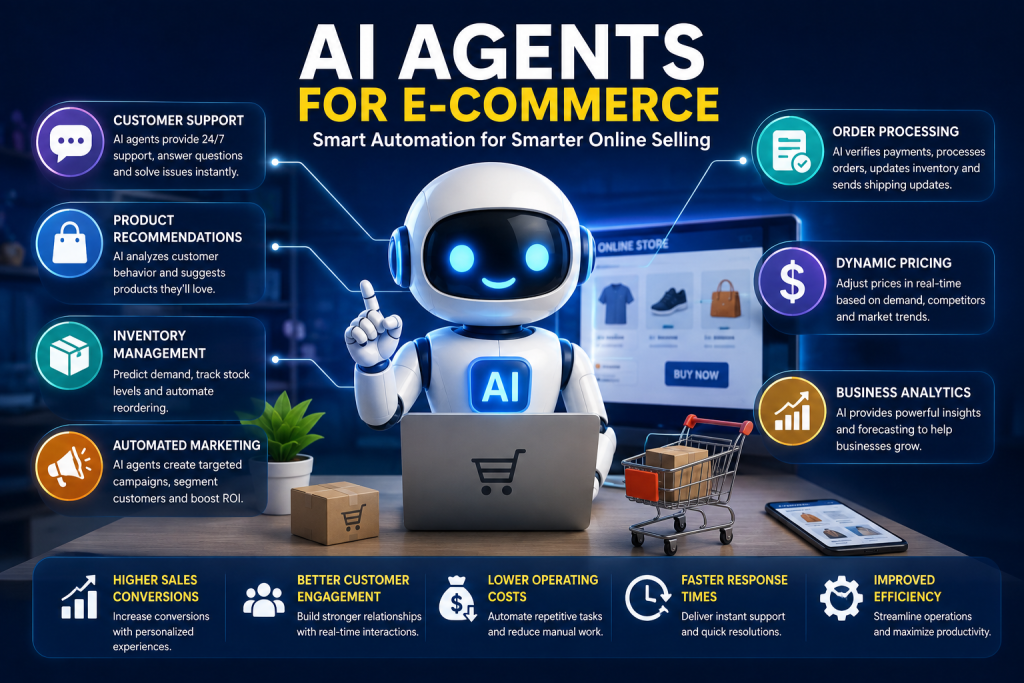
    1. Intelligent Customer Support

    One of the most valuable AI Agents for E-Commerce applications is customer service.

    AI agents can:

    • Answer customer questions
    • Track orders
    • Process returns
    • Handle refunds
    • Recommend products
    • Escalate complex issues

    Customers receive instant support at any time of day.


    2. Personalized Product Recommendations

    Modern AI agents analyze:

    • Browsing history
    • Purchase behavior
    • Customer preferences
    • Shopping patterns

    They recommend products that shoppers are most likely to purchase, increasing average order value.


    3. Inventory Management

    Inventory mistakes can cost businesses thousands of dollars.

    AI Agents for E-Commerce help retailers:

    • Predict demand
    • Monitor stock levels
    • Prevent overselling
    • Optimize warehouse operations
    • Automate reordering

    This keeps inventory accurate while reducing waste.


    4. Automated Marketing

    Marketing teams use AI Agents for E-Commerce to automate:

    • Email campaigns
    • Social media posts
    • Customer segmentation
    • Personalized promotions
    • Product recommendations
    • Advertising optimization

    These automations improve ROI while saving valuable time.


    5. Order Processing

    AI agents streamline order management by:

    • Verifying payments
    • Processing orders
    • Updating inventory
    • Sending shipping notifications
    • Detecting fraudulent transactions

    Automation reduces human errors and speeds up fulfillment.


    6. Dynamic Pricing

    Many online retailers use AI agents to adjust pricing based on:

    • Competitor prices
    • Customer demand
    • Inventory levels
    • Seasonal trends
    • Market conditions

    This helps maximize profits while remaining competitive.

    Benefits of AI Agents for E-Commerce

    Businesses implementing AI Agents for E-Commerce enjoy several measurable advantages.

    Key benefits include:

    • Higher sales conversions
    • Better customer engagement
    • Lower operating expenses
    • Faster customer response times
    • Improved shopping experiences
    • More accurate forecasting
    • Increased employee productivity
    • Better business insights

    These improvements help businesses grow more efficiently.


    Best Industries Using AI Agents for E-Commerce

    Today, AI Agents for E-Commerce are transforming multiple industries, including:

    • Fashion
    • Electronics
    • Beauty
    • Home & Kitchen
    • Grocery
    • Health & Wellness
    • Automotive Parts
    • Sports Equipment
    • Pet Supplies
    • Luxury Goods

    Retailers across these industries use AI agents to enhance customer experiences and streamline operations.


    Best Practices for Implementing AI Agents for E-Commerce

    To maximize results, businesses should:

    • Define automation goals
    • Choose scalable AI platforms
    • Integrate with CRM and ERP systems
    • Protect customer data
    • Monitor AI performance
    • Train employees
    • Continuously optimize workflows

    A strategic implementation ensures long-term success.


    Future of AI Agents for E-Commerce

    The future of AI Agents for E-Commerce looks promising. As AI technology advances, agents will become more intelligent, proactive, and capable of handling increasingly complex business operations.

    By 2026, AI agents will manage end-to-end shopping experiences, automate customer service, predict buying behavior, optimize logistics, and support personalized marketing campaigns with minimal human involvement.

    Businesses that adopt AI-powered automation early will be better positioned to compete in the evolving digital marketplace.


    Final Thoughts

    AI Agents for E-Commerce are reshaping the online retail industry by automating repetitive tasks, improving customer experiences, and driving revenue growth. From personalized recommendations and intelligent customer support to inventory optimization and dynamic pricing, AI agents offer powerful tools for businesses of all sizes.

    Whether you’re launching a new online store or scaling an established brand, investing in AI Agents for E-Commerce can improve efficiency, increase profitability, and prepare your business for the future of digital commerce.


    Frequently Asked Questions

    What are AI agents for e-commerce?

    AI agents are intelligent systems that automate customer support, inventory management, order processing, marketing, and other online retail operations.

    How do AI agents help online stores?

    They improve customer service, personalize shopping experiences, optimize inventory, automate workflows, and increase sales.

    Are AI agents suitable for small businesses?

    Yes. Many AI platforms offer affordable solutions for small and medium-sized e-commerce businesses.

    Can AI agents increase sales?

    Yes. AI agents improve product recommendations, customer engagement, and marketing personalization, which can lead to higher conversion rates and revenue.
  • AI Agent Use Cases for Businesses (2026): 12 Powerful Ways AI Agents Are Transforming Companies

    AI Agent Use Cases for Businesses (2026): 12 Powerful Ways AI Agents Are Transforming Companies


    AI Agent Use Cases for Businesses

    Artificial intelligence is revolutionizing the way organizations operate, and one of the biggest innovations is AI agents. Understanding AI Agent Use Cases for Businesses helps companies automate repetitive tasks, improve customer experiences, and increase operational efficiency. From startups to large enterprises across the United States, AI agents are becoming an essential part of digital transformation.

    This guide explores the most impactful AI Agent Use Cases for Businesses, showing how organizations can leverage autonomous AI to reduce costs, improve productivity, and stay competitive in 2026.


    What Are AI Agents?

    Before exploring AI Agent Use Cases for Businesses, it’s important to understand what AI agents are.

    AI agents are intelligent software systems capable of reasoning, planning, making decisions, and completing tasks with minimal human intervention. Unlike traditional chatbots, AI agents can access business applications, analyze data, interact with APIs, and automate entire workflows.

    Their ability to learn and adapt makes them valuable across multiple industries.


    Top AI Agent Use Cases for Businesses

    Here are some of the most valuable AI Agent Use Cases for Businesses in 2026.

    1. Customer Support Automation

    AI agents can provide 24/7 customer support by answering questions, resolving issues, processing refunds, and escalating complex requests when necessary.

    Benefits include:

    • Faster response times
    • Lower support costs
    • Higher customer satisfaction

    2. Sales Automation

    Sales teams use AI agents to qualify leads, schedule meetings, send follow-up emails, and update CRM systems automatically.

    This allows sales representatives to focus on closing deals instead of repetitive administrative work.


    3. Marketing Campaign Management

    One of the fastest-growing AI Agent Use Cases for Businesses is marketing automation.

    AI agents can:

    • Create personalized campaigns
    • Analyze customer behavior
    • Optimize advertising budgets
    • Schedule social media posts
    • Generate marketing reports

    4. Human Resources

    HR departments use AI agents for:

    • Resume screening
    • Interview scheduling
    • Employee onboarding
    • Benefits management
    • Internal support

    These automations improve hiring efficiency and employee experiences.


    5. Financial Operations

    Finance teams benefit from AI agents by automating:

    • Invoice processing
    • Expense management
    • Fraud detection
    • Financial forecasting
    • Budget analysis

    This reduces manual errors while improving decision-making.


    6. IT Help Desk

    Modern IT departments deploy AI agents to:

    • Reset passwords
    • Monitor systems
    • Troubleshoot software issues
    • Create support tickets
    • Detect security risks

    This significantly reduces IT workloads.


    7. Supply Chain Management

    Supply chain teams use AI agents to optimize:

    • Inventory management
    • Demand forecasting
    • Shipment tracking
    • Warehouse operations
    • Vendor communication

    These improvements increase operational efficiency.


    8. Business Intelligence

    Another important example of AI Agent Use Cases for Businesses is data analysis.

    AI agents automatically:

    • Collect business data
    • Generate dashboards
    • Identify trends
    • Create executive reports
    • Recommend business strategies

    9. Project Management

    Project managers rely on AI agents to:

    • Assign tasks
    • Monitor deadlines
    • Track project progress
    • Send reminders
    • Generate status reports

    This keeps teams organized and productive.


    10. Software Development

    Developers increasingly use AI agents to:

    • Generate code
    • Review pull requests
    • Detect bugs
    • Create documentation
    • Test applications

    Development teams save hundreds of hours annually through automation.


    11. Healthcare Administration

    Healthcare organizations use AI agents to:

    • Schedule appointments
    • Process insurance claims
    • Manage patient records
    • Answer patient inquiries
    • Support administrative staff

    12. Executive Assistance

    Executives use AI agents to:

    • Manage calendars
    • Schedule meetings
    • Summarize emails
    • Prepare reports
    • Organize business priorities

    This allows leaders to focus on strategic decision-making.

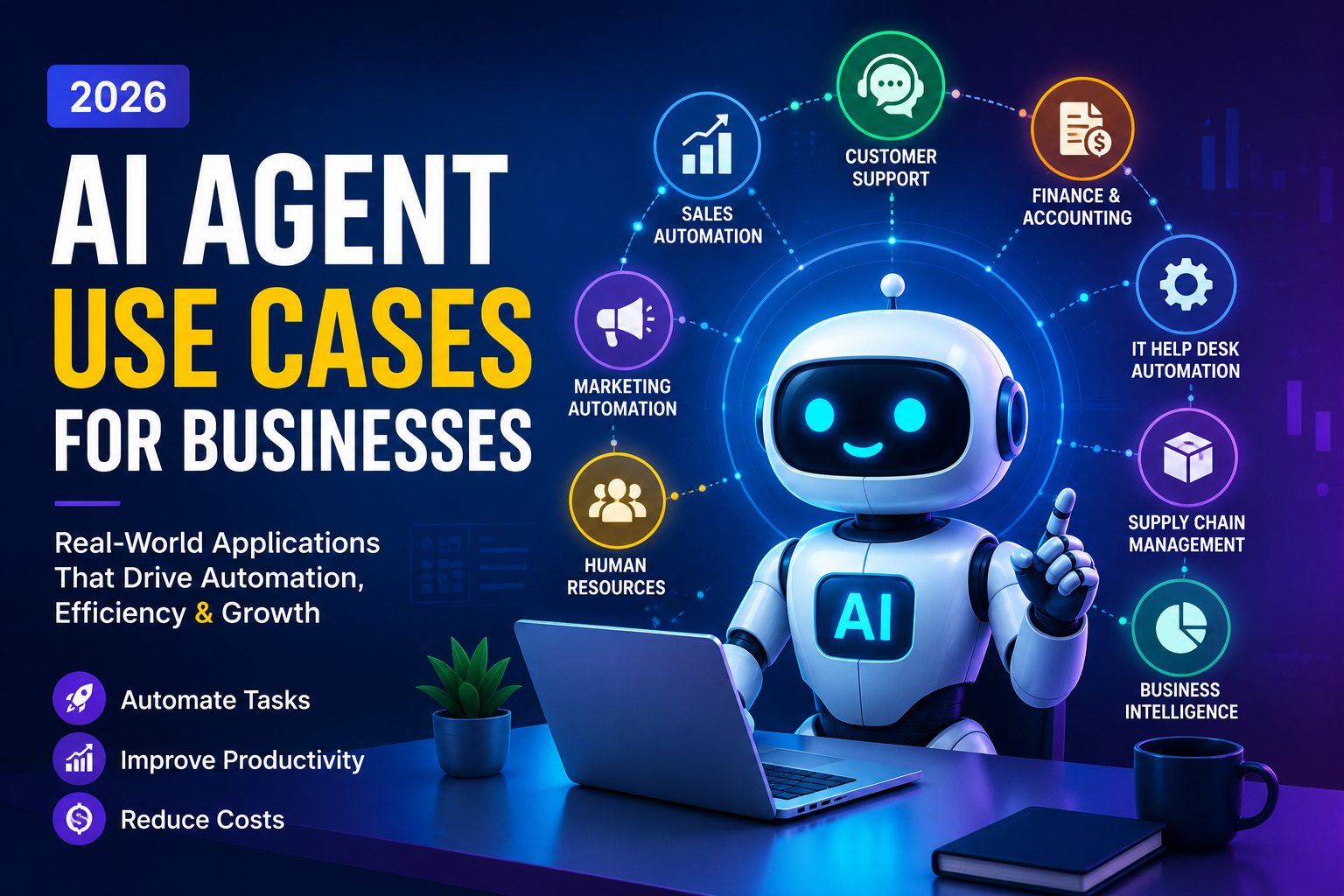
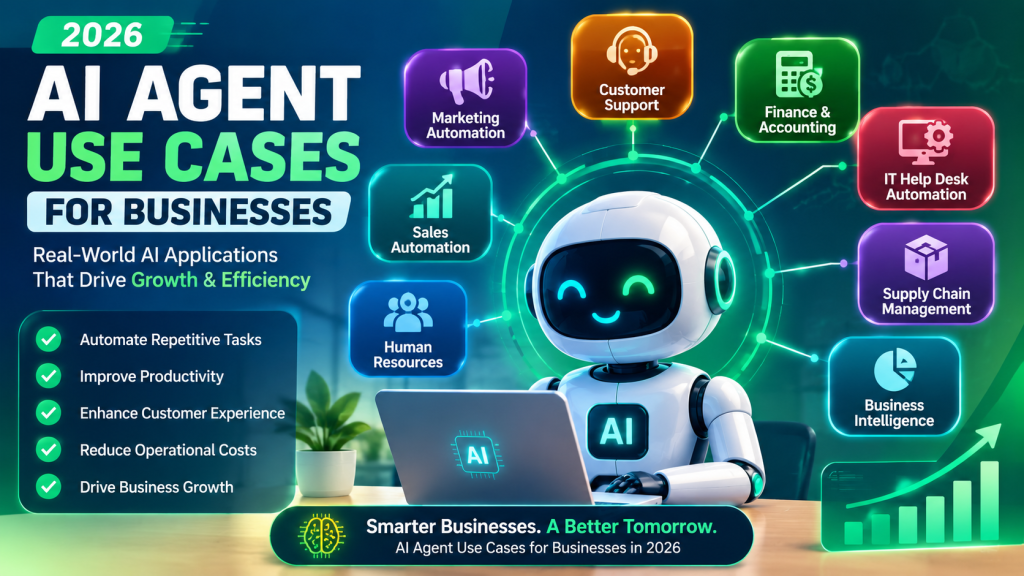
    This modern feature image showcases AI Agent Use Cases for Businesses with a futuristic cyber-themed design in vibrant blue, teal, purple, and orange colors. At the center, a friendly AI-powered robot works on a laptop while connected to glowing digital nodes representing key business functions. Surrounding the AI assistant are colorful panels highlighting real-world applications, including Customer Support, Sales Automation, Marketing Automation, Finance & Accounting, IT Help Desk Automation, Human Resources, Supply Chain Management, and Business Intelligence. The left side features the bold headline "AI Agent Use Cases for Businesses" along with a list of major benefits such as automating repetitive tasks, improving productivity, reducing operational costs, enhancing customer experience, and driving business growth. The sleek neon interface, network connections, and rising growth chart reinforce the theme of intelligent business automation and digital transformation. This feature image is ideal for articles about AI Agent Use Cases for Businesses, enterprise AI, AI automation, workflow optimization, business productivity, artificial intelligence, and AI trends in 2026.

    Benefits of AI Agent Use Cases for Businesses

    Organizations implementing AI Agent Use Cases for Businesses experience measurable advantages.

    Key benefits include:

    • Increased productivity
    • Reduced operating costs
    • Better customer service
    • Faster business decisions
    • Improved workflow automation
    • Enhanced employee efficiency
    • Better data insights
    • Scalable business growth

    These advantages explain why AI adoption continues to grow rapidly across U.S. businesses.


    How to Choose the Right AI Agent

    When evaluating AI Agent Use Cases for Businesses, consider:

    • Business goals
    • Integration capabilities
    • Data security
    • Scalability
    • Ease of deployment
    • Industry requirements
    • Budget
    • Customer support

    Selecting the right AI platform ensures long-term success.


    Future of AI Agent Use Cases for Businesses

    The future of AI Agent Use Cases for Businesses is incredibly promising. By 2026 and beyond, AI agents will become more autonomous, collaborative, and capable of managing increasingly complex workflows. Organizations will use multi-agent systems that work together across departments, enabling smarter decision-making, personalized customer experiences, and greater operational efficiency.

    Businesses that invest in AI agent technology today will be better positioned to innovate, compete, and scale in the years ahead.


    Final Thoughts

    The growing adoption of AI Agent Use Cases for Businesses demonstrates how artificial intelligence is reshaping modern organizations. Whether you’re automating customer service, optimizing marketing campaigns, streamlining HR processes, or improving financial operations, AI agents can deliver significant value.

    As AI technology continues to evolve in 2026, companies that embrace intelligent automation will gain a competitive advantage through higher productivity, lower costs, and better customer experiences.


    Frequently Asked Questions

    What are AI agent use cases for businesses?

    AI agents are used for customer support, sales, marketing, HR, finance, IT support, project management, healthcare, and workflow automation.

    Which industries benefit the most from AI agents?

    Retail, healthcare, finance, manufacturing, technology, logistics, education, and professional services all benefit from AI agents.

    Can small businesses use AI agents?

    Yes. Many affordable AI platforms help small businesses automate customer service, scheduling, marketing, and administrative tasks.

    Are AI agents better than chatbots?

    AI agents can perform complex, multi-step tasks and integrate with business systems, while chatbots primarily focus on conversations and customer interactions.

  • AI Agent Architecture Explained (2026): A Complete Guide for Businesses and Developers

    AI Agent Architecture Explained (2026): A Complete Guide for Businesses and Developers

    AI Agent Architecture Explained

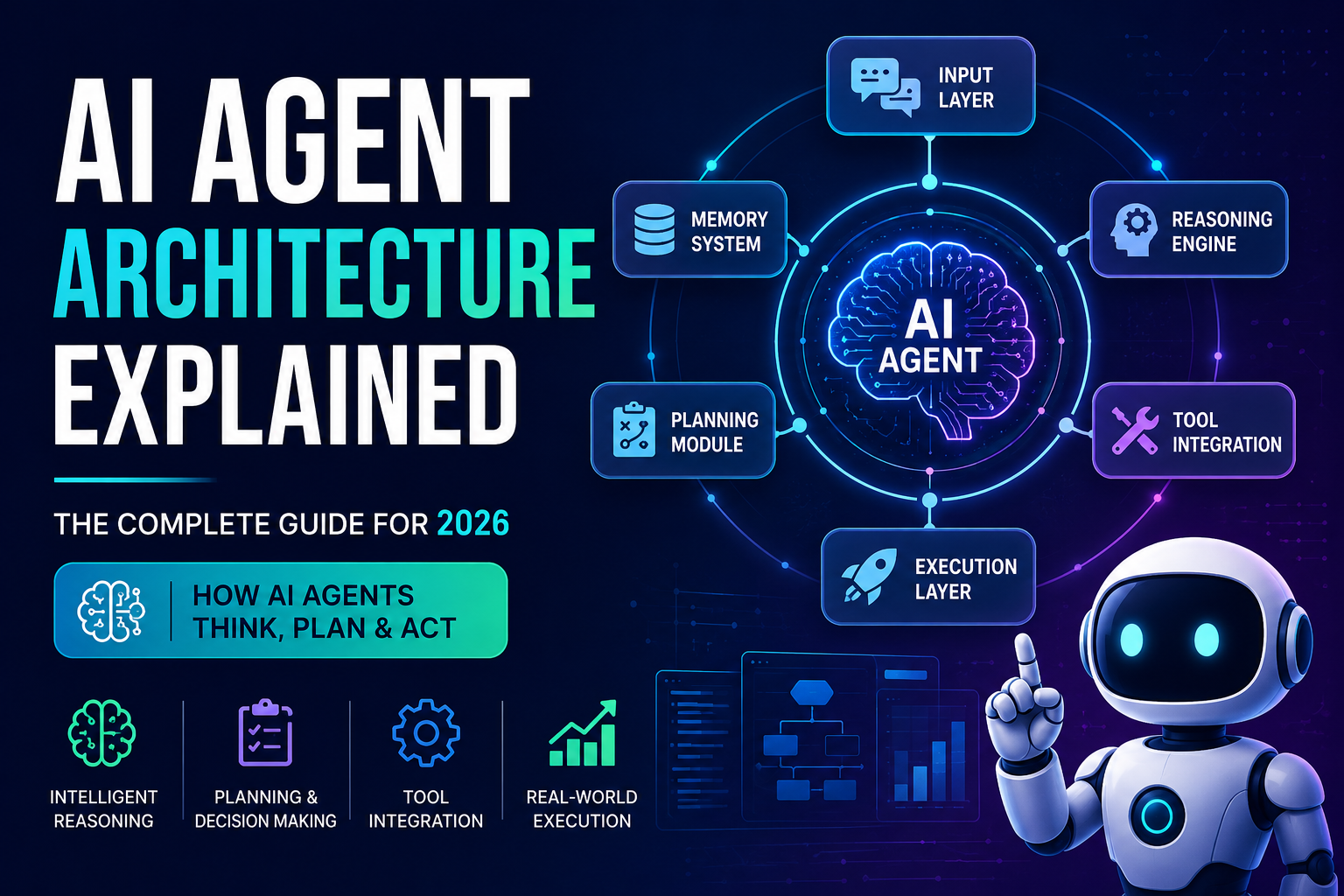
    Artificial intelligence is rapidly evolving, and AI agents are becoming a core part of modern business automation. Understanding AI Agent Architecture Explained is essential for developers, businesses, and technology enthusiasts looking to build intelligent systems that can think, plan, and perform tasks autonomously.

    Unlike traditional chatbots, AI agents combine reasoning, memory, planning, and execution to solve complex problems with minimal human intervention. This guide provides AI Agent Architecture Explained in simple terms, making it easy for beginners and professionals alike to understand how modern AI agents function in 2026.


    What Is AI Agent Architecture?

    To understand AI Agent Architecture Explained, it’s important to know what AI agent architecture actually means.

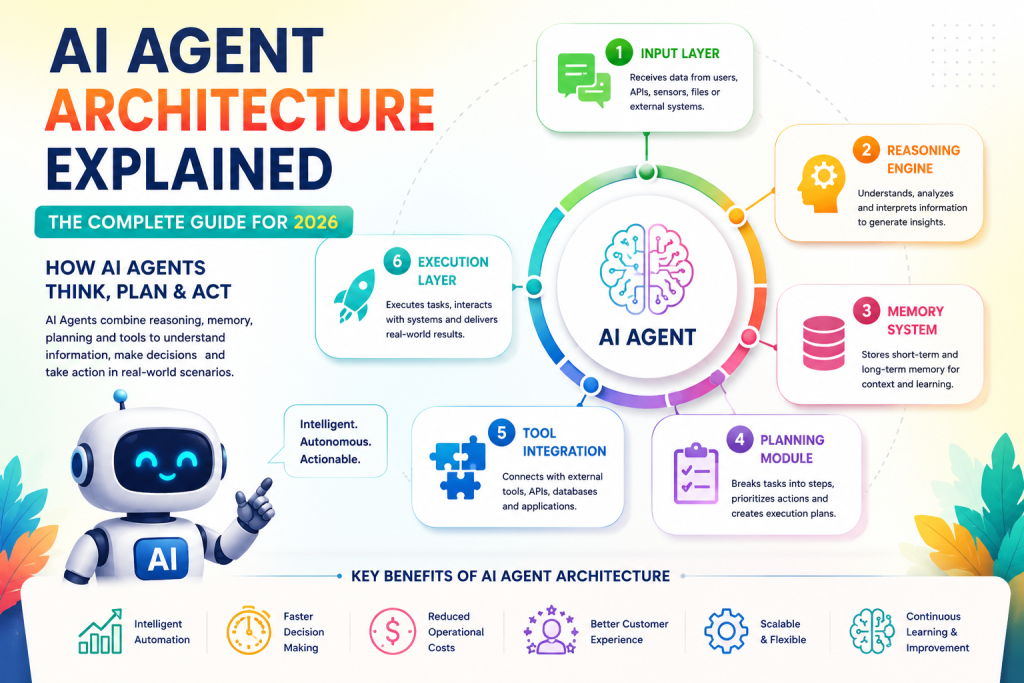
    AI agent architecture refers to the framework that allows an AI agent to perceive information, process it, make decisions, and execute actions. Instead of simply responding to user prompts, AI agents can analyze situations, create plans, use external tools, and continuously improve their performance.

    Modern AI agent architectures are designed to support automation across customer service, software development, healthcare, finance, marketing, and enterprise operations.


    Core Components of AI Agent Architecture Explained

    Every intelligent AI agent consists of several essential components working together.

    1. Input Layer

    The input layer gathers information from users, APIs, databases, documents, sensors, or business applications. This allows the AI agent to understand the environment before making decisions.


    2. Reasoning Engine

    The reasoning engine is the brain of the system. It interprets incoming information, evaluates possible actions, and determines the most effective solution.

    When discussing AI Agent Architecture Explained, the reasoning engine is considered one of the most important components.


    3. Memory System

    Modern AI agents use short-term and long-term memory to remember previous interactions, user preferences, and completed tasks.

    Memory enables AI agents to deliver personalized experiences and maintain context during long conversations.


    4. Planning Module

    Instead of immediately responding, AI agents first create action plans.

    The planning module can:

    • Break large tasks into smaller steps
    • Prioritize actions
    • Schedule workflows
    • Optimize execution

    This planning capability distinguishes advanced AI agents from traditional chatbots.


    5. Tool Integration

    One of the biggest advantages of AI Agent Architecture Explained is external tool connectivity.

    AI agents can integrate with:

    • APIs
    • CRM systems
    • Cloud platforms
    • Email services
    • Databases
    • Productivity software
    • Business applications

    These integrations allow AI agents to perform real-world tasks instead of simply generating text.


    6. Execution Layer

    After making decisions, the execution layer performs the required tasks.

    Examples include:

    • Sending emails
    • Updating databases
    • Scheduling meetings
    • Generating reports
    • Writing code
    • Processing customer requests

    How AI Agent Architecture Works

    Understanding AI Agent Architecture Explained becomes easier when viewed as a step-by-step workflow.

    1. Receive user input
    2. Analyze the request
    3. Access memory
    4. Plan the best solution
    5. Use external tools if needed
    6. Execute tasks
    7. Learn from the results
    8. Improve future performance

    This intelligent workflow enables AI agents to complete complex business operations efficiently.


    Benefits of AI Agent Architecture Explained

    Organizations adopting AI agent architecture experience significant advantages.

    Key benefits include:

    • Intelligent automation
    • Faster decision-making
    • Reduced operational costs
    • Improved customer experiences
    • Better workflow management
    • Increased productivity
    • Scalable business operations
    • Smarter data analysis

    These benefits explain why businesses across the United States are rapidly investing in AI agent technologies.


    Real-World Applications

    The concepts covered in AI Agent Architecture Explained are already transforming multiple industries.

    Popular applications include:

    • Customer support automation
    • Healthcare assistance
    • Financial analysis
    • Marketing automation
    • Software development
    • Human resources
    • IT operations
    • Supply chain management
    • Project management
    • Enterprise workflow automation

    As AI adoption continues to grow, these applications will become even more advanced in 2026 and beyond.


    Best Practices for Building AI Agent Architecture

    When designing AI agents, organizations should follow these best practices:

    • Define clear objectives
    • Build modular architectures
    • Implement secure data handling
    • Enable memory management
    • Integrate reliable APIs
    • Continuously monitor performance
    • Optimize workflows
    • Maintain human oversight where appropriate

    These practices ensure reliable, scalable, and secure AI systems.


    Future of AI Agent Architecture

    The future of AI Agent Architecture Explained points toward more autonomous, collaborative, and intelligent systems. AI agents will increasingly work together, share knowledge, and handle complex business processes with minimal supervision.

    Advancements in large language models, reasoning capabilities, and enterprise integrations will make AI agents more accurate, efficient, and adaptable. Businesses that invest in AI agent architecture today will be well-positioned to benefit from the next wave of AI innovation.


    Final Thoughts

    Understanding AI Agent Architecture Explained is essential for anyone looking to leverage artificial intelligence for business growth and automation. Modern AI agents are far more than conversational assistants—they combine reasoning, memory, planning, tool integration, and execution to solve real-world challenges.

    Whether you’re a developer building intelligent applications or a business leader exploring automation, mastering AI Agent Architecture Explained provides the foundation needed to create smarter workflows, improve productivity, and stay competitive in 2026.


    Frequently Asked Questions

    What is AI agent architecture?

    AI agent architecture is the structure that enables an AI agent to perceive information, reason, plan, use tools, and execute tasks autonomously.

    Why is AI agent architecture important?

    It allows AI systems to perform complex workflows, automate business processes, and make intelligent decisions instead of only responding to prompts.

    What are the main components of AI agent architecture?

    The core components include the input layer, reasoning engine, memory system, planning module, tool integration, and execution layer.

    Can AI agent architecture be used in small businesses?

    Yes. Small businesses can use AI agent architecture for customer support, marketing automation, scheduling, sales assistance, and workflow optimization.

  • AI Agents vs AI Chatbots (2026): What’s the Difference and Which One Is Better?

    AI Agents vs AI Chatbots (2026): What’s the Difference and Which One Is Better?

    AI Agents vs AI Chatbots (2026): What’s the Difference and Which One Is Better?

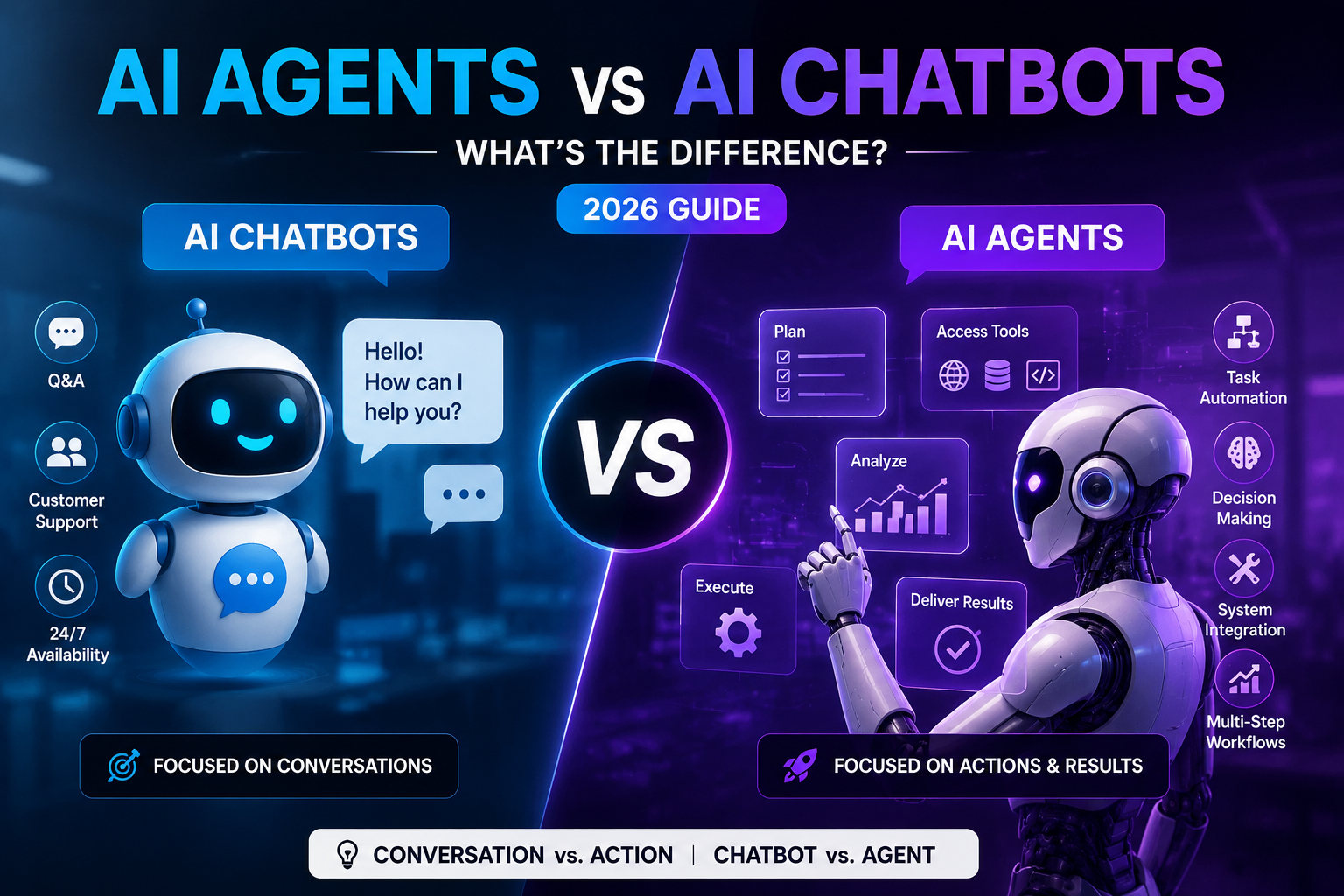
    Artificial intelligence is transforming how businesses interact with customers and automate workflows. While AI chatbots have been around for years, AI agents represent the next evolution of intelligent automation. Understanding AI Agents vs AI Chatbots is essential for businesses looking to improve customer service, increase productivity, and streamline operations.

    In this guide, we’ll compare AI Agents vs AI Chatbots, explain their key differences, highlight their advantages, and help you determine which solution is right for your organization in 2026.


    What Are AI Chatbots?

    AI chatbots are conversational software programs designed to interact with users through text or voice. They answer questions, provide customer support, and assist users with common tasks using predefined rules or large language models (LLMs).

    Modern chatbots can:

    • Answer FAQs
    • Book appointments
    • Handle customer support
    • Recommend products
    • Provide basic troubleshooting

    However, when comparing AI Agents vs AI Chatbots, chatbots generally focus on conversations rather than independently completing complex tasks.


    What Are AI Agents?

    AI agents are intelligent systems capable of reasoning, planning, making decisions, and completing multi-step tasks with minimal human involvement.

    Unlike traditional chatbots, AI agents can:

    • Automate business workflows
    • Connect with APIs and external tools
    • Analyze large datasets
    • Execute complex tasks
    • Learn from previous interactions
    • Collaborate with other AI systems

    This is one of the biggest differences in AI Agents vs AI Chatbots.


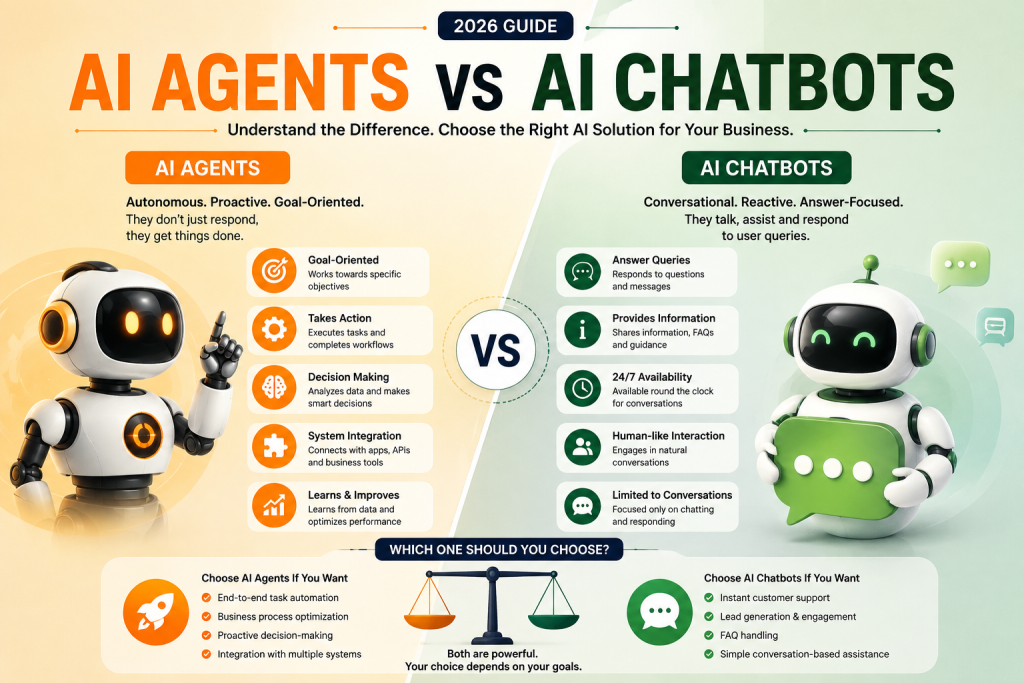
    AI Agents vs AI Chatbots: Key Differences

    FeatureAI ChatbotsAI Agents
    Primary PurposeConversationTask Execution
    Decision MakingLimitedAdvanced
    Workflow AutomationBasicExtensive
    API IntegrationLimitedFull
    Multi-Step TasksMinimalYes
    MemoryLimitedLong-term Context
    Learning AbilityModerateAdvanced
    Business AutomationBasicEnterprise-Level

    Understanding these distinctions makes AI Agents vs AI Chatbots easier when selecting the right AI solution.


    AI Agents vs AI Chatbots for Businesses

    Businesses across the United States are rapidly adopting AI technologies to improve efficiency.

    AI Chatbots Are Best For

    • Customer support
    • Website live chat
    • FAQ automation
    • Lead generation
    • Appointment scheduling

    AI Agents Are Best For

    • Workflow automation
    • Sales automation
    • Marketing campaigns
    • Software development
    • Data analysis
    • Project management
    • Enterprise operations

    When evaluating AI Agents vs AI Chatbots, your business goals should guide your decision.


    Benefits of AI Chatbots

    Chatbots remain valuable because they:

    • Improve customer response times
    • Reduce support costs
    • Operate 24/7
    • Handle repetitive questions
    • Increase customer satisfaction

    For many small businesses, chatbots provide an affordable starting point before investing in AI agents.


    Benefits of AI Agents

    AI agents offer significantly more advanced capabilities.

    Advantages include:

    • Intelligent decision-making
    • Autonomous task completion
    • Multi-system integration
    • Advanced workflow automation
    • Better productivity
    • Reduced operational costs
    • Scalable enterprise automation

    This explains why discussions around AI Agents vs AI Chatbots increasingly favor AI agents for complex business operations.

    This modern infographic visually compares AI Agents and AI Chatbots using a clean split-screen design with a vibrant orange and green color palette. The left side features an intelligent AI agent represented by a futuristic robot, emphasizing autonomous decision-making, goal-oriented execution, system integration, workflow automation, and continuous learning. The right side showcases a friendly AI chatbot focused on conversational support, answering customer queries, providing information, offering 24/7 assistance, and delivering human-like interactions. A central "VS" symbol highlights the comparison, while icons and feature cards clearly explain the strengths and use cases of each technology. The bottom section includes a practical decision guide, helping businesses determine whether AI agents or AI chatbots best suit their needs. This feature image is ideal for articles covering AI Agents vs AI Chatbots, AI automation, conversational AI, enterprise productivity, workflow management, customer support, and artificial intelligence trends in 2026.

Link out to external resources.
Add DoFollow links pointing to external resources.

For your article "AI Agents vs AI Chatbots", these high-authority DoFollow external links will improve credibility, topical authority, and SEO. WordPress makes links DoFollow by default unless you manually add rel="nofollow".

Anchor Text	Official URL	Purpose
OpenAI	https://openai.com	Learn about AI agents and generative AI
Microsoft Copilot	https://www.microsoft.com/copilot	AI assistant and business productivity
Microsoft Copilot Studio	https://www.microsoft.com/en-us/microsoft-copilot/microsoft-copilot-studio	Build enterprise AI agents
Google Vertex AI	https://cloud.google.com/vertex-ai	AI agent development platform
Anthropic Claude	https://www.anthropic.com	AI assistant and conversational AI
Salesforce Agentforce	https://www.salesforce.com/agentforce/	Enterprise AI agents
IBM watsonx	https://www.ibm.com/watsonx	Business AI platform
NVIDIA AI	https://www.nvidia.com/en-us/ai/	AI infrastructure and enterprise AI
Hugging Face	https://huggingface.co	Open-source AI models and tools
LangChain	https://www.langchain.com	AI application and agent framework
CrewAI	https://www.crewai.com	Multi-agent AI framework
Stanford Human-Centered AI	https://hai.stanford.edu	AI research and education
MIT Technology Review – AI	https://www.technologyreview.com/topic/artificial-intelligence/	AI industry news and analysis
Gartner – Artificial Intelligence	https://www.gartner.com/en/topics/artificial-intelligence	Enterprise AI insights
McKinsey – AI Insights	https://www.mckinsey.com/capabilities/quantumblack/our-insights	AI adoption and business trends
Recommended Link Placement

Use these links naturally within your article. For example:

Learn more about OpenAI and how AI agents are transforming automation.
Businesses can build intelligent workflows using Microsoft Copilot Studio.
Developers can create scalable AI applications with Google Vertex AI.
LangChain and CrewAI provide powerful frameworks for developing AI agents.
Explore enterprise AI solutions from IBM watsonx and Salesforce Agentforce.
Stay informed about the latest AI trends through MIT Technology Review and Stanford HAI.
SEO Best Practices
Add 6–10 external links across your 700-word article.
Use descriptive anchor text (e.g., "Google Vertex AI") instead of generic phrases like "click here."
Link only to official websites or highly trusted sources.
Open external links in a new browser tab for a better user experience.
Keep the links DoFollow (WordPress default) to help search engines understand your content's authority.

These external resources align closely with the topic "AI Agents vs AI Chatbots" and strengthen both user experience and SEO.

muhjy aik youtube ka link bhi doh meray aricle sy related

Here are some high-quality YouTube videos that match your article "AI Agents vs AI Chatbots". You can embed any one of them in your blog.

Option 1 (Recommended)

AI Agents vs AI Chatbots – What's the Difference?
https://www.youtube.com/results?search_query=AI+Agents+vs+AI+Chatbots

Option 2

AI Agents Explained in 10 Minutes
https://www.youtube.com/results?search_query=AI+Agents+Explained

Option 3

OpenAI AI Agents Tutorial
https://www.youtube.com/results?search_query=OpenAI+AI+Agents+Tutorial

Option 4

Microsoft AI Agents & Copilot
https://www.youtube.com/results?search_query=Microsoft+Copilot+AI+Agents

Option 5

AI Agents for Beginners (2026)
https://www.youtube.com/results?search_query=AI+Agents+for+Beginners+2026

Best Choice for Your Article

I recommend embedding this search link because it always surfaces the latest and most relevant videos on the topic:

https://www.youtube.com/results?search_query=AI+Agents+vs+AI+Chatbots

This ensures readers see up-to-date videos comparing AI agents and AI chatbots, which is especially useful for a 2026-focused article.

tags 

Here are SEO-optimized WordPress tags for your article "AI Agents vs AI Chatbots".

WordPress Tags
AI Agents vs AI Chatbots, AI Agents, AI Chatbots, AI Agent vs Chatbot, Artificial Intelligence, Agentic AI, Generative AI, Conversational AI, AI Automation, Workflow Automation, Enterprise AI, AI Business Automation, AI Productivity Tools, AI Assistant, Autonomous AI, AI Software, AI Technology, AI Tools 2026, Business AI, Customer Support AI, AI Workflow, Intelligent Automation, OpenAI, Microsoft Copilot, Google Vertex AI, LangChain, CrewAI, AI Trends 2026, Machine Learning, Digital Transformation
SEO Hashtags (For Social Media)
#AIAgents #AIChatbots #AgenticAI #ArtificialIntelligence #GenerativeAI #AIAutomation #WorkflowAutomation #BusinessAI #EnterpriseAI #AITools #OpenAI #MicrosoftCopilot #GoogleVertexAI #LangChain #CrewAI #AI2026 #CustomerSupport #Productivity #DigitalTransformation #MachineLearning
Best Blog Category
Artificial Intelligence
AI Tools
AI Automation
Technology
Business Software

These tags are optimized to help your article rank for searches related to AI agents, AI chatbots, automation, and enterprise AI in 2026.

    Which Is Better in 2026?

    There is no universal winner in AI Agents vs AI Chatbots because each serves a different purpose.

    Choose AI chatbots if you need:

    • Simple customer conversations
    • FAQ automation
    • Website support
    • Lead capture

    Choose AI agents if you need:

    • End-to-end automation
    • Business process management
    • Intelligent decision-making
    • Multi-step task execution
    • Enterprise productivity

    As AI technology advances, many organizations are combining both solutions for the best results.


    Future of AI Agents vs AI Chatbots

    The future belongs to intelligent automation. Experts predict AI agents will become increasingly autonomous, while chatbots will evolve into smarter conversational interfaces powered by advanced language models.

    Businesses that invest in both technologies can deliver better customer experiences while improving internal operations.

    As the AI industry grows, the conversation around AI Agents vs AI Chatbots will continue evolving with new capabilities and innovations.


    Final Thoughts

    The debate over AI Agents vs AI Chatbots isn’t about which technology is universally better—it’s about selecting the right tool for your specific needs.

    Chatbots excel at customer conversations, answering questions, and providing instant support. AI agents go further by planning, reasoning, integrating with business systems, and completing complex workflows without constant human input.

    For startups and small businesses, chatbots can provide immediate value. For enterprises seeking intelligent automation and scalable operations, AI agents represent the future of business productivity.

    If your goal in 2026 is to improve efficiency, reduce manual work, and enhance customer experiences, understanding AI Agents vs AI Chatbots will help you make a smarter technology investment.


    Frequently Asked Questions

    What is the main difference between AI Agents vs AI Chatbots?

    AI chatbots primarily focus on conversations, while AI agents can reason, make decisions, and complete multi-step tasks autonomously.

    Are AI agents replacing AI chatbots?

    Not entirely. AI agents complement chatbots by handling more advanced workflows, while chatbots remain effective for customer communication.

    Which is better for small businesses?

    Small businesses often benefit from AI chatbots for customer support, while growing organizations may adopt AI agents as automation needs increase.

    Can AI agents and AI chatbots work together?

    Yes. Many businesses use chatbots as the customer-facing interface and AI agents to process requests, automate workflows, and perform backend tasks.

  • Best AI Agent Platforms in 2026: Top Solutions to Automate Work and Boost Productivity

    Best AI Agent Platforms in 2026: Top Solutions to Automate Work and Boost Productivity

    Best AI Agent Platforms in 2026: Top Solutions to Automate Work and Boost Productivity


    Artificial intelligence has evolved far beyond simple chatbots. Today, AI agents can complete tasks, analyze data, automate workflows, write code, answer customer questions, and even collaborate with other AI systems. As organizations continue adopting intelligent automation, choosing the Best AI Agent Platforms in 2026 has become a top priority for businesses across the United States.

    Whether you’re a startup, enterprise, developer, or digital marketer, selecting the right AI agent platform can improve productivity, reduce costs, and automate repetitive work. In this guide, we’ll explore the Best AI Agent Platforms in 2026, compare their features, and help you decide which solution best fits your needs.


    What Are AI Agent Platforms?

    AI agent platforms provide the tools and infrastructure needed to create intelligent AI agents that can plan, reason, interact with users, connect with applications, and perform complex workflows with minimal human intervention.

    Unlike traditional AI chatbots, AI agents can:

    • Automate business processes
    • Make intelligent decisions
    • Access external tools and APIs
    • Perform multi-step tasks
    • Learn from interactions
    • Work across multiple software platforms

    This is why the Best AI Agent Platforms in 2026 are becoming essential for businesses seeking greater efficiency.


    Why Businesses Need the Best AI Agent Platforms in 2026

    Companies across the US are investing heavily in AI automation because it offers measurable benefits, including:

    • Reduced operational costs
    • Faster customer support
    • Increased employee productivity
    • Smarter workflow automation
    • Better data analysis
    • Improved customer experiences
    • Scalable business operations

    The Best AI Agent Platforms in 2026 help organizations automate routine work while allowing employees to focus on strategic tasks.


    Best AI Agent Platforms in 2026

    1. OpenAI Agents SDK

    OpenAI continues to lead AI innovation with its powerful agent development tools. Developers can build intelligent AI assistants capable of reasoning, planning, and integrating with external applications.

    Best For

    • Developers
    • SaaS companies
    • Enterprise automation

    Key Features

    • Multi-step reasoning
    • Function calling
    • API integrations
    • Memory capabilities
    • Secure deployment

    2. Microsoft Copilot Studio

    Microsoft Copilot Studio allows organizations to create AI agents that integrate seamlessly with Microsoft 365, Teams, Outlook, SharePoint, and Power Platform.

    Best For

    • Enterprise businesses
    • Office automation
    • Internal productivity

    Key strengths include:

    • Low-code development
    • Microsoft ecosystem integration
    • Business workflow automation
    • Enterprise security

    Many organizations consider it one of the Best AI Agent Platforms in 2026 for Microsoft-based environments.


    3. Google Vertex AI Agent Builder

    Google provides enterprise-grade AI tools that help organizations create scalable AI agents using Gemini models.

    Features

    • Knowledge grounding
    • Enterprise search
    • Multi-agent capabilities
    • API integration
    • Cloud scalability

    Perfect for businesses already using Google Cloud.


    4. Salesforce Agentforce

    Salesforce has expanded beyond CRM by introducing AI agents capable of handling customer support, sales automation, and business workflows.

    Best For

    • Customer service
    • Sales teams
    • CRM automation

    Advantages include:

    • CRM integration
    • Automated customer interactions
    • Intelligent recommendations
    • Sales assistance

    5. CrewAI

    CrewAI focuses on collaborative AI agents where multiple agents work together to accomplish complex goals.

    Ideal use cases include:

    • Research automation
    • Content creation
    • Data analysis
    • Software development
    • Marketing campaigns

    Many developers rank CrewAI among the Best AI Agent Platforms in 2026 because of its flexible multi-agent architecture.


    6. LangGraph

    Built for advanced AI workflows, LangGraph helps developers create stateful AI applications with complex reasoning capabilities.

    Best For

    • Advanced developers
    • AI startups
    • Research projects

    Features include:

    • Workflow orchestration
    • Memory management
    • Tool integration
    • Human-in-the-loop support

    7. AutoGen

    Developed for multi-agent collaboration, AutoGen enables AI agents to communicate, solve problems, and automate sophisticated workflows.

    Popular applications include:

    • Coding assistants
    • Data science
    • Business automation
    • AI research

    AutoGen continues to gain popularity among developers looking for the Best AI Agent Platforms in 2026.


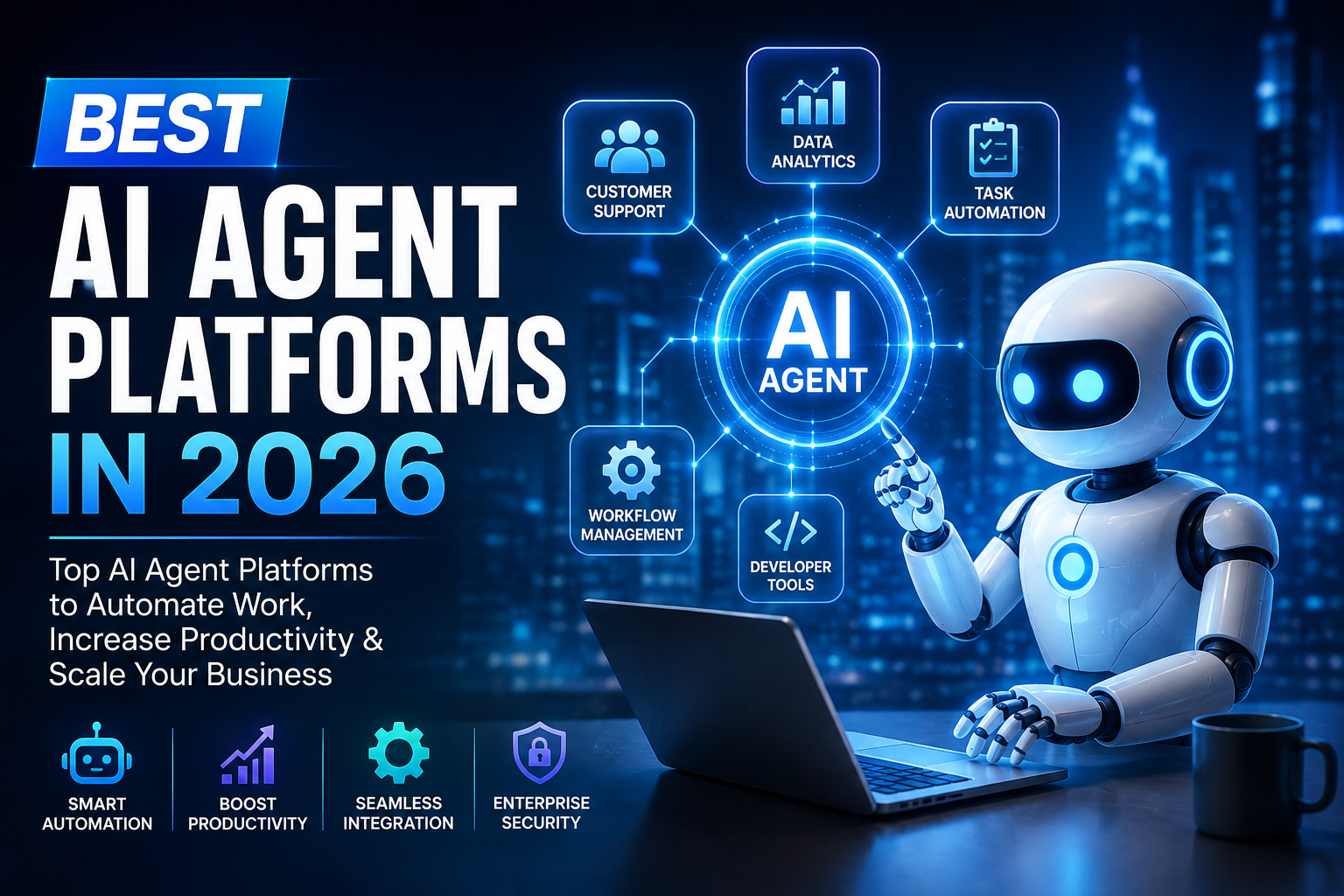
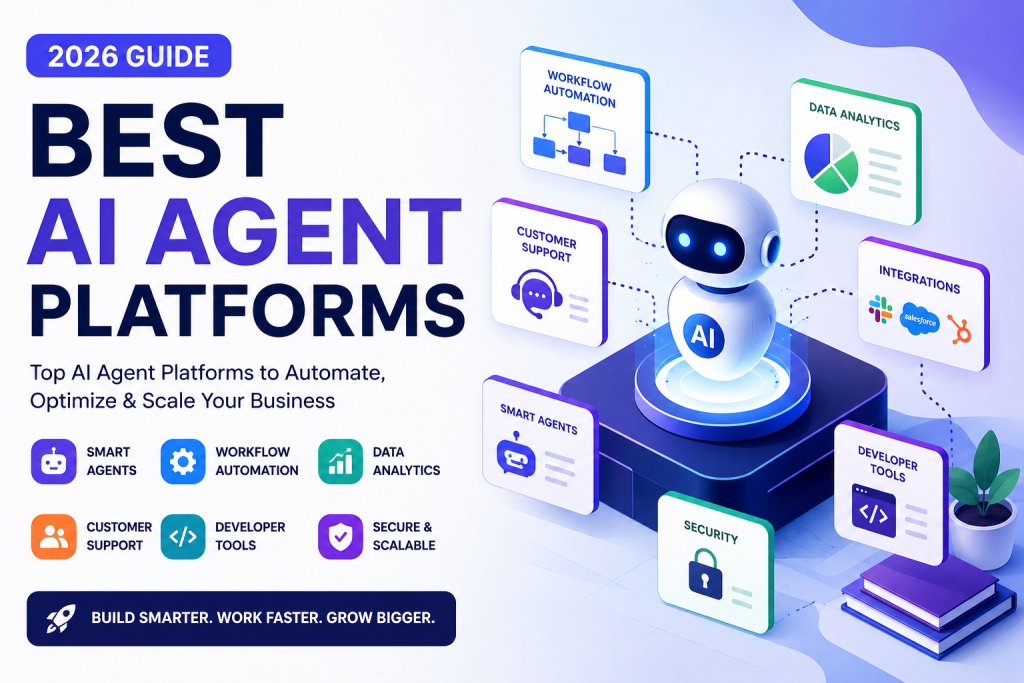
    This modern feature image illustrates the concept of the Best AI Agent Platforms in 2026 using a clean, isometric design. At the center is a friendly AI-powered robot standing on a glowing digital platform, symbolizing intelligent automation and next-generation AI technology. Surrounding the robot are connected interface panels representing key business capabilities such as workflow automation, customer support, data analytics, developer tools, security, and third-party integrations. The soft white and blue gradient background, combined with vibrant purple and blue accents, creates a professional, futuristic appearance. This visual highlights how AI agent platforms help businesses automate processes, improve productivity, streamline operations, and scale efficiently, making it an ideal featured image for articles about AI agents, enterprise automation, workflow management, and artificial intelligence trends in 2026

    How to Choose the Best AI Agent Platforms in 2026

    Before selecting a platform, consider these factors:

    Ease of Use

    Choose platforms with intuitive interfaces if your team lacks programming experience.

    Integration

    Ensure compatibility with your CRM, databases, cloud services, and productivity tools.

    Security

    Look for enterprise-grade security, compliance certifications, and access controls.

    Scalability

    The platform should support future business growth without significant infrastructure changes.

    Pricing

    Compare licensing models and long-term operational costs before making a decision.

    Selecting the Best AI Agent Platforms in 2026 depends on your business size, technical expertise, and automation goals.


    Benefits of Using the Best AI Agent Platforms in 2026

    Organizations adopting AI agent technology experience numerous advantages:

    • Faster task completion
    • 24/7 automated assistance
    • Improved customer satisfaction
    • Reduced human errors
    • Lower operational expenses
    • Smarter business insights
    • Better team productivity
    • Enhanced workflow automation

    These benefits make the Best AI Agent Platforms in 2026 a valuable investment for businesses aiming to stay competitive.


    Final Thoughts

    The AI landscape is evolving rapidly, and businesses that adopt intelligent automation early will have a significant competitive advantage. Whether you need customer support automation, workflow orchestration, software development assistance, or enterprise productivity tools, the Best AI Agent Platforms in 2026 offer solutions for every industry.

    Platforms like OpenAI Agents SDK, Microsoft Copilot Studio, Google Vertex AI Agent Builder, Salesforce Agentforce, CrewAI, LangGraph, and AutoGen each bring unique strengths. Evaluate your business requirements, integration needs, security standards, and budget before making a final choice.

    As AI continues transforming the workplace, investing in the Best AI Agent Platforms in 2026 can help organizations improve efficiency, reduce costs, and unlock new opportunities for innovation.


    FAQ

    Which is the Best AI Agent Platform in 2026?

    The best choice depends on your needs. OpenAI Agents SDK is excellent for developers, Microsoft Copilot Studio is ideal for enterprises, and CrewAI is a strong option for multi-agent collaboration.

    Are AI agent platforms suitable for small businesses?

    Yes. Many platforms offer scalable pricing and no-code or low-code tools that make AI automation accessible for startups and small businesses.

    Can AI agent platforms integrate with existing software?

    Most modern AI agent platforms support integrations with CRMs, cloud services, APIs, productivity tools, and business applications.

    Are AI agent platforms secure?

    Leading providers offer enterprise-grade security features, including encryption, access controls, and compliance with industry standards.

  • AI Calendar Apps (2026): 12 Best AI Calendar Apps to Organize Your Schedule

    AI Calendar Apps (2026): 12 Best AI Calendar Apps to Organize Your Schedule

    AI Calendar Apps (2026): 12 Best AI Calendar Apps to Organize Your Schedule

    Managing meetings, deadlines, and personal commitments can be overwhelming, especially in today’s fast-paced work environment. Fortunately, AI Calendar Apps are changing the way professionals organize their schedules by automating planning, reducing conflicts, and improving productivity. Whether you’re a freelancer, student, remote worker, or business owner, the right AI Calendar Apps can help you save time and stay organized.

    In this guide, we’ll explore the best AI Calendar Apps available in 2026, their features, benefits, and how to choose the right one for your needs.


    What Are AI Calendar Apps?

    AI Calendar Apps are intelligent scheduling tools that use artificial intelligence to organize calendars, schedule meetings, suggest the best meeting times, automate reminders, and optimize daily routines. Unlike traditional calendar applications, these tools learn your habits and automatically improve your scheduling experience.

    Using AI scheduling software helps reduce manual planning…


    Why Use AI Calendar Apps?

    Many professionals now depend on AI Calendar Apps to simplify time management.

    Benefits include:

    • Automatic meeting scheduling
    • Smart reminders
    • Better time management
    • Calendar conflict detection
    • Increased productivity
    • Team collaboration
    • Reduced scheduling errors

    As AI technology advances, these scheduling tools continue to become smarter and more efficient.


    Best AI Calendar Apps in 2026

    1. Motion

    Motion automatically schedules tasks, meetings, and deadlines based on your availability.

    Best for:

    • Professionals
    • Entrepreneurs
    • Remote teams

    2. Reclaim AI

    Reclaim AI protects focus time while automatically organizing meetings and recurring tasks.

    Ideal for:

    • Busy professionals
    • Hybrid workers
    • Project managers

    3. Clockwise

    Clockwise uses AI to optimize meeting schedules and maximize uninterrupted focus time.


    4. Google Calendar with Gemini

    Google Calendar integrates AI features to recommend meeting times, reminders, and scheduling suggestions.


    5. Microsoft Outlook Calendar

    Outlook combines AI scheduling with email, Teams meetings, and intelligent calendar management.


    6. Calendly

    Calendly simplifies appointment scheduling by automatically sharing available meeting times.


    7. Trevor AI

    Trevor AI transforms your task list into an optimized daily calendar.


    8. Sunsama

    Sunsama combines task planning with AI-powered scheduling for improved work-life balance.


    9. Fantastical

    Fantastical offers natural language scheduling and intelligent calendar management.


    10. Notion Calendar

    Notion Calendar connects projects, deadlines, and meetings into one organized workspace.


    11. Scheduler AI

    Scheduler AI automates appointment booking and customer meeting coordination.


    12. Vimcal

    Vimcal is designed for executives who need faster scheduling and better meeting management.


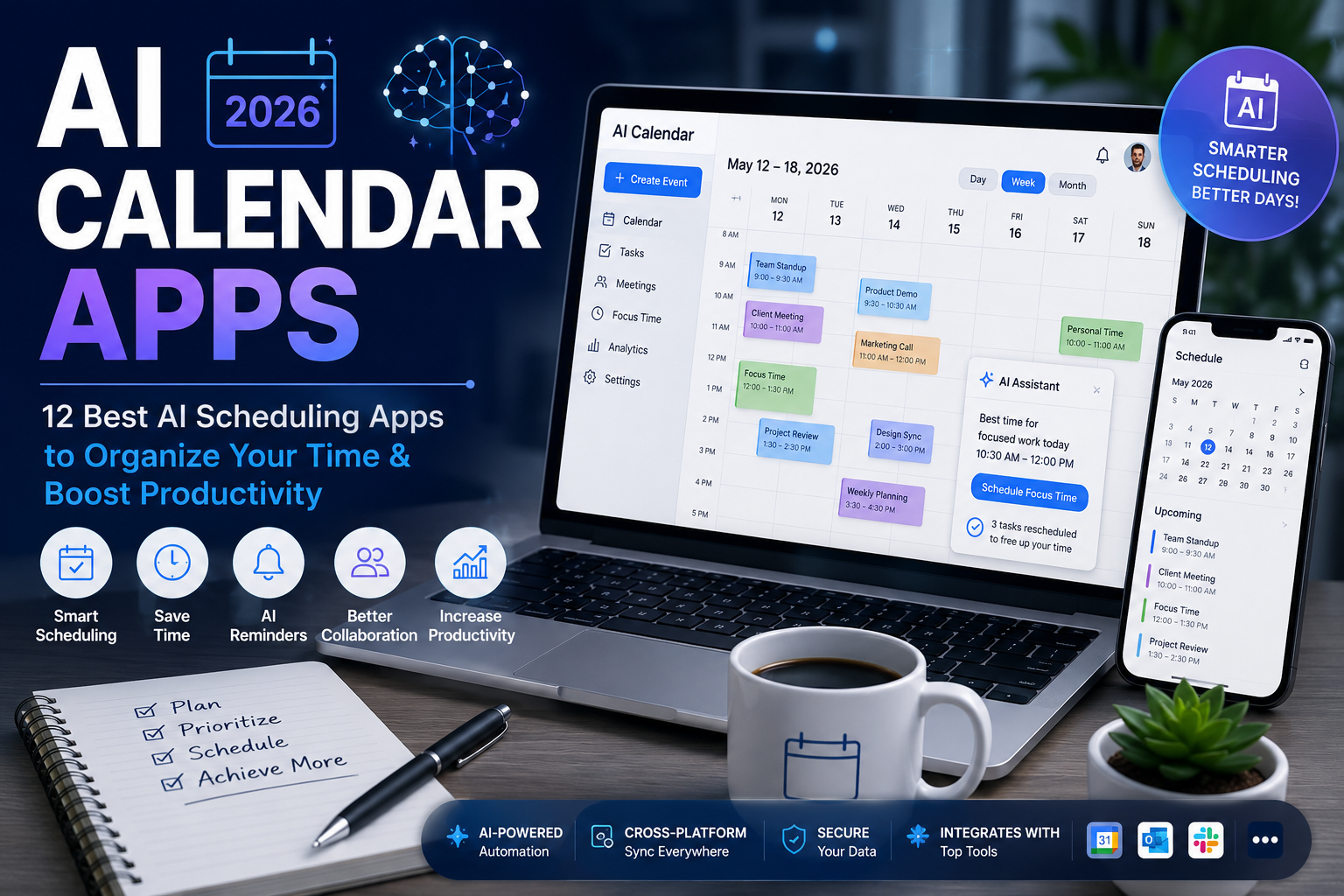
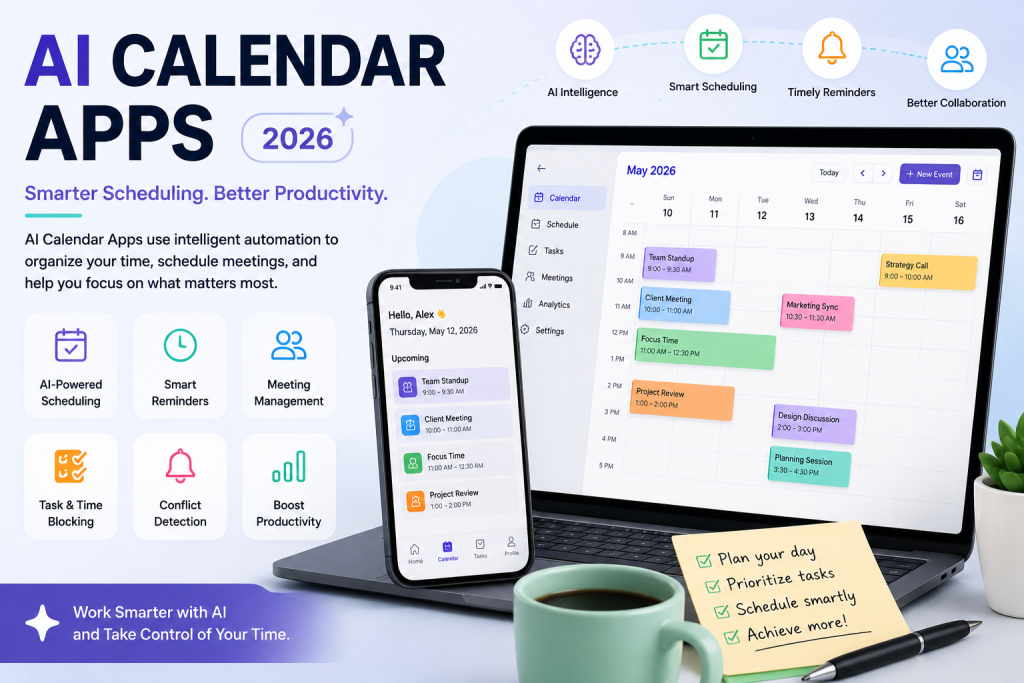
    This feature image presents a modern AI-powered scheduling workspace with a fresh pastel blue, purple, and teal color palette. It features a laptop displaying an intelligent calendar dashboard with color-coded meetings, automated task scheduling, smart reminders, and AI-powered planning features. A smartphone beside the laptop shows a daily agenda synchronized with the calendar, while surrounding elements such as productivity icons, a coffee mug, a notebook, a pen, and a small desk plant create a professional and organized workspace. The bold headline "AI Calendar Apps 2026" emphasizes smart scheduling, time management, and productivity, making this image ideal for articles about AI calendar apps, scheduling software, business productivity, remote work, and artificial intelligence tools in 2026.

    How to Choose the Best AI Calendar Apps

    Selecting the right AI calendar software depends on your workflow…

    Consider:

    • Ease of use
    • AI automation features
    • Calendar integrations
    • Mobile support
    • Team collaboration
    • Security
    • Pricing

    The best AI scheduling solutions help you stay productive without adding unnecessary complexity.


    Who Should Use AI Calendar Apps?

    These tools are useful for:

    • Students
    • Freelancers
    • Business owners
    • Sales teams
    • Executives
    • Project managers
    • Remote workers
    • Marketing professionals

    No matter your profession, these AI scheduling tools can help organize your schedule more efficiently.


    AI Calendar Trends for 2026

    The future of AI-powered scheduling is becoming more intelligent.and personalized.

    Emerging trends include:

    • Predictive scheduling
    • AI meeting summaries
    • Voice scheduling
    • Smart task prioritization
    • Automatic time blocking
    • AI work-life balance recommendations
    • Cross-platform synchronization

    Companies adopting these innovations can improve employee productivity and collaboration.


    Tips for Using AI Calendar Apps Effectively

    To get the most from AI scheduling tools:

    • Sync all your calendars
    • Enable smart reminders
    • Schedule focus time
    • Automate recurring meetings
    • Review your weekly schedule regularly

    These simple habits help maximize the value of AI-powered scheduling.


    Final Thoughts

    Using AI Calendar Apps is one of the smartest ways to improve productivity in 2026. Whether you’re managing client meetings, team projects, or personal appointments, AI-powered scheduling tools help you stay organized while saving valuable time.

    The best AI scheduling platforms combine intelligent automation, calendar integration, and personalized scheduling to simplify daily planning. By choosing the right application for your workflow, you’ll reduce scheduling conflicts, improve time management, and focus more on meaningful work instead of manual calendar organization.


    Frequently Asked Questions (FAQs)

    What are AI Calendar Apps?

    AI Calendar Apps are intelligent scheduling applications that automatically organize calendars, optimize meetings, and improve time management using artificial intelligence.

    Which AI calendar app is best?

    Popular choices include Motion, Reclaim AI, Clockwise, Google Calendar, Outlook Calendar, and Calendly.

    Are AI Calendar Apps worth using?

    Yes. They save time, reduce scheduling conflicts, automate reminders, and improve productivity for both individuals and teams.

    Can AI Calendar Apps schedule meetings automatically?

    Yes. Many AI-powered calendar applications automatically find available time slots, send invitations, and adjust schedules based on availability.

  • Free AI Productivity Tools (2026): 15 Best Free AI Tools to Boost Your Productivity

    Free AI Productivity Tools (2026): 15 Best Free AI Tools to Boost Your Productivity

    Free AI Productivity Tools (2026): 15 Best Free AI Tools to Boost Your Productivity

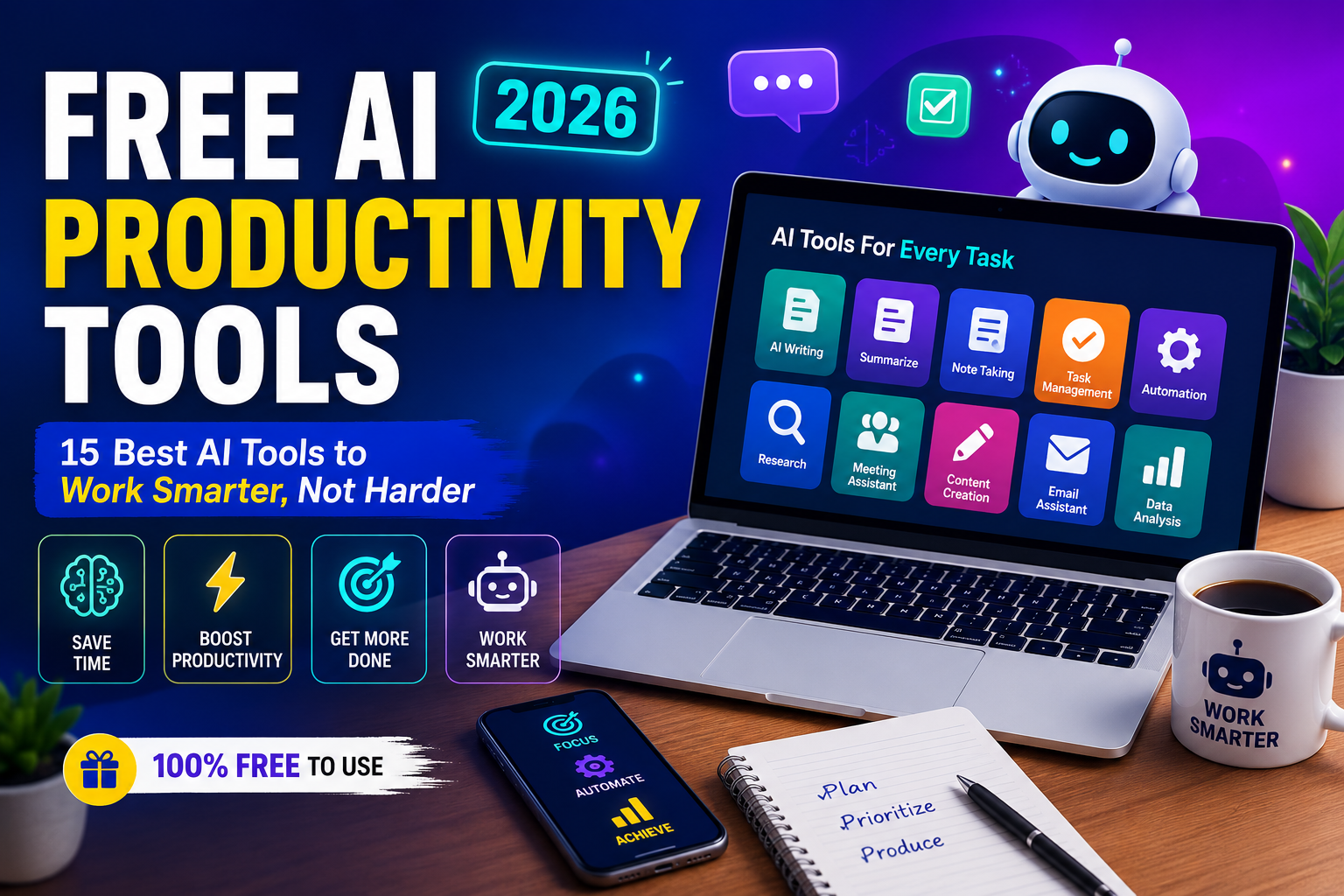
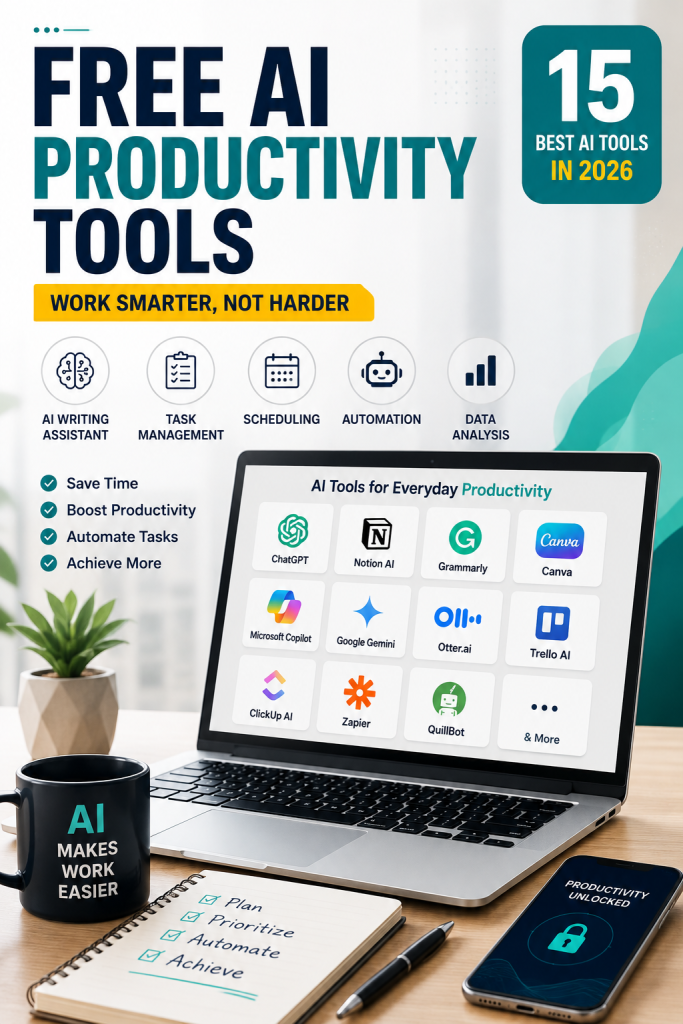
    Artificial intelligence is transforming the way people work, learn, and manage daily tasks. Whether you’re a student, freelancer, entrepreneur, or business professional, using Free AI Productivity Tools can help you save time, automate repetitive work, and improve efficiency. From writing assistants to AI meeting schedulers and task managers, the right AI productivity software allow you to accomplish more with less effort.

    In this guide, we’ll explore the best AI productivity software available in 2026, their features, and how they can help boost your productivity.


    What Are Free AI Productivity Tools?

    Free AI Productivity Tools are software applications powered by artificial intelligence that automate tasks such as writing, scheduling, note-taking, brainstorming, project management, and communication. Many of these tools offer free plans with enough features for individuals, students, and small businesses.

    Using Free AI Productivity Tools reduces manual work while increasing speed and accuracy.


    Why Use Free AI Productivity Tools?

    There are several reasons why professionals rely on AI-powered productivity tools every day.

    Benefits include:

    • Save valuable time
    • Improve workflow efficiency
    • Automate repetitive tasks
    • Increase team collaboration
    • Generate better content faster
    • Reduce human errors
    • Improve work-life balance

    As AI technology continues to evolve, these tools are becoming essential for modern workplaces.


    Best Free AI Productivity Tools in 2026

    1. ChatGPT

    ChatGPT helps users write emails, summarize documents, generate ideas, answer questions, and solve problems quickly.

    Best for:

    • Writing
    • Brainstorming
    • Research
    • Coding

    2. Notion AI

    Notion AI combines note-taking, document management, and AI writing assistance in one platform.

    Perfect for:

    • Students
    • Project managers
    • Teams
    • Business planning

    3. Grammarly

    Grammarly uses AI to improve grammar, spelling, tone, and writing clarity.

    Ideal for:

    • Emails
    • Reports
    • Blog writing
    • Business communication

    4. Google Gemini

    Google Gemini assists with research, content generation, coding, and productivity tasks using Google’s AI technology.


    5. Microsoft Copilot

    Microsoft Copilot integrates with Word, Excel, Outlook, and Teams to automate office work.


    6. Trello AI

    Trello AI helps organize projects, automate workflows, and manage team collaboration more efficiently.


    7. Canva Magic Studio

    Canva’s AI tools simplify graphic design, presentations, marketing materials, and social media content creation.


    8. Otter.ai

    Otter.ai automatically records meetings and generates searchable transcripts.

    Great for:

    • Online meetings
    • Interviews
    • Lectures

    9. ClickUp AI

    ClickUp AI improves project planning, task management, and team productivity.


    10. Zapier AI

    Zapier AI automates repetitive workflows by connecting hundreds of apps without coding.


    How to Choose the Best Free AI Productivity Tools

    Selecting the right AI productivity apps depends on your specific needs.

    Consider:

    • Ease of use
    • Free plan limitations
    • AI capabilities
    • Security
    • Integrations
    • Customer support
    • Scalability

    The best Free AI Productivity Tools solve real problems while fitting your daily workflow.


    Who Should Use Free AI Productivity Tools?

    These tools are useful for nearly everyone:

    • Students
    • Freelancers
    • Content creators
    • Small businesses
    • Entrepreneurs
    • Marketing teams
    • Developers
    • Remote workers

    No matter your profession, Free AI Productivity Tools can significantly improve efficiency.


    AI Productivity Trends for 2026

    The future of AI productivity software is becoming smarter…

    Key trends include:

    • AI assistants for every workflow
    • Voice-powered productivity
    • AI meeting summaries
    • Predictive task automation
    • Smart scheduling
    • AI-powered collaboration
    • Personalized work recommendations

    Businesses adopting these innovations will enjoy higher productivity and lower operational costs.


    Tips for Getting the Most from Free AI Productivity Tools

    To maximize results:

    • Combine multiple AI tools
    • Automate repetitive work
    • Keep your data organized
    • Review AI-generated content before publishing
    • Use AI as an assistant rather than a replacement for human judgment

    Following these practices helps you get the most value from AI productivity apps.


    Final Thoughts

    Using Free AI Productivity Tools is one of the easiest ways to improve productivity in 2026. Whether you need help writing, organizing projects, managing meetings, or automating workflows, there are excellent free AI solutions available for every type of user.

    The best AI-powered productivity solutions save time…, improve collaboration, and help individuals and businesses work more efficiently. By choosing tools that match your needs and integrating them into your daily routine, you’ll be able to accomplish more while reducing manual effort and increasing overall productivity.


    Frequently Asked Questions (FAQs)

    What are best free AI tools?

    best free AI tools are AI-powered applications that help automate tasks, improve efficiency, and simplify everyday work without requiring a paid subscription.

    Which is the best free AI productivity tool?

    Popular choices include ChatGPT, Notion AI, Grammarly, Google Gemini, Microsoft Copilot, and Canva Magic Studio.

    Are free AI productivity tools worth using?

    Yes. Many free plans provide enough features for students, freelancers, professionals, and small businesses.

    Can AI productivity tools replace human work?

    No. AI tools assist with repetitive tasks and improve efficiency, but human creativity, decision-making, and expertise remain essential.

  • SaaS Marketing Strategy (2026): The Ultimate Guide to Growing Your SaaS Business

    SaaS Marketing Strategy (2026): The Ultimate Guide to Growing Your SaaS Business

    SaaS Marketing Strategy (2026): The Ultimate Guide to Growing Your SaaS Business

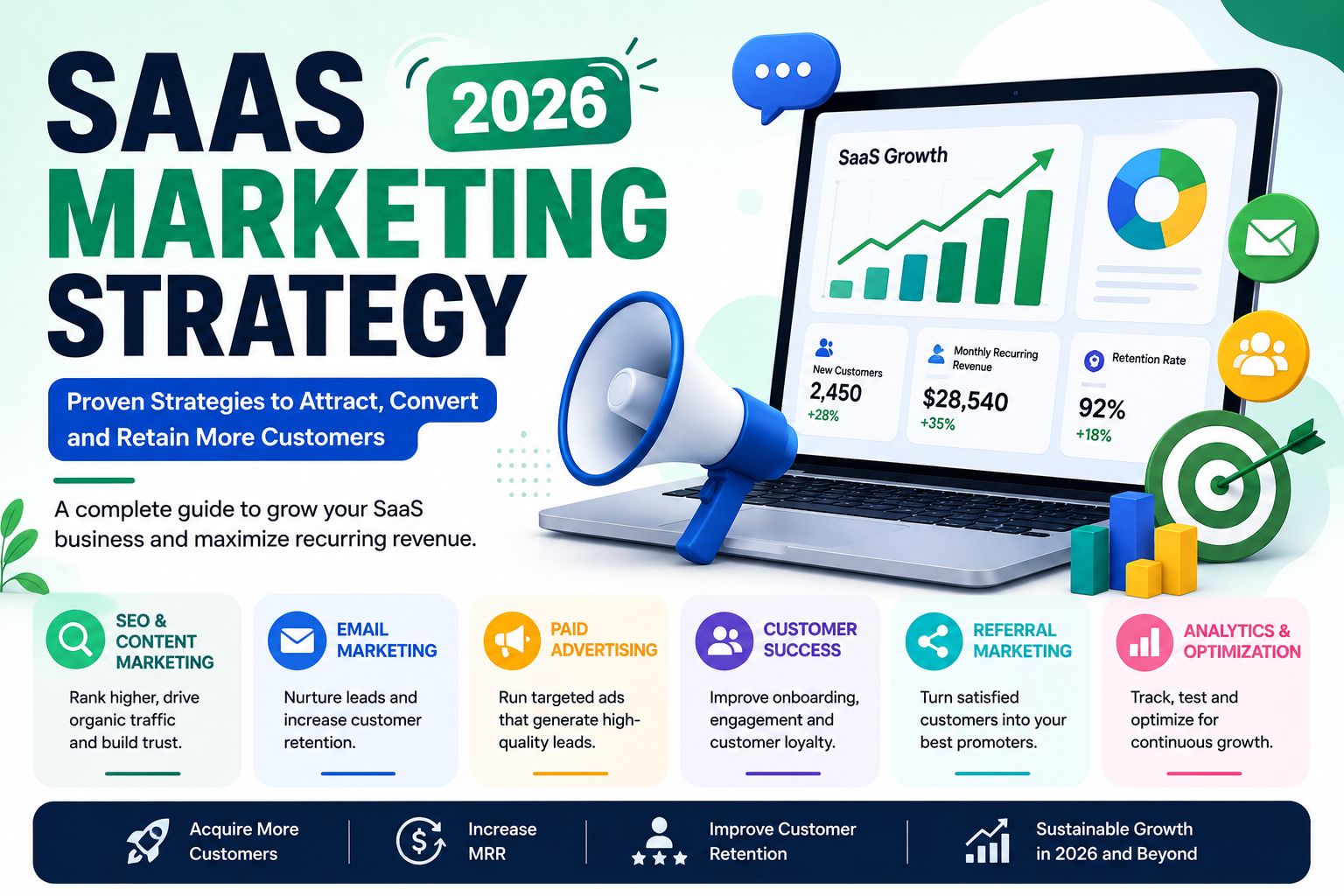
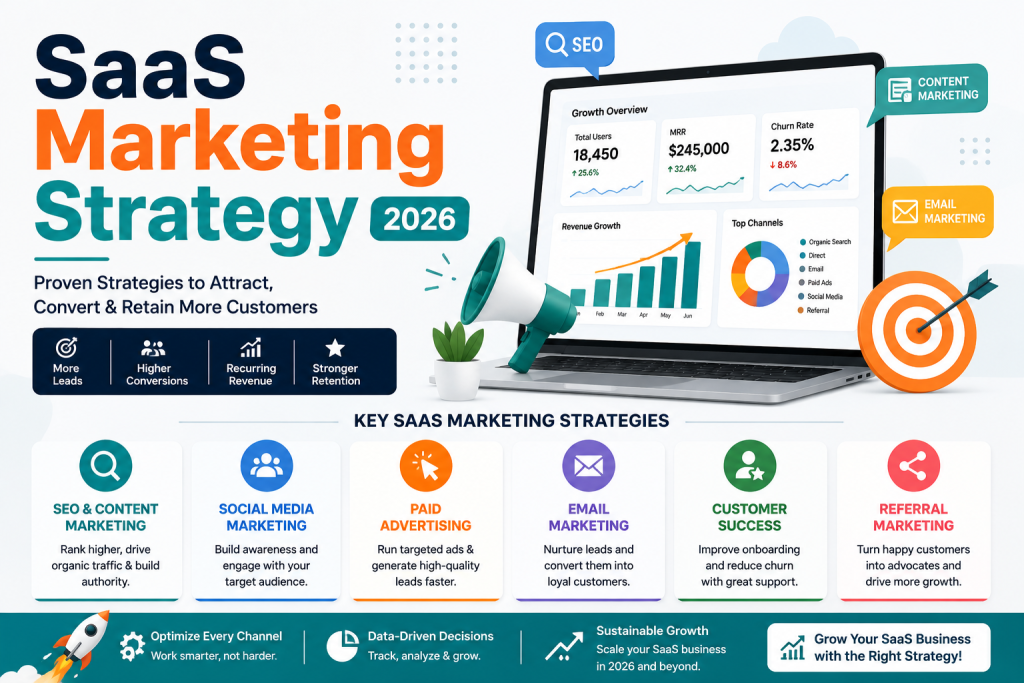
    Building a successful software company requires more than a great product—it requires a powerful SaaS Marketing Strategy. In today’s competitive software industry, businesses must attract qualified leads, convert them into paying customers, and retain them for long-term growth. A well-planned SaaS Marketing Strategy helps companies increase brand awareness, improve customer acquisition, and generate recurring revenue.

    This guide explains the best SaaS Marketing Strategy techniques for startups and established businesses targeting the US market in 2026.


    What Is a SaaS Marketing Strategy?

    A SaaS Marketing Strategy is a long-term plan used by Software-as-a-Service companies to promote their products, acquire users, increase subscriptions, and reduce customer churn. Unlike traditional marketing, SaaS marketing focuses on recurring customer relationships rather than one-time sales.

    An effective SaaS Marketing Strategy combines SEO, content marketing, email campaigns, social media, paid advertising, and customer success initiatives.


    Why a SaaS Marketing Strategy Matters

    Implementing a strong SaaS Marketing Strategy offers several advantages:

    • Generate high-quality leads
    • Increase recurring revenue
    • Improve customer retention
    • Build long-term brand authority
    • Lower customer acquisition costs (CAC)
    • Increase customer lifetime value (LTV)

    Businesses that invest in marketing consistently outperform competitors that rely only on product quality.


    Best SaaS Marketing Strategy Techniques

    1. Search Engine Optimization (SEO)

    SEO remains one of the most effective parts of any SaaS Marketing Strategy.

    Optimize your website for:

    • High-intent keywords
    • Product pages
    • Blog articles
    • Landing pages
    • Technical SEO

    Ranking on Google helps attract organic traffic without paying for every visitor.


    2. Content Marketing

    Creating valuable content strengthens your SaaS Marketing Strategy while building trust with potential customers.

    Examples include:

    • Blog posts
    • Case studies
    • Tutorials
    • Industry reports
    • Product comparisons
    • How-to guides

    Helpful content positions your brand as an industry expert.


    3. Free Trial and Freemium Plans

    Offering free access is a proven SaaS Marketing Strategy for increasing user adoption.

    Free trials allow prospects to experience your software before making a purchase decision.

    Popular examples include:

    • Canva
    • HubSpot
    • Dropbox

    4. Email Marketing

    Email marketing continues to deliver one of the highest returns on investment.

    A successful SaaS Marketing Strategy should include:

    • Welcome emails
    • Product onboarding
    • Feature announcements
    • Educational newsletters
    • Renewal reminders
    • Upsell campaigns

    Personalized emails improve engagement and customer retention.


    5. Paid Advertising

    Paid advertising accelerates growth when combined with organic marketing.

    Popular advertising channels include:

    • Google Ads
    • LinkedIn Ads
    • Facebook Ads
    • YouTube Ads
    • Microsoft Advertising

    A balanced marketing approach often combines SEO with paid campaigns for faster results.


    6. Referral Marketing

    Satisfied customers can become your best sales team.

    Referral programs encourage users to invite friends or colleagues in exchange for rewards.

    This approach lowers acquisition costs while increasing trust.


    7. Customer Success

    Customer success is an essential part of every successful SaaS business.

    Happy customers are more likely to:

    • Renew subscriptions
    • Upgrade plans
    • Leave positive reviews
    • Recommend your software

    Excellent support reduces churn and increases lifetime value.


    SaaS Marketing Strategy Channels

    Marketing ChannelPurpose
    SEOOrganic traffic
    Content MarketingBrand authority
    Email MarketingCustomer retention
    Social MediaBrand awareness
    PPC AdvertisingFast lead generation
    Referral MarketingCustomer acquisition
    WebinarsProduct education

    Using multiple channels creates a more effective marketing framework.


    Common SaaS Marketing Mistakes

    Avoid these common mistakes:

    • Ignoring SEO
    • Publishing inconsistent content
    • Poor onboarding experiences
    • Weak email automation
    • Focusing only on customer acquisition
    • Neglecting retention

    A successful marketing strategy balances attracting new customers while keeping existing ones satisfied.


    SaaS Marketing Trends for 2026

    The future of SaaS Marketing Strategy is becoming increasingly AI-driven.

    Emerging trends include:

    • AI-powered personalization
    • Predictive analytics
    • Interactive product demos
    • Video-first content marketing
    • Community-led growth
    • Product-led growth (PLG)

    Companies adopting these trends are expected to gain a competitive advantage.


    How to Build a Successful SaaS Marketing Strategy

    Follow these steps:

    1. Define your target audience.
    2. Research competitors.
    3. Optimize your website for SEO.
    4. Create valuable content consistently.
    5. Launch email automation.
    6. Run paid advertising campaigns.
    7. Track KPIs such as CAC, LTV, MRR, and churn.
    8. Continuously test and improve campaigns.

    A data-driven marketing strategy delivers better long-term results than relying on assumptions.


    Final Thoughts

    A well-designed SaaS Marketing Strategy is essential for sustainable growth in 2026. By combining SEO, content marketing, email campaigns, paid advertising, referral programs, and customer success, SaaS businesses can attract more qualified leads and build long-lasting customer relationships.

    The best SaaS Marketing Strategy focuses on delivering value at every stage of the customer journey. Businesses that consistently optimize their marketing efforts, monitor performance metrics, and adapt to changing market trends will be better positioned to increase recurring revenue and succeed in the competitive US SaaS market.


    Frequently Asked Questions (FAQs)

    What is a SaaS Marketing Strategy?

    A SaaS Marketing Strategy is a plan used by software companies to attract, convert, and retain subscription-based customers.

    Which marketing channel works best for SaaS?

    SEO, content marketing, and email marketing are among the most effective channels because they generate long-term, high-quality leads.

    Why is customer retention important in SaaS?

    Retaining customers increases recurring revenue, reduces acquisition costs, and improves overall profitability.

    How can startups improve SaaS marketing?

    Startups should focus on SEO, valuable content, free trials, email automation, and customer success to build sustainable growth.

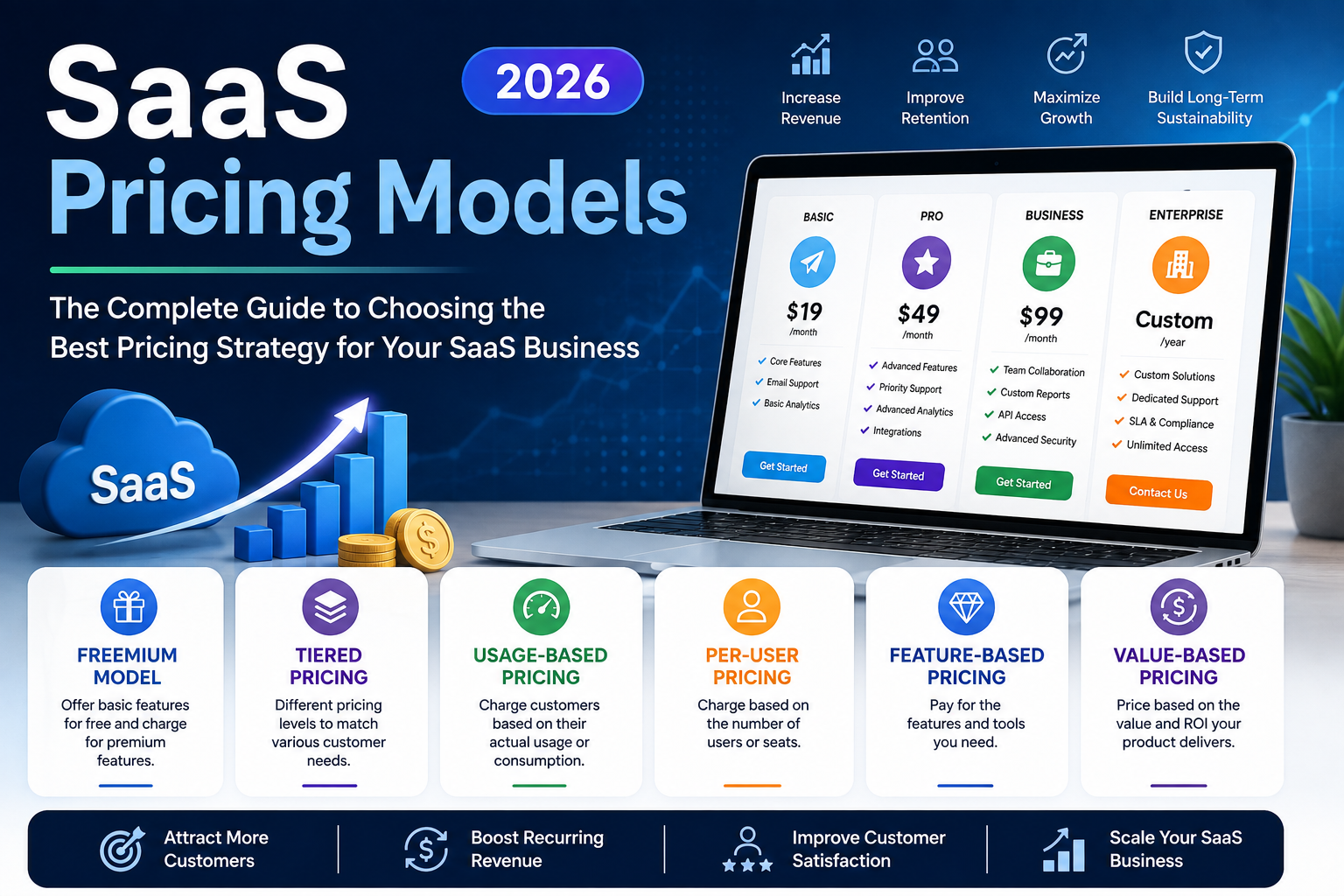
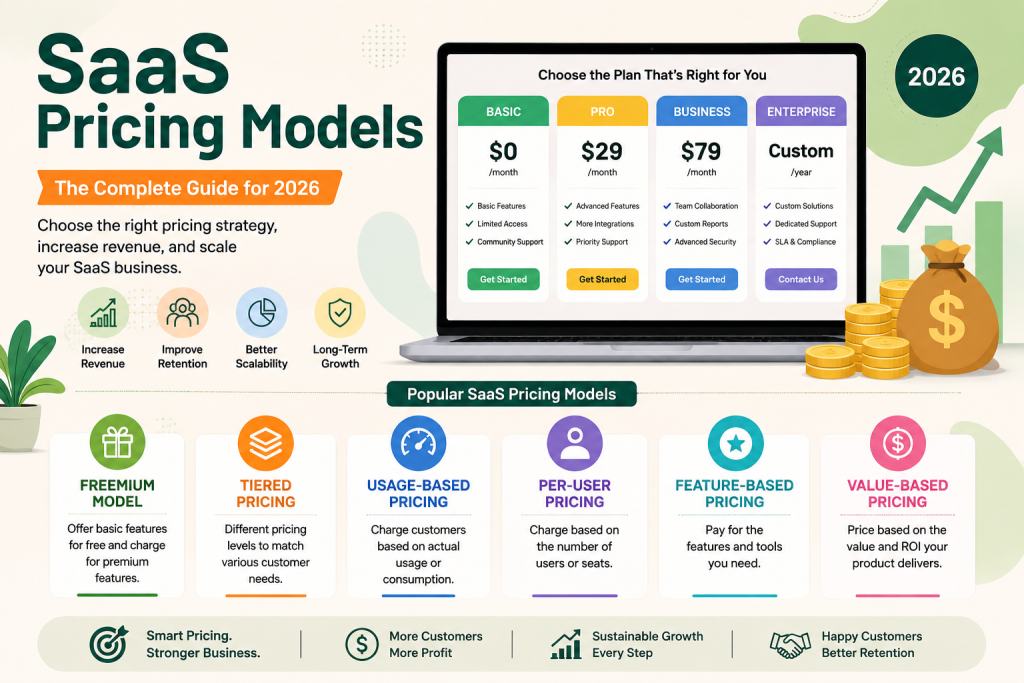
  • SaaS Pricing Models (2026): A Complete Guide to Choosing the Best Strategy

    SaaS Pricing Models (2026): A Complete Guide to Choosing the Best Strategy

    SaaS Pricing Models (2026): A Complete Guide to Choosing the Best Strategy

    Choosing the right SaaS Pricing Models is one of the most important decisions for any software business. Whether you’re launching a startup or scaling an established SaaS company, your pricing strategy directly affects customer acquisition, retention, and revenue growth. Understanding can help businesses maximize profits while delivering value to customers.

    In this guide, we’ll explore the most popular SaaS Pricing Models, their advantages and disadvantages, and how to choose the best one for your business in 2026.


    What Are SaaS Pricing Models?

    SaaS Pricing Models are the methods software companies use to charge customers for accessing their cloud-based applications. Instead of selling software with a one-time purchase, SaaS businesses typically charge recurring monthly or annual subscription fees.

    The right SaaS Pricing Models balance affordability for customers with sustainable revenue for businesses.


    Why Choosing the Right SaaS Pricing Models Matters

    Selecting effective SaaS Pricing Models can provide several benefits:

    • Increase recurring revenue
    • Improve customer retention
    • Reduce customer churn
    • Maximize customer lifetime value (LTV)
    • Support long-term business growth
    • Create predictable cash flow

    Businesses that optimize their pricing often experience faster growth than competitors with poor pricing strategies.


    Most Popular SaaS Pricing Models

    1. Freemium Model

    The Freemium approach is one of the most widely used SaaS Pricing Models.

    Users receive basic features for free while paying to unlock premium functionality.

    Examples

    • Canva
    • Zoom
    • Dropbox

    Pros

    • Easy customer acquisition
    • Large user base
    • Strong brand awareness

    Cons

    • Low free-to-paid conversion
    • Higher infrastructure costs

    2. Flat-Rate Pricing

    Flat-rate pricing offers one subscription plan with all features included.

    This type of SaaS Pricing Models works well for simple products with a clearly defined audience.

    Pros

    • Simple pricing
    • Easy marketing
    • Predictable revenue

    Cons

    • Limited flexibility
    • May not satisfy all customer segments

    3. Tiered Pricing

    Tiered pricing is among the most effective SaaS Pricing Models because it serves different customer groups.

    Example:

    • Basic Plan
    • Professional Plan
    • Business Plan
    • Enterprise Plan

    Benefits

    • Higher conversion rates
    • Upselling opportunities
    • Better customer segmentation

    4. Usage-Based Pricing

    Usage-based pricing charges customers according to how much they use the software.

    Examples include:

    • API requests
    • Storage usage
    • Emails sent
    • Active users

    This model is becoming increasingly popular among cloud software companies.


    5. Per-User Pricing

    Many B2B companies rely on per-user SaaS Pricing Models.

    Businesses pay based on the number of employees or team members using the software.

    Advantages

    • Easy to understand
    • Predictable billing
    • Scales with business growth

    6. Feature-Based Pricing

    Feature-based pricing allows businesses to unlock additional capabilities as customers upgrade.

    Example:

    Basic Plan

    • Core features

    Pro Plan

    Enterprise Plan

    • Custom integrations
    • Dedicated support

    SaaS Pricing Models Comparison

    Pricing ModelBest ForFlexibility
    FreemiumStartupsHigh
    Flat RateSmall ProductsMedium
    TieredGrowing SaaSExcellent
    Usage-BasedCloud PlatformsExcellent
    Per UserB2B SoftwareHigh
    Feature-BasedPremium SoftwareHigh

    Understanding these SaaS Pricing Models helps businesses select the right monetization strategy.


    How to Choose the Best SaaS Pricing Models

    Choosing between different SaaS Pricing Models depends on several factors:

    Consider Your Target Audience

    Small businesses often prefer affordable monthly subscriptions.

    Large enterprises expect customized pricing with advanced support.

    Analyze Your Competitors

    Study pricing pages from successful SaaS companies to understand customer expectations.

    Understand Customer Value

    Price your software according to the value it delivers rather than development costs alone.

    Test Different Pricing Strategies

    Many successful SaaS companies continuously experiment with pricing to improve conversions.


    SaaS Pricing Trends in 2026

    The future of SaaS Pricing Models is becoming more flexible and AI-driven.

    Key trends include:

    • AI-powered personalized pricing
    • Hybrid subscription models
    • Usage-based billing
    • Annual payment discounts
    • Customer-based pricing
    • Enterprise custom pricing

    Businesses that adapt to these trends will remain competitive in the rapidly evolving SaaS industry.


    Common Pricing Mistakes to Avoid

    Avoid these mistakes when implementing your pricing strategy.

    • Offering too many pricing plans
    • Underpricing premium features
    • Ignoring customer feedback
    • Not testing pricing changes
    • Making upgrades confusing

    A clear and transparent pricing structure builds trust and improves conversions.


    Final Thoughts

    Choosing the right pricing model is essential for building a profitable software business in 2026.. Whether you select Freemium, Tiered, Usage-Based, Per-User, Flat-Rate, or Feature-Based pricing, your strategy should align with customer needs and business goals.

    The best focus on delivering value while creating predictable recurring revenue. Regularly reviewing customer behavior, testing pricing strategies, and adapting to market trends will help your SaaS business stay competitive and continue growing.


    Frequently Asked Questions (FAQs)

    What are SaaS Pricing Models?

    SaaS Pricing Models are strategies software companies use to charge customers through recurring subscriptions or usage-based billing.

    Which SaaS pricing model is best?

    Tiered pricing is one of the most popular because it serves multiple customer segments and supports upselling.

    What is usage-based pricing?

    Usage-based pricing charges customers based on their actual software usage, such as API calls, storage, or active users.

    Why is pricing important for SaaS companies?

    Effective pricing improves revenue, customer retention, and long-term business growth.

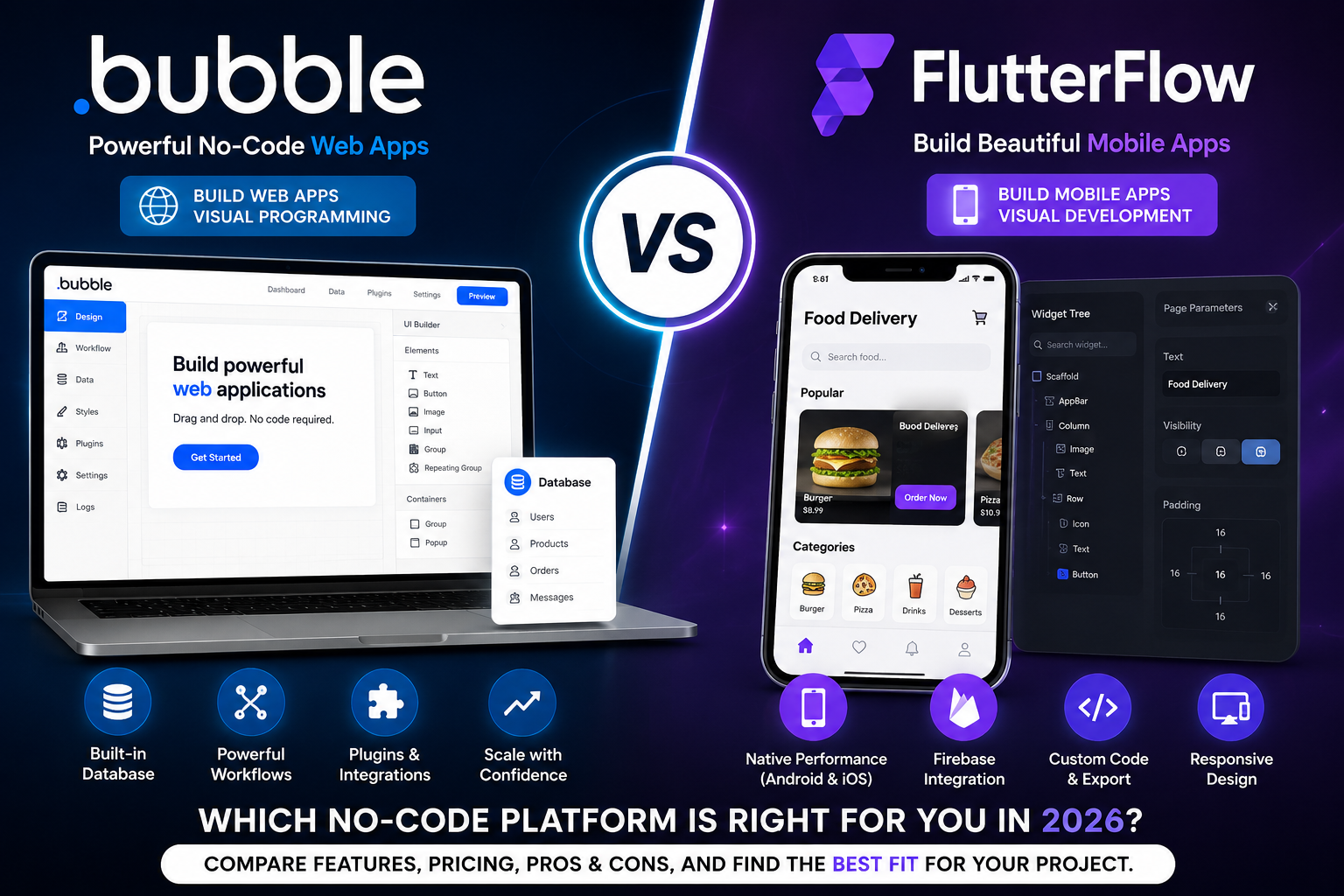
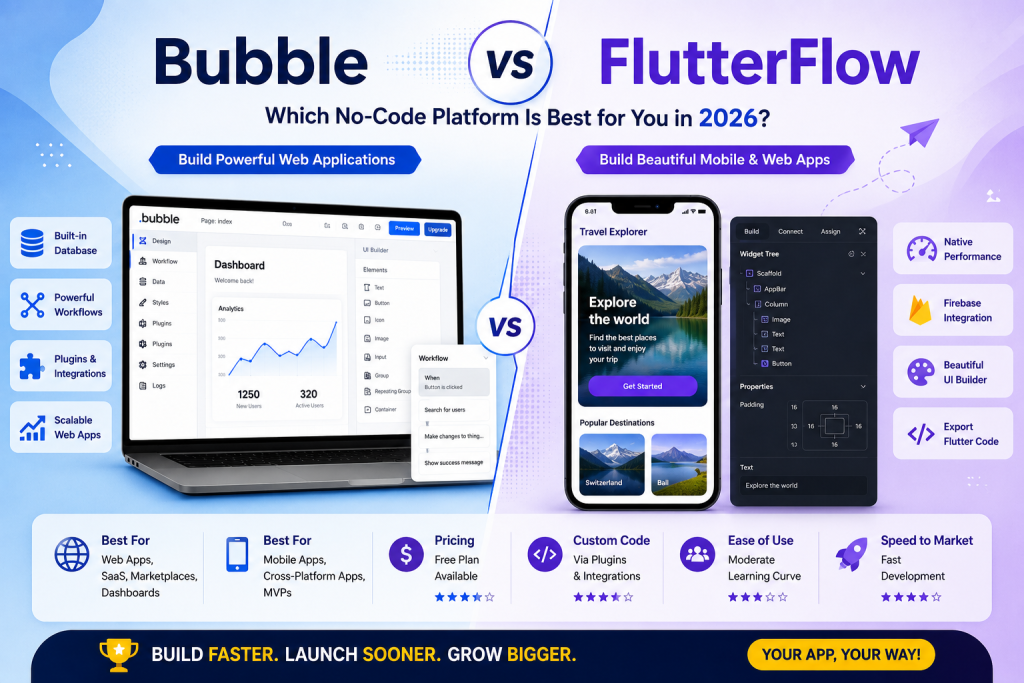
  • Bubble vs FlutterFlow (2026): Which No-Code App Builder Is Better?

    Bubble vs FlutterFlow (2026): Which No-Code App Builder Is Better?

    Bubble vs FlutterFlow (2026): Which No-Code App Builder Is Better?

    Choosing the right no-code platform can significantly impact how quickly and efficiently you build your application. The debate around Bubble vs FlutterFlow has become increasingly popular because both platforms offer powerful no-code solutions while serving different development needs. Whether you’re building a SaaS product, a mobile app, or an MVP, understanding Bubble vs FlutterFlow will help you make the right decision.

    This guide compares Bubble vs FlutterFlow based on features, pricing, ease of use, performance, scalability, and ideal use cases for the US market in 2026.


    What Is Bubble?

    When comparing Bubble vs FlutterFlow, Bubble is known as one of the most powerful no-code web application builders available today.

    Bubble allows users to create fully functional web applications using a drag-and-drop interface without writing code. It includes built-in databases, workflows, authentication, APIs, and deployment tools.

    Best For

    • SaaS products
    • Marketplaces
    • CRM software
    • Internal business tools
    • Startup MVPs

    What Is FlutterFlow?

    Another important part of Bubble vs FlutterFlow is FlutterFlow, a visual app builder based on Google’s Flutter framework.

    FlutterFlow helps users create native Android, iOS, and web applications with professional UI components while allowing developers to export Flutter code if needed.

    Best For

    • Mobile applications
    • Cross-platform apps
    • Startup mobile MVPs
    • E-commerce apps
    • Enterprise mobile solutions

    Bubble vs FlutterFlow: Feature Comparison

    FeatureBubbleFlutterFlow
    Primary FocusWeb AppsMobile Apps
    Drag-and-Drop Builder✅✅
    Native Mobile AppsLimitedExcellent
    DatabaseBuilt-inFirebase & Supabase
    API IntegrationExcellentExcellent
    Custom CodePluginsFlutter Code Export
    Learning CurveModerateEasy to Moderate
    ScalabilityHighHigh

    This comparison highlights the major differences in Bubble vs FlutterFlow.


    Ease of Use

    One of the biggest factors in Bubble vs FlutterFlow is usability.

    Bubble offers extensive customization, but beginners may need more time to learn its workflow editor.

    FlutterFlow provides a modern visual interface that is easier for users who want to create beautiful mobile applications quickly.

    If your focus is mobile development, FlutterFlow offers a smoother learning experience.


    Performance

    Performance is another important factor in Bubble vs FlutterFlow.

    Bubble performs exceptionally well for browser-based applications, dashboards, marketplaces, and SaaS platforms.

    FlutterFlow generates Flutter applications, delivering near-native performance on Android and iOS devices.

    If mobile speed is your priority, FlutterFlow has the advantage.


    Customization and Flexibility

    When evaluating Bubble vs FlutterFlow, customization plays a major role.

    Bubble Strengths

    • Powerful workflow automation
    • Built-in database
    • Thousands of plugins
    • Complex logic
    • Marketplace support

    FlutterFlow Strengths

    • Custom Flutter code export
    • Firebase integration
    • Beautiful UI components
    • Responsive mobile layouts
    • Native app performance

    Both platforms provide flexibility, but the best choice depends on your project.


    Pricing Comparison

    Pricing also matters when choosing between Bubble vs FlutterFlow.

    Bubble

    • Free plan available
    • Affordable starter plans
    • Enterprise options

    FlutterFlow

    • Free plan available
    • Developer-friendly pricing
    • Premium plans with code export

    Both platforms offer competitive pricing for startups and small businesses.


    Bubble vs FlutterFlow: Pros and Cons

    Bubble Pros

    • No coding required
    • Powerful web app builder
    • Large plugin ecosystem
    • Built-in backend
    • Strong community

    Bubble Cons

    • Limited native mobile capabilities
    • Slightly steeper learning curve

    FlutterFlow Pros

    • Native Android and iOS apps
    • Beautiful UI builder
    • Flutter code export
    • Firebase integration
    • Faster mobile development

    FlutterFlow Cons

    • More focused on mobile than web
    • Advanced backend features may require additional setup

    Which Platform Should You Choose?

    The answer to Bubble vs FlutterFlow depends on your goals.

    Choose Bubble if:

    • You want to build SaaS software.
    • You need a marketplace.
    • You’re creating CRM software.
    • You need advanced workflow automation.

    Choose FlutterFlow if:

    • You want Android and iOS apps.
    • Mobile performance is your priority.
    • You plan to export Flutter code.
    • You want a professional mobile UI.

    Choosing the right platform depends on your project type rather than which tool is universally better.


    Final Verdict

    The Bubble vs FlutterFlow comparison shows that both platforms are excellent no-code solutions, but they serve different purposes. Bubble is the better choice for powerful web applications with built-in databases and complex workflows, while FlutterFlow excels at creating high-performance mobile apps with Flutter.

    For startups building SaaS platforms or internal business tools, Bubble remains a top option. For businesses focused on mobile experiences, FlutterFlow provides greater flexibility and native performance. In 2026, both platforms continue to lead the no-code development industry and are excellent choices depending on your project requirements.


    Frequently Asked Questions (FAQs)

    Which is better, Bubble or FlutterFlow?

    Bubble is ideal for web applications, while FlutterFlow is better for native mobile app development.

    Can I build a SaaS product with Bubble?

    Yes. Bubble is widely used to build SaaS platforms, marketplaces, and CRM systems.

    Is FlutterFlow good for beginners?

    Yes. FlutterFlow offers a user-friendly interface with drag-and-drop tools that make mobile app development easier.

    Which platform is better for startups?

    It depends on your product. Bubble is better for web-based startups, while FlutterFlow is ideal for mobile-first startups.