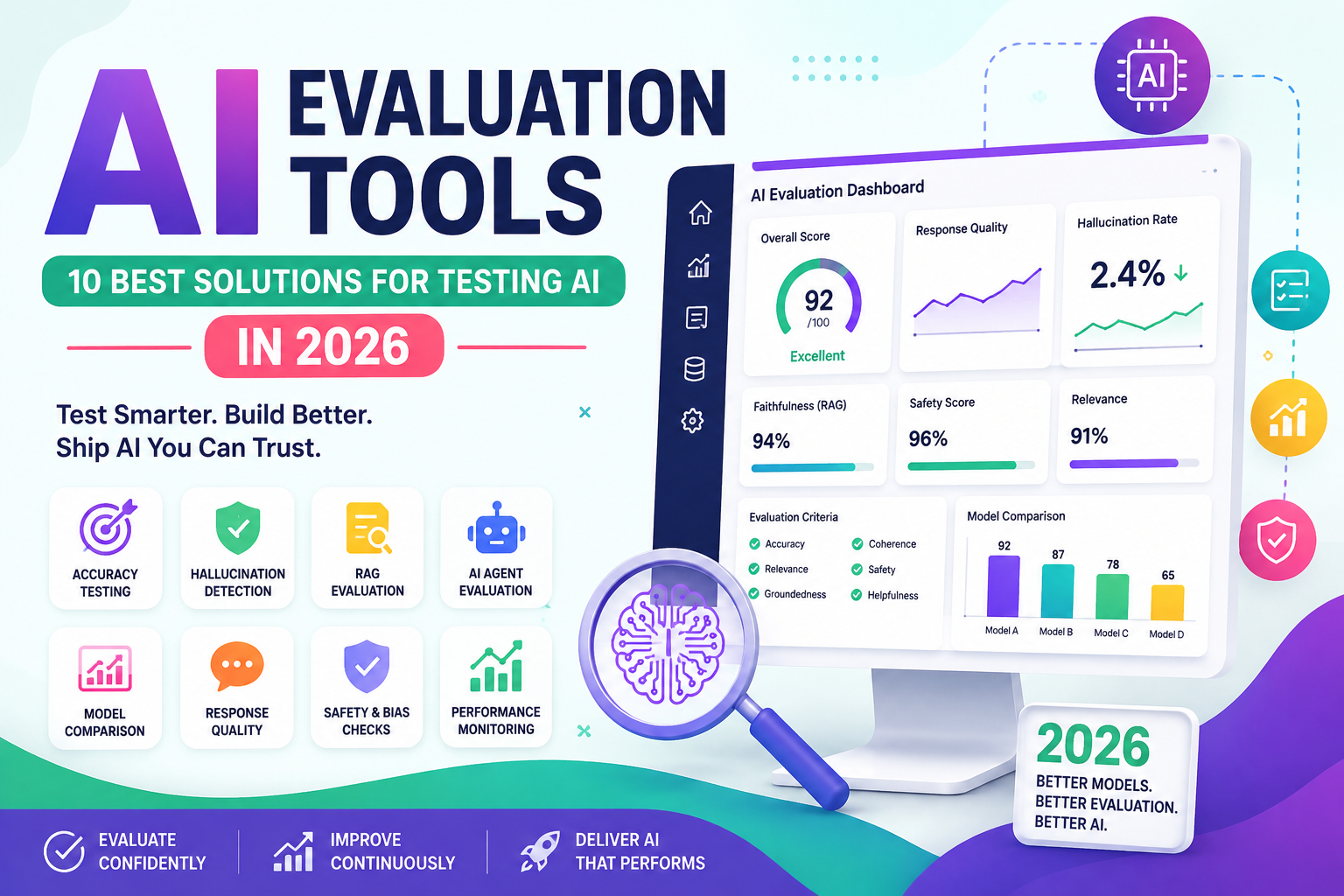
AI Evaluation Tools: 10 Best Solutions for Testing AI in 2026
Artificial intelligence is becoming part of customer service, software development, healthcare, finance, marketing, and enterprise operations. But building an AI application is only the beginning. Businesses also need to know whether their models are accurate, reliable, safe, relevant, and consistent.
This is where AI Evaluation Tools become valuable. They help developers and AI teams test model outputs, compare prompts, detect hallucinations, evaluate RAG applications, measure agent performance, and identify quality problems before they affect users.
In 2026, AI evaluation is moving from basic experimentation toward continuous testing throughout the AI development lifecycle. Google Cloud, for example, describes evaluation as a way to assess generative AI models using metrics, rubrics, datasets, and model comparisons.
What Are AI Evaluation Tools?
AI Evaluation Tools are software platforms and frameworks designed to measure the quality and performance of artificial intelligence systems.
Traditional software testing often checks whether an application produces an expected output. AI applications are more complicated because an answer can be technically valid while still being inaccurate, irrelevant, unsafe, or poorly written.
Evaluation systems can measure factors such as:
- Accuracy
- Relevance
- Groundedness
- Hallucination
- Safety
- Helpfulness
- Instruction following
- Response consistency
- Tool-call accuracy
- Agent performance
Modern evaluation services can use predefined metrics, custom criteria, adaptive rubrics, deterministic calculations, and model-based scoring.
Why AI Evaluation Matters in 2026
AI models can change behavior after a prompt update, model migration, retrieval change, or system modification. A response that looked excellent during development may perform poorly with real-world queries.
This makes continuous evaluation essential.
For example, a company might change its language model to reduce costs. The new model may be faster and cheaper but produce more hallucinations. Without a proper evaluation process, the business may not discover the problem until customers complain.
Evaluation gives teams measurable evidence instead of relying entirely on manual inspection or subjective opinions. Current industry comparisons emphasize the importance of repeatable evaluations for detecting regressions and validating AI applications before production.
Key Features to Look For
1. Automated Testing
One of the most useful capabilities is automated testing. Teams can create a dataset containing questions, expected behaviors, or reference answers and repeatedly test their AI system.
Automated evaluation makes it easier to compare different prompts, models, and application versions.
2. LLM-as-a-Judge Evaluation
Some platforms use another language model to evaluate an AI-generated response according to predefined criteria.
For example, an evaluator can score whether an answer is relevant, helpful, factual, or aligned with instructions.
This approach is particularly useful when there is no simple mathematical answer. However, teams should validate evaluator reliability and avoid treating automated scores as perfect ground truth.
3. Hallucination Detection
Hallucinations remain an important concern for generative AI applications.
An evaluation workflow can test whether responses are supported by provided information and whether the system invents unsupported claims.
This is particularly important for RAG applications, enterprise knowledge assistants, and customer-support systems.
4. RAG Evaluation
Retrieval-augmented generation introduces multiple potential failure points. The system might retrieve irrelevant documents, miss important information, or generate an incorrect response from otherwise useful context.
AI Evaluation Tools can assess retrieval quality and response groundedness separately, helping developers determine whether the problem originates in retrieval or generation.
Google Cloud’s evaluation documentation specifically includes evaluation workflows for generative AI systems and supports datasets created from production logs, uploaded examples, and synthetic data.
5. AI Agent Evaluation
AI agents are more difficult to evaluate than simple chatbots because they can perform multiple actions.
An agent may search a database, call an API, use a calculator, retrieve documents, and then generate a final response.
Evaluation should therefore examine not only the final answer but also the agent’s intermediate actions, tool calls, and overall task completion.
Recent evaluation platforms increasingly support agent and multi-step workflow testing.
6. Prompt Testing and Regression Testing
Prompt changes can unexpectedly improve one scenario while damaging another.
A strong evaluation workflow allows developers to compare prompt versions against the same test dataset. This makes it easier to identify improvements and prevent regressions.
For production teams, evaluation can become part of CI/CD so that significant quality problems are detected before a new version is released.
Popular AI Evaluation Tools in 2026
The market includes open-source frameworks, managed platforms, RAG-focused solutions, and tools designed for production monitoring.
Popular options include:
- DeepEval — useful for open-source LLM evaluation and metric-based testing
- Promptfoo — useful for prompt testing, regression testing, and security-oriented evaluations
- Ragas — focused strongly on RAG evaluation
- LangSmith — useful for evaluation and testing within LangChain-based workflows
- Braintrust — designed around evaluation workflows and experiments
- Arize Phoenix — combines observability, tracing, and evaluation
- Comet Opik — supports evaluation and monitoring of LLM applications
- Confident AI — provides evaluation capabilities for RAG, agents, and conversational systems
- Google Cloud Gen AI Evaluation — provides model evaluation using metrics, rubrics, datasets, and comparisons
Current 2026 comparisons show that these platforms differ in their focus, including open-source development, RAG testing, agent evaluation, production workflows, and managed evaluation.
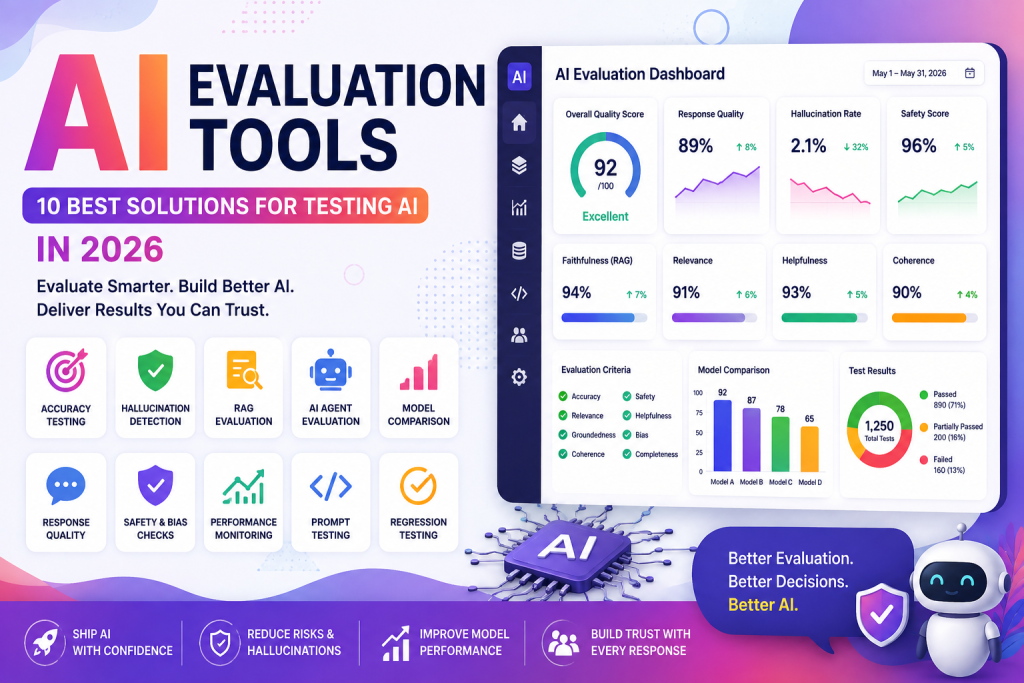
Benefits for Businesses
Using AI Evaluation Tools can provide several advantages:
- More reliable AI responses
- Faster testing
- Better model selection
- Reduced hallucinations
- Improved RAG performance
- Safer AI applications
- Easier prompt optimization
- Automated regression detection
- Better development workflows
- Measurable AI quality
For organizations serving large numbers of customers, these benefits can translate into better user experiences and fewer costly AI failures.
How to Choose the Right Tool
Before selecting an evaluation platform, consider your specific application.
If you are building a RAG chatbot, prioritize retrieval and groundedness metrics. If you are developing an autonomous agent, look for multi-step tracing and task-completion evaluation.
For teams working with several models, model comparison and experiment management can be particularly valuable.
Also consider:
- Open-source vs. managed deployment
- Integration with your existing stack
- Custom evaluation metrics
- Human review capabilities
- Dataset management
- CI/CD integration
- Production monitoring
- Privacy and security
- Pricing and scalability
The best platform is not necessarily the one with the longest feature list. It is the one that fits your development workflow and produces useful evidence about AI quality.
Future of AI Evaluation
The future of AI Evaluation Tools will move toward continuous, automated, and application-specific testing.
Instead of evaluating a model only before launch, organizations will increasingly evaluate AI systems throughout their entire lifecycle. Production data, user feedback, automated judges, human reviewers, and specialized metrics can work together to provide a more complete picture.
Google’s current evaluation service supports model comparisons, prompt optimization, custom criteria, adaptive rubrics, and evaluation datasets, demonstrating how evaluation is becoming integrated into the broader AI development process.
Conclusion
AI Evaluation Tools are becoming essential for teams that want to build dependable AI applications in 2026. They help developers measure accuracy, relevance, safety, groundedness, hallucinations, agent behavior, and overall application quality.
The most effective strategy is to combine automated testing with carefully designed datasets, meaningful metrics, human review, and continuous monitoring.
As AI applications become more complex, businesses will need more than impressive demos. They will need measurable evidence that their AI systems work reliably in real-world situations.