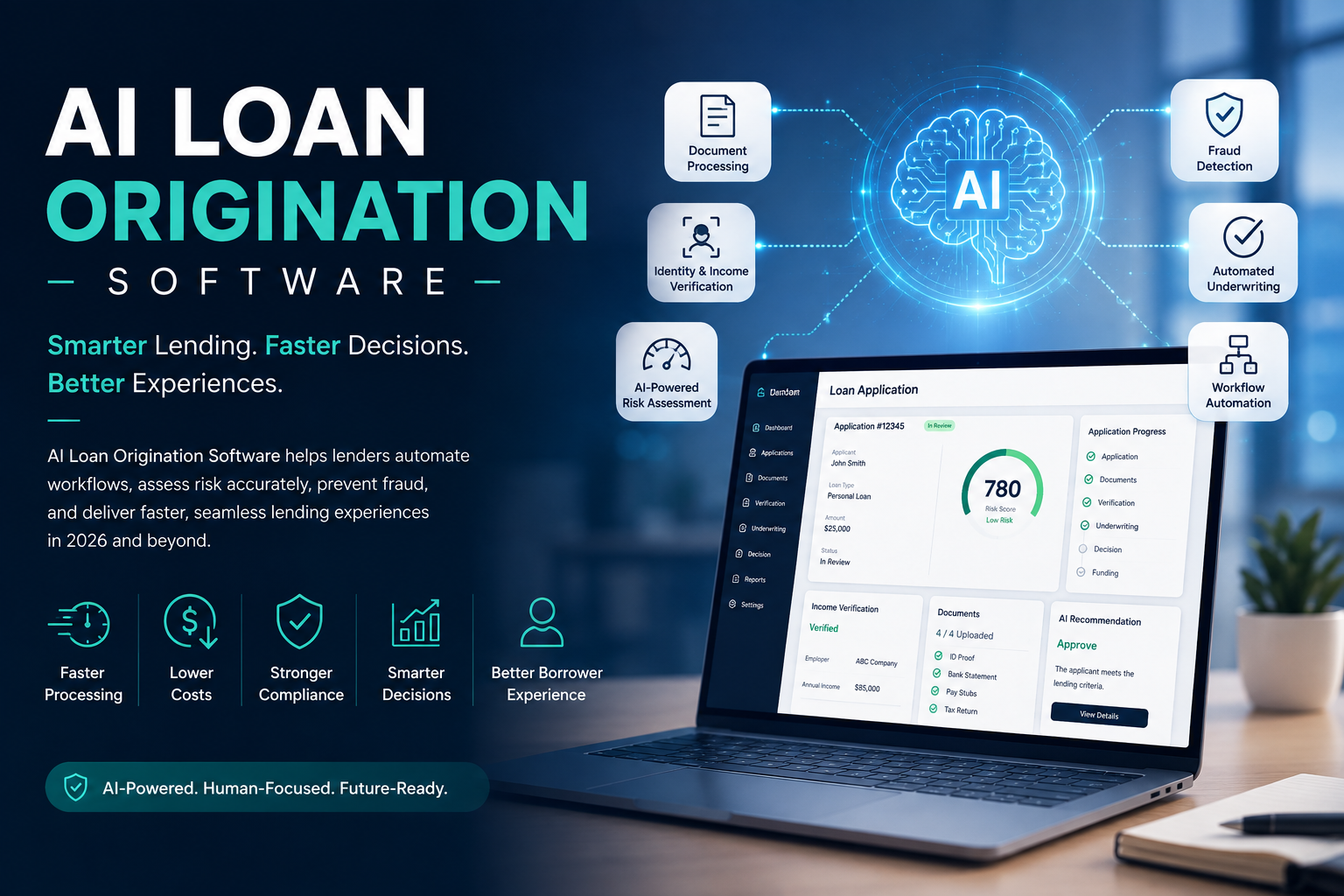
AI Loan Origination Software: How AI Is Transforming Lending in 2026
The lending industry is becoming increasingly digital, and borrowers now expect applications, verification, approvals, and funding to happen faster than ever. At the same time, lenders need accurate risk assessments, strong compliance controls, efficient workflows, and better fraud protection. AI Loan Origination Software is helping financial institutions modernize these processes by combining artificial intelligence, machine learning, automation, and data analysis.
In 2026, AI-powered lending is becoming especially important for banks, credit unions, fintech companies, mortgage lenders, and alternative lenders looking to reduce manual work while delivering faster and more consistent lending experiences.
What Is AI Loan Origination Software?
AI Loan Origination Software is technology that uses artificial intelligence to automate and improve stages of the loan origination process, from application intake to underwriting, verification, decision support, and document processing.
Traditional loan origination often requires employees to collect documents, enter data, verify information, review applications, and communicate with applicants. AI can automate many repetitive steps while providing lenders with data-driven insights.
Depending on the platform, an AI-powered lending system may support:
- Digital loan applications
- Document processing
- Income and employment verification
- Credit risk assessment
- Fraud detection
- Underwriting support
- Decision automation
- Compliance checks
- Workflow management
- Applicant communication
The objective is to make lending faster and more efficient without removing appropriate human oversight.
Why AI Loan Origination Software Matters in 2026
Modern borrowers expect a convenient digital experience. Long application processes and repeated document requests can cause applicants to abandon applications before completing them.
AI Loan Origination Software can streamline the borrower journey by automating information collection, extracting data from uploaded documents, identifying missing information, and routing applications to the appropriate workflow.
For lenders, automation can reduce processing time and administrative costs. For borrowers, it can create faster and more transparent application experiences.
The technology is particularly useful as lenders manage increasing application volumes across mortgages, personal loans, auto financing, small-business lending, and other credit products.
How AI Loan Origination Works
1. Digital Application Intake
The process typically starts with an online application. AI-powered systems can guide applicants through required fields and identify incomplete information before submission.
Natural-language processing can also help interpret information provided in free-text fields.
2. Intelligent Document Processing
Borrowers may need to submit bank statements, tax documents, pay stubs, identification, and other records.
AI document processing can extract important information from these files and organize it automatically. This can reduce manual data entry and make applications easier for underwriting teams to review.
3. Automated Verification
AI can help lenders verify information such as income, employment, identity, and financial activity using permitted data sources and established verification workflows.
Automated verification can reduce repetitive tasks and allow employees to focus on cases that require additional review.
4. AI-Powered Risk Assessment
AI Loan Origination Software can analyze multiple factors to support credit risk assessment. Depending on the product and applicable rules, these may include credit history, income-related information, debt obligations, repayment patterns, and other relevant data.
Machine learning can identify relationships across large datasets and help lenders prioritize applications according to risk.
5. Decision Support
AI can generate recommendations or risk scores based on predefined policies and validated models. Lenders can use these insights to support approval, referral, or decline decisions.
For consumer credit, however, automated decision-making must operate within applicable fair-lending and adverse-action requirements. The CFPB has stated that creditors using complex algorithms still need to provide specific and accurate reasons for adverse credit decisions. (consumerfinance.gov)
Benefits of AI Loan Origination Software
Financial institutions can gain several advantages from intelligent loan origination.
Faster Processing
Automating document extraction, verification, and workflow routing can reduce the time required to review applications.
Lower Operational Costs
Employees can spend less time on repetitive data-entry and document-review tasks.
Better Consistency
Automated workflows can apply the same processes and business rules across applications, helping reduce avoidable manual variation.
Improved Fraud Detection
AI can analyze application information, device signals, identity information, and behavioral patterns to identify potential inconsistencies or suspicious activity.
Better Customer Experience
A faster application process with fewer repetitive requests can create a more convenient digital lending journey.
Greater Scalability
Automation allows lenders to handle larger application volumes without increasing manual workloads at the same rate.
AI Loan Origination for Different Lending Products
Mortgage Lending
Mortgage applications involve extensive documentation and verification. AI can support document classification, data extraction, income analysis, and workflow automation.
Personal Loans
For personal lending, AI can help automate applications, identity verification, risk assessment, and decision workflows.
Auto Loans
Automated processing can help lenders assess applications and move qualified borrowers through approval more efficiently.
Small-Business Lending
Small-business applicants may have complex financial records. AI can help organize financial information, analyze cash-flow data, and support underwriting workflows.
AI and Fraud Prevention During Origination
Fraud prevention is a major part of modern lending. AI Loan Origination Software can examine application information for inconsistencies and identify potentially suspicious patterns.
For example, a system may detect unusual combinations of identity data, device information, application behavior, or financial records.
This does not mean every unusual application is fraudulent. Instead, AI can prioritize cases for additional verification or human investigation.
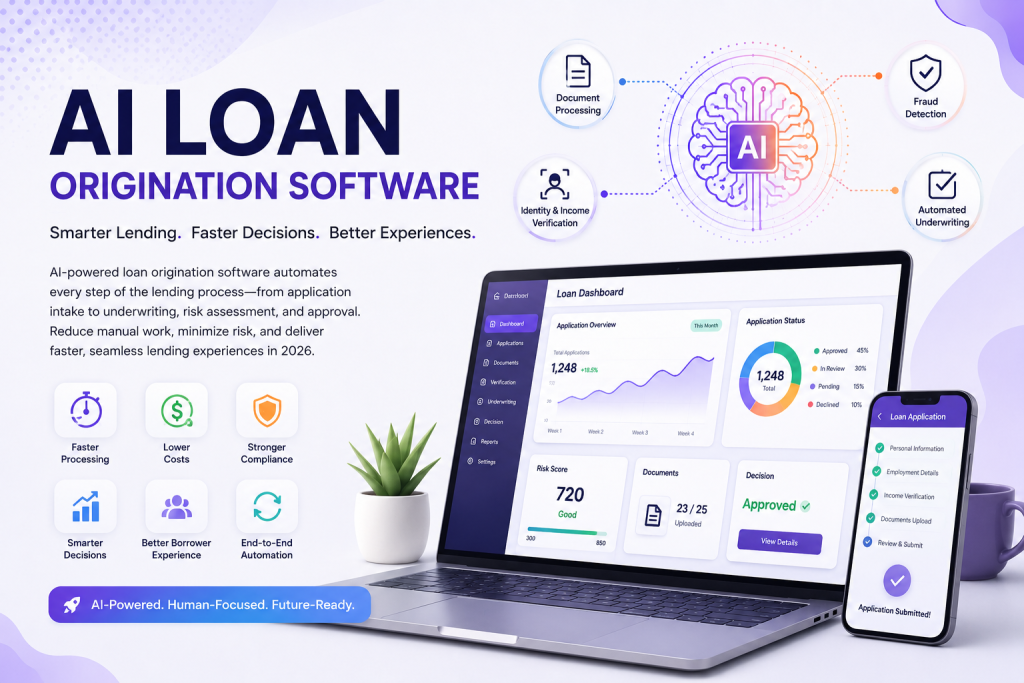
Compliance and Responsible AI
Lending decisions can have significant financial consequences, so governance is essential.
Organizations should consider fairness, explainability, privacy, cybersecurity, model validation, and documentation when implementing AI-powered lending systems.
The CFPB has emphasized that lenders cannot avoid existing credit laws simply because an automated or complex model is being used. (consumerfinance.gov)
The NIST AI Risk Management Framework can also provide a useful foundation for organizations seeking structured approaches to identifying and managing AI-related risks. (nist.gov)
Challenges of AI Loan Origination
Despite its advantages, AI Loan Origination Software has several implementation challenges.
Data quality: Poor or incomplete data can reduce the accuracy of AI models.
Model bias: Historical data may contain patterns that produce unfair outcomes if models are not carefully tested.
Explainability: Lenders need to understand and document why automated systems produce certain results.
Security: Loan applications contain sensitive personal and financial information that requires strong protection.
Integration: AI systems must often connect with loan origination systems, credit bureaus, core banking platforms, document systems, and compliance tools.
Model drift: Changes in economic conditions or borrower behavior can affect model performance over time.
How to Choose the Right Platform
Before choosing AI Loan Origination Software, lenders should evaluate the platform’s workflow automation, integrations, document intelligence, risk assessment capabilities, security controls, reporting, and compliance features.
Important questions include:
- Can it integrate with existing lending systems?
- Does it support automated document processing?
- Can it provide explainable decision support?
- Does it maintain audit trails?
- Can teams monitor model performance?
- Does it support human review?
- How does it protect sensitive applicant data?
- Can it scale with application volume?
The best solution should fit the lender’s loan products, operating model, technology stack, and regulatory requirements.
The Future of AI Loan Origination
The future of AI Loan Origination Software will likely involve greater automation, real-time verification, intelligent document processing, predictive analytics, and AI agents that assist employees with multi-step workflows.
AI assistants may help summarize applications, identify missing documents, organize borrower information, and prepare cases for human review.
However, successful lending automation will depend on more than speed. Responsible implementation will require strong governance, testing, cybersecurity, explainability, and ongoing monitoring.
As financial institutions modernize their lending operations in 2026, AI can become an important tool for creating faster, more scalable, and more efficient loan origination processes.
Conclusion
AI Loan Origination Software is transforming lending by automating application processing, document analysis, verification, risk assessment, fraud screening, and workflow management.
For banks, credit unions, fintech lenders, mortgage providers, and other financial organizations, the technology can reduce manual work while improving borrower experiences and operational scalability.
The strongest implementation combines AI automation with accurate data, validated models, regulatory compliance, strong security, and human oversight. By maintaining that balance, lenders can take advantage of AI while building lending systems that are efficient, transparent, and responsible in 2026.
Leave a Reply