AI Personal Finance Apps: 10 Smart Ways AI Can Improve Money Management in 2026
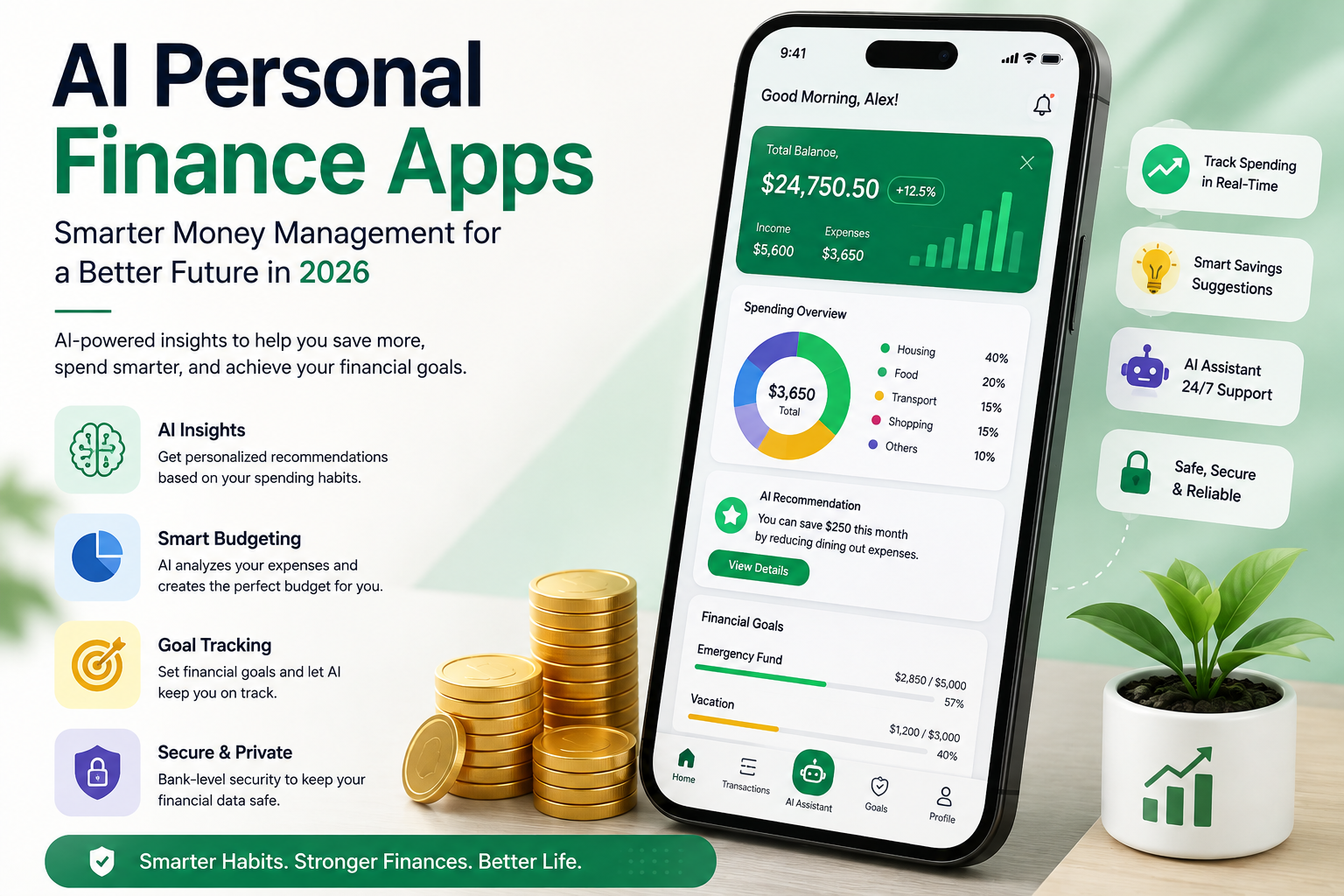
Managing money has become more complicated as households handle multiple bank accounts, credit cards, loans, subscriptions, investments, retirement accounts, and savings goals. At the same time, people increasingly expect financial technology to provide faster answers and more personalized guidance. AI Personal Finance Apps are helping address this demand by combining budgeting tools, financial data analysis, automation, and conversational AI.
In 2026, AI-powered finance products are expanding beyond simple expense tracking. Newer systems can organize financial information, identify spending patterns, provide personalized insights, analyze portfolios, and help users think through savings or debt strategies. The Consumer Financial Protection Bureau has noted growing use of AI-enabled financial tools for budgeting, saving, credit management, debt repayment, and other personal-finance decisions.
What Are AI Personal Finance Apps?
AI Personal Finance Apps are digital financial-management applications that use artificial intelligence to analyze a user’s financial information and provide insights, recommendations, or automated assistance.
Traditional budgeting applications generally organize transactions into categories and display charts. AI-powered applications can go further by identifying recurring patterns, detecting unusual spending, summarizing financial activity, and generating personalized suggestions.
Some newer platforms can also connect multiple financial accounts and provide a consolidated view of assets, liabilities, investments, and spending. A 2026 SEC filing describes an AI-powered consumer platform that aggregates thousands of financial-account integrations and provides portfolio tracking, fee analysis, scenario modeling, and conversational financial summaries.
Why AI Personal Finance Apps Matter in 2026
Financial decisions often involve large amounts of information. A person may need to understand monthly cash flow, credit-card balances, retirement savings, investment performance, and upcoming bills at the same time.
AI Personal Finance Apps can simplify this information by turning raw financial data into understandable insights.
For example, an app could identify that dining expenses have increased over several months, highlight a recurring subscription, or suggest adjusting a savings target based on recent cash flow.
The objective is not simply to display financial data. It is to help users understand their habits and make more informed decisions.
1. Smarter Budgeting
One of the most useful features of AI Personal Finance Apps is intelligent budgeting.
Instead of creating a budget entirely from scratch, AI can analyze previous transactions and identify typical spending patterns. It can categorize expenses, estimate recurring costs, and highlight areas where spending has changed significantly.
This can make budgeting easier for people who find traditional spreadsheets or manual tracking difficult.
2. Real-Time Spending Insights
AI can analyze transactions as they arrive and provide more immediate visibility into spending.
A personal finance application may identify that a user is approaching a monthly category limit or spending more than usual on a particular type of purchase.
These insights can help people make adjustments before a budgeting problem becomes significant.
3. Savings and Financial Goals
Another important capability is goal tracking.
AI Personal Finance Apps can help users establish targets for emergency savings, vacations, major purchases, education, or retirement. The application may monitor progress and provide reminders or suggestions when spending patterns make a goal harder to achieve.
Some tools can also model different savings scenarios, helping users understand how changes in contributions could affect future goals.
4. Debt Management
AI can organize outstanding balances and help users understand debt repayment options.
For example, an application may summarize credit-card balances, interest costs, payment schedules, and utilization patterns. It can then present possible repayment strategies for consideration.
The CFPB’s research shows that consumers are already using AI-enabled financial products for customized debt-repayment and savings guidance.
Important financial decisions should still be reviewed carefully, particularly when recommendations involve significant borrowing or repayment changes.
5. Credit Monitoring and Insights
AI can also help users understand credit-related information.
A personal finance platform may organize credit factors, identify changes in utilization, and explain common credit concepts in simpler language.
The technology can make financial information more accessible, but users should distinguish between educational insights and formal credit decisions made by lenders.
6. Subscription and Bill Management
Recurring charges are easy to overlook. AI can identify subscriptions, recurring bills, and unusual changes in payment amounts.
AI Personal Finance Apps may group recurring expenses, alert users before certain payments, and help identify services that are no longer being used.
This can improve visibility into monthly cash flow and potentially help reduce unnecessary expenses.
7. Personalized Financial Insights
Personalization is one of the biggest advantages of AI-powered finance technology.
Instead of showing identical recommendations to every user, a system can consider spending behavior, financial goals, account balances, and other permitted information.
For example, two people with the same income may receive different budgeting suggestions because their expenses and financial objectives are different.
8. Investment and Portfolio Tracking
Some AI Personal Finance Apps now extend into investment analysis.
They can consolidate brokerage accounts, show portfolio allocations, track holdings, identify concentration risks, and provide informational summaries.
Certain AI financial platforms are also adding conversational interfaces so users can ask questions about their portfolios and receive organized explanations.
AI-generated investment information should not automatically be treated as professional financial advice or a guarantee of investment performance.
9. Cash-Flow Forecasting
Predicting upcoming cash flow can help people prepare for bills and avoid unexpected shortages.
AI systems can analyze recurring income and expenses to estimate future account activity. A forecast could help users identify periods when expenses may exceed available cash and encourage earlier planning.
The quality of these forecasts depends heavily on accurate and complete financial data.
10. AI Financial Assistants
Conversational assistants are becoming another major feature. Users can ask questions such as how much they spent during a particular month, which categories increased, or how their savings progress is changing.
However, the CFPB has warned that financial chatbots and automated systems can sometimes provide inaccurate information or struggle with complex consumer problems.
That means a useful financial assistant should clearly communicate limitations and provide pathways to human support when necessary.
Benefits of AI Personal Finance Apps
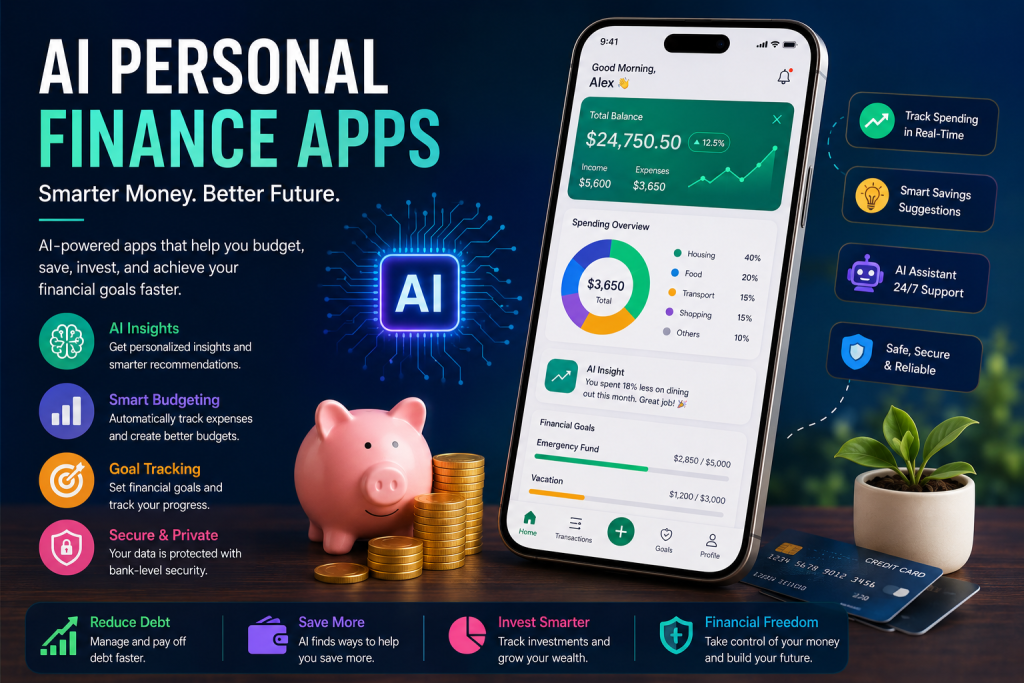
AI Personal Finance Apps can provide several benefits:
- Less manual transaction tracking
- Personalized budgeting insights
- Easier savings management
- Better visibility into recurring expenses
- Faster financial summaries
- Automated financial organization
- Improved portfolio visibility
- More convenient financial education
- Earlier awareness of spending changes
The biggest benefit is often convenience: users can spend less time organizing financial information and more time acting on it.
Privacy and Security Considerations
Financial applications require access to highly sensitive information. Users should understand what data an application collects, why it needs access, how information is shared, and how long it is retained.
The CFPB specifically advises consumers to understand how financial-data sharing works before connecting bank or credit-card accounts to an application.
Privacy policies, encryption, authentication, access controls, and data-sharing practices should therefore be important factors when selecting an app.
The CFPB is also continuing work related to personal financial data rights and data security, making transparency around financial-data access increasingly important.
How to Choose the Right App
Before choosing AI Personal Finance Apps, compare the features that matter most for your financial situation.
Look for:
- Secure account connections
- Clear privacy policies
- Accurate transaction categorization
- Budgeting and savings tools
- Goal tracking
- Debt-management features
- Investment tracking
- Transparent AI recommendations
- Human-support options
- Strong authentication and security
Avoid selecting an application solely because it uses AI. Data protection, usability, reliability, and transparency are equally important.
The Future of AI Personal Finance Apps
The future of AI Personal Finance Apps will likely involve more conversational interfaces, predictive cash-flow tools, automated financial planning, personalized education, and integrated investment analysis.
As AI becomes better at organizing financial information, applications may increasingly act as personal financial assistants rather than simple budgeting dashboards.
However, trust will remain critical. The most successful products will combine useful automation with transparent recommendations, strong privacy protections, accurate information, and appropriate human support.
Conclusion
AI Personal Finance Apps are transforming everyday money management by helping users budget, track spending, save, manage debt, monitor investments, and understand financial information more easily.
In 2026, the technology is moving toward more personalized and conversational experiences, but users should still evaluate privacy, security, accuracy, and the limitations of automated recommendations.
The strongest financial technology will not simply tell users what to do. It will help them understand their financial situation, identify opportunities, and make more informed decisions while keeping control of their money and personal data.
Leave a Reply