
AI Fraud Prevention in Banking: How AI Is Fighting Financial Fraud in 2026
Digital banking has transformed how people save, spend, transfer, and manage money. At the same time, criminals are developing more sophisticated methods to exploit online financial services. Account takeovers, payment scams, synthetic identities, card fraud, and money laundering can create significant losses for banks and customers.
AI Fraud Prevention in Banking is becoming an important security strategy because artificial intelligence can analyze huge amounts of financial data, identify unusual behavior, and help fraud teams respond quickly. Unlike traditional systems that depend mainly on fixed rules, modern AI can recognize complex patterns across multiple channels.
What Is AI Fraud Prevention in Banking?
AI Fraud Prevention in Banking refers to using artificial intelligence, machine learning, behavioral analytics, and predictive models to identify, assess, and prevent potentially fraudulent financial activity.
Traditional fraud detection often depends on predefined rules. For example, a bank may flag a transaction when it exceeds a certain amount or originates from an unusual location. AI-based systems can evaluate many signals together, including transaction history, device information, login behavior, location, account activity, and spending patterns.
The goal is not simply to block transactions. The objective is to distinguish legitimate activity from potentially fraudulent behavior while reducing unnecessary customer friction.
Why AI Fraud Prevention in Banking Matters in 2026
Digital payments and mobile banking continue to increase the speed and volume of financial transactions. Criminals can exploit this speed by attempting many fraudulent actions within a short period.
AI Fraud Prevention in Banking can help financial institutions analyze transactions in near real time and prioritize high-risk events. Machine learning models can recognize patterns that may be difficult to identify with traditional rules alone.
The technology can also adapt as fraud patterns change. When new attack methods emerge, banks can retrain models and update detection strategies using new data.
How AI Detects Banking Fraud
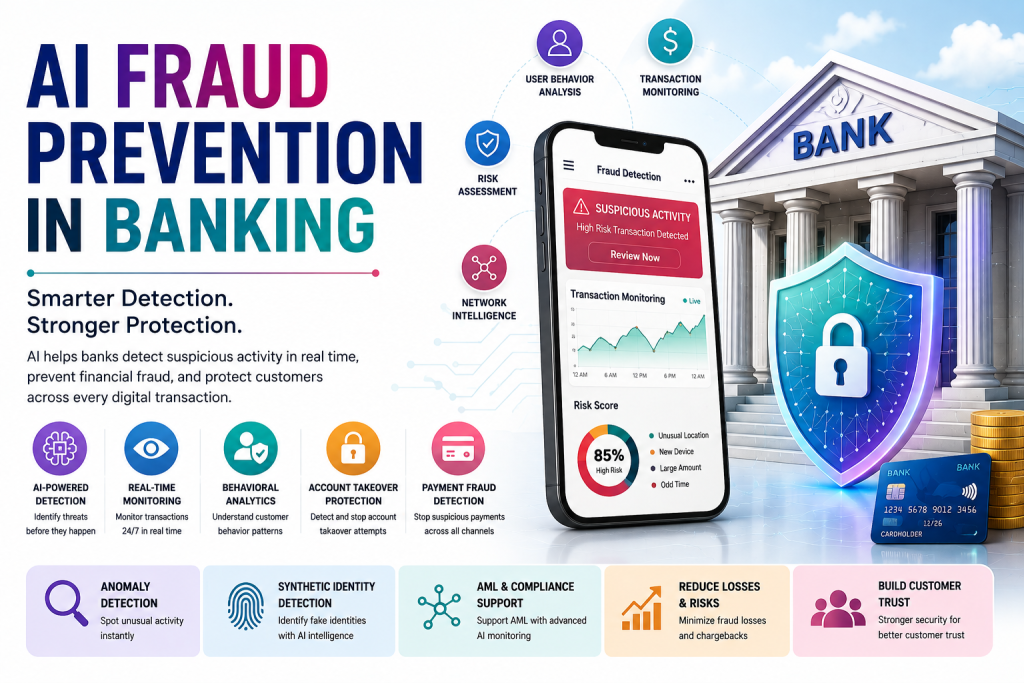
1. Real-Time Transaction Monitoring
Real-time transaction monitoring allows banks to evaluate activity as it happens. An AI system can examine transaction amount, timing, location, device, merchant information, and previous account behavior.
A suspicious transaction can receive a higher risk score and trigger additional authentication, manual review, or a temporary hold.
2. Behavioral Analytics
Behavioral analytics creates a picture of normal customer activity. The system may learn typical login times, devices, locations, spending habits, and transfer behavior.
If a customer’s behavior suddenly changes, the system can identify the deviation and increase the transaction’s risk level.
3. Anomaly Detection
Anomaly detection focuses on identifying activity that differs from expected patterns. This approach is useful when criminals use new tactics that have not been included in traditional fraud rules.
Machine learning can compare current activity with historical patterns and identify unusual combinations of signals.
4. Account Takeover Protection
Account takeover occurs when criminals obtain unauthorized access to a customer’s financial account. AI can examine login behavior, device changes, authentication events, password activity, and transaction patterns.
When several unusual signals appear together, the system can request stronger verification or alert a fraud analyst.
5. Payment Fraud Detection
Payment fraud can occur through cards, digital wallets, bank transfers, and other electronic payment channels. AI-powered payment monitoring can evaluate transactions rapidly and identify suspicious combinations of amount, location, device, recipient, and timing.
This can help banks respond quickly while allowing normal transactions to continue with minimal disruption.
6. Synthetic Identity Detection
Synthetic identity fraud combines real and fabricated information to create identities that appear legitimate. These cases can be difficult to identify using a single data point.
AI can examine relationships between identity information, account activity, applications, devices, and transaction histories. This broader analysis can reveal inconsistencies that might otherwise remain hidden.
7. Anti-Money-Laundering Support
Artificial intelligence can support anti-money-laundering programs by identifying unusual transaction networks, customer behavior, and patterns of financial activity.
Rather than reviewing every transaction manually, financial crime teams can use risk-based systems to prioritize cases that require closer investigation.
Key Benefits of AI Fraud Prevention in Banking
AI-driven fraud management can provide several benefits:
- Faster identification of suspicious activity
- Real-time transaction analysis
- Better anomaly detection
- Reduced manual investigation workload
- Improved account takeover protection
- More effective payment monitoring
- Better identification of emerging fraud patterns
- Scalable analysis of large transaction volumes
- Improved customer security
- More efficient fraud investigations
Another important advantage is alert prioritization. Instead of treating every unusual event equally, AI can help fraud teams focus on cases with the strongest indicators of risk.
Challenges of AI Fraud Detection
AI Fraud Prevention in Banking offers significant advantages, but financial institutions must manage several challenges.
Data Quality
AI models depend heavily on the quality of their data. Inaccurate, incomplete, or outdated information can reduce model effectiveness.
False Positives
If legitimate transactions are frequently blocked, customers may become frustrated and fraud teams may face unnecessary workloads. Effective systems therefore need to balance security with customer convenience.
Explainability
Banks should be able to understand why a model assigned a particular risk score, especially when decisions affect customers. Explainable AI can make automated fraud decisions easier to review.
Privacy and Security
Fraud systems process sensitive financial information. Access controls, encryption, secure storage, and appropriate data governance are essential for protecting this information.
Model Risk
AI models can introduce their own risks. Banks should use testing, validation, monitoring, documentation, and human oversight to maintain reliable model performance.
How Banks Can Implement AI Fraud Prevention in Banking
A successful implementation should begin with clear fraud objectives and measurable outcomes.
Banks can:
- Identify major fraud categories and risk scenarios.
- Collect and clean relevant transaction and behavioral data.
- Select suitable machine learning models.
- Test models using historical and simulated fraud cases.
- Establish risk thresholds and response actions.
- Integrate AI with existing fraud and security systems.
- Monitor false positives and false negatives.
- Continuously validate model performance.
- Maintain governance and documentation.
- Keep experienced fraud analysts involved in important decisions.
AI should support human investigators rather than eliminate human judgment entirely.
The Future of AI Fraud Prevention in Banking
The future of AI Fraud Prevention in Banking will likely involve more advanced behavioral analytics, network analysis, real-time risk scoring, and automated investigation workflows.
AI agents may also assist fraud teams by summarizing alerts, connecting related events, and recommending investigation priorities. However, automated systems will need strong controls to prevent incorrect decisions and protect sensitive information.
Banks will increasingly combine AI with cybersecurity, identity verification, transaction monitoring, and responsible AI governance. This integrated approach can create stronger protection across digital financial channels.
Conclusion
AI Fraud Prevention in Banking is becoming an essential component of modern financial security. By combining machine learning, behavioral analytics, anomaly detection, real-time monitoring, and human expertise, financial institutions can build more adaptive defenses against changing fraud techniques.
The strongest strategy is not simply deploying an AI model. It is creating a complete fraud-management framework supported by accurate data, continuous testing, strong governance, security controls, and human oversight.
As financial fraud evolves in 2026, banks that invest in intelligent and well-managed detection systems can improve protection while maintaining a smoother experience for legitimate customers.