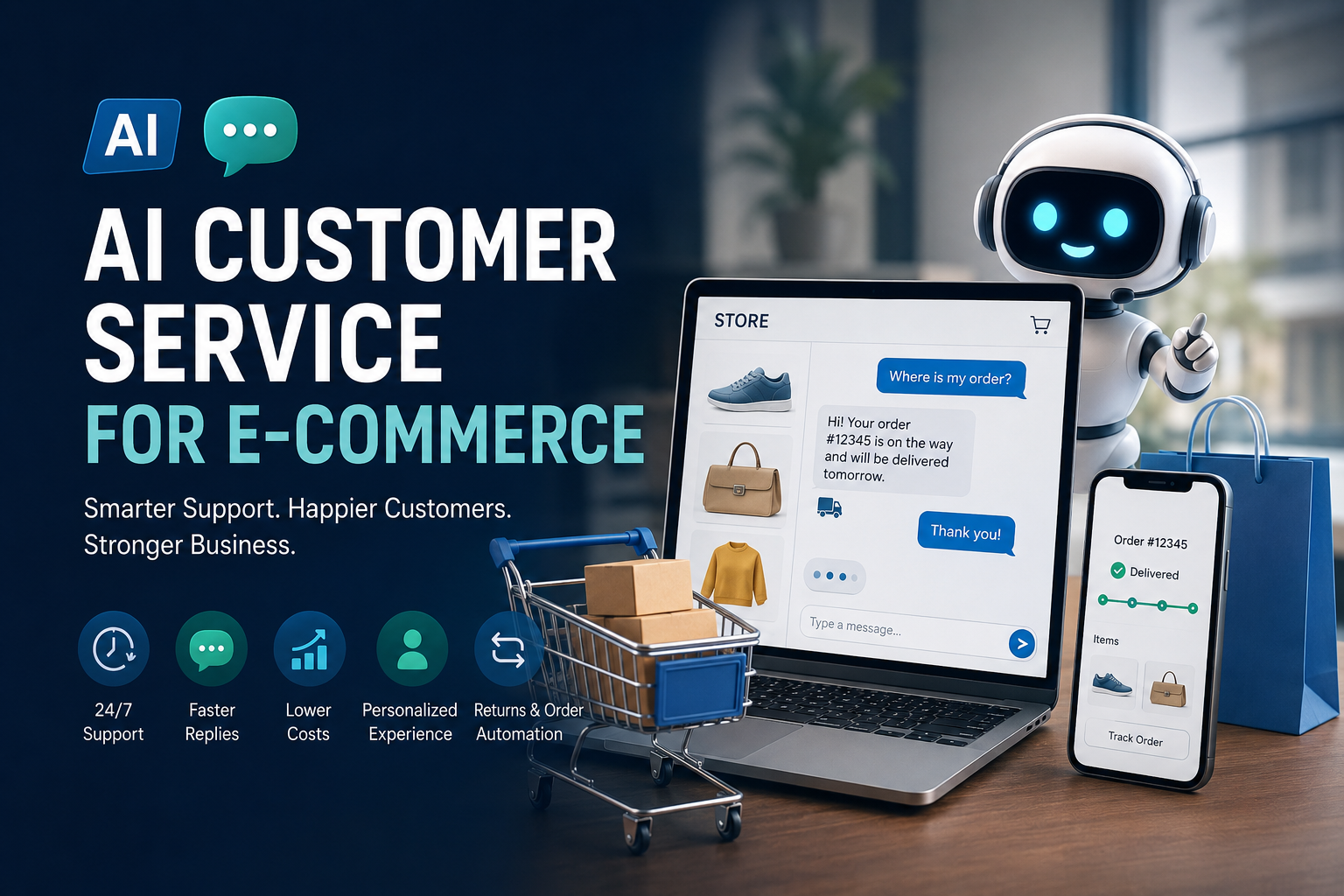
AI Customer Service for E-Commerce: The Future of Online Support in 2026
Online shoppers expect quick answers, smooth returns, and helpful support at every stage of the buying journey. For U.S. e-commerce businesses, meeting these expectations can become difficult as order volumes grow. AI Customer Service for E-Commerce helps retailers automate routine questions, deliver faster responses, and provide support around the clock.
In 2026, AI-powered support is becoming an important part of modern online retail. Shopify stores, direct-to-consumer brands, and large marketplaces can use AI chatbots and AI agents to improve customer experiences while reducing repetitive work.
What Is AI Customer Service for E-Commerce?
AI Customer Service for E-Commerce refers to artificial intelligence tools that communicate with customers, answer questions, solve common problems, and automate support workflows. These systems can understand natural-language questions and use approved information from product catalogs, order systems, shipping platforms, and customer accounts.
Unlike traditional chatbots that rely on rigid scripts, modern AI tools can understand context, answer follow-up questions, and transfer complicated cases to human representatives.
How Does AI Customer Service Work?
AI Customer Service for E-Commerce combines technologies such as natural language processing, machine learning, knowledge bases, and business integrations. When a customer asks a question, the AI identifies the intent and retrieves relevant information before generating a response.
For example, a shopper asking about an order can receive shipping information automatically. If the issue involves a refund dispute or another complex situation, the system can escalate the conversation to a human agent.
Key Benefits for Online Stores
1. 24/7 Customer Support
One of the biggest advantages of AI Customer Service for E-Commerce is continuous availability. Customers can ask about products, shipping, returns, or order status even when a support team is offline.
This is especially valuable for U.S. businesses serving customers across different time zones.
2. Faster Response Times
Customers do not want to wait hours for simple answers. AI can respond to frequently asked questions within seconds, reducing support queues and helping shoppers make purchasing decisions faster.
3. Lower Support Costs
AI Customer Service for E-Commerce can handle repetitive requests that would otherwise require employee time. Human representatives can focus on complex cases, complaints, and situations requiring judgment or empathy.
This makes customer support easier to scale as an online store grows.
4. Personalized Customer Experiences
AI can use permitted customer and order information to create more relevant interactions. For example, an assistant can recognize an existing order and provide information specific to that purchase.
Personalized assistance can reduce customer effort and make support conversations more useful.
5. Automated Returns and Order Support
Returns are a major part of online retail. AI Customer Service for E-Commerce can explain return policies, collect required information, provide status updates, and guide eligible requests through established workflows.
AI can also assist with order changes, shipping questions, product availability, and common account requests.
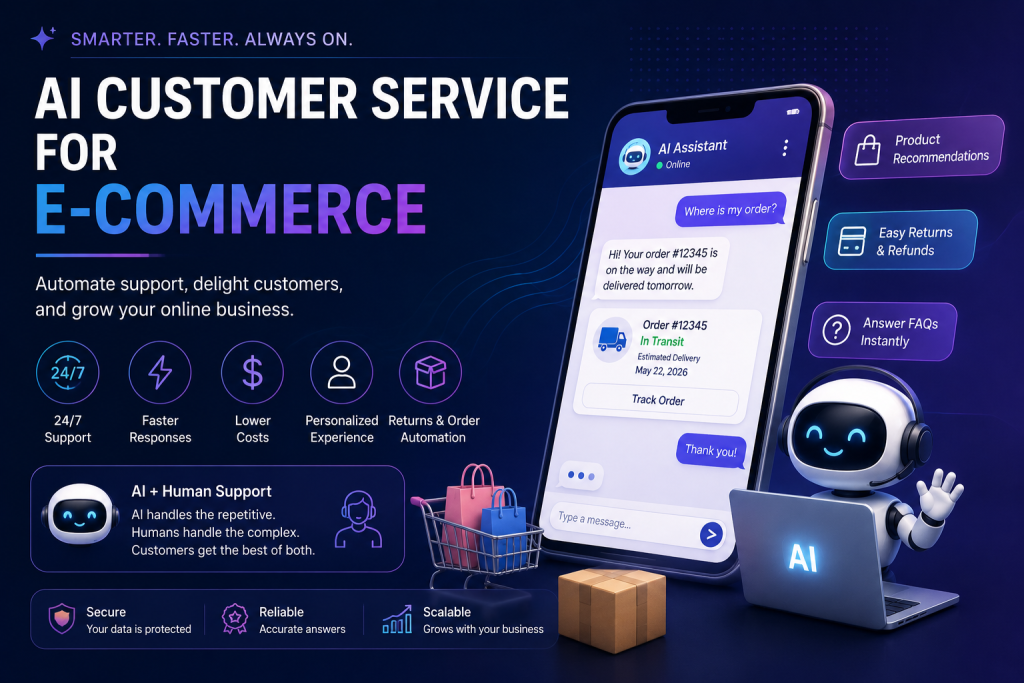
Common E-Commerce AI Customer Service Use Cases
Retailers can use AI support throughout the customer journey. Common applications include:
- Product questions
- Order tracking
- Shipping updates
- Returns and exchanges
- Refund status
- Frequently asked questions
- Product availability
- Account assistance
- Post-purchase support
- Human-agent escalation
These use cases allow businesses to automate repetitive tasks without removing access to human assistance.
Best Practices for Implementation
Businesses should treat AI Customer Service for E-Commerce as a customer-experience strategy rather than simply installing a chatbot. Start by identifying repetitive questions that are suitable for automation.
Connect the AI system to reliable business data, establish clear escalation rules, and monitor conversations regularly. Businesses should also protect customer information, restrict access to necessary data, and test responses before launching the system widely.
Human oversight is particularly important for refunds, complaints, account security, and other sensitive decisions.
Challenges to Consider
AI support is powerful, but it is not perfect. Systems can misunderstand questions, produce inaccurate information, or struggle with unusual situations. Poorly configured AI can frustrate customers instead of helping them.
Businesses should monitor accuracy, update knowledge sources, provide easy access to human agents, and establish strong privacy and security practices.
The Future of AI Customer Service
The future of AI Customer Service for E-Commerce will move beyond simple question-and-answer chatbots. AI agents will increasingly handle multi-step tasks, connect with business systems, and support shoppers throughout the purchasing journey.
A customer could eventually ask an AI assistant to find a product, compare options, place an order, track delivery, and start a return within one conversation.
Final Thoughts
AI Customer Service for E-Commerce is transforming how online retailers support shoppers. By combining automation, personalization, and intelligent workflows, businesses can provide faster assistance while allowing human teams to focus on higher-value interactions.
For U.S. retailers in 2026, the best strategy is not necessarily to replace human support. Instead, businesses should use AI to handle repetitive work and give human agents better information and more time to solve complex customer problems.
Frequently Asked Questions
What is AI Customer Service for E-Commerce?
It is the use of artificial intelligence to automate customer support tasks such as answering questions, tracking orders, handling returns, and providing personalized assistance.
Can AI customer service improve e-commerce sales?
Yes. Faster answers and personalized support can reduce buying friction, help customers find products, and improve the shopping experience.
Is AI customer service suitable for small businesses?
Yes. Small e-commerce businesses can use AI tools to handle common questions and provide support without building a large customer service department.
Will AI replace customer service agents?
AI is more likely to automate repetitive tasks than completely replace human representatives. Human agents remain important for complex, sensitive, and emotional customer situations.