How Generative AI Works: A Complete Beginner’s Guide (2026)
Artificial intelligence has rapidly evolved from simple automation to creating human-like text, images, videos, music, and even software code. If you’ve ever wondered How Generative AI Works, you’re not alone. Millions of people across the United States are exploring this revolutionary technology to improve productivity, creativity, and business operations.
In this guide, you’ll learn How Generative AI Works, the technology behind it, its real-world applications, benefits, challenges, and why it will continue transforming industries in 2026 and beyond.
What Is Generative AI?
Before understanding How Generative AI Works, it’s important to know what generative AI actually is.
Generative AI is a branch of artificial intelligence that creates original content instead of simply analyzing existing information. It can generate articles, emails, images, videos, computer code, music, and more by learning patterns from massive datasets.
Unlike traditional AI systems that predict or classify information, generative AI creates entirely new content based on user prompts.
How Generative AI Works
Understanding How Generative AI Works begins with machine learning and deep learning technologies.
Generative AI models are trained using billions of pieces of data collected from books, websites, research papers, images, videos, and public information. During training, the AI learns relationships between words, images, sounds, and patterns.
When a user enters a prompt, the AI processes the request by:
- Understanding the user’s instructions
- Analyzing learned patterns
- Predicting the most appropriate response
- Generating new content in real time
- Improving accuracy through advanced AI models
This entire process happens within seconds, making AI-powered tools incredibly efficient.
The Technology Behind Generative AI
To fully understand How Generative AI Works, it’s important to know the core technologies involved.
Large Language Models (LLMs)
Large Language Models are trained on enormous datasets and help AI understand language, answer questions, summarize information, and generate human-like conversations.
Deep Learning
Deep learning uses neural networks that mimic the human brain to recognize patterns and improve decision-making over time.
Neural Networks
Neural networks allow AI systems to process complex relationships between words, images, and data, enabling highly accurate content generation.
Transformer Architecture
Most modern AI systems use Transformer models, which allow AI to understand context instead of processing words individually.
Step-by-Step Process of How Generative AI Works
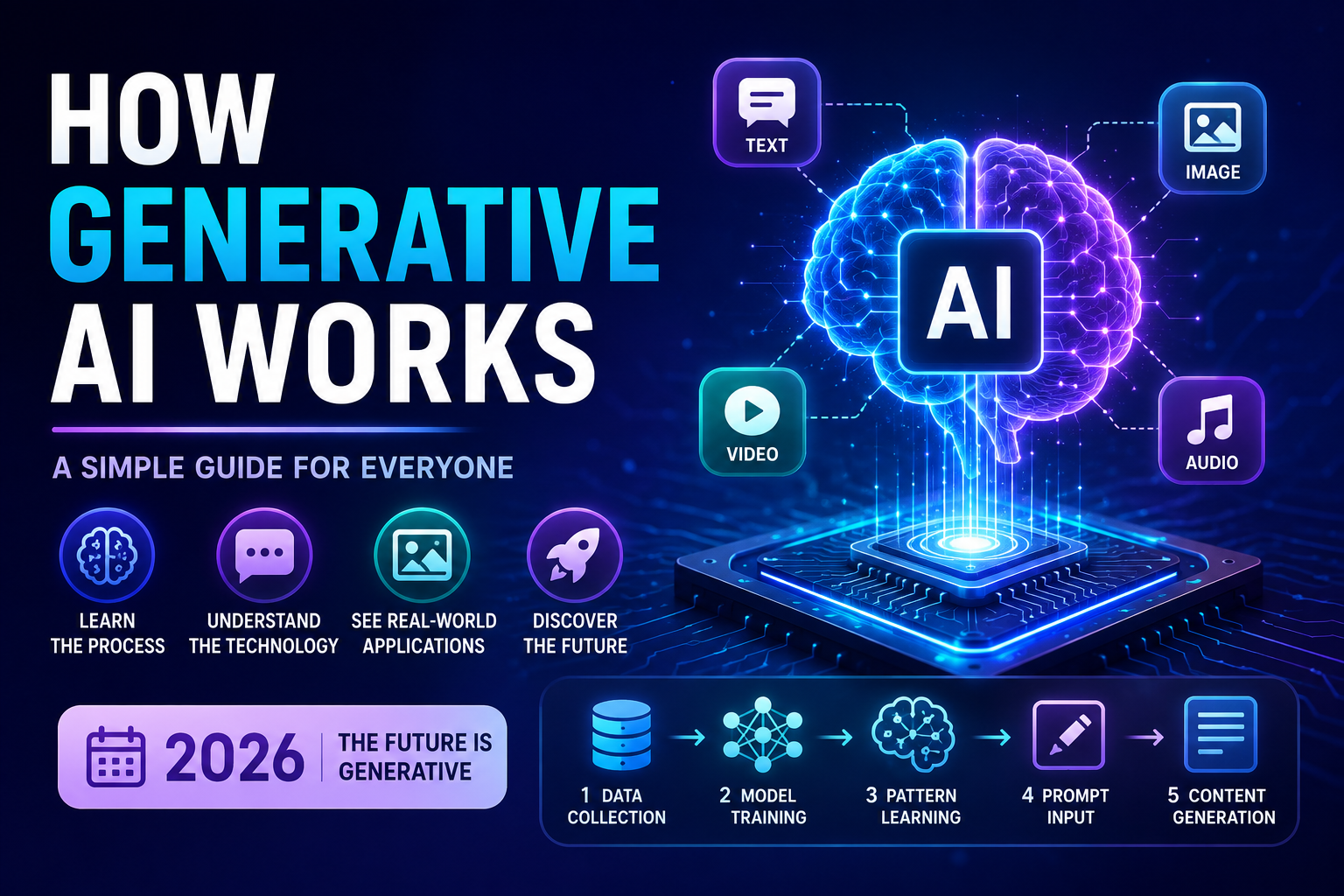
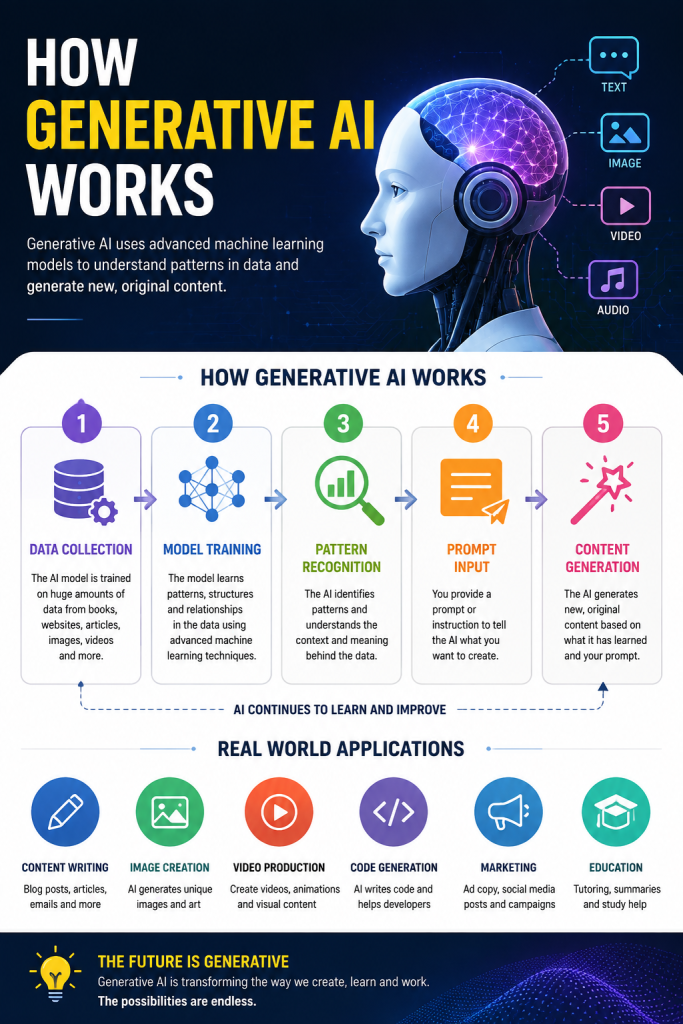
Here’s a simple explanation of How Generative AI Works:
Step 1: Training
The AI learns from billions of examples.
Step 2: Pattern Recognition
It identifies relationships between different types of information.
Step 3: Prompt Analysis
The AI understands what the user is asking.
Step 4: Content Generation
It predicts the best possible output based on its training.
Step 5: Response Delivery
The AI delivers human-like responses almost instantly.
Real-World Applications
Businesses across the United States use generative AI every day.
Popular applications include:
- Writing blog articles
- Email marketing
- Customer support
- Software development
- Image generation
- Video creation
- Product descriptions
- Medical research
- Financial analysis
- Education and tutoring
These practical examples make it easier to understand How Generative AI Works in everyday life.
Benefits of Generative AI
Learning How Generative AI Works also means understanding its advantages.
Major benefits include:
- Faster content creation
- Increased productivity
- Lower business costs
- Improved customer experiences
- Personalized recommendations
- Better marketing campaigns
- Enhanced creativity
- Faster software development
- Business automation
- Time savings
Organizations adopting AI can streamline workflows while delivering higher-quality services.
Challenges and Limitations
Although impressive, understanding How Generative AI Works also requires recognizing its limitations.
Some common challenges include:
- AI hallucinations
- Copyright concerns
- Data privacy risks
- Biased outputs
- Security issues
- Ethical considerations
- Inaccurate information
For these reasons, AI-generated content should always be reviewed by humans before publication or business use.
Popular Generative AI Tools in 2026
Several AI platforms demonstrate How Generative AI Works in practical ways.
Popular tools include:
- ChatGPT
- Google Gemini
- Claude AI
- Microsoft Copilot
- GitHub Copilot
- Adobe Firefly
- Midjourney
- Runway AI
These tools help businesses and individuals automate tasks while boosting creativity and efficiency.
The Future of Generative AI
Experts predict that generative AI will become even more powerful in 2026 and beyond.
As AI models improve, How Generative AI Works will continue evolving with:
- More accurate responses
- Better reasoning abilities
- Faster content generation
- Personalized AI assistants
- Advanced business automation
- Smarter healthcare solutions
- Improved education technologies
Businesses that embrace AI early will have a competitive advantage in the digital economy.
Final Thoughts
Understanding How Generative AI Works is becoming increasingly important for professionals, students, entrepreneurs, and businesses. By combining machine learning, deep learning, neural networks, and advanced language models, generative AI can create original content in seconds while helping organizations improve productivity and innovation.
As AI technology continues advancing throughout 2026, learning How Generative AI Works will empower individuals and businesses to use these tools responsibly, efficiently, and creatively. Whether you’re creating content, writing code, designing graphics, or automating workflows, generative AI is shaping the future of work and digital transformation.
Frequently Asked Questions
How Generative AI Works?
Generative AI works by training on massive datasets, recognizing patterns, understanding user prompts, and generating original content using advanced machine learning and deep learning models.
What technologies power generative AI?
Generative AI uses Large Language Models (LLMs), neural networks, transformer architecture, and deep learning to create human-like content.
Can generative AI create original content?
Yes. It can generate text, images, videos, music, software code, presentations, and much more based on user prompts.
Is generative AI safe to use?
Yes, when used responsibly. Users should verify AI-generated content for accuracy, privacy, copyright, and ethical considerations before using it professionally.
Which industries benefit from generative AI?
Generative AI is widely used in healthcare, education, marketing, finance, e-commerce, software development, entertainment, and customer service.