Tag: AI Underwriting

  • AI Insurance Software: How AI Is Transforming Insurance in 2026

    AI Insurance Software: How AI Is Transforming Insurance in 2026

    AI Insurance Software: How AI Is Transforming Insurance in 2026

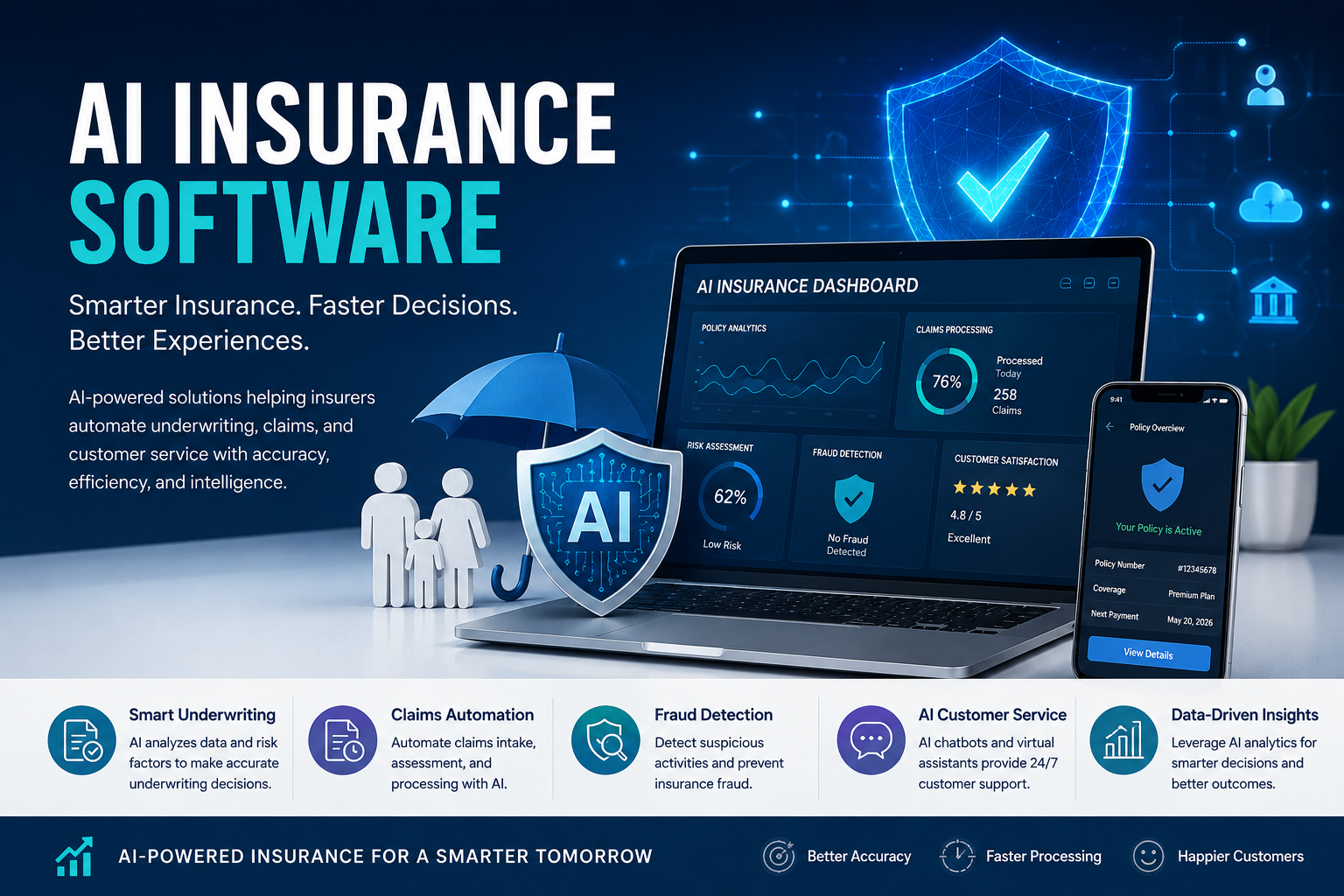
    Insurance is becoming increasingly digital, data-driven, and customer-focused. Insurers are under pressure to quote policies faster, process claims efficiently, identify fraud, improve risk assessment, and provide personalized service. AI Insurance Software is becoming an important technology for helping carriers automate repetitive work and analyze large amounts of insurance data.

    In 2026, artificial intelligence is being used across insurance for underwriting, pricing, customer service, claims handling, marketing, and fraud detection. The National Association of Insurance Commissioners (NAIC) confirms these are active areas of AI use and notes that consumers increasingly expect faster, more convenient digital insurance experiences.

    What Is AI Insurance Software?

    AI Insurance Software refers to platforms that use machine learning, natural-language processing, computer vision, predictive analytics, and generative AI to support insurance operations.

    Depending on the product, the technology can help insurers analyze applications, extract information from documents, estimate risk, detect suspicious claims, answer customer questions, and automate workflows.

    The objective is not necessarily to remove human professionals from the process. Instead, AI can handle repetitive analysis while insurance employees focus on complex decisions, customer needs, and exceptions.

    Why AI Insurance Software Matters in 2026

    The insurance industry manages enormous volumes of structured and unstructured data. Applications, policy documents, inspection reports, photographs, claims forms, medical records, correspondence, and customer interactions all contain information that may influence insurance decisions.

    AI Insurance Software can organize this information and turn it into useful insights more quickly than many manual workflows.

    Recent insurance research also shows that AI and machine learning are being incorporated across multiple lines of business, while regulators and industry stakeholders continue to examine consumer impacts, governance, and applicable laws.

    For insurers, the opportunity is to improve operational efficiency without sacrificing accuracy, fairness, security, or regulatory compliance.

    Key Uses of AI Insurance Software

    1. AI-Powered Underwriting

    AI Insurance Software can support underwriting by extracting information from applications and documents, identifying relevant risk factors, and helping underwriters prioritize submissions.

    In commercial insurance, AI can summarize broker submissions, identify missing information, and support risk selection. McKinsey’s June 2026 research describes an AI-enabled underwriting operating model in which technology can support intake, triage, risk selection, pricing, and issuance while human underwriters focus on complex decisions and portfolio management.

    2. Claims Automation

    Claims processing is one of the most valuable areas for insurance automation. AI can classify claims, extract information, review documents, and help route cases to the right team.

    Computer vision can also support the assessment of images, such as photographs of vehicle or property damage. When a claim is straightforward, automated processing can potentially shorten cycle times while complex cases receive human review.

    3. Fraud Detection

    AI insurance systems can analyze claims, customer behavior, policy activity, and transaction patterns to identify unusual combinations of signals.

    Machine learning can help insurers identify claims that deserve additional investigation without requiring every case to be reviewed manually. This can improve fraud detection while helping claims teams focus on higher-risk cases.

    4. Customer Service

    AI-powered assistants can answer common policy questions, explain basic coverage information, provide claim-status updates, and help customers navigate routine tasks.

    The NAIC notes that some insurers already use AI-powered chatbots for common questions, basic information, and simple transactions.

    5. Pricing and Risk Assessment

    Predictive analytics can help insurers analyze large datasets to support pricing and risk evaluation. Depending on the line of insurance and applicable requirements, models may consider historical claims, policy characteristics, customer information, and other permitted variables.

    However, insurers need strong controls to ensure that data and models are appropriate, accurate, and consistent with applicable laws.

    6. Document Processing

    Insurance involves large amounts of paperwork. AI can extract information from forms, policy documents, invoices, medical records, inspection reports, and correspondence.

    Intelligent document processing can reduce manual data entry and help employees find relevant information faster.

    7. Personalized Insurance Experiences

    AI can help insurers personalize customer interactions by analyzing preferences, communication history, and policy information. It can support more relevant recommendations, proactive notifications, and digital self-service.

    Personalization should always be balanced with privacy, transparency, and responsible data practices.
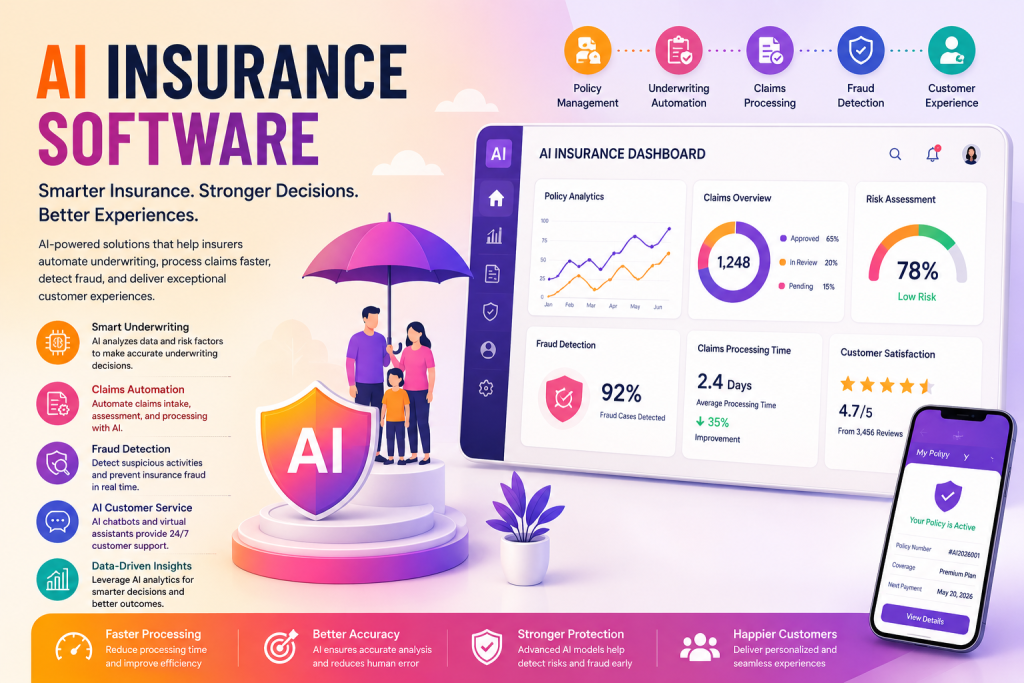
    A modern colorful AI Insurance Software infographic showcasing how artificial intelligence is transforming insurance in 2026. The image features an AI insurance dashboard with policy analytics, claims processing, risk assessment, fraud detection, processing time, and customer satisfaction metrics, along with a smartphone displaying an active insurance policy. Supporting visuals include an AI shield, insurance umbrella, family protection, and connected digital icons. The design highlights smart underwriting, claims automation, fraud detection, AI customer service, data-driven insights, faster processing, better accuracy, stronger protection, and improved customer experiences. The peach, orange, pink, purple, teal, and blue color palette creates a bright, professional, and modern insurtech theme.

    Benefits of AI Insurance Software

    AI Insurance Software can provide several practical benefits:

    • Faster underwriting and claims workflows
    • Lower administrative workload
    • Improved document processing
    • Better fraud detection
    • More consistent analysis
    • Faster customer service
    • Scalable operations
    • Stronger data-driven decision support
    • Potentially lower processing costs

    The greatest value often comes from combining multiple capabilities rather than deploying a single AI feature.

    Challenges and Risks

    AI insurance technology also introduces important risks.

    Data quality is a major concern. Poor, incomplete, outdated, or biased data can affect model performance.

    Explainability is another issue. Insurers may need to understand why a model generated a particular recommendation, especially when AI influences decisions that can materially affect customers.

    Fairness and bias require ongoing testing. Models trained on historical data may reproduce undesirable patterns if they are not carefully evaluated.

    Privacy and cybersecurity are equally important because insurance systems can process sensitive personal, financial, health, and property information.

    Third-party risk also matters. Insurers may rely on external data providers, cloud platforms, or AI models, making vendor oversight an important part of governance.

    How to Choose the Right AI Insurance Software

    Organizations evaluating AI Insurance Software should consider:

    • Integration with existing insurance systems
    • Data security and privacy controls
    • Model transparency and explainability
    • Workflow automation
    • Human review capabilities
    • Monitoring and model validation
    • Audit trails and documentation
    • Scalability
    • Vendor support
    • Total cost of ownership

    Insurers should also establish clear governance before deployment. NIST’s AI Risk Management Framework is a voluntary resource for managing AI risks and promoting trustworthy, transparent, secure, privacy-enhanced, and fair AI systems.

    Future of AI Insurance Software

    The future of AI Insurance Software will likely involve more intelligent automation, multimodal models, real-time analytics, generative AI, and AI agents.

    In underwriting, AI may increasingly handle routine submission intake and data preparation. In claims, systems may combine text, images, and structured data to support faster assessment. Customer service could become more conversational and personalized.

    At the same time, responsible AI will become more important. NIST’s AI Risk Management Framework is being revised, and on April 7, 2026, NIST released a concept note for a critical-infrastructure profile focused on trustworthy AI risk management.

    The insurance industry will therefore need to balance automation with human oversight, governance, testing, and strong data controls.

    Conclusion

    AI Insurance Software is changing how insurers approach underwriting, claims, fraud detection, customer service, pricing, and document processing. In 2026, the technology is moving beyond experimentation toward practical business workflows.

    Insurers that implement AI thoughtfully can improve speed, efficiency, and customer experiences while giving employees better tools for complex decisions.

    The most successful strategy will not be simply adopting the newest AI model. It will be creating an AI-enabled insurance operation built around reliable data, continuous monitoring, responsible
  • AI Underwriting Software: How AI Is Transforming Risk Assessment in 2026

    AI Underwriting Software: How AI Is Transforming Risk Assessment in 2026

    AI Underwriting Software: How AI Is Transforming Risk Assessment in 2026

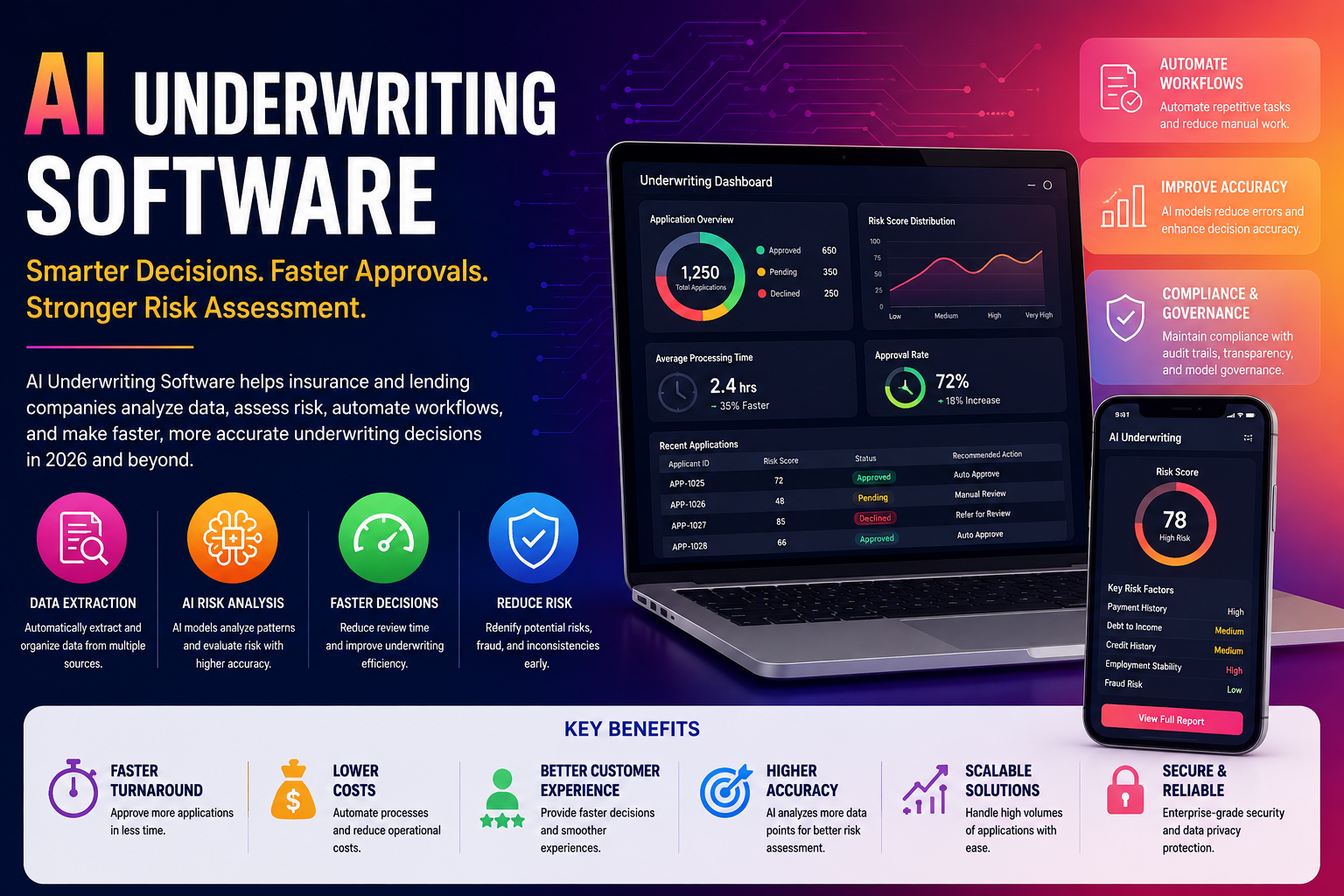
    Insurance and lending organizations are under growing pressure to make faster, more accurate, and consistent decisions. Customers expect quick approvals, while businesses need stronger risk assessment and lower operational costs. AI Underwriting Software helps financial organizations analyze large amounts of information, identify risk patterns, automate repetitive work, and support better underwriting decisions.

    In 2026, artificial intelligence is becoming increasingly important across insurance and financial services. The National Association of Insurance Commissioners (NAIC) says AI is being used in insurance for underwriting, pricing, claims, fraud detection, and other functions. Regulators are also focusing on governance, documentation, testing, explainability, and third-party oversight.

    What Is AI Underwriting Software?

    AI Underwriting Software uses artificial intelligence and machine learning to support the evaluation of applicants, policies, borrowers, or other forms of financial risk.

    Instead of requiring professionals to manually review every data point, these systems can process structured and unstructured information and highlight cases that need attention.

    Depending on the industry, an AI underwriting platform may analyze application details, financial records, claims history, property information, credit information, customer behavior, and permitted external data.

    The technology does not necessarily replace human underwriters. It can work as a decision-support layer that helps professionals review applications faster and concentrate on complex cases.

    Why AI Underwriting Software Matters in 2026

    Traditional underwriting can involve extensive documentation, repetitive data entry, and manual analysis. AI Underwriting Software can extract information, compare risk factors, calculate scores, and route applications according to business rules.

    For insurance companies, AI can support underwriting, pricing, risk assessment, and fraud detection. The NAIC notes that AI is increasingly used in underwriting and that existing insurance laws apply regardless of whether decisions involve humans, algorithms, or third-party vendors.

    For lenders, AI can analyze large amounts of applicant information and support credit decisions. However, automated lending requires strong explainability and consumer protections. The CFPB states that creditors using complex algorithms must still provide specific and accurate reasons for adverse credit actions.

    How AI Underwriting Works

    1. Data Collection and Extraction

    The process begins by collecting relevant information. AI can extract data from applications, financial documents, claims records, and other sources. Natural language processing and document intelligence can reduce manual entry and speed up review.

    2. Risk Assessment

    Machine learning models evaluate multiple variables to identify patterns associated with risk.

    An insurance model might examine claims history, property characteristics, location-related information, and policy details. A lending model may evaluate financial history, repayment information, income-related data, and other permitted factors.

    3. Automated Risk Scoring

    After analyzing available information, the system can generate a risk score or classification. Underwriting teams can use these scores to prioritize applications and determine which cases require additional review.

    4. Decision Support

    AI Underwriting Software can recommend an outcome based on an organization’s policies and risk criteria. A human professional can then review the recommendation, particularly for complex or high-risk cases.

    5. Continuous Monitoring

    Risk can change over time. New information, claims data, market conditions, or customer behavior may affect an assessment. AI can support ongoing monitoring and alert teams when significant changes require attention.

    Key Benefits of AI Underwriting Software

    Organizations adopting AI Underwriting Software can gain several advantages:

    • Faster processing: Automation reduces repetitive review and data-entry work.
    • Greater consistency: Automated workflows can apply defined criteria consistently.
    • Better data analysis: Machine learning can evaluate large datasets and identify relationships.
    • Lower operational costs: Teams can spend more time on complex cases.
    • Fraud detection support: Unusual information can be flagged for investigation.
    • Better customer experience: Faster processing can reduce application waiting times.
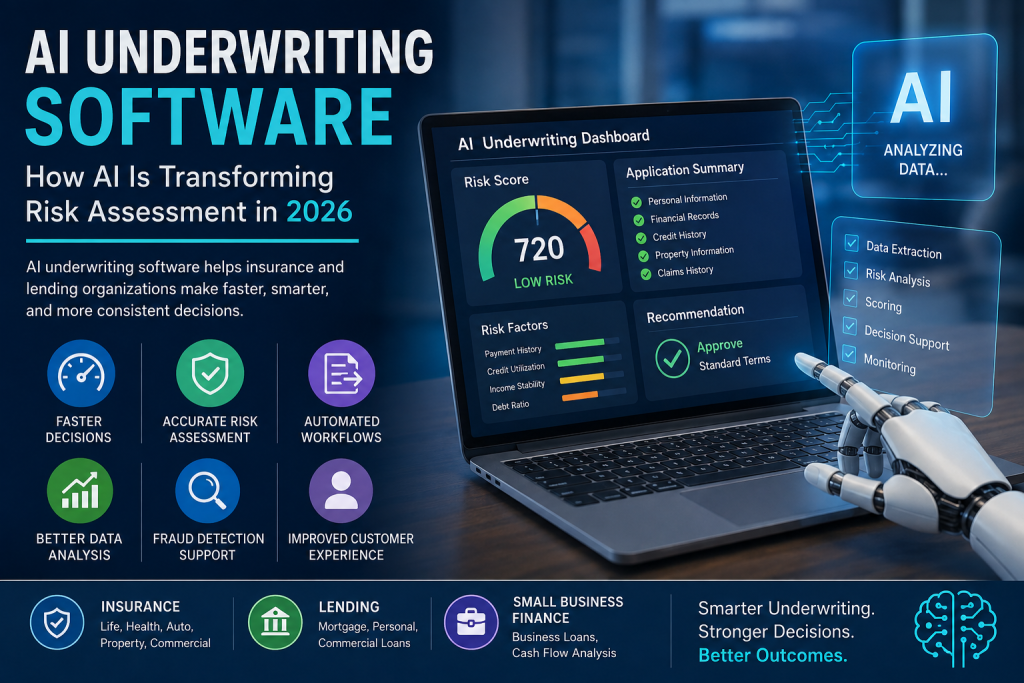
    A modern AI underwriting software infographic showing how artificial intelligence is transforming risk assessment in 2026. The design features an AI-powered underwriting dashboard displaying risk scores, application data, risk factors, and automated approval recommendations. Supporting visuals highlight faster decisions, accurate risk assessment, automated workflows, data analysis, fraud detection, and improved customer experience. The image also showcases applications in insurance, lending, and small-business finance, using a professional dark-blue and cyan technology theme.

    Applications Across Insurance and Lending

    Insurance

    Insurers can use AI Underwriting Software for property, auto, life, health, and commercial underwriting. Systems can summarize documents, identify inconsistencies, evaluate risk factors, and support pricing decisions.

    Lending

    Lenders can use AI for mortgage, personal, commercial, and other credit underwriting. Automated systems can analyze applicant information while supporting risk-based decisions.

    Small Business Finance

    AI can also evaluate small-business applications by processing financial documents and identifying relevant business risk indicators.

    Challenges and Risks

    Although the benefits are significant, organizations need strong controls.

    Data Quality: Poor or incomplete data can produce unreliable results. Businesses should validate data sources and continuously monitor data quality.

    Bias and Fairness: Historical data can contain patterns that lead to unfair outcomes. Regular testing can help identify potential bias.

    Explainability: Complex models may make it difficult to understand why a recommendation was produced. This is especially important when decisions affect consumers.

    For credit decisions, the CFPB has clarified that complex algorithms do not remove the obligation to provide specific reasons for adverse actions.

    Privacy and Security: Underwriting may involve sensitive financial or personal information, making access controls, encryption, and data governance essential.

    Third-Party Risk: Organizations may depend on external data providers or AI models. The NAIC is examining transparency, governance, accountability, and regulatory issues involving third-party data and models.

    How to Choose the Right Platform

    Before selecting AI Underwriting Software, businesses should evaluate data integrations, model transparency, risk scoring, workflow automation, monitoring, security, and reporting.

    Important questions include:

    • Can it integrate with existing underwriting systems?
    • Does it support explainable decisions?
    • Can teams monitor model performance?
    • Does it provide audit trails?
    • Can users test accuracy and potential bias?
    • Does it support human review?
    • How does it manage third-party data?
    • Can it scale as application volume increases?

    The right platform should match the organization’s industry, risk profile, regulatory requirements, and technology infrastructure.

    The Future of AI Underwriting

    The future of AI Underwriting Software will likely include greater automation, real-time data analysis, intelligent document processing, predictive analytics, and continuous risk monitoring.

    AI agents may assist with tasks such as gathering missing information, summarizing applications, checking documentation, and preparing cases for human review.

    Governance will remain essential. The NAIC’s 2026 work emphasizes regulatory attention to AI, including testing, accuracy, fairness, bias, governance, and third-party oversight.

    Conclusion

    AI Underwriting Software is changing risk assessment by combining automation, machine learning, data analysis, and human oversight. It can help underwriting teams process information faster, improve consistency, identify risk patterns, and create more efficient workflows.

    The strongest implementation is not simply about selecting an advanced AI model. Organizations should prioritize data quality, explainability, fairness, security, monitoring, governance, and human review.

    As AI adoption expands in 2026, AI Underwriting Software can help businesses build faster and more scalable decision-making processes while maintaining appropriate controls and customer protections.