Tag: AI Productivity Tools

  • What Is Generative AI? Amazing Benefits & Real-World Uses (2026)

    What Is Generative AI? Amazing Benefits & Real-World Uses (2026)

    What Is Generative AI? Amazing Benefits & Real-World Uses (2026)

    Focus Keyword: What Is Generative AI

    Artificial intelligence is changing the way people work, learn, and create. One of the fastest-growing areas of this technology is What Is Generative AI. From writing articles and creating realistic images to generating code and videos, generative AI is transforming industries across the United States.

    If you’ve been wondering What Is Generative AI, this beginner-friendly guide explains everything you need to know. We’ll cover how it works, its benefits, real-world applications, popular tools, challenges, and why it will continue shaping the future in 2026 and beyond.

    What Is Generative AI?

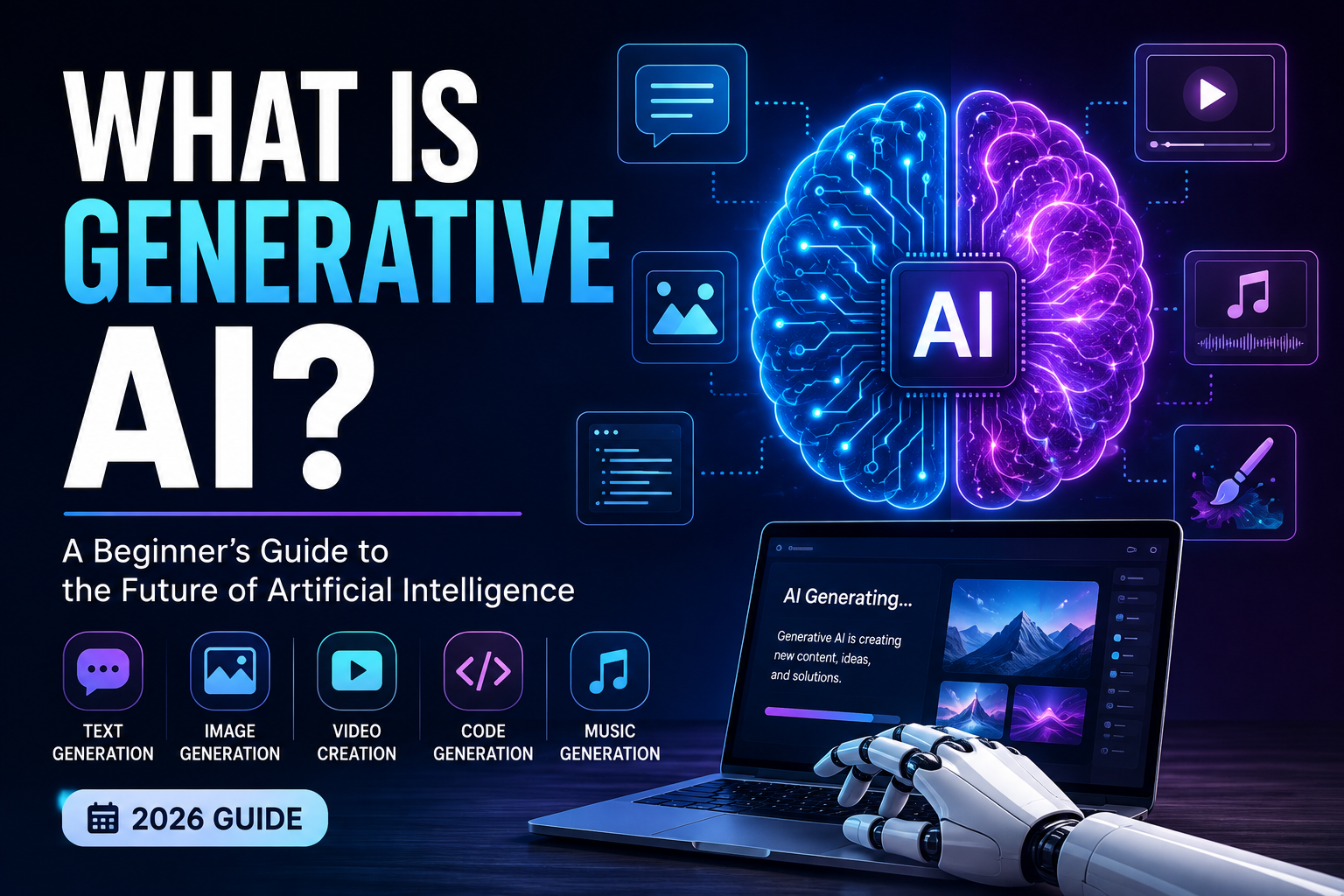
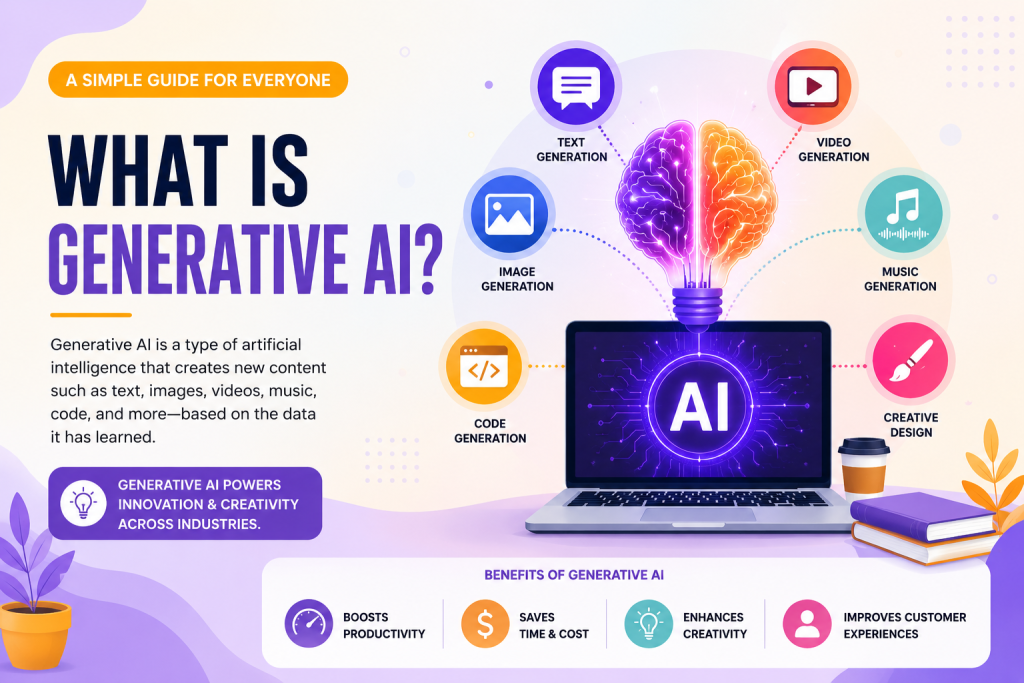
    What Is Generative AI? It is a type of artificial intelligence that can create new content instead of simply analyzing existing information. Unlike traditional AI systems that classify or predict outcomes, generative AI produces original text, images, videos, music, code, and other digital content based on user prompts and learned patterns.

    The technology is powered by advanced machine learning models trained on massive datasets. These models recognize relationships in data and generate responses that closely resemble human-created content.

    How Does Generative AI Work?

    To better understand What Is Generative AI, it’s helpful to know how the technology operates. Generative AI models are trained using billions of examples collected from books, websites, images, videos, and other digital sources.

    Once trained, the AI can:

    • Generate written content
    • Create realistic images
    • Build software code
    • Produce videos
    • Answer questions
    • Summarize documents
    • Translate languages
    • Brainstorm creative ideas

    As users continue interacting with these systems, developers improve their performance through ongoing model updates and fine-tuning.

    Key Benefits of Generative AI

    Businesses and individuals across the United States are adopting generative AI because it offers significant advantages.

    Some of the biggest benefits include:

    • Faster content creation
    • Improved productivity
    • Lower operational costs
    • Personalized customer experiences
    • Better marketing campaigns
    • Smarter business automation
    • Enhanced creativity
    • Faster software development
    • Improved customer support

    These benefits explain why discussions around What Is Generative AI have become increasingly common in nearly every industry.

    Real-World Applications of Generative AI

    Learning What Is Generative AI becomes easier when you look at practical use cases.

    Content Creation

    Writers, bloggers, marketers, and businesses use generative AI to create articles, product descriptions, emails, social media posts, and advertising copy within minutes.

    Graphic Design

    AI-powered image generators help designers produce logos, illustrations, social media graphics, and marketing visuals more efficiently.

    Software Development

    Developers use AI coding assistants to write code, debug applications, generate documentation, and improve programming productivity.

    Customer Support

    Many companies now deploy AI assistants that provide 24/7 customer support, answer frequently asked questions, and resolve common issues instantly.

    Education

    Students and educators use AI for tutoring, research assistance, personalized learning, and educational content creation.

    Healthcare

    Healthcare organizations leverage AI to assist with medical documentation, patient communication, and research support while helping professionals save valuable time.
    Popular Generative AI Tools in 2026

    Several AI platforms have become industry leaders.

    Popular tools include:

    • ChatGPT
    • Google Gemini
    • Claude AI
    • Microsoft Copilot
    • Midjourney
    • Adobe Firefly
    • GitHub Copilot
    • Runway AI

    These tools demonstrate how rapidly the market has evolved and why understanding What Is Generative AI is becoming essential for professionals and businesses.

    Challenges and Limitations

    Although the technology is impressive, there are still challenges associated with What Is Generative AI.

    Some limitations include:

    • AI-generated misinformation
    • Copyright concerns
    • Bias in training data
    • Privacy and security risks
    • Hallucinated responses
    • Ethical considerations

    Organizations should always review AI-generated content before publishing or making business decisions.

    Why Generative AI Matters for Businesses

    Companies across the U.S. are investing heavily in AI-powered automation. Understanding What Is Generative AI helps business owners identify opportunities to reduce costs, improve customer experiences, and streamline workflows.

    From e-commerce and healthcare to finance and education, organizations are integrating AI into daily operations to stay competitive in an increasingly digital economy.

    The Future of Generative AI

    The future looks incredibly promising. As technology advances, What Is Generative AI will become an even more important topic for businesses and consumers alike.

    By 2026 and beyond, AI is expected to deliver more accurate responses, create increasingly realistic media, automate complex business tasks, and support professionals across nearly every industry.

    Experts also predict tighter AI regulations, greater transparency, and stronger security measures that will make AI systems more reliable and trustworthy.

    Final Thoughts

    Understanding What Is Generative AI is no longer optional in today’s digital world. Whether you’re a student, entrepreneur, content creator, marketer, or business owner, generative AI offers countless opportunities to improve productivity and unlock new levels of creativity.

    As AI technology continues evolving, those who learn and adopt it early will be better prepared for the future of work, business, and innovation. By understanding What Is Generative AI, you can confidently explore AI-powered tools and use them responsibly to achieve personal and professional success.

    Frequently Asked Questions

    What Is Generative AI?

    Generative AI is a branch of artificial intelligence that creates original content such as text, images, videos, music, and code using advanced machine learning models.

    How is generative AI different from traditional AI?

    Traditional AI analyzes, predicts, or classifies data, while generative AI creates entirely new content based on patterns learned during training.

    Is generative AI safe?

    Generative AI can be safe when used responsibly. Users should always verify AI-generated information and follow privacy, security, and copyright best practices.

    What industries use generative AI?

    Generative AI is widely used in marketing, education, healthcare, finance, software development, e-commerce, entertainment, and customer service.

    What are the best generative AI tools in 2026?

    Some of the leading tools include ChatGPT, Google Gemini, Claude AI, Microsoft Copilot, Midjourney, Adobe Firefly, GitHub Copilot, and Runway AI.
  • AI Agent Use Cases for Businesses (2026): 12 Powerful Ways AI Agents Are Transforming Companies

    AI Agent Use Cases for Businesses (2026): 12 Powerful Ways AI Agents Are Transforming Companies


    AI Agent Use Cases for Businesses

    Artificial intelligence is revolutionizing the way organizations operate, and one of the biggest innovations is AI agents. Understanding AI Agent Use Cases for Businesses helps companies automate repetitive tasks, improve customer experiences, and increase operational efficiency. From startups to large enterprises across the United States, AI agents are becoming an essential part of digital transformation.

    This guide explores the most impactful AI Agent Use Cases for Businesses, showing how organizations can leverage autonomous AI to reduce costs, improve productivity, and stay competitive in 2026.


    What Are AI Agents?

    Before exploring AI Agent Use Cases for Businesses, it’s important to understand what AI agents are.

    AI agents are intelligent software systems capable of reasoning, planning, making decisions, and completing tasks with minimal human intervention. Unlike traditional chatbots, AI agents can access business applications, analyze data, interact with APIs, and automate entire workflows.

    Their ability to learn and adapt makes them valuable across multiple industries.


    Top AI Agent Use Cases for Businesses

    Here are some of the most valuable AI Agent Use Cases for Businesses in 2026.

    1. Customer Support Automation

    AI agents can provide 24/7 customer support by answering questions, resolving issues, processing refunds, and escalating complex requests when necessary.

    Benefits include:

    • Faster response times
    • Lower support costs
    • Higher customer satisfaction

    2. Sales Automation

    Sales teams use AI agents to qualify leads, schedule meetings, send follow-up emails, and update CRM systems automatically.

    This allows sales representatives to focus on closing deals instead of repetitive administrative work.


    3. Marketing Campaign Management

    One of the fastest-growing AI Agent Use Cases for Businesses is marketing automation.

    AI agents can:

    • Create personalized campaigns
    • Analyze customer behavior
    • Optimize advertising budgets
    • Schedule social media posts
    • Generate marketing reports

    4. Human Resources

    HR departments use AI agents for:

    • Resume screening
    • Interview scheduling
    • Employee onboarding
    • Benefits management
    • Internal support

    These automations improve hiring efficiency and employee experiences.


    5. Financial Operations

    Finance teams benefit from AI agents by automating:

    • Invoice processing
    • Expense management
    • Fraud detection
    • Financial forecasting
    • Budget analysis

    This reduces manual errors while improving decision-making.


    6. IT Help Desk

    Modern IT departments deploy AI agents to:

    • Reset passwords
    • Monitor systems
    • Troubleshoot software issues
    • Create support tickets
    • Detect security risks

    This significantly reduces IT workloads.


    7. Supply Chain Management

    Supply chain teams use AI agents to optimize:

    • Inventory management
    • Demand forecasting
    • Shipment tracking
    • Warehouse operations
    • Vendor communication

    These improvements increase operational efficiency.


    8. Business Intelligence

    Another important example of AI Agent Use Cases for Businesses is data analysis.

    AI agents automatically:

    • Collect business data
    • Generate dashboards
    • Identify trends
    • Create executive reports
    • Recommend business strategies

    9. Project Management

    Project managers rely on AI agents to:

    • Assign tasks
    • Monitor deadlines
    • Track project progress
    • Send reminders
    • Generate status reports

    This keeps teams organized and productive.


    10. Software Development

    Developers increasingly use AI agents to:

    • Generate code
    • Review pull requests
    • Detect bugs
    • Create documentation
    • Test applications

    Development teams save hundreds of hours annually through automation.


    11. Healthcare Administration

    Healthcare organizations use AI agents to:

    • Schedule appointments
    • Process insurance claims
    • Manage patient records
    • Answer patient inquiries
    • Support administrative staff

    12. Executive Assistance

    Executives use AI agents to:

    • Manage calendars
    • Schedule meetings
    • Summarize emails
    • Prepare reports
    • Organize business priorities

    This allows leaders to focus on strategic decision-making.

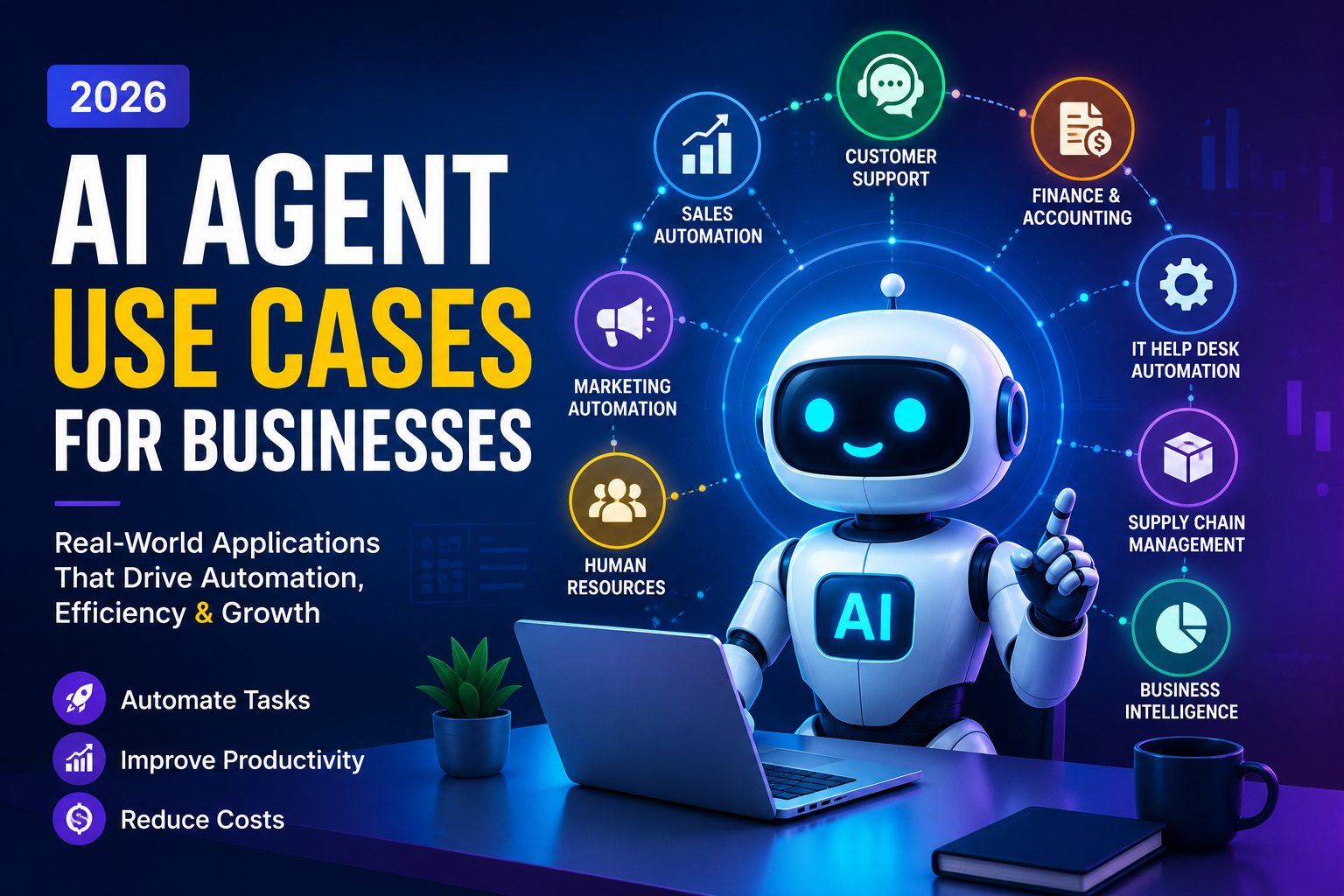
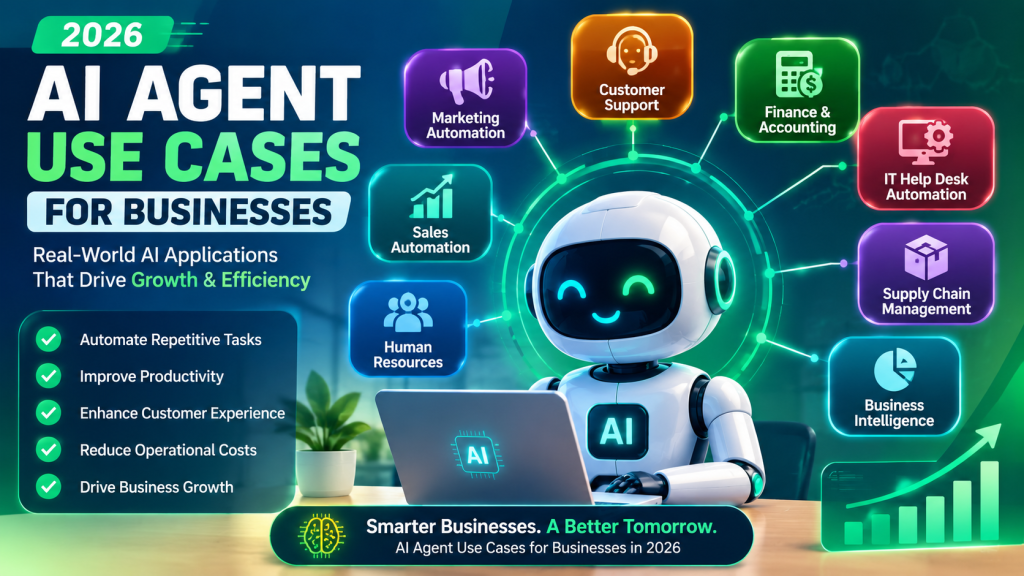
    This modern feature image showcases AI Agent Use Cases for Businesses with a futuristic cyber-themed design in vibrant blue, teal, purple, and orange colors. At the center, a friendly AI-powered robot works on a laptop while connected to glowing digital nodes representing key business functions. Surrounding the AI assistant are colorful panels highlighting real-world applications, including Customer Support, Sales Automation, Marketing Automation, Finance & Accounting, IT Help Desk Automation, Human Resources, Supply Chain Management, and Business Intelligence. The left side features the bold headline "AI Agent Use Cases for Businesses" along with a list of major benefits such as automating repetitive tasks, improving productivity, reducing operational costs, enhancing customer experience, and driving business growth. The sleek neon interface, network connections, and rising growth chart reinforce the theme of intelligent business automation and digital transformation. This feature image is ideal for articles about AI Agent Use Cases for Businesses, enterprise AI, AI automation, workflow optimization, business productivity, artificial intelligence, and AI trends in 2026.

    Benefits of AI Agent Use Cases for Businesses

    Organizations implementing AI Agent Use Cases for Businesses experience measurable advantages.

    Key benefits include:

    • Increased productivity
    • Reduced operating costs
    • Better customer service
    • Faster business decisions
    • Improved workflow automation
    • Enhanced employee efficiency
    • Better data insights
    • Scalable business growth

    These advantages explain why AI adoption continues to grow rapidly across U.S. businesses.


    How to Choose the Right AI Agent

    When evaluating AI Agent Use Cases for Businesses, consider:

    • Business goals
    • Integration capabilities
    • Data security
    • Scalability
    • Ease of deployment
    • Industry requirements
    • Budget
    • Customer support

    Selecting the right AI platform ensures long-term success.


    Future of AI Agent Use Cases for Businesses

    The future of AI Agent Use Cases for Businesses is incredibly promising. By 2026 and beyond, AI agents will become more autonomous, collaborative, and capable of managing increasingly complex workflows. Organizations will use multi-agent systems that work together across departments, enabling smarter decision-making, personalized customer experiences, and greater operational efficiency.

    Businesses that invest in AI agent technology today will be better positioned to innovate, compete, and scale in the years ahead.


    Final Thoughts

    The growing adoption of AI Agent Use Cases for Businesses demonstrates how artificial intelligence is reshaping modern organizations. Whether you’re automating customer service, optimizing marketing campaigns, streamlining HR processes, or improving financial operations, AI agents can deliver significant value.

    As AI technology continues to evolve in 2026, companies that embrace intelligent automation will gain a competitive advantage through higher productivity, lower costs, and better customer experiences.


    Frequently Asked Questions

    What are AI agent use cases for businesses?

    AI agents are used for customer support, sales, marketing, HR, finance, IT support, project management, healthcare, and workflow automation.

    Which industries benefit the most from AI agents?

    Retail, healthcare, finance, manufacturing, technology, logistics, education, and professional services all benefit from AI agents.

    Can small businesses use AI agents?

    Yes. Many affordable AI platforms help small businesses automate customer service, scheduling, marketing, and administrative tasks.

    Are AI agents better than chatbots?

    AI agents can perform complex, multi-step tasks and integrate with business systems, while chatbots primarily focus on conversations and customer interactions.

  • Free AI Productivity Tools (2026): 15 Best Free AI Tools to Boost Your Productivity

    Free AI Productivity Tools (2026): 15 Best Free AI Tools to Boost Your Productivity

    Free AI Productivity Tools (2026): 15 Best Free AI Tools to Boost Your Productivity

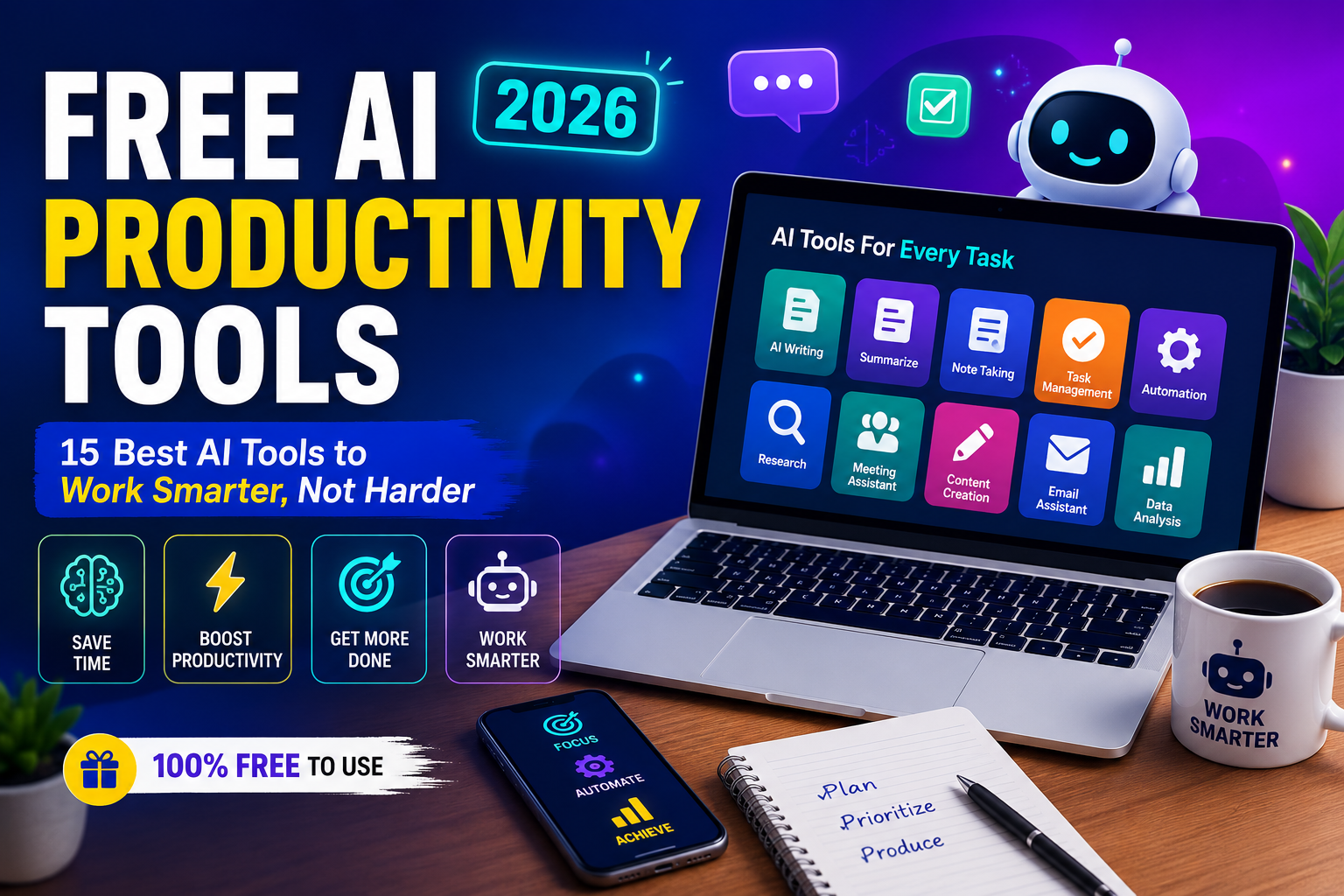
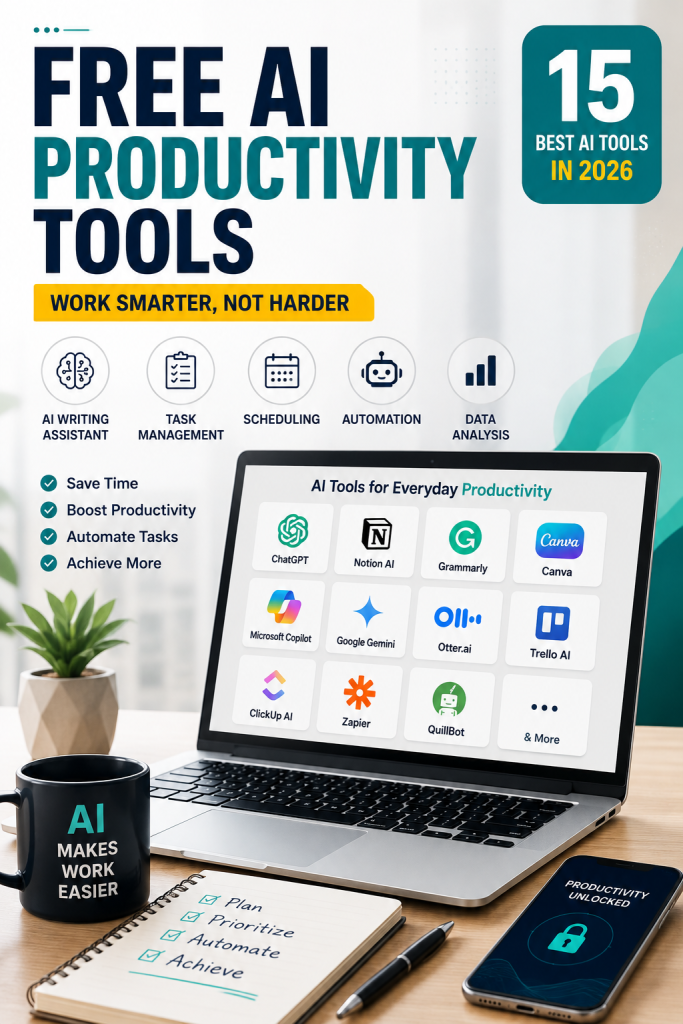
    Artificial intelligence is transforming the way people work, learn, and manage daily tasks. Whether you’re a student, freelancer, entrepreneur, or business professional, using Free AI Productivity Tools can help you save time, automate repetitive work, and improve efficiency. From writing assistants to AI meeting schedulers and task managers, the right AI productivity software allow you to accomplish more with less effort.

    In this guide, we’ll explore the best AI productivity software available in 2026, their features, and how they can help boost your productivity.


    What Are Free AI Productivity Tools?

    Free AI Productivity Tools are software applications powered by artificial intelligence that automate tasks such as writing, scheduling, note-taking, brainstorming, project management, and communication. Many of these tools offer free plans with enough features for individuals, students, and small businesses.

    Using Free AI Productivity Tools reduces manual work while increasing speed and accuracy.


    Why Use Free AI Productivity Tools?

    There are several reasons why professionals rely on AI-powered productivity tools every day.

    Benefits include:

    • Save valuable time
    • Improve workflow efficiency
    • Automate repetitive tasks
    • Increase team collaboration
    • Generate better content faster
    • Reduce human errors
    • Improve work-life balance

    As AI technology continues to evolve, these tools are becoming essential for modern workplaces.


    Best Free AI Productivity Tools in 2026

    1. ChatGPT

    ChatGPT helps users write emails, summarize documents, generate ideas, answer questions, and solve problems quickly.

    Best for:

    • Writing
    • Brainstorming
    • Research
    • Coding

    2. Notion AI

    Notion AI combines note-taking, document management, and AI writing assistance in one platform.

    Perfect for:

    • Students
    • Project managers
    • Teams
    • Business planning

    3. Grammarly

    Grammarly uses AI to improve grammar, spelling, tone, and writing clarity.

    Ideal for:

    • Emails
    • Reports
    • Blog writing
    • Business communication

    4. Google Gemini

    Google Gemini assists with research, content generation, coding, and productivity tasks using Google’s AI technology.


    5. Microsoft Copilot

    Microsoft Copilot integrates with Word, Excel, Outlook, and Teams to automate office work.


    6. Trello AI

    Trello AI helps organize projects, automate workflows, and manage team collaboration more efficiently.


    7. Canva Magic Studio

    Canva’s AI tools simplify graphic design, presentations, marketing materials, and social media content creation.


    8. Otter.ai

    Otter.ai automatically records meetings and generates searchable transcripts.

    Great for:

    • Online meetings
    • Interviews
    • Lectures

    9. ClickUp AI

    ClickUp AI improves project planning, task management, and team productivity.


    10. Zapier AI

    Zapier AI automates repetitive workflows by connecting hundreds of apps without coding.


    How to Choose the Best Free AI Productivity Tools

    Selecting the right AI productivity apps depends on your specific needs.

    Consider:

    • Ease of use
    • Free plan limitations
    • AI capabilities
    • Security
    • Integrations
    • Customer support
    • Scalability

    The best Free AI Productivity Tools solve real problems while fitting your daily workflow.


    Who Should Use Free AI Productivity Tools?

    These tools are useful for nearly everyone:

    • Students
    • Freelancers
    • Content creators
    • Small businesses
    • Entrepreneurs
    • Marketing teams
    • Developers
    • Remote workers

    No matter your profession, Free AI Productivity Tools can significantly improve efficiency.


    AI Productivity Trends for 2026

    The future of AI productivity software is becoming smarter…

    Key trends include:

    • AI assistants for every workflow
    • Voice-powered productivity
    • AI meeting summaries
    • Predictive task automation
    • Smart scheduling
    • AI-powered collaboration
    • Personalized work recommendations

    Businesses adopting these innovations will enjoy higher productivity and lower operational costs.


    Tips for Getting the Most from Free AI Productivity Tools

    To maximize results:

    • Combine multiple AI tools
    • Automate repetitive work
    • Keep your data organized
    • Review AI-generated content before publishing
    • Use AI as an assistant rather than a replacement for human judgment

    Following these practices helps you get the most value from AI productivity apps.


    Final Thoughts

    Using Free AI Productivity Tools is one of the easiest ways to improve productivity in 2026. Whether you need help writing, organizing projects, managing meetings, or automating workflows, there are excellent free AI solutions available for every type of user.

    The best AI-powered productivity solutions save time…, improve collaboration, and help individuals and businesses work more efficiently. By choosing tools that match your needs and integrating them into your daily routine, you’ll be able to accomplish more while reducing manual effort and increasing overall productivity.


    Frequently Asked Questions (FAQs)

    What are best free AI tools?

    best free AI tools are AI-powered applications that help automate tasks, improve efficiency, and simplify everyday work without requiring a paid subscription.

    Which is the best free AI productivity tool?

    Popular choices include ChatGPT, Notion AI, Grammarly, Google Gemini, Microsoft Copilot, and Canva Magic Studio.

    Are free AI productivity tools worth using?

    Yes. Many free plans provide enough features for students, freelancers, professionals, and small businesses.

    Can AI productivity tools replace human work?

    No. AI tools assist with repetitive tasks and improve efficiency, but human creativity, decision-making, and expertise remain essential.

  • Bubble vs FlutterFlow (2026): Which No-Code App Builder Is Better?

    Bubble vs FlutterFlow (2026): Which No-Code App Builder Is Better?

    Bubble vs FlutterFlow (2026): Which No-Code App Builder Is Better?

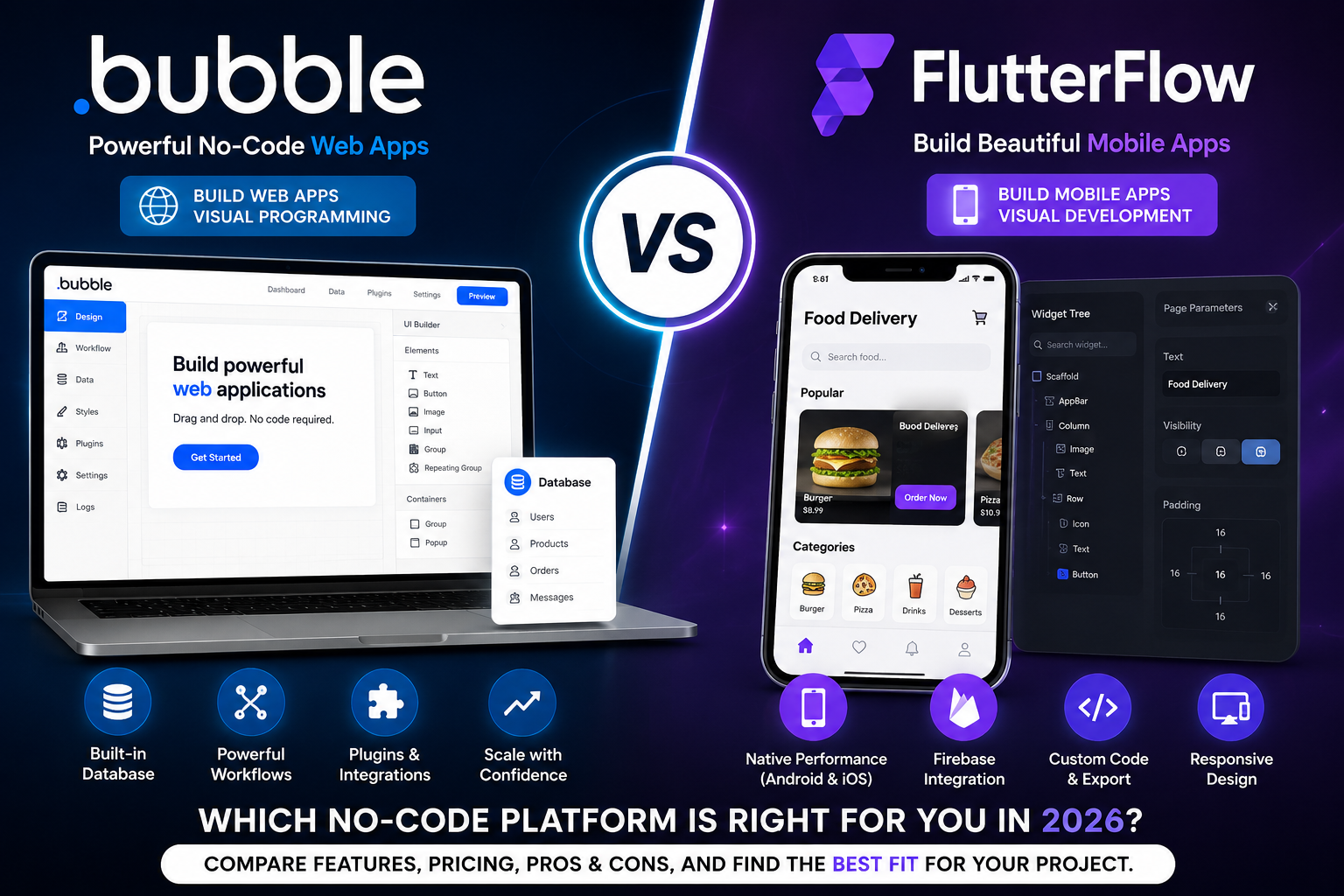
    Choosing the right no-code platform can significantly impact how quickly and efficiently you build your application. The debate around Bubble vs FlutterFlow has become increasingly popular because both platforms offer powerful no-code solutions while serving different development needs. Whether you’re building a SaaS product, a mobile app, or an MVP, understanding Bubble vs FlutterFlow will help you make the right decision.

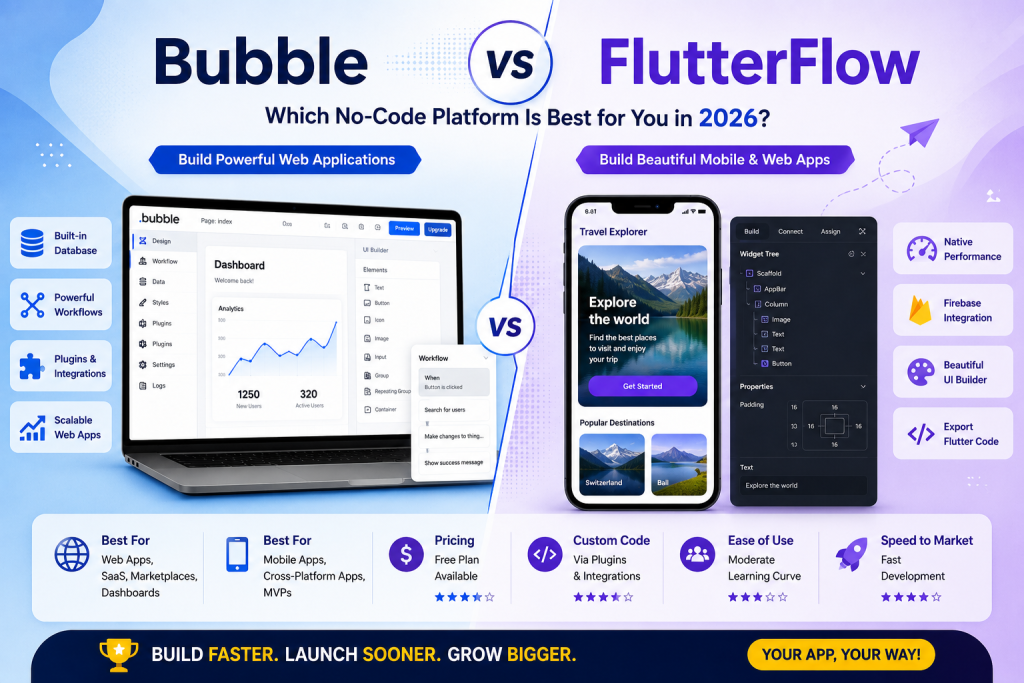
    This guide compares Bubble vs FlutterFlow based on features, pricing, ease of use, performance, scalability, and ideal use cases for the US market in 2026.


    What Is Bubble?

    When comparing Bubble vs FlutterFlow, Bubble is known as one of the most powerful no-code web application builders available today.

    Bubble allows users to create fully functional web applications using a drag-and-drop interface without writing code. It includes built-in databases, workflows, authentication, APIs, and deployment tools.

    Best For

    • SaaS products
    • Marketplaces
    • CRM software
    • Internal business tools
    • Startup MVPs

    What Is FlutterFlow?

    Another important part of Bubble vs FlutterFlow is FlutterFlow, a visual app builder based on Google’s Flutter framework.

    FlutterFlow helps users create native Android, iOS, and web applications with professional UI components while allowing developers to export Flutter code if needed.

    Best For

    • Mobile applications
    • Cross-platform apps
    • Startup mobile MVPs
    • E-commerce apps
    • Enterprise mobile solutions

    Bubble vs FlutterFlow: Feature Comparison

    FeatureBubbleFlutterFlow
    Primary FocusWeb AppsMobile Apps
    Drag-and-Drop Builderโœ…โœ…
    Native Mobile AppsLimitedExcellent
    DatabaseBuilt-inFirebase & Supabase
    API IntegrationExcellentExcellent
    Custom CodePluginsFlutter Code Export
    Learning CurveModerateEasy to Moderate
    ScalabilityHighHigh

    This comparison highlights the major differences in Bubble vs FlutterFlow.


    Ease of Use

    One of the biggest factors in Bubble vs FlutterFlow is usability.

    Bubble offers extensive customization, but beginners may need more time to learn its workflow editor.

    FlutterFlow provides a modern visual interface that is easier for users who want to create beautiful mobile applications quickly.

    If your focus is mobile development, FlutterFlow offers a smoother learning experience.


    Performance

    Performance is another important factor in Bubble vs FlutterFlow.

    Bubble performs exceptionally well for browser-based applications, dashboards, marketplaces, and SaaS platforms.

    FlutterFlow generates Flutter applications, delivering near-native performance on Android and iOS devices.

    If mobile speed is your priority, FlutterFlow has the advantage.


    Customization and Flexibility

    When evaluating Bubble vs FlutterFlow, customization plays a major role.

    Bubble Strengths

    • Powerful workflow automation
    • Built-in database
    • Thousands of plugins
    • Complex logic
    • Marketplace support

    FlutterFlow Strengths

    • Custom Flutter code export
    • Firebase integration
    • Beautiful UI components
    • Responsive mobile layouts
    • Native app performance

    Both platforms provide flexibility, but the best choice depends on your project.


    Pricing Comparison

    Pricing also matters when choosing between Bubble vs FlutterFlow.

    Bubble

    • Free plan available
    • Affordable starter plans
    • Enterprise options

    FlutterFlow

    • Free plan available
    • Developer-friendly pricing
    • Premium plans with code export

    Both platforms offer competitive pricing for startups and small businesses.


    Bubble vs FlutterFlow: Pros and Cons

    Bubble Pros

    • No coding required
    • Powerful web app builder
    • Large plugin ecosystem
    • Built-in backend
    • Strong community

    Bubble Cons

    • Limited native mobile capabilities
    • Slightly steeper learning curve

    FlutterFlow Pros

    • Native Android and iOS apps
    • Beautiful UI builder
    • Flutter code export
    • Firebase integration
    • Faster mobile development

    FlutterFlow Cons

    • More focused on mobile than web
    • Advanced backend features may require additional setup

    Which Platform Should You Choose?

    The answer to Bubble vs FlutterFlow depends on your goals.

    Choose Bubble if:

    • You want to build SaaS software.
    • You need a marketplace.
    • You’re creating CRM software.
    • You need advanced workflow automation.

    Choose FlutterFlow if:

    • You want Android and iOS apps.
    • Mobile performance is your priority.
    • You plan to export Flutter code.
    • You want a professional mobile UI.

    Choosing the right platform depends on your project type rather than which tool is universally better.


    Final Verdict

    The Bubble vs FlutterFlow comparison shows that both platforms are excellent no-code solutions, but they serve different purposes. Bubble is the better choice for powerful web applications with built-in databases and complex workflows, while FlutterFlow excels at creating high-performance mobile apps with Flutter.

    For startups building SaaS platforms or internal business tools, Bubble remains a top option. For businesses focused on mobile experiences, FlutterFlow provides greater flexibility and native performance. In 2026, both platforms continue to lead the no-code development industry and are excellent choices depending on your project requirements.


    Frequently Asked Questions (FAQs)

    Which is better, Bubble or FlutterFlow?

    Bubble is ideal for web applications, while FlutterFlow is better for native mobile app development.

    Can I build a SaaS product with Bubble?

    Yes. Bubble is widely used to build SaaS platforms, marketplaces, and CRM systems.

    Is FlutterFlow good for beginners?

    Yes. FlutterFlow offers a user-friendly interface with drag-and-drop tools that make mobile app development easier.

    Which platform is better for startups?

    It depends on your product. Bubble is better for web-based startups, while FlutterFlow is ideal for mobile-first startups.

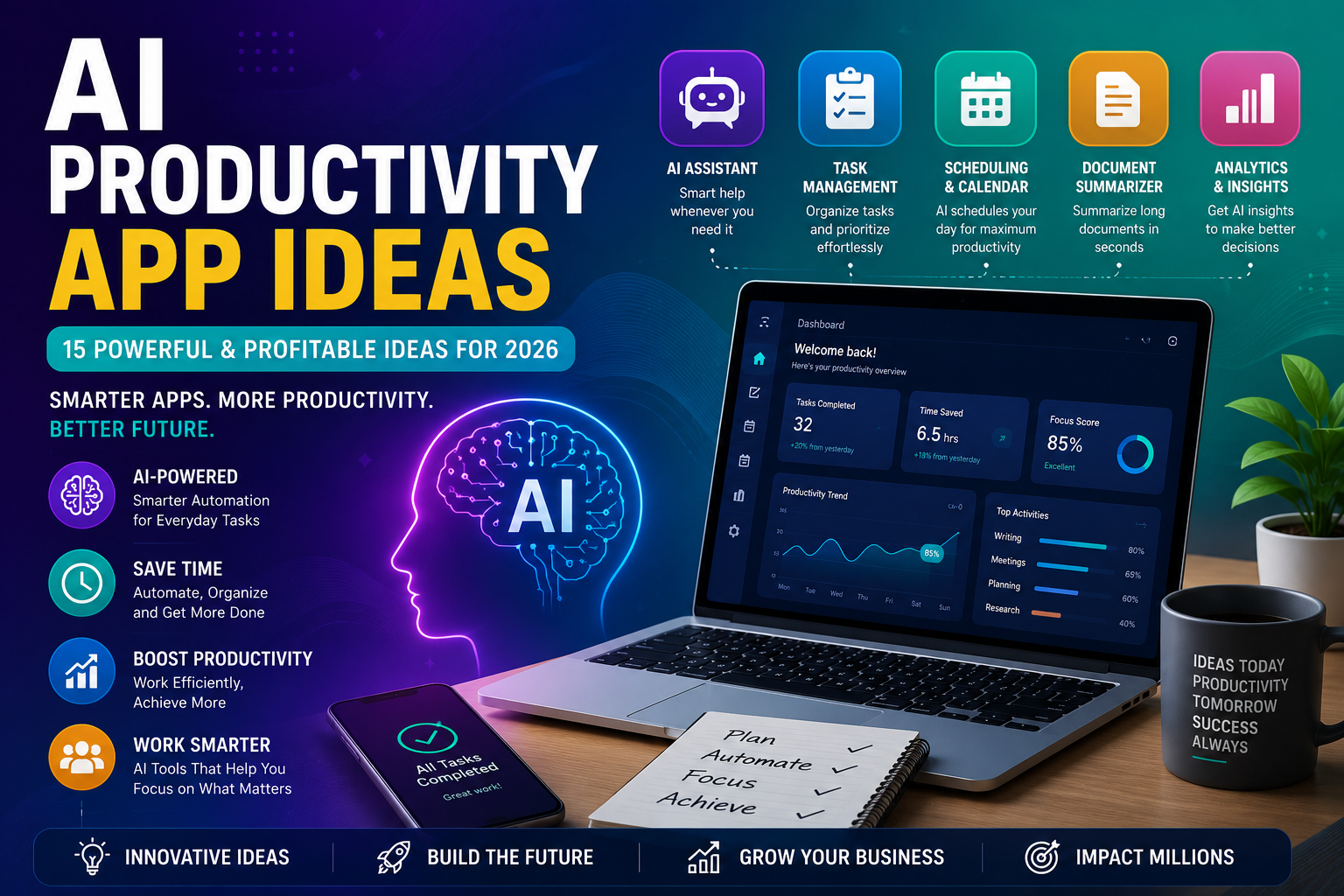
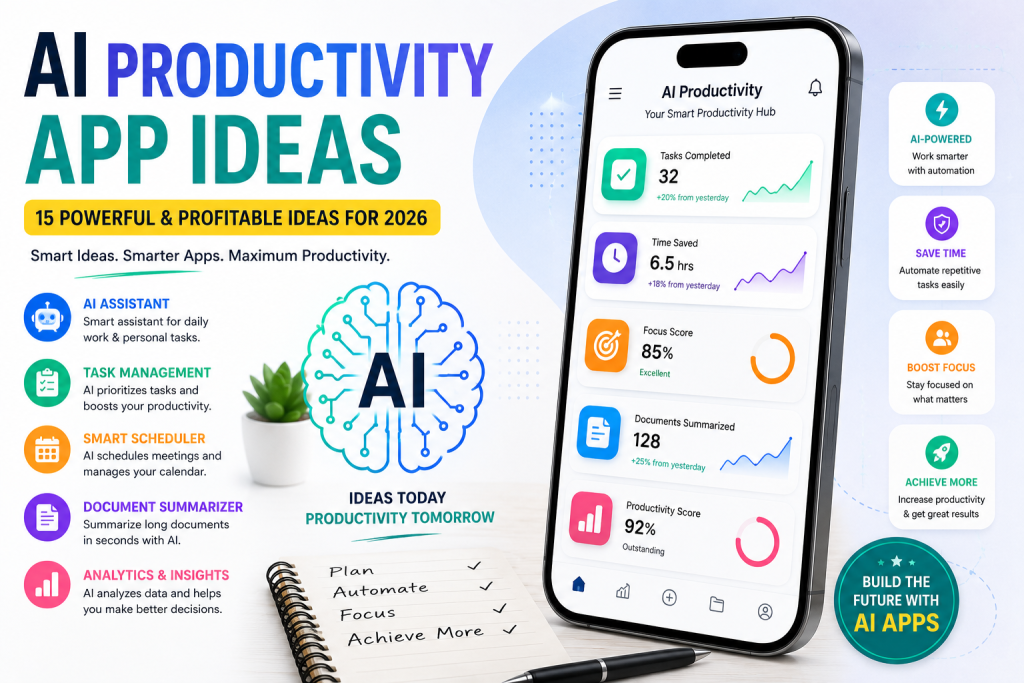
  • AI Productivity App Ideas (2026): 15 Innovative AI Apps That Boost Efficiency

    AI Productivity App Ideas (2026): 15 Innovative AI Apps That Boost Efficiency

    AI Productivity App Ideas (2026): 15 Innovative AI Apps That Boost Efficiency

    AI Productivity App Ideas for 2026

    Artificial intelligence is transforming the way people work, communicate, and manage daily tasks. Businesses, entrepreneurs, freelancers, and students across the United States are increasingly looking for AI Productivity App Ideas that save time, automate repetitive work, and improve efficiency. Whether you’re planning to launch a startup or build your next SaaS product, choosing the right AI-powered app idea can give you a competitive advantage.

    In this guide, we’ll explore the best AI Productivity App Ideas for 2026, explain why they’re in demand, and share tips for creating a successful AI application.


    Why AI Productivity Apps Are Growing

    The demand for AI Productivity App Ideas continues to rise as companies adopt AI to streamline operations. Modern AI tools help users write emails, schedule meetings, summarize documents, manage projects, and automate workflows.

    Benefits include:

    • Increased productivity
    • Time-saving automation
    • Improved collaboration
    • Better decision-making
    • Reduced operational costs
    • Higher business efficiency

    These advantages make AI Productivity App Ideas one of the fastest-growing categories in the software industry.


    Best AI Productivity App Ideas for 2026

    If you’re searching for profitable AI Productivity App Ideas, consider these innovative concepts.

    1. AI Meeting Assistant

    Create an app that records meetings, generates transcripts, summarizes discussions, and automatically creates action items.

    Best For:

    Remote teams and businesses.


    2. AI Task Management App

    Develop a smart to-do list that prioritizes tasks using artificial intelligence based on deadlines, workload, and user behavior.


    3. AI Email Assistant

    Build an application that writes emails, suggests replies, categorizes inbox messages, and automates follow-ups.


    4. AI Note-Taking App

    Allow users to convert voice recordings into searchable notes with AI-generated summaries.


    5. AI Calendar & Scheduling Assistant

    An AI-powered calendar can automatically schedule meetings, avoid conflicts, and optimize daily productivity.


    6. AI Document Summarizer

    Help users summarize long reports, PDFs, legal documents, and research papers within seconds.


    7. AI Project Management Platform

    Combine project planning, team collaboration, workload balancing, and predictive analytics into one intelligent workspace.


    8. AI Writing Assistant

    Offer AI-powered content generation for blogs, social media posts, emails, reports, and marketing copy.


    9. AI Knowledge Management App

    Enable businesses to organize internal documents while providing instant AI-powered search and answers.


    10. AI Business Dashboard

    Create a centralized dashboard that analyzes sales, marketing, finance, and customer data using AI insights.

    These AI Productivity App Ideas solve real-world problems and have strong commercial potential.


    Features Every AI Productivity App Should Include

    When building AI Productivity App Ideas, consider adding features that users expect in modern applications.

    • AI chatbot assistance
    • Voice commands
    • Smart notifications
    • Workflow automation
    • Cloud synchronization
    • Real-time collaboration
    • Data analytics
    • Calendar integration
    • Mobile compatibility
    • Enterprise-grade security

    These features improve usability and increase customer satisfaction.


    How to Build AI Productivity Apps

    Turning AI Productivity App Ideas into successful products requires a structured approach.

    Step 1: Identify a Problem

    Focus on solving a specific productivity challenge for businesses or individuals.

    Step 2: Validate Your Idea

    Research competitors and gather feedback from potential users.

    Step 3: Choose AI Technology

    Use AI APIs, machine learning services, or no-code AI platforms depending on your budget and technical skills.

    Step 4: Build an MVP

    Launch a Minimum Viable Product with only the most essential features.

    Step 5: Collect User Feedback

    Improve the application based on customer reviews and usage data.

    Following these steps increases the chances of building successful AI Productivity App Ideas.


    Why Businesses Invest in AI Productivity Apps

    Companies across the United States continue investing in AI Productivity App Ideas because they improve efficiency and reduce manual work.

    Organizations use AI productivity software to:

    • Automate repetitive tasks
    • Improve employee collaboration
    • Reduce operational costs
    • Increase workflow efficiency
    • Make data-driven decisions
    • Enhance customer service

    As AI adoption accelerates, productivity-focused applications are expected to remain one of the most profitable software categories.


    Common Mistakes to Avoid

    Many developers struggle when launching AI Productivity App Ideas because they overlook important factors.

    Avoid these mistakes:

    • Building too many features initially
    • Ignoring user experience
    • Skipping security measures
    • Choosing the wrong AI platform
    • Not validating market demand
    • Forgetting mobile optimization

    Keeping your app simple and user-focused leads to better adoption and long-term success.


    Final Verdict

    The future of software is powered by artificial intelligence, and AI Productivity App Ideas offer incredible opportunities for entrepreneurs, startups, and businesses in 2026. Whether you build an AI meeting assistant, task manager, email assistant, or document summarizer, solving real productivity challenges is the key to success.

    Start with a focused idea, launch a simple MVP, gather user feedback, and continue improving your product. By addressing real business needs, your AI productivity app can stand out in a competitive market and attract users across the United States.


    Frequently Asked Questions (FAQs)

    What are AI productivity apps?

    AI productivity apps use artificial intelligence to automate tasks, improve organization, and increase efficiency for individuals and businesses.

    Which AI productivity app idea is best for startups?

    AI meeting assistants, task management apps, email assistants, and document summarizers are among the most promising ideas in 2026.

    Can I build an AI productivity app without coding?

    Yes. No-code platforms and AI APIs allow beginners to create AI-powered productivity applications without extensive programming knowledge.

    Are AI productivity apps profitable?

    Yes. As businesses continue investing in automation and efficiency tools, AI productivity apps have strong revenue potential through subscriptions, licensing, and enterprise solutions.

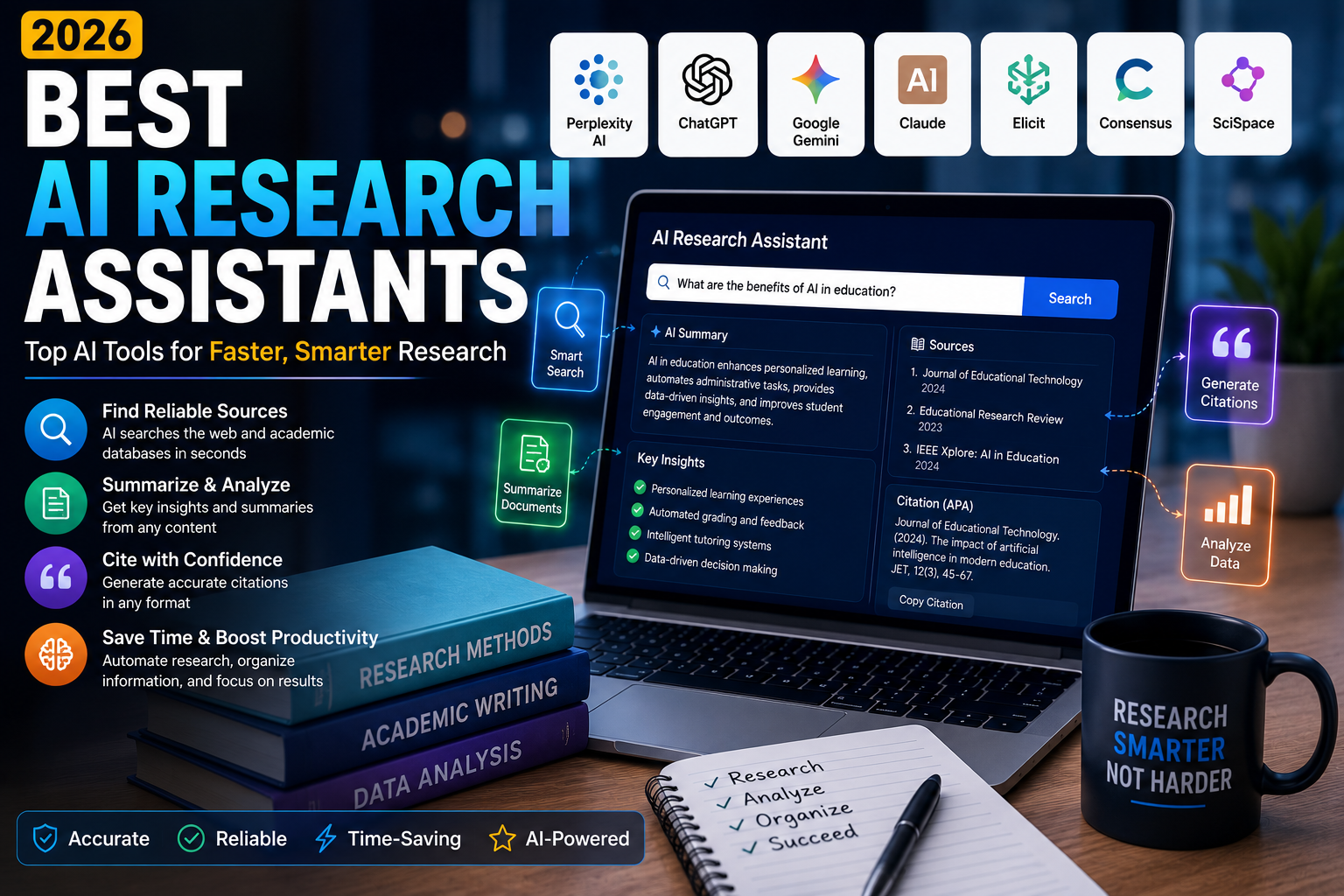
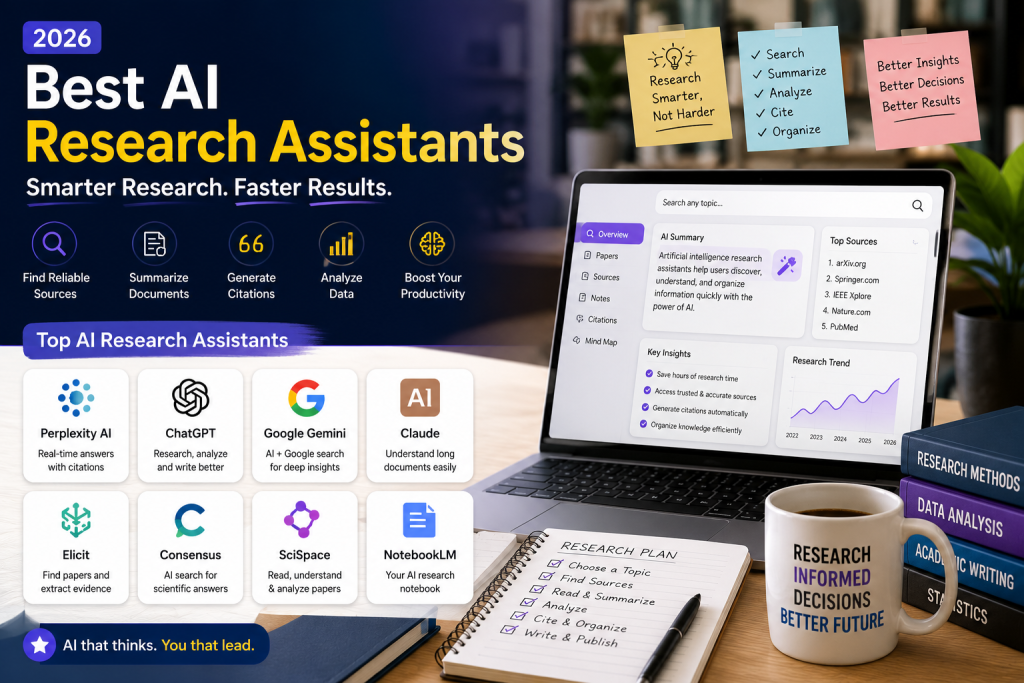
  • Best AI Research Assistants (2026): Top AI Tools for Faster, Smarter Research

    Best AI Research Assistants (2026): Top AI Tools for Faster, Smarter Research

    Best AI Research Assistants (2026): Top AI Tools for Faster, Smarter Research

    Best AI Research Assistants in 2026

    Research has become faster and more efficient thanks to artificial intelligence. Whether you’re a student, researcher, business professional, marketer, or content creator, the Best AI Research Assistants can help you find reliable information, summarize lengthy documents, analyze data, and organize knowledge in minutes instead of hours.

    In this guide, we’ll explore the Best AI Research Assistants available in 2026, comparing their features, pricing, and ideal use cases. If you’re searching for the right AI-powered research tool, this article will help you make an informed decision.


    What Are AI Research Assistants?

    AI research assistants are intelligent software tools that use artificial intelligence to search for information, summarize articles, answer complex questions, generate citations, and organize research materials. Many platforms also integrate with academic journals, web sources, PDFs, and cloud storage.

    The Best AI Research Assistants help users save time while improving the accuracy and quality of research.


    Why AI Research Tools Are Growing in the US

    Across the United States, professionals, students, universities, and businesses are increasingly using AI to improve research workflows. From academic writing and market research to legal analysis and business intelligence, the Best AI Research Assistants reduce manual work while delivering faster insights.

    Benefits include:

    • Faster information discovery
    • AI-generated summaries
    • Citation assistance
    • Improved productivity
    • Better organization
    • Time savings
    • More accurate research

    1. Perplexity AI

    Perplexity AI is one of the Best AI Research Assistants for finding reliable answers with cited sources.

    Key Features

    • Real-time web search
    • Source citations
    • AI summaries
    • Follow-up questions
    • Academic-friendly responses

    Best For: Students, professionals, and researchers.


    2. ChatGPT

    ChatGPT continues to be one of the Best AI Research Assistants thanks to its ability to explain complex topics, summarize documents, brainstorm ideas, and assist with writing.

    Key Features

    • Natural conversations
    • Document analysis
    • Writing assistance
    • Research summaries
    • Code explanations

    Best For: Everyday research and content creation.


    3. Google Gemini

    Google Gemini combines AI reasoning with Google’s search ecosystem.

    Key Features

    • Web-powered research
    • Google Workspace integration
    • AI summaries
    • Multimodal support
    • Productivity features

    Best For: Google users and business professionals.


    4. Claude

    Claude is well known for analyzing large documents and generating detailed summaries.

    Key Features

    • Long-context processing
    • Research assistance
    • Document comparison
    • Safe AI responses
    • Natural writing support

    Best For: Academic and business research.


    5. Elicit

    Elicit is designed specifically for academic and scientific research.

    Key Features

    • Literature reviews
    • Research paper summaries
    • Citation management
    • Evidence-based answers
    • Academic database search

    Best For: Researchers and graduate students.


    6. Consensus

    Consensus helps users discover evidence from peer-reviewed scientific studies.

    Key Features

    • Scientific search
    • Peer-reviewed sources
    • AI summaries
    • Research insights
    • Easy-to-read results

    Best For: Healthcare professionals, educators, and students.


    7. SciSpace

    SciSpace simplifies reading and understanding academic papers.

    Key Features

    • Paper explanations
    • Citation support
    • AI chatbot
    • PDF analysis
    • Research recommendations

    Best For: University students and researchers.


    How to Choose the Best AI Research Assistants

    When selecting the Best AI Research Assistants, consider the following:

    • Accuracy of responses
    • Source citations
    • Academic support
    • Document analysis
    • Ease of use
    • Pricing
    • Privacy
    • Integrations

    Choosing the right platform depends on whether your focus is academic research, business intelligence, content creation, or professional analysis.


    Benefits of Using AI Research Assistants

    The Best AI Research Assistants provide numerous advantages for individuals and organizations:

    • Save hours of research time
    • Generate accurate summaries
    • Improve research quality
    • Find trusted sources quickly
    • Organize research efficiently
    • Enhance collaboration
    • Support academic writing
    • Increase overall productivity

    As AI continues to evolve, research assistants are becoming indispensable tools for professionals and students alike.


    Pricing Comparison

    ToolStarting Price
    Perplexity AIFree / Pro Plan
    ChatGPTFree / Plus Plan
    Google GeminiFree / Advanced Plan
    ClaudeFree / Pro Plan
    ElicitFree / Paid Plans
    ConsensusFree / Premium Plans
    SciSpaceFree / Premium Plans

    Why the Best AI Research Assistants Matter in 2026

    In today’s fast-paced digital world, finding accurate information quickly is essential. The Best AI Research Assistants enable users to analyze complex topics, summarize extensive documents, and access trusted information without spending countless hours searching online.

    For US businesses, universities, educators, and professionals, these AI tools improve decision-making, accelerate research projects, and enhance productivity. Whether you’re preparing a business report, writing a research paper, or exploring industry trends, AI-powered research assistants can make the process significantly more efficient.


    Final Verdict

    Choosing the Best AI Research Assistants depends on your specific needs. Perplexity AI is an excellent choice for web-based research with citations, ChatGPT excels at explanations and brainstorming, Google Gemini integrates seamlessly with Google’s ecosystem, Claude handles long documents effectively, while Elicit, Consensus, and SciSpace are outstanding for academic research.

    If you’re looking to improve productivity, access reliable information, and simplify research in 2026, investing time in the Best AI Research Assistants is a smart decision. Compare their features, explore free plans, and select the platform that best supports your research goals.


    Frequently Asked Questions (FAQs)

    Which is the Best AI Research Assistants for students?

    Perplexity AI, ChatGPT, and SciSpace are excellent choices for students because they simplify research, summarize documents, and provide learning support.

    Are AI research assistants reliable?

    Yes, many leading AI research assistants provide citations and references, but users should always verify important information using trusted sources.

    Can AI research assistants help with academic writing?

    Absolutely. They can summarize papers, generate ideas, explain concepts, and assist with citations while improving overall productivity.

    Are free AI research assistants available?

    Yes. Most leading platforms, including ChatGPT, Perplexity AI, Google Gemini, Claude, Elicit, and Consensus, offer free plans with optional premium upgrades.

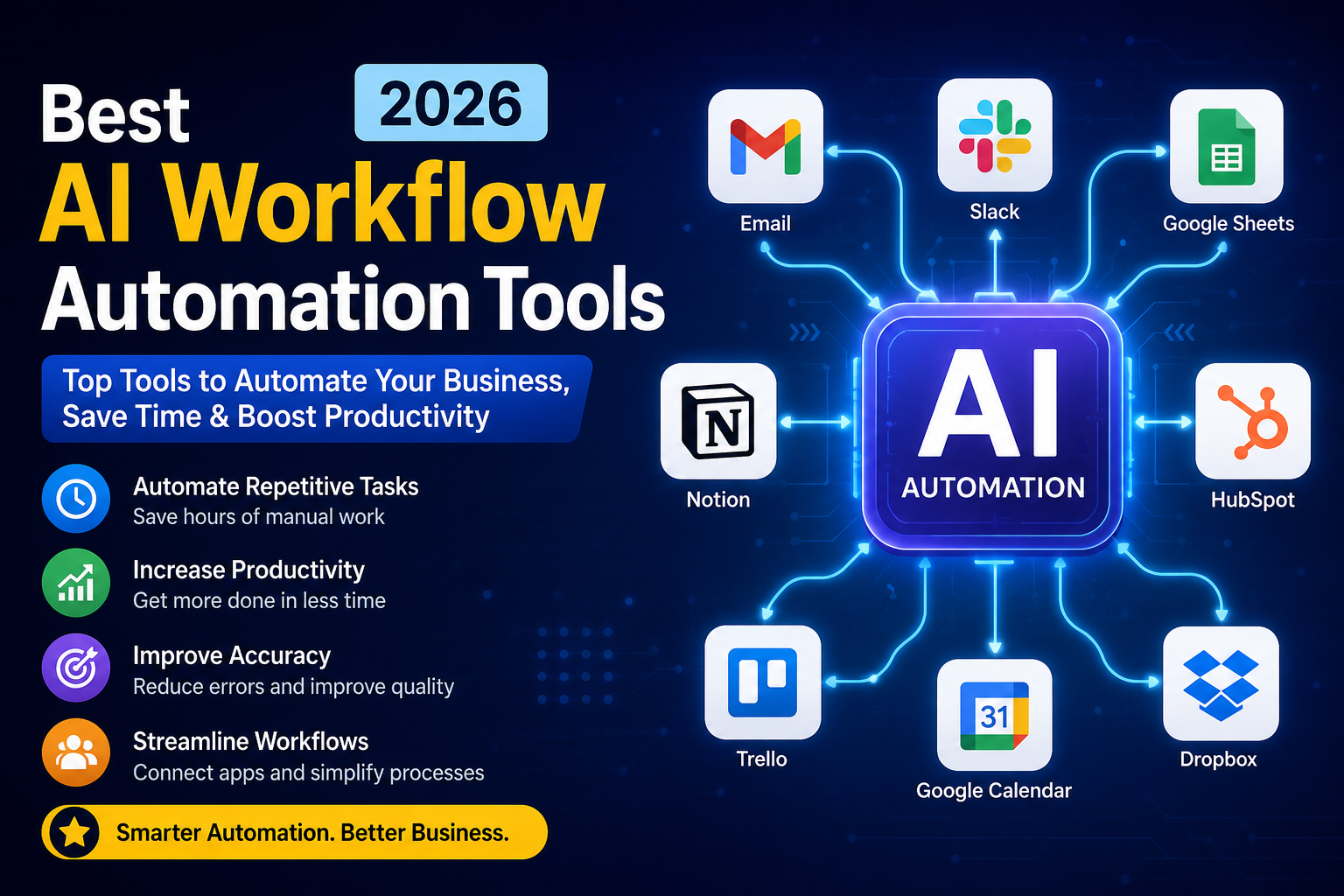
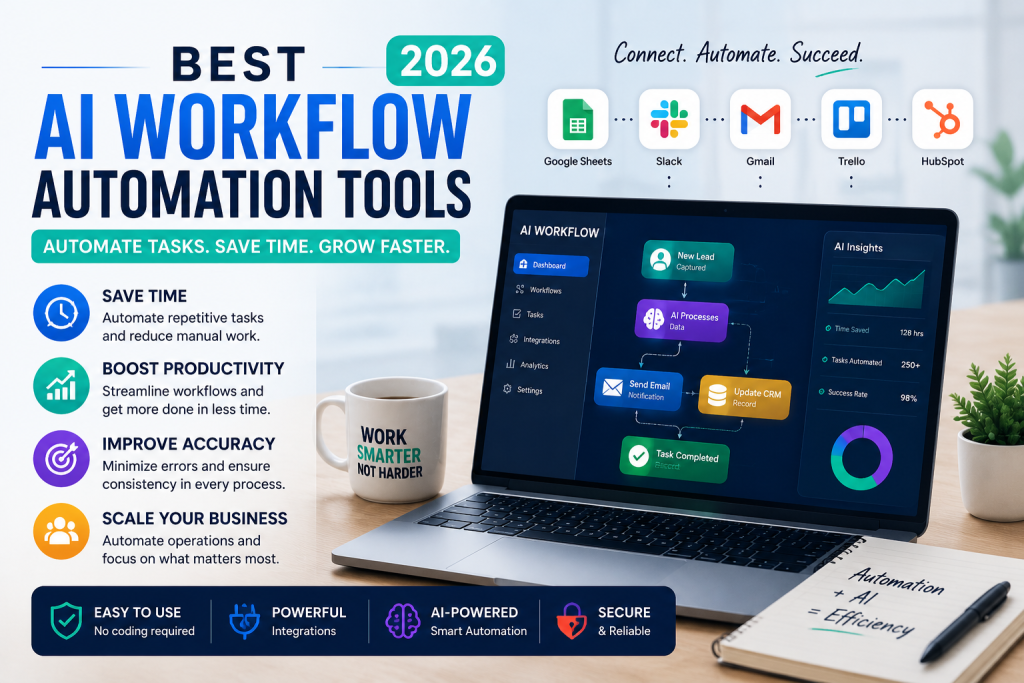
  • Best AI Workflow Automation Tools (2026): Top Solutions to Save Time and Boost Productivity

    Best AI Workflow Automation Tools (2026): Top Solutions to Save Time and Boost Productivity

    Best AI Workflow Automation Tools (2026): Top Solutions to Save Time and Boost Productivity

    Best AI Workflow Automation Tools in 2026

    Businesses across the United States are adopting AI faster than ever to improve productivity, reduce manual work, and streamline operations. Whether you’re a freelancer, small business owner, or part of a large enterprise, choosing the Best AI Workflow Automation Tools can help automate repetitive tasks, improve team collaboration, and save valuable time.

    In this guide, we’ll explore the Best AI Workflow Automation Tools available in 2026, highlighting their features, pricing, and ideal use cases. If you’re looking for the perfect automation platform for your business, this article will help you make an informed decision.


    What Are AI Workflow Automation Tools?

    AI workflow automation tools use artificial intelligence to automate repetitive business processes. These platforms can connect your favorite apps, generate content, analyze data, assign tasks, send notifications, and even make smart decisions based on predefined rules.

    The Best AI Workflow Automation Tools reduce human error while increasing efficiency across marketing, customer service, HR, finance, project management, and sales.


    1. Zapier AI

    Zapier remains one of the most popular automation platforms in 2026.

    Key Features

    • Connects over 8,000 apps
    • AI-powered workflow builder
    • Natural language automation creation
    • Email and document automation
    • CRM integrations

    Best For: Small businesses, startups, and freelancers.


    2. Make (Formerly Integromat)

    Make offers advanced visual workflow automation with flexible customization.

    Key Features

    • Drag-and-drop workflow builder
    • AI integrations
    • Conditional logic
    • Data transformation
    • API connectivity

    Best For: Developers and growing businesses.


    3. Microsoft Power Automate

    Perfect for organizations already using Microsoft 365.

    Key Features

    • AI Builder
    • Robotic Process Automation (RPA)
    • Office 365 integration
    • SharePoint automation
    • Teams notifications

    Best For: Enterprise companies.


    4. Workato

    Workato combines enterprise automation with AI-driven intelligence.

    Key Features

    • Enterprise-grade security
    • CRM automation
    • HR workflow automation
    • Finance automation
    • AI recommendations

    Best For: Large organizations.


    5. n8n

    An open-source automation platform gaining popularity among developers.

    Key Features

    • Self-hosting
    • AI integrations
    • Custom JavaScript support
    • Unlimited customization
    • API automation

    Best For: Developers and technical teams.


    6. ClickUp AI Automations

    ClickUp now offers powerful AI-powered workflow automation for project management.

    Key Features

    • Task automation
    • AI writing assistant
    • Smart reminders
    • Project templates
    • Team collaboration

    Best For: Marketing agencies and remote teams.


    7. Notion AI

    Notion AI continues expanding beyond documentation.

    Key Features

    • AI-generated notes
    • Knowledge management
    • Database automation
    • Meeting summaries
    • Task suggestions

    Best For: Content creators and startups.


    How to Choose the Best AI Workflow Automation Tools

    When selecting the Best AI Workflow Automation Tools, consider the following factors:

    • Ease of use
    • App integrations
    • AI capabilities
    • Security
    • Pricing
    • Scalability
    • Customer support

    Businesses should choose software that matches their workflow requirements rather than paying for unnecessary features.


    Benefits of Using AI Workflow Automation

    Using the Best AI Workflow Automation Tools offers several advantages:

    • Saves hours every week
    • Reduces repetitive manual work
    • Improves productivity
    • Minimizes human error
    • Enhances collaboration
    • Accelerates customer response times
    • Increases business efficiency
    • Scales operations without hiring additional staff

    As AI technology advances, automation platforms continue becoming smarter and more reliable.


    Pricing Comparison

    ToolStarting Price
    Zapier AIFree / Paid Plans
    MakeFree / Paid Plans
    Microsoft Power AutomatePaid Plans
    WorkatoCustom Pricing
    n8nFree / Cloud Plans
    ClickUp AIPaid Add-on
    Notion AIPaid Add-on

    Why US Businesses Are Investing in AI Automation

    Companies across the United States are embracing AI automation to stay competitive. From eCommerce stores and digital marketing agencies to healthcare providers and financial institutions, businesses are replacing repetitive manual processes with intelligent automation.

    The Best AI Workflow Automation Tools help organizations reduce operational costs, improve employee productivity, and deliver better customer experiences. Whether you’re running a startup or managing an enterprise, automation can significantly improve efficiency and profitability.


    Final Verdict

    Choosing the Best AI Workflow Automation Tools depends on your business size, budget, and automation needs. Zapier AI is an excellent choice for beginners, while Make provides advanced customization. Microsoft Power Automate is ideal for enterprise users, Workato excels in large-scale automation, and n8n offers unmatched flexibility for developers.

    If your goal is to save time, automate repetitive tasks, and improve productivity in 2026, investing in one of the Best AI Workflow Automation Tools is a smart decision. Compare features, test free plans, and select the platform that best fits your workflow to maximize efficiency and long-term growth.


    Frequently Asked Questions (FAQs)

    Which is the Best AI Workflow Automation Tools for beginners?

    Zapier AI is one of the easiest platforms for beginners due to its user-friendly interface and extensive app integrations.

    Are AI workflow automation tools worth it?

    Yes. They save time, reduce manual work, improve productivity, and help businesses scale efficiently.

    Can small businesses use AI workflow automation?

    Absolutely. Many platforms offer free or affordable plans designed specifically for startups and small businesses.

    Which AI workflow automation tool is best for enterprises?

    Microsoft Power Automate and Workato are excellent choices for enterprise-level automation because of their security, scalability, and advanced AI features.

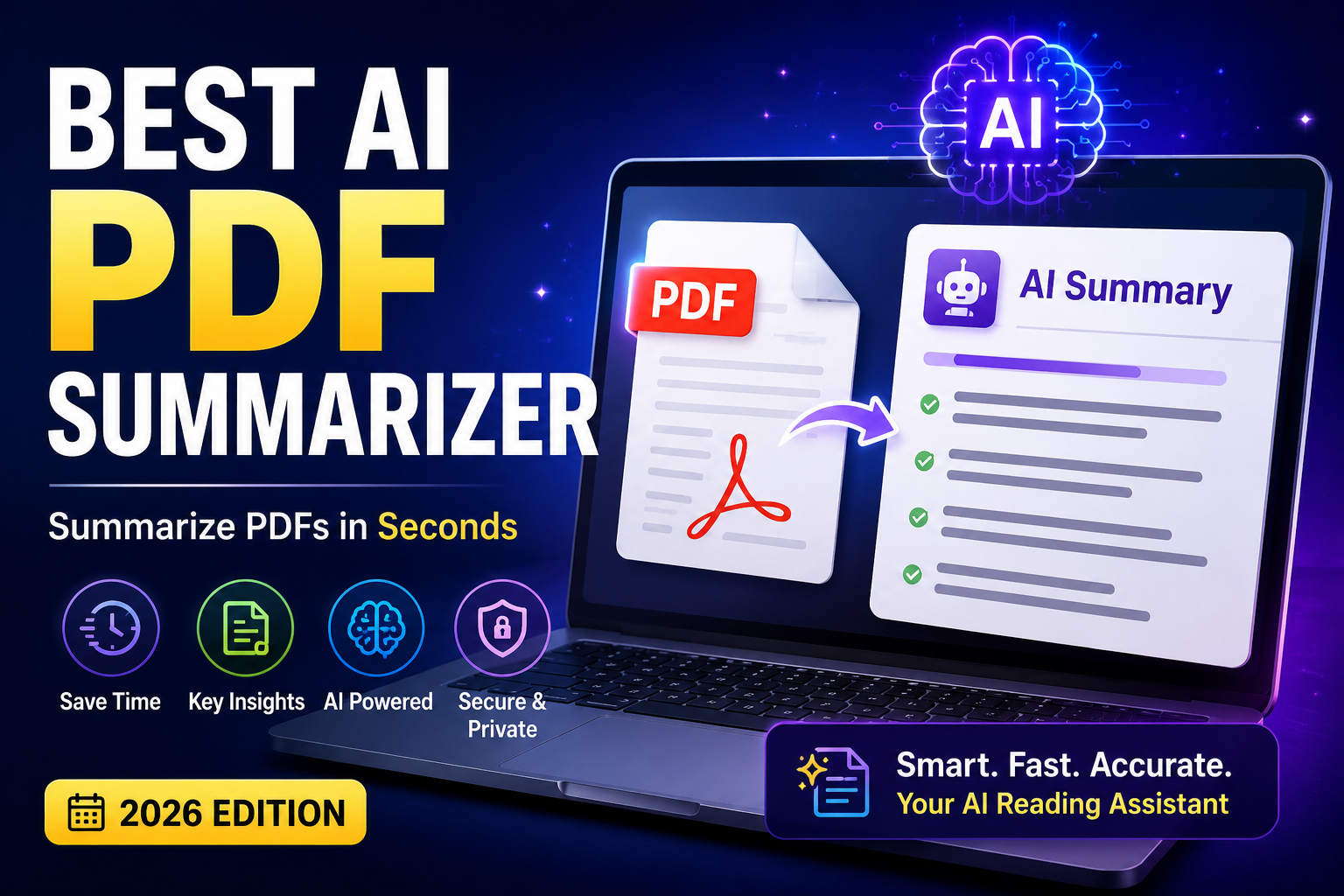
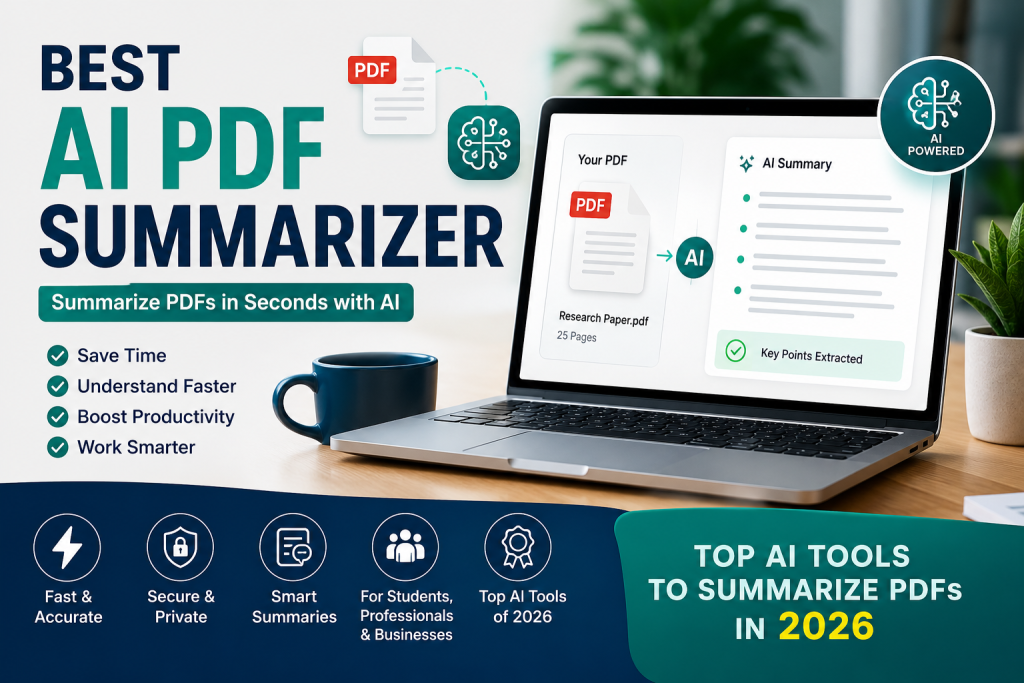
  • Best AI PDF Summarizer (2026): Top AI Tools to Summarize PDFs Faster

    Best AI PDF Summarizer (2026): Top AI Tools to Summarize PDFs Faster

    Best AI PDF Summarizer (2026): Top AI Tools to Summarize PDFs Fasters

    Best AI PDF Summarizer (2026): Save Time with Smarter AI Tools

    Finding the Best AI PDF Summarizer can dramatically reduce the time you spend reading lengthy documents. Whether you’re a student, researcher, business professional, lawyer, or educator in the United States, AI-powered PDF summarization tools make it easy to understand reports, research papers, contracts, eBooks, and manuals in just a few seconds.

    In this 2026 guide, we’ll compare the tools based on accuracy, speed, security, pricing, and ease of use so you can choose the right solution for your needs.

    Why Choose the Best AI PDF Summarizer?

    The Best AI PDF Summarizer helps users quickly identify the most important information without reading every page. Modern AI technology creates accurate summaries while preserving the original meaning of the document.

    Key Benefits

    • Save hours of reading time
    • Summarize research papers instantly
    • Understand legal and financial documents
    • Improve workplace productivity
    • Create study notes in minutes
    • Extract key insights from long PDF files

    Using the Best AI PDF Summarizer is one of the easiest ways to increase productivity and improve document management.

    Top AI PDF Summarizer Tools in 2026

    1. ChatGPT

    ChatGPT is considered one of the Best AI PDF Summarizer options because it provides detailed summaries, explains complex topics, and answers follow-up questions about uploaded PDF documents.

    Best For:

    • Students
    • Researchers
    • Business professionals
    • Writers

    2. Claude AI

    Claude AI is excellent for summarizing long PDF documents while maintaining context. It works particularly well for books, research papers, and technical documentation.

    Highlights

    • Excellent accuracy
    • Handles lengthy documents
    • Strong contextual understanding

    3. Adobe Acrobat AI Assistant

    Adobe Acrobat AI Assistant combines trusted PDF editing with advanced AI features, making it another choice for professionals.

    Features

    • Instant summaries
    • Smart document insights
    • Citation support
    • Secure file handling

    4. Smallpdf AI

    Smallpdf AI offers a beginner-friendly interface with quick summarization features. It’s a great choice for office workers, freelancers, and small businesses.

    5. UPDF AI

    UPDF AI combines PDF editing, translation, annotation, and AI-powered summaries into one platform for improved productivity.

    How to Choose the Best AI PDF Summarizer

    Before selecting the Best AI PDF Summarizer, consider the following factors:

    Accuracy

    Choose software that produces reliable summaries without leaving out important information.

    Speed

    Fast processing helps you complete work more efficiently.

    Security

    Select platforms that use encrypted uploads and protect sensitive documents.

    Pricing

    Compare free and premium plans based on your usage requirements.

    Ease of Use

    They should provide a clean, user-friendly interface suitable for both beginners and professionals.

    Who Should Use the Best AI PDF Summarizer?

    The Best AI PDF Summarizer is useful for anyone who works with digital documents on a regular basis.

    It is especially valuable for:

    • College students
    • University researchers
    • Teachers
    • Lawyers
    • Financial analysts
    • HR professionals
    • Healthcare workers
    • Business executives
    • Content creators
    • Marketing teams

    Free vs Paid AI PDF Summarizers

    Free AI tools are suitable for occasional users and small files. Paid versions generally provide:

    • Higher upload limits
    • Faster performance
    • Better AI models
    • Team collaboration
    • Advanced document analysis
    • Priority support

    If you regularly summarize PDFs, investing in the Best AI PDF Summarizer can improve efficiency and save valuable time.

    Final Verdict

    Choosing the Best AI PDF Summarizer depends on your workflow and document requirements. ChatGPT offers outstanding flexibility, Claude AI excels with large files, Adobe Acrobat AI Assistant integrates seamlessly into professional environments, while Smallpdf AI and UPDF AI provide user-friendly experiences for everyday users.

    As AI technology continues to evolve in 2026, the Best AI PDF Summarizer tools are becoming faster, smarter, and more accurate. Whether you’re studying, reviewing business reports, or analyzing legal documents, these AI solutions can significantly reduce reading time.

    If you’re searching for the , the tools listed above are among the best choices for users in the United States. The not only saves time but also improves productivity by delivering concise, accurate, and easy-to-understand document summaries.

  • Best AI Image Generators (2026): Top AI Tools to Create Stunning Images

    Best AI Image Generators (2026): Top AI Tools to Create Stunning Images

    Best AI Image Generators (2026): Top AI Tools to Create Stunning Images

    Focus Keyword: Best AI Image Generators (Used naturally 13 times)

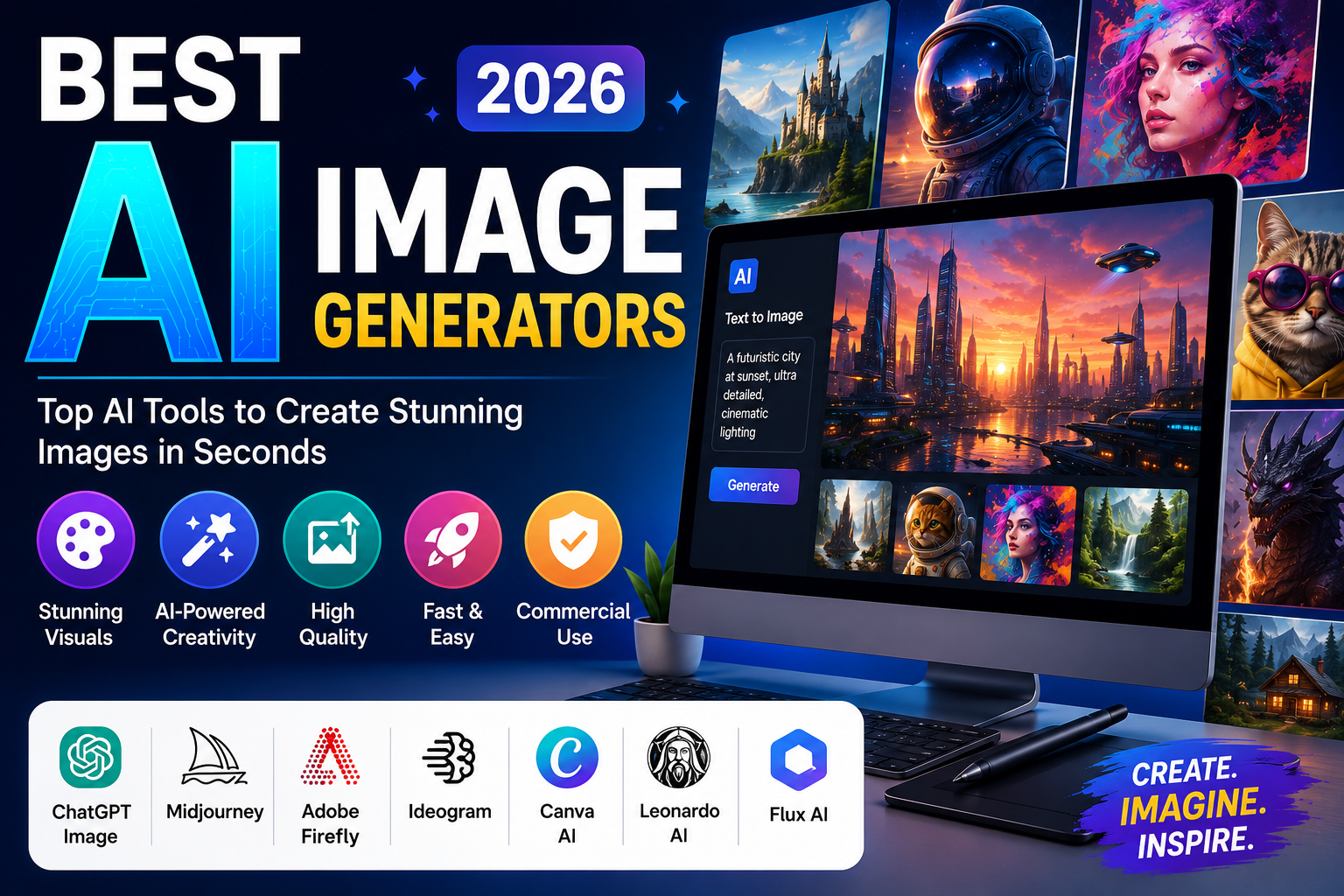
    Artificial intelligence has transformed digital creativity, making it easier than ever to generate professional-quality images from simple text prompts. Whether you’re a graphic designer, marketer, blogger, entrepreneur, or social media creator, the Best AI Image Generators can help you create eye-catching visuals in minutes.

    In this guide, we’ll explore the Best AI Image Generators available in 2026, compare their features, pricing, strengths, and ideal use cases, helping readers in the United States choose the right AI art tool for their needs.

    Why Use AI Image Generators?

    Modern AI image tools can create realistic photos, illustrations, logos, social media graphics, concept art, product mockups, and marketing visuals with just a few words. The Best AI Image Generators save time, reduce design costs, and allow users with little or no design experience to produce impressive artwork.

    Key benefits include:

    • Faster content creation
    • High-quality AI-generated artwork
    • Multiple artistic styles
    • Commercial-use options
    • Easy editing and customization
    • Improved productivity for businesses

    Best AI Image Generators in 2026

    1. ChatGPT Image Generation

    One of the Best AI Image Generators, ChatGPT enables users to create detailed, high-quality visuals from natural language prompts. It supports realistic scenes, illustrations, marketing graphics, and creative concepts while making prompt writing simple for beginners.

    Best For: Content creators, bloggers, marketers, and businesses.

    2. Midjourney

    Midjourney continues to rank among the Best AI Image Generators because of its cinematic artwork and exceptional artistic quality.

    Key Features

    • Ultra-realistic images
    • Fantasy artwork
    • Character design
    • Creative illustrations
    • High-resolution output

    Best For: Artists and designers.

    3. Adobe Firefly

    Adobe Firefly integrates seamlessly with Creative Cloud, making it one of the Best AI Image Generators for professional designers.

    Features

    • Commercial-safe image generation
    • Photoshop integration
    • Generative Fill
    • Vector artwork
    • Text effects

    Best For: Adobe users.

    4. Ideogram

    Ideogram stands out for generating AI images with accurate text rendering, making it ideal for posters, advertisements, and branding.

    Best For: Logo and typography design.

    5. Canva AI

    Canva AI combines image generation with its easy drag-and-drop editor. Many small businesses consider it one of the Best AI Image Generators for creating marketing materials quickly.

    Best For: Small businesses and social media creators.

    6. Leonardo AI

    Leonardo AI offers advanced customization and high-quality assets for games, product concepts, and digital art.

    Features

    • AI canvas
    • Image editing
    • Asset generation
    • Texture creation
    • Prompt refinement

    Best For: Game developers and creative professionals.

    7. Flux AI

    Flux AI has become one of the fastest-growing entries among the Best AI Image Generators, delivering realistic images, strong prompt understanding, and detailed visual outputs.

    Best For: Professional-quality AI artwork.

    Comparison Table

    AI ToolFree PlanBest ForImage Quality
    ChatGPT Image GenerationYesContent CreationExcellent
    MidjourneyNoDigital ArtExcellent
    Adobe FireflyLimitedProfessional DesignExcellent
    IdeogramYesLogos & TextVery Good
    Canva AIYesMarketingVery Good
    Leonardo AIYesGame AssetsExcellent
    Flux AILimitedRealistic ImagesExcellent

    How to Choose the Best AI Image Generators

    Before selecting from the Best AI Image Generators, consider these important factors:

    Image Quality

    Choose a platform that consistently produces detailed and realistic visuals.

    Ease of Use

    Beginners should prioritize intuitive interfaces with simple prompt workflows.

    Commercial Licensing

    If you create images for business or clients, verify commercial usage rights.

    Editing Tools

    Built-in editing features can save significant time.

    Pricing

    Many of the Best AI Image Generators offer free plans, while premium subscriptions unlock higher resolution, faster rendering, and advanced creative controls.

    Who Should Use AI Image Generators?

    The Best AI Image Generators are useful for:

    • Bloggers creating feature images
    • Digital marketers designing ads
    • Small businesses producing branded content
    • Social media managers
    • Graphic designers
    • E-commerce store owners
    • Content creators
    • Students and educators

    These tools help users produce professional visuals without hiring a designer for every project.

    Benefits of AI Image Generators

    Using the Best AI Image Generators provides several advantages:

    • Faster image creation
    • Lower design costs
    • Unlimited creative possibilities
    • Better marketing visuals
    • Consistent brand graphics
    • Improved workflow efficiency
    • Professional-quality artwork in minutes

    As AI technology continues to improve, these platforms are becoming essential for modern digital content creation.

    Final Thoughts

    The Best AI Image Generators have revolutionized how individuals and businesses create visual content. Whether you need realistic product images, artistic illustrations, social media graphics, or marketing materials, today’s AI tools deliver exceptional results with minimal effort.

    For users in the United States, platforms like ChatGPT Image Generation, Midjourney, Adobe Firefly, Canva AI, Leonardo AI, Ideogram, and Flux AI provide powerful solutions for every skill level and budget. Choosing one of the Best AI Image Generators can help you save time, enhance creativity, and produce high-quality visuals that stand out online in 2026.


  • ClickUp AI vs Notion AI (2026): Which AI Productivity Tool Is Better?

    ClickUp AI vs Notion AI (2026): Which AI Productivity Tool Is Better?

    ClickUp AI vs Notion AI (2026): Which AI Productivity Tool Is Better?

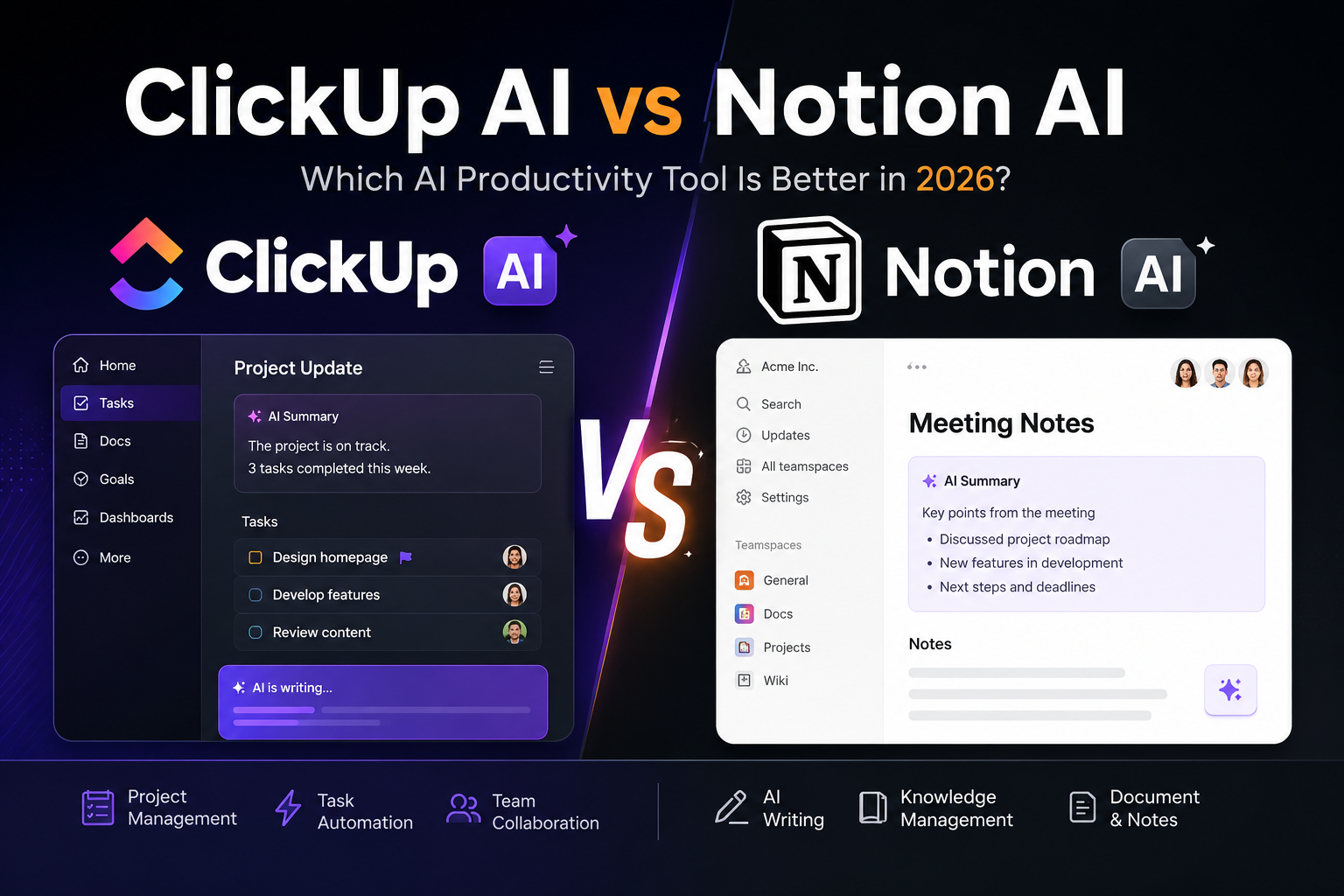
    Artificial intelligence is changing how individuals and businesses manage tasks, documents, and team collaboration. From writing content and organizing projects to automating workflows, AI-powered productivity platforms are becoming essential. If you’re comparing ClickUp AI vs Notion AI, this guide will help you decide which platform offers the best value in 2026.

    Whether you’re a project manager, entrepreneur, freelancer, student, or business owner in the United States, choosing the right AI workspace can boost efficiency and simplify daily work. In this comparison, we’ll evaluate ClickUp AI vs Notion AI based on features, ease of use, collaboration, AI capabilities, pricing, integrations, and overall productivity.

    Why Compare ClickUp AI vs Notion AI?

    Although both tools use artificial intelligence to improve productivity, they focus on different workflows and user needs.

    Before making your decision, compare these key factors:

    • AI writing capabilities
    • Project management features
    • Task automation
    • Knowledge management
    • Collaboration tools
    • Templates
    • Integrations
    • Ease of use
    • Pricing

    Understanding these differences will help you select the productivity platform that best fits your workflow.

    ClickUp AI vs Notion AI: Quick Overview

    ClickUp AI

    ClickUp AI is designed for project management, task tracking, team collaboration, and workflow automation. Its AI assistant helps users create tasks, summarize meetings, generate documents, and improve project efficiency.

    Key Features

    • AI task creation
    • Project management
    • Meeting summaries
    • Workflow automation
    • Time tracking
    • Team collaboration

    Best For

    Businesses, agencies, project managers, operations teams, and remote organizations.


    Notion AI

    Notion AI combines note-taking, documentation, databases, and AI writing into one flexible workspace. It helps users generate content, summarize notes, brainstorm ideas, and organize knowledge.

    Key Features

    • AI writing assistant
    • Smart note organization
    • Knowledge management
    • Document summaries
    • Database support
    • Team collaboration

    Best For

    Students, startups, content creators, educators, freelancers, and knowledge workers.

    ClickUp AI vs Notion AI: Feature Comparison

    AI Writing

    When comparing ClickUp AI vs Notion AI, both platforms include AI writing features but with different strengths.

    ClickUp AI focuses on productivity by generating task descriptions, project updates, meeting notes, and internal documentation.

    Notion AI excels at blog writing, brainstorming, summarizing documents, rewriting content, and creating structured notes.

    Project Management

    ClickUp provides one of the most complete project management systems available, offering task dependencies, dashboards, timelines, goals, calendars, and automation.

    Notion offers project tracking as well, but its strength lies in flexibility rather than advanced project management.

    Collaboration

    Both tools support real-time collaboration.

    ClickUp is ideal for larger teams that manage complex projects across departments.

    Notion provides collaborative documents, shared workspaces, and databases that are easy to customize for smaller teams.

    Integrations

    ClickUp integrates with hundreds of business tools, including Slack, Google Drive, GitHub, Zoom, and Microsoft Teams.

    Notion also supports numerous integrations while maintaining a streamlined workspace for documents and knowledge management.

    Ease of Use

    Notion offers a clean, minimal interface that many users find easy to customize.

    ClickUp includes more advanced features, making it powerful but requiring a slightly longer learning curve.

    Pricing

    Both platforms provide free plans with premium upgrades.

    ClickUp delivers excellent value for businesses that need advanced project management.

    Notion is a strong option for individuals and teams focused on documentation, collaboration, and content creation.

    Pros and Cons

    ClickUp AI

    Pros

    • Powerful project management
    • Excellent workflow automation
    • Advanced collaboration
    • Time tracking
    • Business-focused AI features

    Cons

    • Can feel overwhelming for beginners.
    • Some advanced AI features require paid plans.

    Notion AI

    Pros

    • Outstanding document creation
    • Flexible workspace
    • Excellent note-taking
    • Clean interface
    • Strong AI writing capabilities

    Cons

    • Project management features are less advanced than ClickUp.
    • Heavy customization may require setup time.

    Who Should Choose ClickUp AI?

    Choose ClickUp AI if you need:

    • Project management
    • Task automation
    • Team collaboration
    • Workflow optimization
    • Business operations
    • Agile project planning

    Who Should Choose Notion AI?

    Choose Notion AI if you need:

    • AI writing
    • Note-taking
    • Knowledge management
    • Documentation
    • Brainstorming
    • Content creation

    Final Verdict

    When comparing ClickUp AI vs Notion AI, the best choice depends on your workflow and business requirements.

    ClickUp AI is the better option for organizations that require advanced project management, task automation, team collaboration, and operational efficiency. Its powerful productivity tools make it an excellent solution for growing businesses and professional teams.

    Notion AI is ideal for users who prioritize note-taking, documentation, knowledge management, and AI-assisted writing. Its flexible workspace is especially valuable for students, creators, freelancers, startups, and professionals managing information rather than complex projects.

    As AI-powered productivity software continues to evolve throughout 2026, both platforms are becoming more intelligent and feature-rich. By understanding the strengths of ClickUp AI vs Notion AI, you can confidently choose the platform that best supports your productivity goals, collaboration style, and long-term workflow.