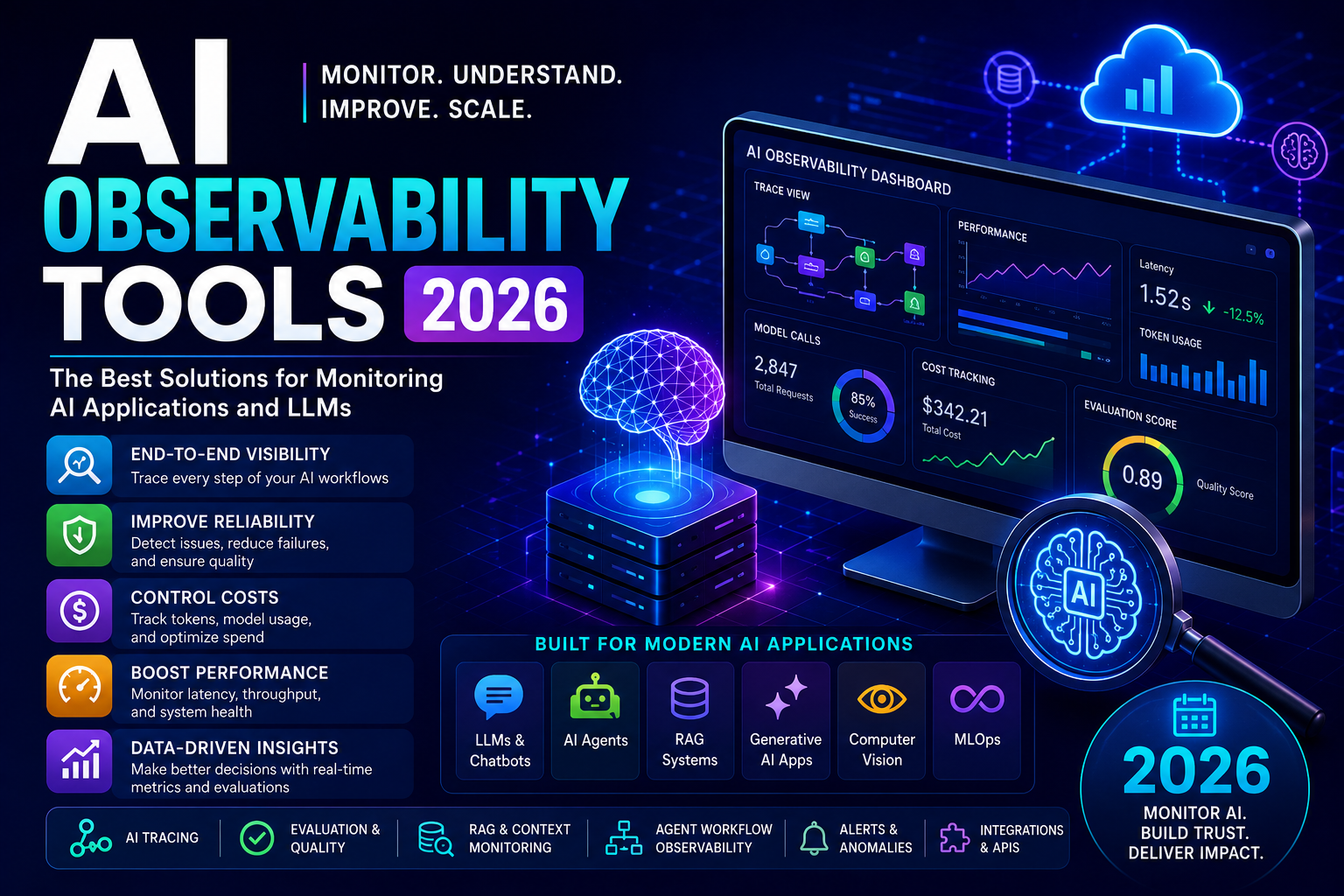
AI Observability Tools: 10 Best Solutions for Monitoring AI in 2026
Artificial intelligence applications are becoming more complex, especially as businesses adopt large language models (LLMs), AI agents, retrieval-augmented generation (RAG), and generative AI. Traditional application monitoring can show whether a request succeeded, but it may not explain why an AI response was inaccurate, expensive, slow, or unsafe.
That is why AI Observability Tools are becoming an important part of modern AI development. They help engineering and product teams monitor AI behavior, trace model requests, measure latency and token usage, evaluate response quality, identify failures, and control operating costs.
In 2026, AI observability is increasingly focused not only on whether an AI application is running, but also on whether it is producing reliable and useful results.
What Are AI Observability Tools?
AI Observability Tools are platforms that provide visibility into the behavior and performance of AI applications.
Traditional observability typically focuses on metrics such as uptime, errors, CPU usage, memory, and response time. AI applications require additional information, including prompts, model responses, tool calls, token consumption, retrieval steps, evaluation scores, and agent workflows.
This additional visibility helps developers understand what happened inside an AI application when something goes wrong.
For example, an AI chatbot might return a successful HTTP response while providing incorrect information. Traditional monitoring may report the request as successful, while an AI observability system can help identify the problematic prompt, model response, retrieval step, or tool call.
Why AI Observability Matters in 2026
The growing complexity of AI systems makes monitoring more challenging. An AI agent may make multiple model calls, retrieve information from databases, use external tools, and make several decisions before returning a final response.
Without detailed tracing, debugging these workflows can become difficult.
Modern AI Observability Tools help teams answer questions such as:
- Why did an AI response fail?
- Which model generated the response?
- How many tokens were used?
- What did the request cost?
- How long did the model take to respond?
- Did the AI application hallucinate?
- Which tool call caused the problem?
- Is response quality declining?
- Are users receiving consistent results?
These capabilities are especially useful for companies running customer-facing AI applications.
Key Features to Look For
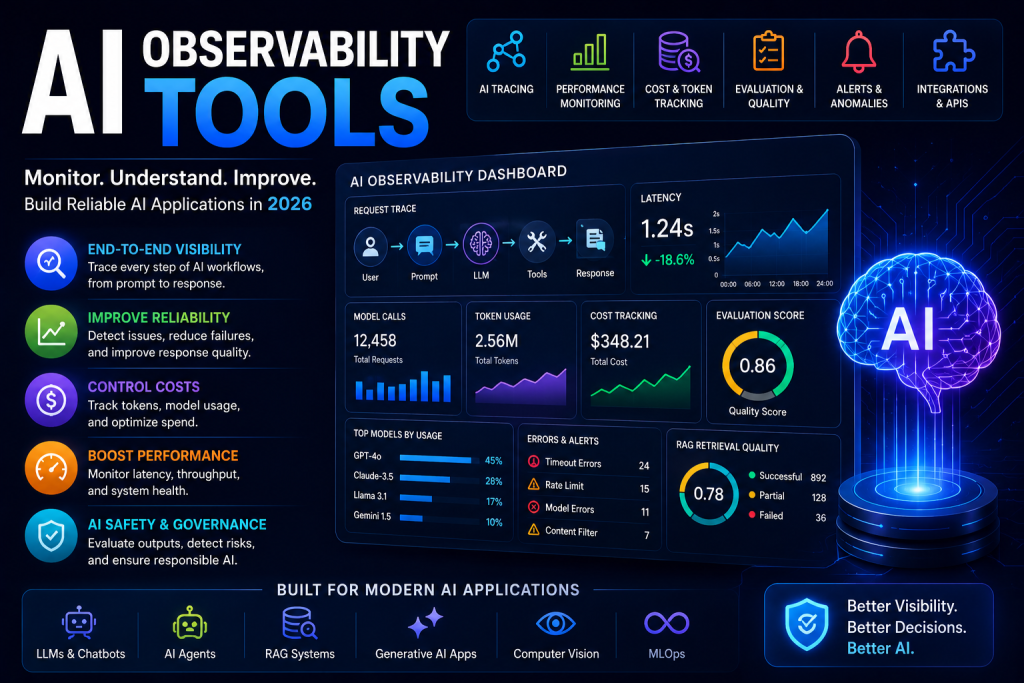
1. AI Tracing
Tracing is one of the most important features of AI Observability Tools. It records the steps involved in an AI request and can show prompts, responses, model calls, retrieval operations, and tool interactions.
For AI agents, tracing becomes even more important because one user request may involve multiple connected operations.
2. Performance Monitoring
AI applications need to be monitored for latency, errors, throughput, and reliability.
Teams can use AI monitoring platforms to identify slow model responses, API failures, unusual traffic patterns, and performance bottlenecks.
This allows developers to investigate problems before they significantly affect users.
3. Token and Cost Tracking
AI models can become expensive when applications generate large numbers of requests.
AI Observability Tools can track token consumption and estimate model costs. This helps teams determine which applications, users, prompts, or models are generating the highest expenses.
Cost visibility is especially valuable when organizations use multiple AI providers or models.
4. Output Quality Evaluation
Monitoring whether an application responds is not enough. Teams also need to determine whether the response is actually useful.
AI evaluation features can score responses for factors such as accuracy, relevance, toxicity, hallucination risk, and adherence to predefined requirements.
Current AI observability platforms increasingly combine tracing with evaluation so teams can connect a poor-quality result with the specific execution steps that produced it.
5. AI Agent Monitoring
AI agents introduce another layer of complexity because they can make decisions and call tools independently.
An agent might retrieve information, call an API, perform calculations, ask another model for information, and then produce a final response.
AI Observability Tools can provide visibility into these multi-step workflows, helping developers identify where an agent became inefficient or made an incorrect decision.
Comet notes that modern agent observability increasingly requires multi-step trace visualization and evaluation at individual stages of an agent workflow.
6. RAG Monitoring
Retrieval-augmented generation allows AI applications to retrieve information from external databases before generating a response.
RAG systems can fail when the wrong information is retrieved, relevant information is missing, or the model incorrectly interprets the retrieved content.
AI observability solutions can trace retrieval steps and evaluate whether the retrieved context contributed to an accurate response.
This is particularly useful for enterprise chatbots, knowledge bases, customer-support systems, and internal AI assistants.
7. Prompt Monitoring
Prompts can have a major impact on AI performance.
Development teams can monitor prompt versions, compare responses, and identify which instructions produce better results.
Prompt monitoring can also help teams detect unexpected changes after a model, application, or prompt is updated.
Best AI Observability Tools in 2026
There is no single platform that is best for every organization. Different tools focus on different needs.
Popular options in 2026 include:
- Langfuse — strong open-source and self-hosting option
- LangSmith — particularly useful for LangChain and LangGraph applications
- Arize Phoenix — strong for tracing, evaluation, RAG, and OpenTelemetry workflows
- Braintrust — focused on evaluation-driven development
- Comet Opik — useful for high-volume AI and agent monitoring
- W&B Weave — useful for teams already working with Weights & Biases
- Datadog LLM Observability — suitable for organizations already using Datadog
- MLflow — useful for broader machine-learning lifecycle workflows
- Galileo — focused on AI quality and evaluation
- SigNoz — useful for teams wanting AI monitoring alongside broader application observability
Recent 2026 comparisons show that these platforms differ considerably in areas such as tracing, evaluation, open-source support, agent monitoring, and integration with existing infrastructure.
How to Choose the Right Platform
Before selecting AI Observability Tools, businesses should identify their most important monitoring requirements.
Consider:
AI framework: Does the platform integrate with your existing development stack?
Tracing: Can you inspect individual model calls and complete agent workflows?
Evaluation: Can you measure response quality rather than just technical performance?
Cost monitoring: Does it track tokens and model expenses?
Security: How does it handle prompts, responses, customer information, and sensitive data?
Scalability: Can it support your expected production workload?
OpenTelemetry: Does it work with standardized telemetry and existing observability infrastructure?
Deployment: Do you need cloud hosting, self-hosting, or both?
The right choice should be based on your actual production requirements rather than simply choosing the platform with the largest feature list.
Benefits for Businesses
Implementing AI Observability Tools can provide several advantages:
- Faster debugging
- Better AI reliability
- Improved response quality
- Lower model costs
- Easier incident investigation
- Better visibility into AI agents
- Improved RAG performance
- More reliable production deployments
- Better monitoring of model changes
- Stronger AI governance
These benefits can help companies move from experimental AI projects toward dependable production systems.
Challenges to Consider
AI observability also creates challenges. AI systems can generate sensitive prompts and responses, so organizations must consider privacy, access controls, retention policies, and security.
Another challenge is data volume. Large AI applications can generate huge numbers of traces, making storage and analysis expensive.
Teams should also avoid collecting unnecessary sensitive information and should carefully determine what telemetry needs to be retained.
Future of AI Observability
The future of AI Observability Tools is moving beyond basic logging toward intelligent monitoring and automated evaluation.
As AI agents become more autonomous, observability platforms will increasingly need to understand entire workflows rather than individual model requests.
Organizations will also place greater emphasis on quality, safety, cost efficiency, and reliability. In other words, the key question is shifting from “Did the AI system respond?” to “Did it respond correctly, efficiently, safely, and at an acceptable cost?”
Conclusion
AI Observability Tools are becoming essential for organizations deploying AI applications in production. They provide visibility into model performance, prompts, responses, costs, latency, retrieval systems, and agent workflows.
In 2026, the strongest observability strategies combine traditional infrastructure monitoring with AI-specific tracing and evaluation.
For businesses building AI chatbots, copilots, RAG applications, or autonomous agents, investing in the right observability approach can make it easier to detect problems, improve quality, manage costs, and build more reliable AI products.