AI Investment Tools: How Artificial Intelligence Is Transforming Investing in 2026
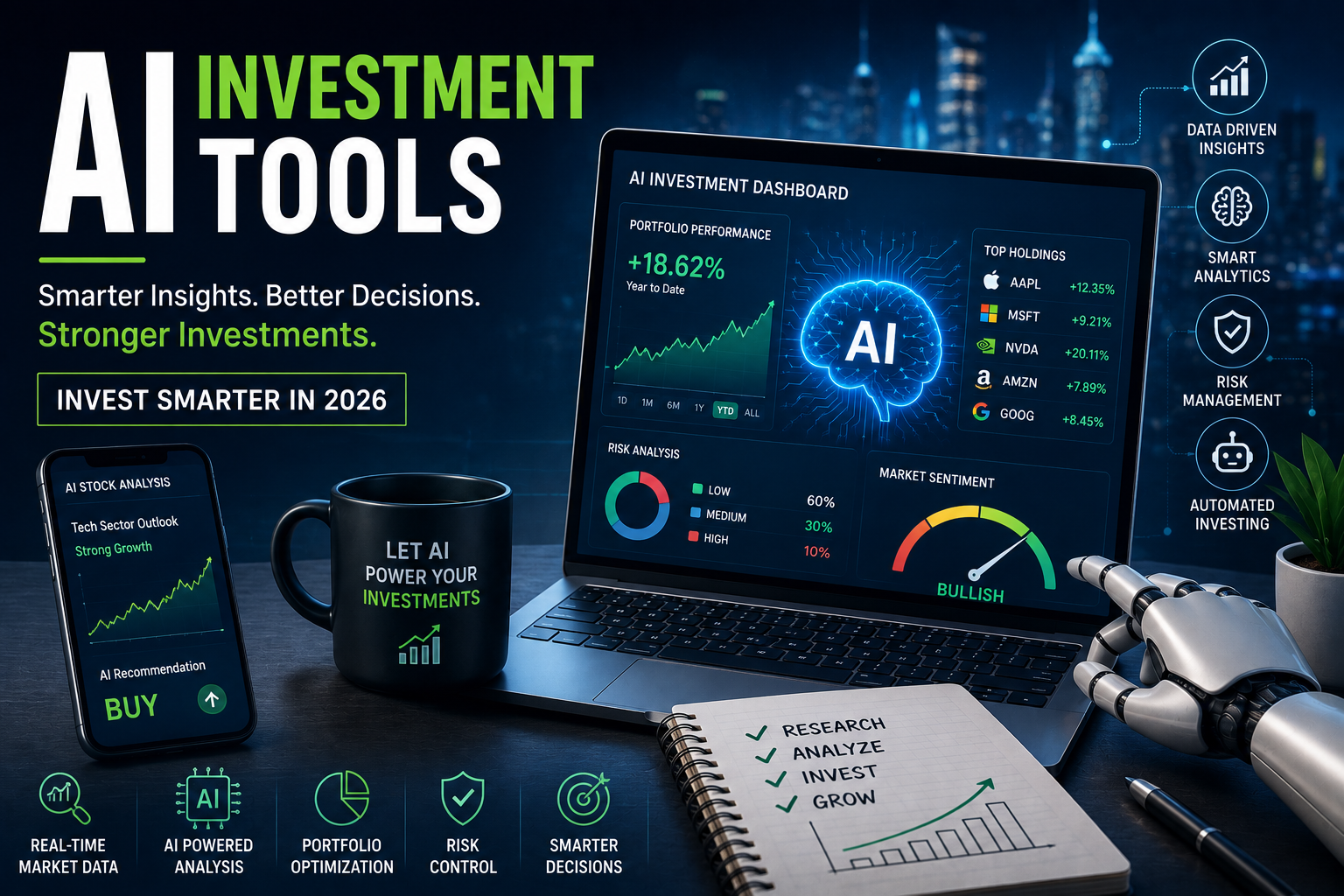
Investing has become increasingly digital, data-driven, and accessible. In 2026, investors can use artificial intelligence to research companies, analyze market information, build portfolios, monitor risk, and automate parts of their investment process. AI Investment Tools are becoming useful for both beginners and experienced investors who want faster access to financial insights.
For American investors, these technologies can be particularly useful for researching stocks, ETFs, retirement portfolios, and other financial products. However, AI should be viewed as a research and decision-support technology—not a guarantee of investment success.
What Are AI Investment Tools?
AI Investment Tools are software platforms that use artificial intelligence, machine learning, natural-language processing, or related technologies to assist with investing and financial research. Depending on the platform, these tools may summarize financial information, identify market trends, compare securities, analyze portfolios, generate research reports, or provide automated investing features.
Some tools are designed for education and research, while others connect to investment accounts or provide portfolio-management services. The SEC explains that robo-advisers use computer algorithms to provide online investment advisory services, and investors should consider factors such as fees, the information used, investment approach, and level of human interaction.
How AI Investment Tools Work
Modern AI Investment Tools process large amounts of financial information much faster than a person could manually review. A platform might analyze company filings, earnings information, historical price data, economic indicators, portfolio allocations, and other permitted data sources.
Machine learning can identify patterns in historical information, while natural-language processing can help organize and summarize financial documents. Generative AI can also turn complex financial information into easier-to-understand explanations.
However, speed does not guarantee accuracy. Investors should treat AI-generated information as a research aid rather than automatically assuming that every recommendation is correct.
Key Benefits of AI Investment Tools
One of the biggest benefits of AI Investment Tools is efficiency. Investors can spend less time collecting information and more time evaluating whether an investment fits their goals.
1. Faster Investment Research
AI can quickly summarize financial documents, compare companies, organize market information, and highlight potentially relevant data. This can make investment research more efficient, particularly when an investor needs to examine multiple companies or industries.
2. Portfolio Analysis
Some platforms can examine asset allocation, diversification, historical performance, and potential risk. These insights can help investors understand how different holdings interact within a portfolio.
3. Personalized Financial Insights
AI can analyze information supplied by an investor and produce personalized educational insights based on goals, risk preferences, and time horizons. However, personalization should not be confused with guaranteed investment advice or returns.
4. Automation
Robo-advisory platforms can automate parts of portfolio construction and management. This can make investing more convenient, particularly for people who prefer a structured, automated approach.
AI Investment Tools for Stock Research
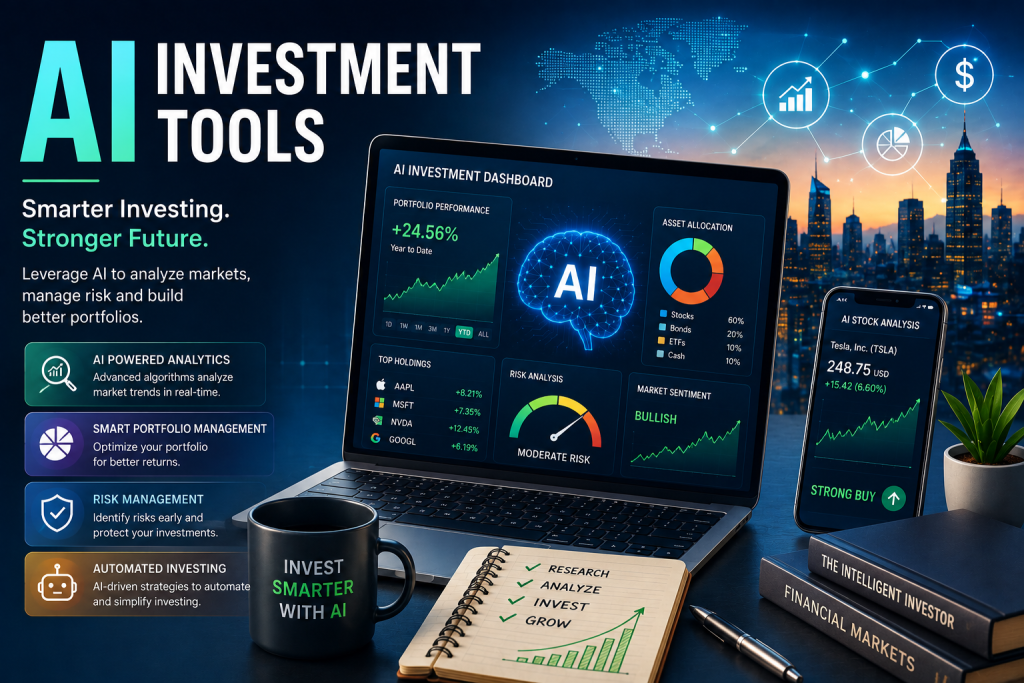
For investors researching individual stocks, AI Investment Tools can help organize information about companies, industries, financial performance, and market developments.
An AI research assistant may summarize an earnings report, explain financial terminology, compare business metrics, or help generate questions for further research. These capabilities can be especially helpful when investors need to review large quantities of information.
Still, investors should verify important claims against original company filings and reliable financial sources before making decisions.
AI Investment Tools for Portfolio Management
Portfolio management is another major use case for AI Investment Tools. Some platforms can evaluate diversification, asset allocation, portfolio risk, and investment objectives.
Automated investment platforms may also rebalance portfolios according to predetermined strategies. The appropriate approach depends on the investor’s objectives, time horizon, financial circumstances, and risk tolerance.
For retirement investors, AI-assisted analysis can also help organize information about accounts such as 401(k) plans and IRAs, although investors should understand the limitations and fees of any technology they use.
Risks and Limitations
Although AI Investment Tools can make investing more efficient, they also introduce risks.
AI systems can produce inaccurate information, misunderstand financial context, rely on incomplete data, or generate confident-sounding conclusions that are wrong. Investors should therefore verify important information independently.
There is also a growing risk of AI-related investment scams. FINRA warned in 2026 that criminals are using deepfakes and voice phishing to make fraudulent investment communications appear more convincing.
FINRA has also warned about unregistered automated trading services that claim to use AI and sometimes promote unrealistic or risk-free returns.
How to Choose AI Investment Tools
When evaluating AI Investment Tools, investors should look beyond flashy AI features.
Consider:
- Transparency: Does the platform explain how its recommendations or analysis work?
- Fees: Understand subscription, management, trading, and other charges.
- Security: Review account protection, privacy practices, and authentication options.
- Regulatory status: Check whether an investment adviser, broker, or platform is appropriately registered.
- Human support: Determine whether qualified human assistance is available when needed.
- Data quality: Find out what information the system uses and how frequently it is updated.
The SEC recommends that investors research investment professionals and firms through its Investment Adviser Public Disclosure resources before relying on investment recommendations.
AI Investment Tools and the Future of Investing
The role of AI Investment Tools is likely to expand as financial technology becomes more sophisticated. Future platforms may combine portfolio analysis, financial education, document analysis, risk monitoring, and personalized planning in a single experience.
Generative AI and AI agents could also make financial interfaces more conversational. Instead of searching through multiple dashboards, an investor might ask questions in natural language and receive explanations based on available account or market information.
At the same time, investors should remain cautious about claims that AI can predict markets with certainty. No technology can remove investment risk, and past performance does not guarantee future results.
Best Practices for Investors
Using AI Investment Tools responsibly means combining technology with independent judgment. Investors should verify important information, understand the risks of each investment, review fees, and avoid platforms that promise guaranteed profits.
Before using an automated investment service, understand its investment strategy and the role of human oversight. A technology-driven approach can be useful, but it should support—not replace—sound financial decision-making.
Conclusion
AI Investment Tools are changing how investors research, analyze, and manage investments in 2026. They can improve efficiency, simplify complex information, support portfolio analysis, and automate selected investment tasks.
The most effective use of these tools is not to blindly follow AI-generated recommendations. Instead, investors can use AI to accelerate research while verifying important information through reliable sources and maintaining control over their financial decisions.
As AI continues to evolve, investors who understand both its capabilities and limitations will be better prepared to use technology responsibly in a rapidly changing financial environment.