AI Wealth Management: How Artificial Intelligence Is Changing Investing in 2026
Managing wealth has become more complex as investors face changing markets, retirement needs, tax considerations, inflation, and an expanding range of investment products. At the same time, wealth-management firms are looking for ways to deliver more personalized services while improving efficiency. AI Wealth Management is emerging as an important technology for analyzing financial information, supporting portfolio decisions, improving client experiences, and automating repetitive advisory tasks.
In 2026, artificial intelligence is becoming increasingly relevant across the wealth-management industry. McKinsey describes AI, demographic change, and changing client expectations as major forces that could reshape the industry over the coming decade.
What Is AI Wealth Management?
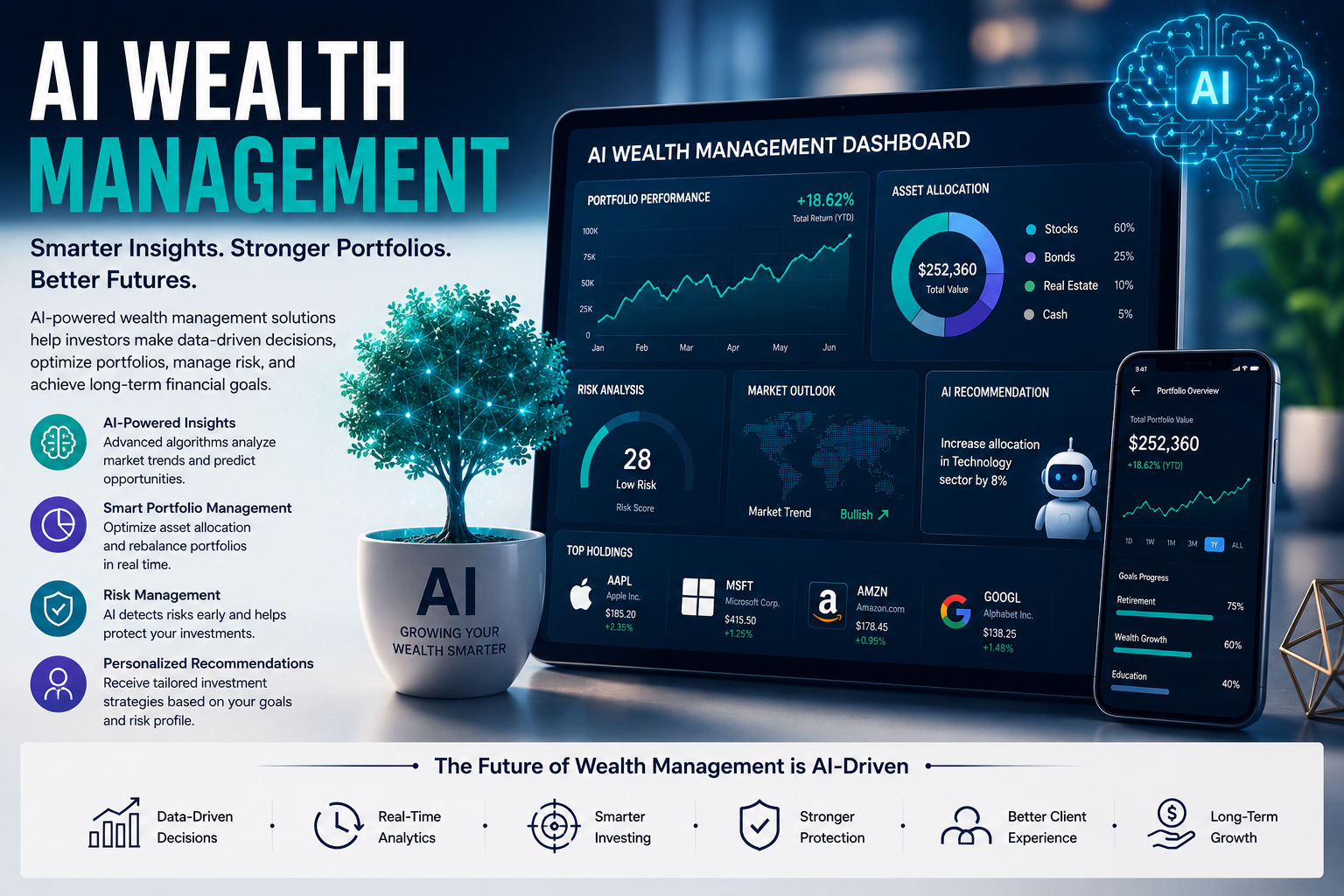
AI Wealth Management refers to using artificial intelligence, machine learning, predictive analytics, natural-language processing, and automation to support investment and financial-planning activities.
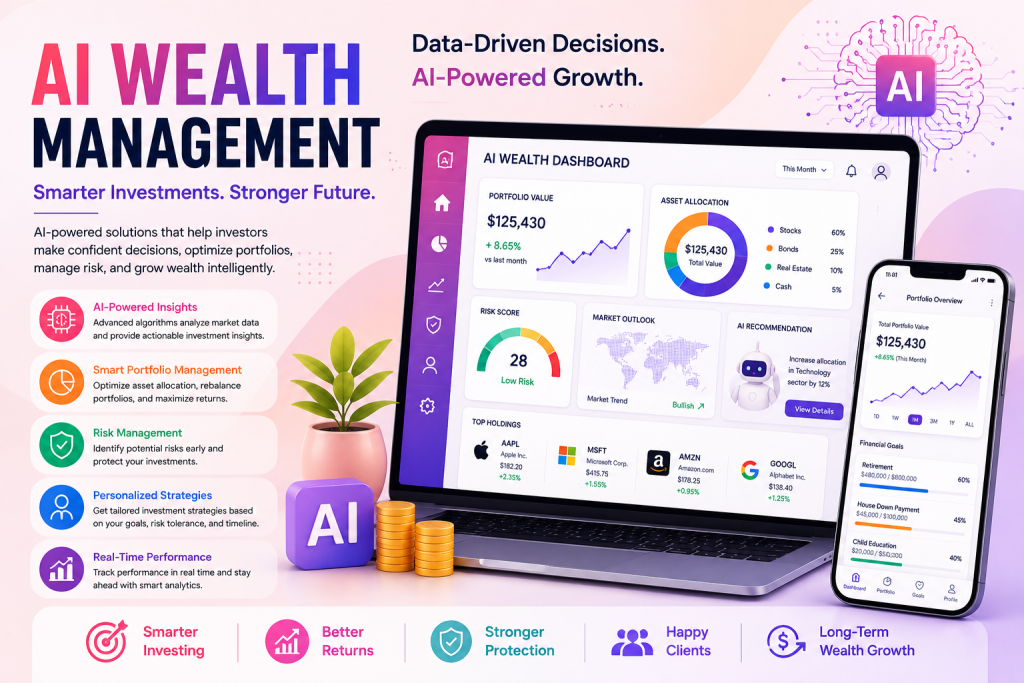
These systems can analyze portfolio information, investor objectives, market data, and other permitted information to generate insights. Depending on the platform, AI can help with portfolio construction, rebalancing, financial planning, tax-related workflows, investment research, risk analysis, and customer communication.
AI does not automatically replace financial advisors. Instead, it can act as a technology layer that helps professionals process information faster and spend more time on complex financial decisions and client relationships.
Why AI Wealth Management Matters in 2026
Investor expectations are changing. Clients increasingly expect personalized digital experiences, fast access to information, and advice that reflects their individual financial goals.
AI Wealth Management can help firms respond by analyzing large amounts of information and generating personalized insights more efficiently.
Robo-advisory platforms already use software-based algorithms to provide automated portfolio-management services. SEC filings, for example, describe automated digital advisory services that allocate assets among investments according to target portfolio allocations and rebalancing algorithms.
However, technology does not remove an adviser’s responsibilities. The SEC continues to emphasize fiduciary obligations, including duties of care and loyalty and managing or disclosing conflicts of interest.
Key Applications of AI Wealth Management
1. Portfolio Management
One of the most important applications is portfolio analysis. AI can evaluate asset allocation, diversification, risk exposure, investment objectives, and historical performance.
The system can highlight potential concentration risks or allocation changes that deserve attention. Automated platforms can also support portfolio rebalancing according to predefined strategies.
2. Personalized Investment Insights
AI Wealth Management can analyze client information to help generate more personalized financial insights.
For example, a platform may organize information around investment objectives, time horizon, risk preferences, and existing holdings. Advisors can then use these insights as a starting point for conversations with clients.
Personalization should still be based on accurate information and appropriate suitability or fiduciary processes.
3. Financial Planning
AI can assist with financial-planning workflows by organizing information about income, assets, expenses, savings goals, and retirement objectives.
It can help advisors model scenarios and explain complex financial concepts in simpler language. This can make planning sessions more efficient while keeping important decisions under appropriate human oversight.
4. Investment Research
Research is another valuable application. AI can summarize financial reports, organize market information, compare companies, and help advisors locate relevant information more quickly.
Generative AI can also provide conversational interfaces that allow professionals to ask questions about large collections of financial documents.
However, AI-generated research should be verified against reliable sources before being used in client-facing investment decisions.
5. Risk Analysis
AI Wealth Management can support risk analysis by examining portfolio exposure, market conditions, asset correlations, and other relevant signals.
Predictive analytics can identify scenarios that may deserve further investigation. The technology can therefore act as an early-warning system rather than a guarantee of future market performance.
6. Tax and Retirement Planning
AI can assist with certain tax-planning and retirement workflows by organizing financial information and modeling potential scenarios.
This area is becoming increasingly important as technology reduces the time required to produce complex planning outputs. McKinsey highlighted an AI-enabled tax-planning workflow in 2026 as an example of how AI may change the economics and operating model of wealth management.
Benefits for Wealth-Management Firms
AI Wealth Management can provide several operational and client-facing benefits:
- Faster financial analysis
- More personalized client experiences
- Improved portfolio monitoring
- Reduced repetitive administrative work
- More efficient investment research
- Better workflow automation
- Faster access to financial information
- Scalable digital services
- Improved advisor productivity
The greatest value often comes from combining AI with experienced financial professionals rather than attempting to automate every advisory activity.
Risks and Challenges
AI also introduces important risks.
Accuracy
AI systems can produce incorrect or incomplete information. Financial professionals should verify important outputs before relying on them.
Bias
Models may reflect biases contained in their training data or design. Firms need testing and monitoring processes to identify problematic outcomes.
Conflicts of Interest
Investment recommendations should be evaluated carefully for potential conflicts. A technology provider’s commercial incentives should not override client interests.
A March 2026 SEC enforcement action involving a robo-adviser highlighted the importance of clearly disclosing material conflicts connected with automated portfolio allocations.
Privacy and Security
Wealth-management systems handle highly sensitive financial information. Firms need strong cybersecurity, access controls, data protection, and vendor-management procedures.
Explainability
Advisors and clients may need to understand how an AI system arrived at a recommendation. Clear explanations can improve trust and support appropriate oversight.
How to Choose AI Wealth Management Software
When selecting AI Wealth Management technology, firms should evaluate:
- Portfolio-management capabilities
- Financial-planning features
- Data integrations
- Security controls
- Explainability
- Compliance support
- Human-review workflows
- Reporting and auditability
- Model monitoring
- Vendor reputation
- Total cost of ownership
Firms should also determine exactly which tasks AI will perform and which decisions require human approval.
FINRA noted in 2026 that its rules remain technologically neutral and continue to apply when financial firms use generative AI. It also highlighted the importance of supervision, recordkeeping, fair dealing, and consideration of model reliability and accuracy.
The Future of AI Wealth Management
The future of AI Wealth Management will likely include more intelligent financial-planning assistants, automated research, portfolio personalization, agentic workflows, and integrated tax and retirement planning.
AI may increasingly handle routine preparation while advisors focus on communication, behavioral coaching, complex planning, and decisions requiring judgment.
The industry is therefore moving toward a hybrid model in which technology handles information-intensive tasks while human professionals provide accountability, context, and trust.
Conclusion
AI Wealth Management is reshaping investment management in 2026 by combining artificial intelligence with portfolio analysis, financial planning, investment research, risk assessment, and automation.
The technology can help firms deliver faster and more personalized services, but responsible implementation is essential. Accuracy, privacy, cybersecurity, explainability, fiduciary responsibilities, and conflict management must remain central to any AI-enabled advisory strategy.
For investors and financial firms, the strongest approach is not to treat AI as a replacement for professional judgment. Instead, it should be used as a powerful decision-support technology that helps advisors work more efficiently and enables clients to receive more personalized financial experiences.