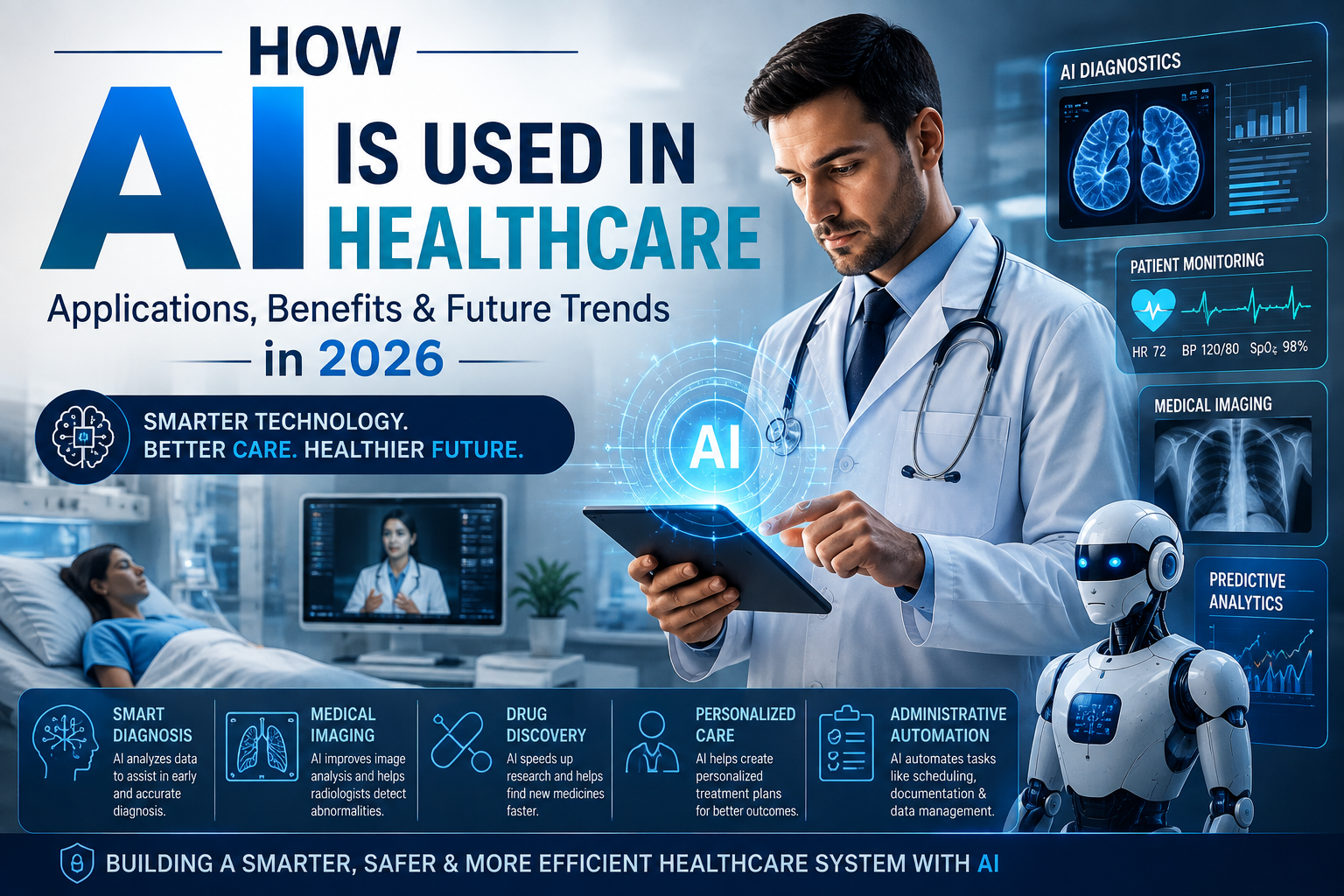
How AI Is Used in Healthcare: Applications, Benefits & Future Trends in 2026
Artificial intelligence is changing how healthcare providers diagnose diseases, manage patient information, discover medicines, and deliver personalized care. In the United States, hospitals, clinics, medical researchers, and healthcare technology companies are increasingly adopting AI to improve efficiency and support better patient outcomes.
Understanding How AI Is Used in Healthcare is important for patients, healthcare professionals, and businesses looking to understand the future of modern medicine.
What Is AI in Healthcare?
Artificial intelligence in healthcare refers to the use of computer systems and machine learning technologies to analyze medical data, recognize patterns, assist healthcare professionals, and automate certain tasks.
How AI Is Used in Healthcare depends on the specific medical application. AI can analyze medical images, help identify potential health risks, summarize clinical information, support drug discovery, and assist doctors with decision-making.
AI is designed to support healthcare professionals rather than replace them. Human expertise remains essential, particularly when making complex medical decisions.
How AI Is Used in Healthcare in 2026
In 2026, healthcare AI is being applied across many areas of the U.S. healthcare system. Some of the most important applications include:
1. Medical Diagnosis
AI can analyze large amounts of medical information and identify patterns that may be difficult to detect manually. Healthcare organizations can use AI-assisted systems to support the detection of certain diseases and abnormalities.
For example, AI-powered medical imaging tools can help analyze X-rays, CT scans, MRIs, and other diagnostic images. These systems can flag areas that may require closer examination by qualified professionals.
2. Medical Imaging
Medical imaging is one of the most widely discussed applications of AI in healthcare. Machine learning models can examine images and identify patterns associated with certain conditions.
How AI Is Used in Healthcare for medical imaging can include assisting radiologists with image analysis, prioritizing potentially urgent cases, and supporting more consistent evaluations.
AI does not eliminate the need for radiologists. Instead, it can provide an additional layer of analysis that healthcare professionals can consider alongside clinical evidence.
3. Drug Discovery and Development
Developing new medicines can take years and require significant financial investment. AI can help researchers analyze biological data, identify potential drug candidates, and predict how certain compounds may behave.
This can help pharmaceutical companies and researchers explore promising possibilities more efficiently.
4. Personalized Medicine
Every patient is different. AI can analyze information such as medical history, test results, and other permitted health data to help healthcare professionals understand individual patient needs.
How AI Is Used in Healthcare for personalized medicine may support more individualized treatment strategies and risk assessments.
The goal is to move toward healthcare approaches that consider the characteristics and needs of individual patients rather than relying only on generalized treatment models.
5. Administrative Automation
Healthcare professionals spend significant amounts of time on administrative work. AI can assist with tasks such as documentation, scheduling, information retrieval, and summarization.
AI-powered tools can help organize information and reduce repetitive workloads, potentially allowing healthcare workers to spend more time interacting with patients.
6. Virtual Health Assistants
AI-powered virtual assistants can answer common health-related questions, provide general information, help patients navigate healthcare services, and support appointment-related tasks.
How AI Is Used in Healthcare through virtual assistants can make basic information more accessible, especially outside traditional office hours.
However, AI assistants should not be treated as substitutes for professional medical diagnosis or emergency care.
Benefits of AI in Healthcare
The growing adoption of AI offers several potential benefits for U.S. healthcare organizations.
How AI Is Used in Healthcare can help organizations process information faster, automate repetitive tasks, support clinical workflows, and potentially improve operational efficiency.
Other potential benefits include:
- Faster analysis of large datasets
- Assistance with medical image interpretation
- Reduced administrative workload
- Improved workflow efficiency
- Support for medical research
- More personalized patient experiences
- Better access to healthcare information
The actual benefits depend on the quality of the AI system, available data, implementation process, and level of human oversight.
Challenges and Risks of Healthcare AI
AI also creates important challenges. Healthcare organizations must consider privacy, cybersecurity, bias, accuracy, transparency, and regulatory requirements.
How AI Is Used in Healthcare must be carefully managed because incorrect or incomplete AI-generated information could potentially affect patient care.
Healthcare providers should validate AI systems, monitor performance, protect sensitive patient information, and maintain appropriate human oversight.
Another major consideration is bias. If an AI model is trained on incomplete or unrepresentative data, its performance may not be equally reliable for every patient population.
The Future of AI in Healthcare
The future of healthcare AI is likely to involve deeper integration with electronic health records, medical devices, research platforms, and clinical workflows.
How AI Is Used in Healthcare will continue expanding as AI models become more capable and healthcare organizations develop better ways to integrate them responsibly.
In the coming years, AI may increasingly assist with early disease detection, clinical documentation, research, patient engagement, and healthcare operations. However, successful adoption will depend on combining advanced technology with medical expertise, ethical standards, and strong patient protections.
Final Thoughts
How AI Is Used in Healthcare is no longer simply a question about futuristic technology. AI is already becoming part of modern healthcare, particularly in areas such as medical imaging, research, administrative automation, personalized care, and clinical decision support.
For U.S. healthcare organizations in 2026, the most effective approach is to use AI as a tool that supports qualified professionals while maintaining patient safety, privacy, and human oversight. As the technology develops, responsible implementation will be just as important as innovation.
Frequently Asked Questions
How is AI used in healthcare?
AI is used to support medical diagnosis, medical imaging, drug discovery, administrative tasks, personalized medicine, research, and patient communication.
Can AI replace doctors?
No. AI can assist healthcare professionals with specific tasks, but doctors and other qualified professionals remain responsible for clinical judgment and patient care.
Is AI safe for healthcare?
AI can provide valuable support, but its safety depends on factors such as accuracy, validation, data quality, privacy protections, and appropriate human oversight.
Why is AI important in healthcare?
AI can help healthcare organizations analyze large amounts of information, automate repetitive tasks, support research, and improve certain clinical and administrative workflows.