AI FinTech Security: Powerful Ways AI Protects Digital Finance in 2026
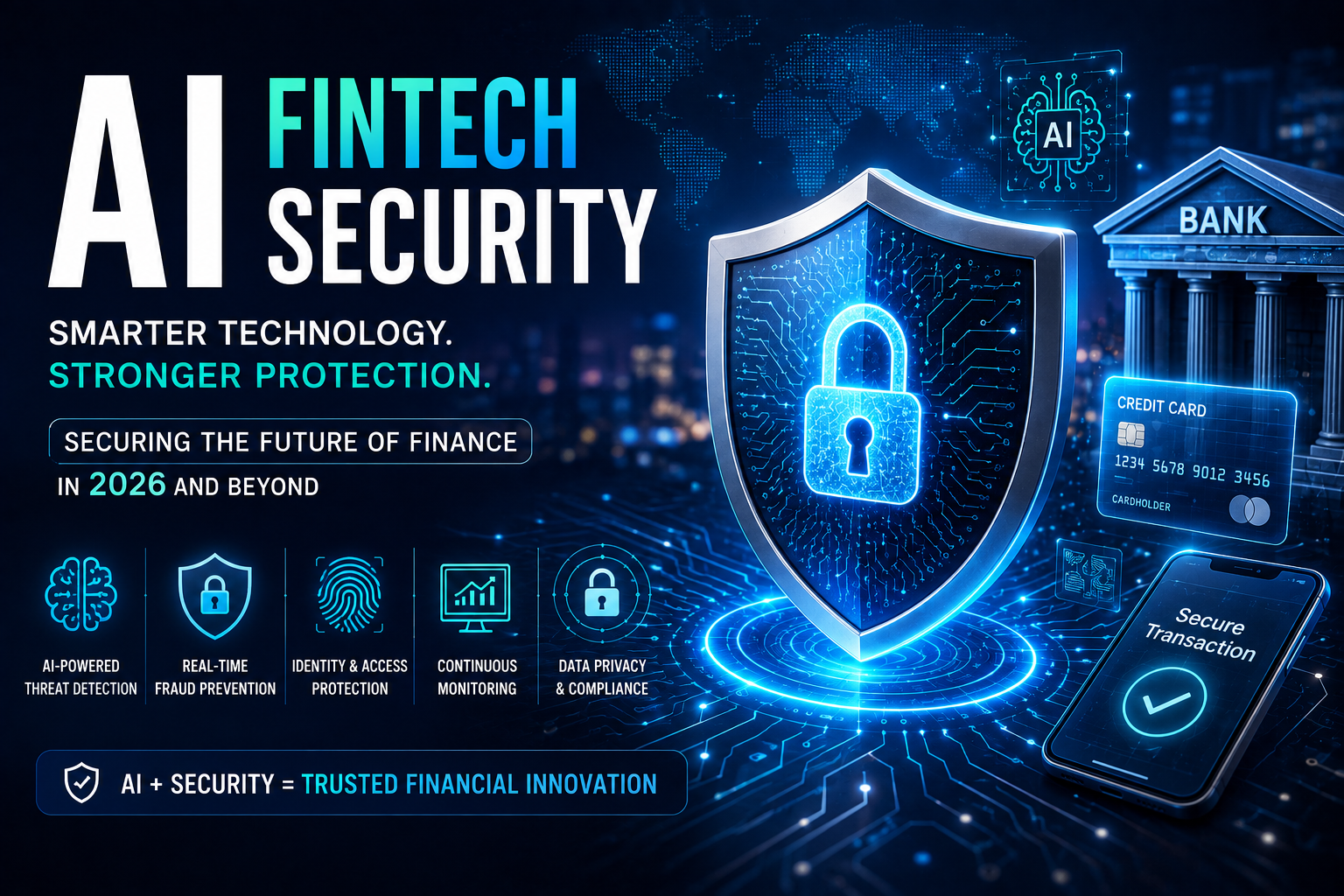
Financial services are becoming more connected, automated, and digital. As banks, fintech companies, payment platforms, and financial technology providers process enormous amounts of data, cybersecurity has become a core business priority. AI FinTech Security is emerging as a powerful approach for detecting threats, monitoring transactions, protecting customer accounts, and responding to cyber incidents faster.
In 2026, the challenge is more complex because artificial intelligence can strengthen cyber defenses while also giving attackers new capabilities. The Office of the Comptroller of the Currency has highlighted sophisticated cyber threats and fraud as ongoing concerns for banks and noted the importance of understanding both the benefits and risks of advanced AI cybersecurity tools.
What Is AI FinTech Security?
AI FinTech Security combines artificial intelligence, machine learning, behavioral analytics, automation, and cybersecurity controls to protect financial systems and digital transactions. Instead of relying only on static rules, AI-powered security systems can analyze large volumes of activity and identify patterns associated with suspicious behavior.
For example, a security platform can evaluate login behavior, device signals, transaction patterns, authentication attempts, and network activity. When activity differs significantly from normal behavior, the system can generate an alert or trigger additional security checks.
Why AI FinTech Security Matters in 2026
AI FinTech Security matters because financial organizations are attractive targets for cybercriminals. Banks and fintech platforms manage sensitive information, payment credentials, financial accounts, and valuable digital assets.
The OCC’s Spring 2026 risk assessment states that cyber threats and fraud remain concerns for the federal banking system and that cybercriminal groups targeting financial institutions are becoming increasingly sophisticated.
Artificial intelligence can help security teams analyze threats at a scale that would be difficult to achieve through manual review alone. However, automation should complement experienced security professionals rather than eliminate human oversight.
How AI Detects Financial Cyber Threats
A major strength of AI FinTech Security is continuous analysis. Machine learning models can examine large volumes of activity and identify unusual patterns.
Behavioral Analytics
Behavioral analytics establishes a baseline for normal activity. If an account normally logs in from one device and suddenly shows unusual access behavior, an AI system can assign a higher risk level for investigation.
Anomaly Detection
AI-powered anomaly detection looks for activity that does not fit established patterns. This can help identify unusual payment behavior, account takeovers, suspicious logins, and other potential threats.
Real-Time Monitoring
Real-time monitoring allows security teams to evaluate activity as it occurs. This is particularly useful for digital payments, online banking, and high-volume financial platforms where a delayed response can increase potential losses.
Identity and Access Protection
AI can support identity verification and access control by analyzing authentication patterns and device information. When risk signals increase, systems can require stronger authentication before allowing access.
AI FinTech Security and Fraud Prevention
Fraud prevention is closely connected to cybersecurity. AI FinTech Security can analyze transaction behavior and identify potentially suspicious activity before or during a transaction.
A modern fraud detection system may consider transaction amount, frequency, location-related signals, device characteristics, account history, and other indicators. Instead of treating every transaction equally, risk-based systems can prioritize unusual activity for additional review.
This approach can improve customer protection while reducing unnecessary friction for legitimate users.
Protecting AI Systems Themselves
AI FinTech Security is not only about using AI to defend financial networks. Financial institutions must also secure the AI systems they deploy.
NIST’s 2026 research on AI agent security notes that AI agents introduce novel security threats and that traditional cybersecurity practices may need to be adapted. NIST also emphasizes appropriate identity and authorization controls for AI agents that interact with data, tools, and applications.
Organizations should protect training data, model inputs, outputs, APIs, credentials, and connected systems. Access should follow least-privilege principles so an AI system receives only the permissions it actually needs.
Key Benefits of AI FinTech Security
AI FinTech Security can provide several important benefits:
- Faster threat detection: AI can process large amounts of activity quickly.
- Continuous monitoring: Automated systems can operate around the clock.
- Better threat prioritization: AI can help security teams focus on higher-risk events.
- Reduced manual workload: Routine analysis can be automated.
- Adaptive protection: Machine learning systems can respond to changing patterns.
- Improved response: Automated workflows can trigger alerts and predefined actions faster.
Challenges and Risks
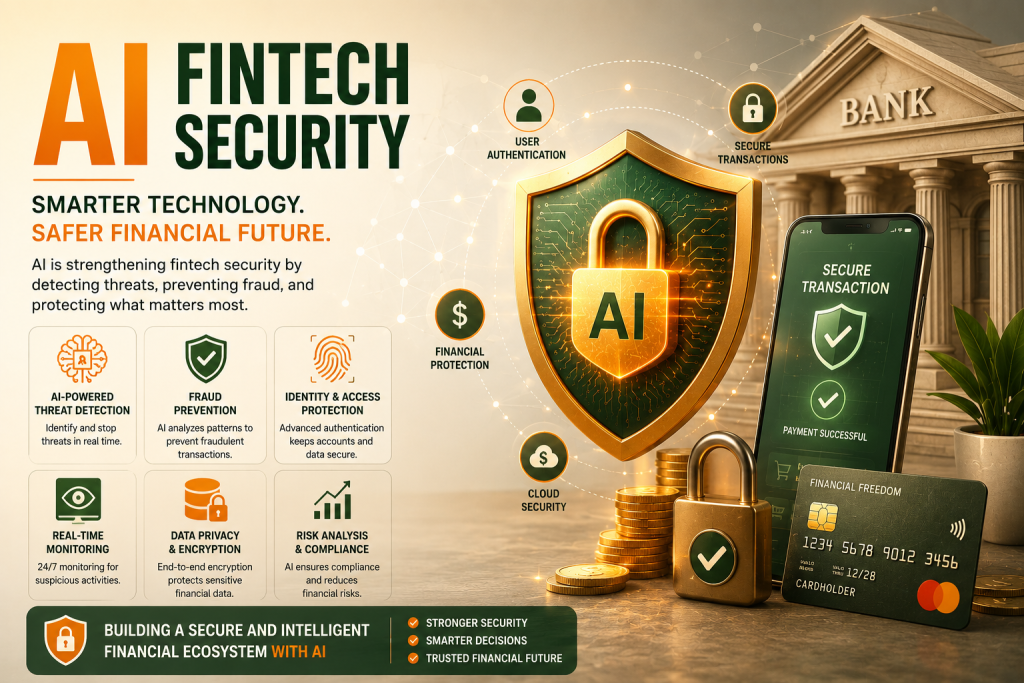
Despite its advantages, AI FinTech Security also creates new risks. AI models can produce false positives, miss previously unseen attacks, or generate inaccurate conclusions when data quality is poor.
Attackers can also target AI systems through techniques such as prompt injection, data poisoning, model manipulation, credential theft, and abuse of connected tools.
NIST explains that AI security concerns can involve confidentiality, integrity, availability, training data, output data, and the underlying software and hardware supporting AI systems.
For this reason, financial organizations need continuous monitoring, model testing, access controls, incident-response procedures, and strong governance.
Best Practices for Financial Organizations
A strong AI FinTech Security strategy should combine artificial intelligence with established cybersecurity practices.
Organizations should:
- Maintain strong identity and access management.
- Encrypt sensitive information.
- Monitor AI systems and connected applications continuously.
- Test models for accuracy and security weaknesses.
- Keep software and dependencies updated.
- Establish human review for high-impact decisions.
- Maintain incident-response and recovery plans.
- Limit AI permissions using least-privilege access.
- Regularly assess third-party AI and cloud providers.
NIST’s Cybersecurity Framework 2.0 provides a structured approach for managing cybersecurity risk, while the AI Risk Management Framework helps organizations address risks associated with artificial intelligence.
The Future of AI FinTech Security
The future of AI FinTech Security will likely involve greater use of AI agents, automated security operations, behavioral analytics, real-time fraud detection, and integrated identity protection.
NIST launched its AI Agent Standards Initiative in February 2026 to support secure and interoperable adoption of AI agents. The initiative focuses on helping organizations use increasingly autonomous systems with appropriate security and standards.
For financial organizations, this development is important because autonomous systems may eventually interact with customer data, payment platforms, accounts, and internal applications.
The strongest security strategies will not rely on AI alone. They will combine advanced technology with skilled security teams, strong governance, continuous monitoring, and clear authorization controls.
Conclusion
AI FinTech Security is becoming an essential part of modern financial cybersecurity. Artificial intelligence can help organizations detect suspicious activity, analyze threats, protect identities, and respond to incidents more efficiently.
At the same time, financial institutions must secure the AI systems they deploy and understand the new risks created by increasingly autonomous technology.
In 2026, the most effective approach is a balanced one: use AI to improve speed and scale while maintaining strong cybersecurity fundamentals, human oversight, risk management, and continuous testing. This combination can help financial organizations build more resilient digital services and protect customers in an increasingly complex threat environment.