Tag: AI Customer Support

  • AI Customer Service for E-Commerce: The Future of Online Support in 2026

    AI Customer Service for E-Commerce: The Future of Online Support in 2026

    AI Customer Service for E-Commerce: The Future of Online Support in 2026

    Online shoppers expect quick answers, smooth returns, and helpful support at every stage of the buying journey. For U.S. e-commerce businesses, meeting these expectations can become difficult as order volumes grow. AI Customer Service for E-Commerce helps retailers automate routine questions, deliver faster responses, and provide support around the clock.

    In 2026, AI-powered support is becoming an important part of modern online retail. Shopify stores, direct-to-consumer brands, and large marketplaces can use AI chatbots and AI agents to improve customer experiences while reducing repetitive work.

    What Is AI Customer Service for E-Commerce?

    AI Customer Service for E-Commerce refers to artificial intelligence tools that communicate with customers, answer questions, solve common problems, and automate support workflows. These systems can understand natural-language questions and use approved information from product catalogs, order systems, shipping platforms, and customer accounts.

    Unlike traditional chatbots that rely on rigid scripts, modern AI tools can understand context, answer follow-up questions, and transfer complicated cases to human representatives.

    How Does AI Customer Service Work?

    AI Customer Service for E-Commerce combines technologies such as natural language processing, machine learning, knowledge bases, and business integrations. When a customer asks a question, the AI identifies the intent and retrieves relevant information before generating a response.

    For example, a shopper asking about an order can receive shipping information automatically. If the issue involves a refund dispute or another complex situation, the system can escalate the conversation to a human agent.

    Key Benefits for Online Stores

    1. 24/7 Customer Support

    One of the biggest advantages of AI Customer Service for E-Commerce is continuous availability. Customers can ask about products, shipping, returns, or order status even when a support team is offline.

    This is especially valuable for U.S. businesses serving customers across different time zones.

    2. Faster Response Times

    Customers do not want to wait hours for simple answers. AI can respond to frequently asked questions within seconds, reducing support queues and helping shoppers make purchasing decisions faster.

    3. Lower Support Costs

    AI Customer Service for E-Commerce can handle repetitive requests that would otherwise require employee time. Human representatives can focus on complex cases, complaints, and situations requiring judgment or empathy.

    This makes customer support easier to scale as an online store grows.

    4. Personalized Customer Experiences

    AI can use permitted customer and order information to create more relevant interactions. For example, an assistant can recognize an existing order and provide information specific to that purchase.

    Personalized assistance can reduce customer effort and make support conversations more useful.

    5. Automated Returns and Order Support

    Returns are a major part of online retail. AI Customer Service for E-Commerce can explain return policies, collect required information, provide status updates, and guide eligible requests through established workflows.

    AI can also assist with order changes, shipping questions, product availability, and common account requests.
    Common E-Commerce AI Customer Service Use Cases

    Retailers can use AI support throughout the customer journey. Common applications include:

    • Product questions
    • Order tracking
    • Shipping updates
    • Returns and exchanges
    • Refund status
    • Frequently asked questions
    • Product availability
    • Account assistance
    • Post-purchase support
    • Human-agent escalation

    These use cases allow businesses to automate repetitive tasks without removing access to human assistance.

    Best Practices for Implementation

    Businesses should treat AI Customer Service for E-Commerce as a customer-experience strategy rather than simply installing a chatbot. Start by identifying repetitive questions that are suitable for automation.

    Connect the AI system to reliable business data, establish clear escalation rules, and monitor conversations regularly. Businesses should also protect customer information, restrict access to necessary data, and test responses before launching the system widely.

    Human oversight is particularly important for refunds, complaints, account security, and other sensitive decisions.

    Challenges to Consider

    AI support is powerful, but it is not perfect. Systems can misunderstand questions, produce inaccurate information, or struggle with unusual situations. Poorly configured AI can frustrate customers instead of helping them.

    Businesses should monitor accuracy, update knowledge sources, provide easy access to human agents, and establish strong privacy and security practices.

    The Future of AI Customer Service

    The future of AI Customer Service for E-Commerce will move beyond simple question-and-answer chatbots. AI agents will increasingly handle multi-step tasks, connect with business systems, and support shoppers throughout the purchasing journey.

    A customer could eventually ask an AI assistant to find a product, compare options, place an order, track delivery, and start a return within one conversation.

    Final Thoughts

    AI Customer Service for E-Commerce is transforming how online retailers support shoppers. By combining automation, personalization, and intelligent workflows, businesses can provide faster assistance while allowing human teams to focus on higher-value interactions.

    For U.S. retailers in 2026, the best strategy is not necessarily to replace human support. Instead, businesses should use AI to handle repetitive work and give human agents better information and more time to solve complex customer problems.

    Frequently Asked Questions

    What is AI Customer Service for E-Commerce?

    It is the use of artificial intelligence to automate customer support tasks such as answering questions, tracking orders, handling returns, and providing personalized assistance.

    Can AI customer service improve e-commerce sales?

    Yes. Faster answers and personalized support can reduce buying friction, help customers find products, and improve the shopping experience.

    Is AI customer service suitable for small businesses?

    Yes. Small e-commerce businesses can use AI tools to handle common questions and provide support without building a large customer service department.

    Will AI replace customer service agents?

    AI is more likely to automate repetitive tasks than completely replace human representatives. Human agents remain important for complex, sensitive, and emotional customer situations.
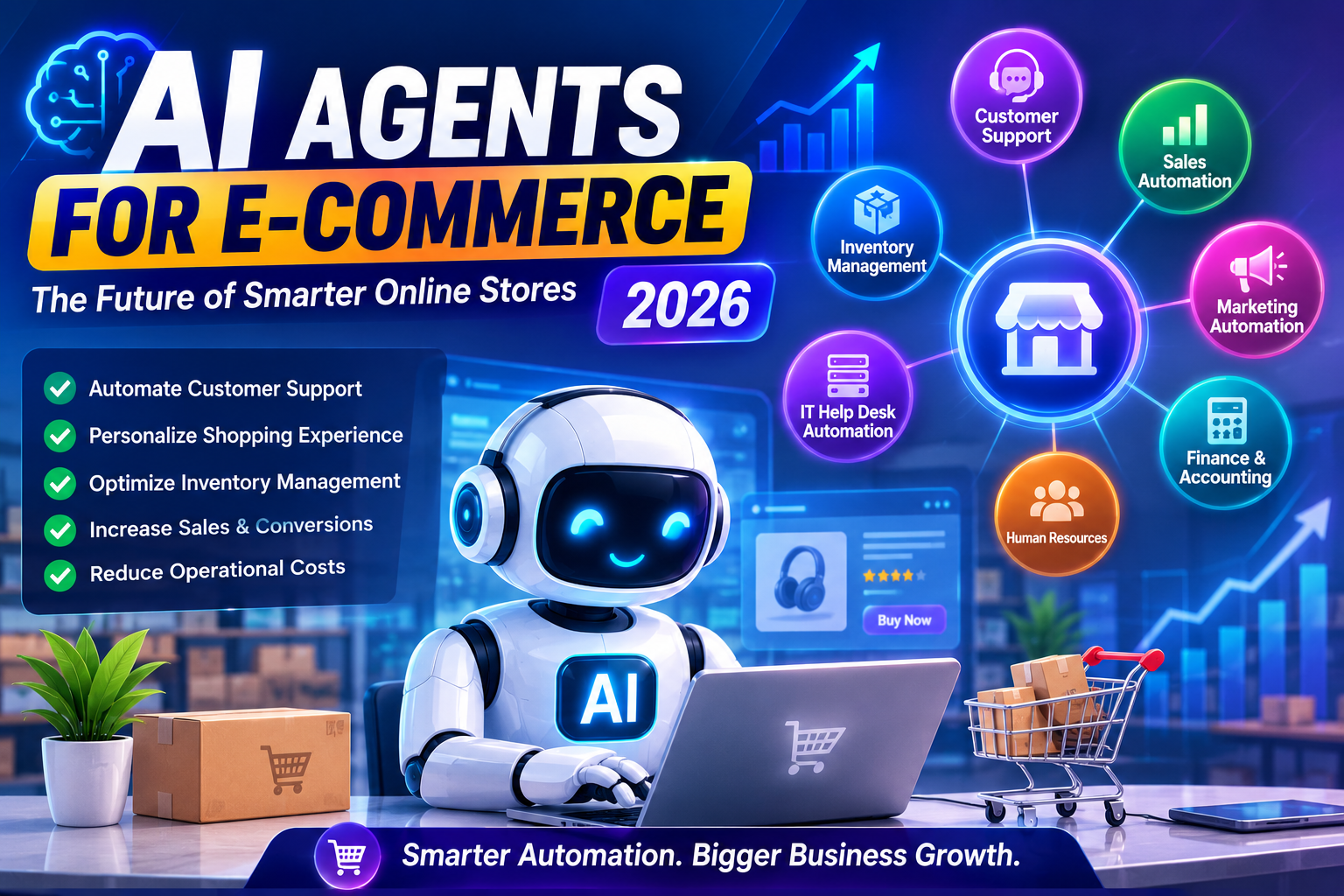
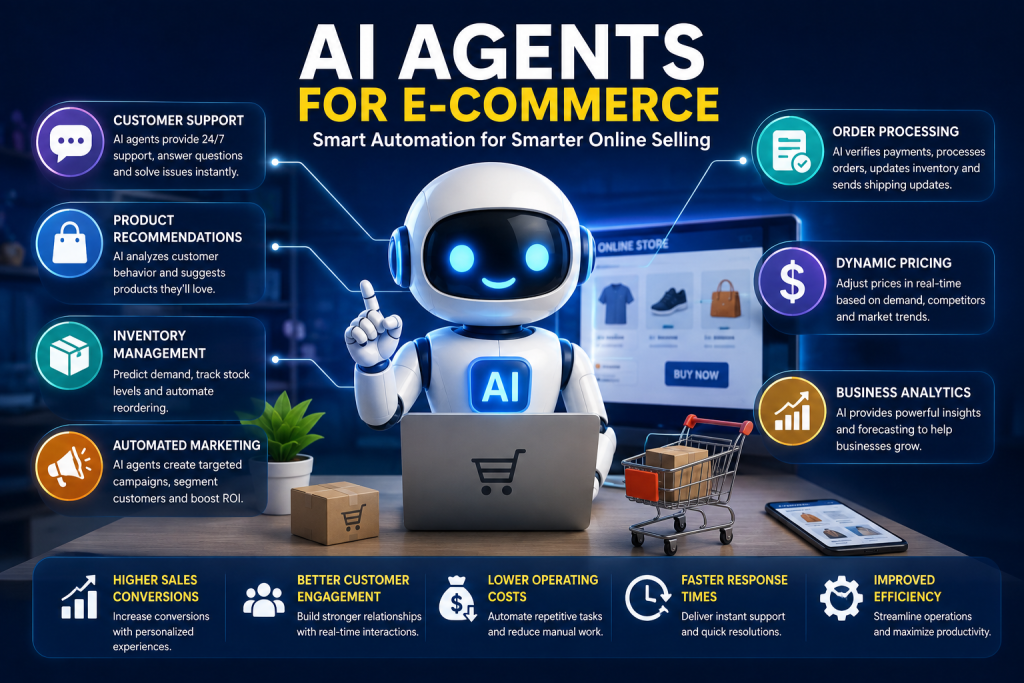
  • AI Agents for E-Commerce (2026): How AI Is Transforming Online Stores

    AI Agents for E-Commerce (2026): How AI Is Transforming Online Stores

    What Are AI Agents for E-Commerce?

    AI Agents for E-Commerce are intelligent software systems designed to automate business processes, make decisions, and perform tasks without constant human intervention. Unlike traditional chatbots, AI agents can analyze customer behavior, interact with multiple business systems, learn from previous actions, and execute complex workflows.

    They help online retailers reduce manual work while delivering faster and more personalized shopping experiences.


    Why Businesses Are Investing in AI Agents for E-Commerce

    Many U.S. businesses are adopting AI Agents for E-Commerce because they improve efficiency and customer satisfaction.

    Major benefits include:

    • 24/7 customer support
    • Faster order processing
    • Personalized shopping experiences
    • Reduced operational costs
    • Better inventory management
    • Increased conversion rates
    • Automated marketing campaigns
    • Improved business scalability

    These advantages make AI agents one of the fastest-growing technologies in online retail.


    Top AI Agents for E-Commerce Use Cases

    1. Intelligent Customer Support

    One of the most valuable AI Agents for E-Commerce applications is customer service.

    AI agents can:

    • Answer customer questions
    • Track orders
    • Process returns
    • Handle refunds
    • Recommend products
    • Escalate complex issues

    Customers receive instant support at any time of day.


    2. Personalized Product Recommendations

    Modern AI agents analyze:

    • Browsing history
    • Purchase behavior
    • Customer preferences
    • Shopping patterns

    They recommend products that shoppers are most likely to purchase, increasing average order value.


    3. Inventory Management

    Inventory mistakes can cost businesses thousands of dollars.

    AI Agents for E-Commerce help retailers:

    • Predict demand
    • Monitor stock levels
    • Prevent overselling
    • Optimize warehouse operations
    • Automate reordering

    This keeps inventory accurate while reducing waste.


    4. Automated Marketing

    Marketing teams use AI Agents for E-Commerce to automate:

    • Email campaigns
    • Social media posts
    • Customer segmentation
    • Personalized promotions
    • Product recommendations
    • Advertising optimization

    These automations improve ROI while saving valuable time.


    5. Order Processing

    AI agents streamline order management by:

    • Verifying payments
    • Processing orders
    • Updating inventory
    • Sending shipping notifications
    • Detecting fraudulent transactions

    Automation reduces human errors and speeds up fulfillment.


    6. Dynamic Pricing

    Many online retailers use AI agents to adjust pricing based on:

    • Competitor prices
    • Customer demand
    • Inventory levels
    • Seasonal trends
    • Market conditions

    This helps maximize profits while remaining competitive.


    Benefits of AI Agents for E-Commerce

    Businesses implementing AI Agents for E-Commerce enjoy several measurable advantages.

    Key benefits include:

    • Higher sales conversions
    • Better customer engagement
    • Lower operating expenses
    • Faster customer response times
    • Improved shopping experiences
    • More accurate forecasting
    • Increased employee productivity
    • Better business insights

    These improvements help businesses grow more efficiently.


    Best Industries Using AI Agents for E-Commerce

    Today, AI Agents for E-Commerce are transforming multiple industries, including:

    • Fashion
    • Electronics
    • Beauty
    • Home & Kitchen
    • Grocery
    • Health & Wellness
    • Automotive Parts
    • Sports Equipment
    • Pet Supplies
    • Luxury Goods

    Retailers across these industries use AI agents to enhance customer experiences and streamline operations.


    Best Practices for Implementing AI Agents for E-Commerce

    To maximize results, businesses should:

    • Define automation goals
    • Choose scalable AI platforms
    • Integrate with CRM and ERP systems
    • Protect customer data
    • Monitor AI performance
    • Train employees
    • Continuously optimize workflows

    A strategic implementation ensures long-term success.


    Future of AI Agents for E-Commerce

    The future of AI Agents for E-Commerce looks promising. As AI technology advances, agents will become more intelligent, proactive, and capable of handling increasingly complex business operations.

    By 2026, AI agents will manage end-to-end shopping experiences, automate customer service, predict buying behavior, optimize logistics, and support personalized marketing campaigns with minimal human involvement.

    Businesses that adopt AI-powered automation early will be better positioned to compete in the evolving digital marketplace.


    Final Thoughts

    AI Agents for E-Commerce are reshaping the online retail industry by automating repetitive tasks, improving customer experiences, and driving revenue growth. From personalized recommendations and intelligent customer support to inventory optimization and dynamic pricing, AI agents offer powerful tools for businesses of all sizes.

    Whether you’re launching a new online store or scaling an established brand, investing in AI Agents for E-Commerce can improve efficiency, increase profitability, and prepare your business for the future of digital commerce.


    Frequently Asked Questions

    What are AI agents for e-commerce?

    AI agents are intelligent systems that automate customer support, inventory management, order processing, marketing, and other online retail operations.

    How do AI agents help online stores?

    They improve customer service, personalize shopping experiences, optimize inventory, automate workflows, and increase sales.

    Are AI agents suitable for small businesses?

    Yes. Many AI platforms offer affordable solutions for small and medium-sized e-commerce businesses.

    Can AI agents increase sales?

    Yes. AI agents improve product recommendations, customer engagement, and marketing personalization, which can lead to higher conversion rates and revenue.

  • AI Agent Use Cases for Businesses (2026): 12 Powerful Ways AI Agents Are Transforming Companies

    AI Agent Use Cases for Businesses (2026): 12 Powerful Ways AI Agents Are Transforming Companies


    AI Agent Use Cases for Businesses

    Artificial intelligence is revolutionizing the way organizations operate, and one of the biggest innovations is AI agents. Understanding AI Agent Use Cases for Businesses helps companies automate repetitive tasks, improve customer experiences, and increase operational efficiency. From startups to large enterprises across the United States, AI agents are becoming an essential part of digital transformation.

    This guide explores the most impactful AI Agent Use Cases for Businesses, showing how organizations can leverage autonomous AI to reduce costs, improve productivity, and stay competitive in 2026.


    What Are AI Agents?

    Before exploring AI Agent Use Cases for Businesses, it’s important to understand what AI agents are.

    AI agents are intelligent software systems capable of reasoning, planning, making decisions, and completing tasks with minimal human intervention. Unlike traditional chatbots, AI agents can access business applications, analyze data, interact with APIs, and automate entire workflows.

    Their ability to learn and adapt makes them valuable across multiple industries.


    Top AI Agent Use Cases for Businesses

    Here are some of the most valuable AI Agent Use Cases for Businesses in 2026.

    1. Customer Support Automation

    AI agents can provide 24/7 customer support by answering questions, resolving issues, processing refunds, and escalating complex requests when necessary.

    Benefits include:

    • Faster response times
    • Lower support costs
    • Higher customer satisfaction

    2. Sales Automation

    Sales teams use AI agents to qualify leads, schedule meetings, send follow-up emails, and update CRM systems automatically.

    This allows sales representatives to focus on closing deals instead of repetitive administrative work.


    3. Marketing Campaign Management

    One of the fastest-growing AI Agent Use Cases for Businesses is marketing automation.

    AI agents can:

    • Create personalized campaigns
    • Analyze customer behavior
    • Optimize advertising budgets
    • Schedule social media posts
    • Generate marketing reports

    4. Human Resources

    HR departments use AI agents for:

    • Resume screening
    • Interview scheduling
    • Employee onboarding
    • Benefits management
    • Internal support

    These automations improve hiring efficiency and employee experiences.


    5. Financial Operations

    Finance teams benefit from AI agents by automating:

    • Invoice processing
    • Expense management
    • Fraud detection
    • Financial forecasting
    • Budget analysis

    This reduces manual errors while improving decision-making.


    6. IT Help Desk

    Modern IT departments deploy AI agents to:

    • Reset passwords
    • Monitor systems
    • Troubleshoot software issues
    • Create support tickets
    • Detect security risks

    This significantly reduces IT workloads.


    7. Supply Chain Management

    Supply chain teams use AI agents to optimize:

    • Inventory management
    • Demand forecasting
    • Shipment tracking
    • Warehouse operations
    • Vendor communication

    These improvements increase operational efficiency.


    8. Business Intelligence

    Another important example of AI Agent Use Cases for Businesses is data analysis.

    AI agents automatically:

    • Collect business data
    • Generate dashboards
    • Identify trends
    • Create executive reports
    • Recommend business strategies

    9. Project Management

    Project managers rely on AI agents to:

    • Assign tasks
    • Monitor deadlines
    • Track project progress
    • Send reminders
    • Generate status reports

    This keeps teams organized and productive.


    10. Software Development

    Developers increasingly use AI agents to:

    • Generate code
    • Review pull requests
    • Detect bugs
    • Create documentation
    • Test applications

    Development teams save hundreds of hours annually through automation.


    11. Healthcare Administration

    Healthcare organizations use AI agents to:

    • Schedule appointments
    • Process insurance claims
    • Manage patient records
    • Answer patient inquiries
    • Support administrative staff

    12. Executive Assistance

    Executives use AI agents to:

    • Manage calendars
    • Schedule meetings
    • Summarize emails
    • Prepare reports
    • Organize business priorities

    This allows leaders to focus on strategic decision-making.

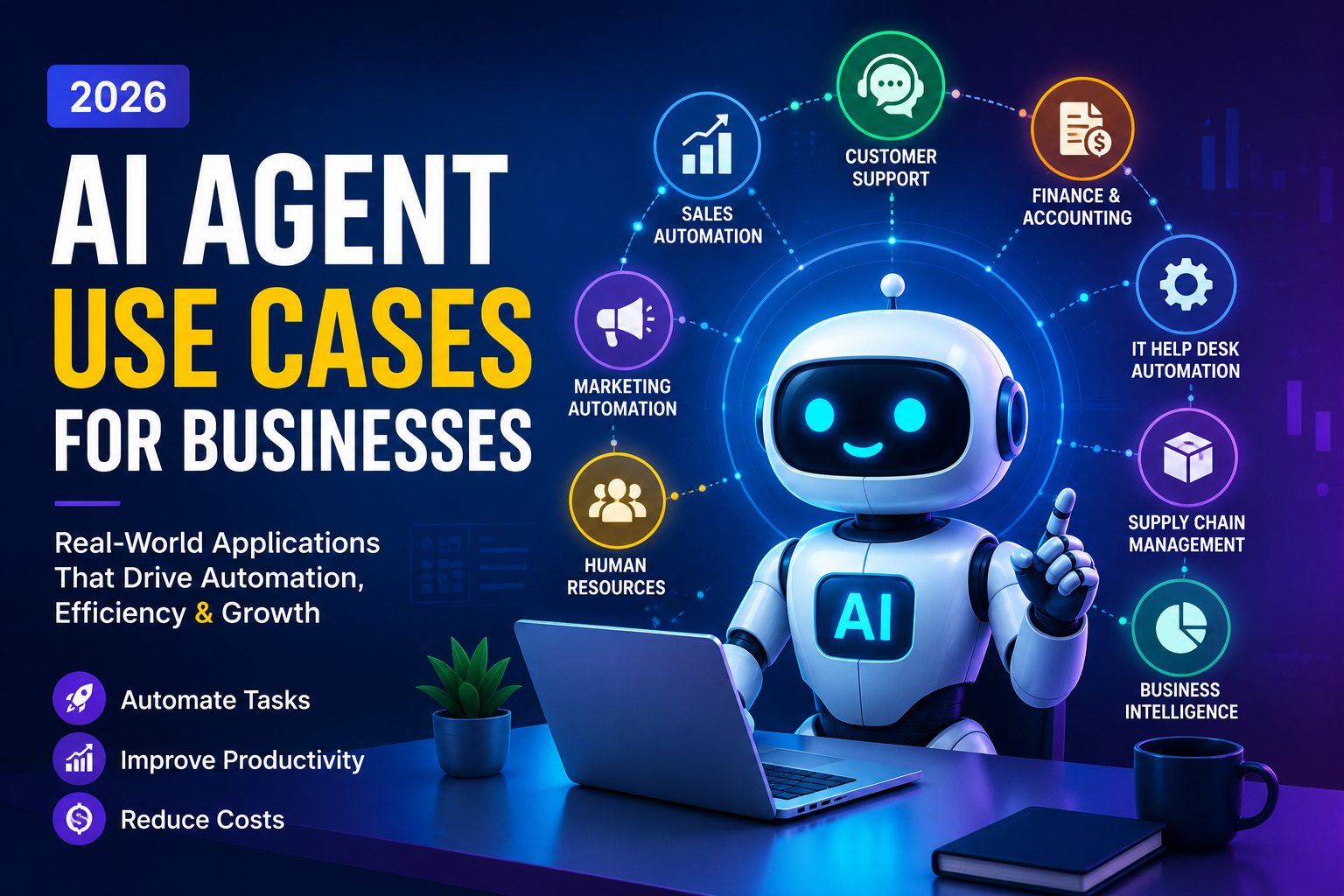
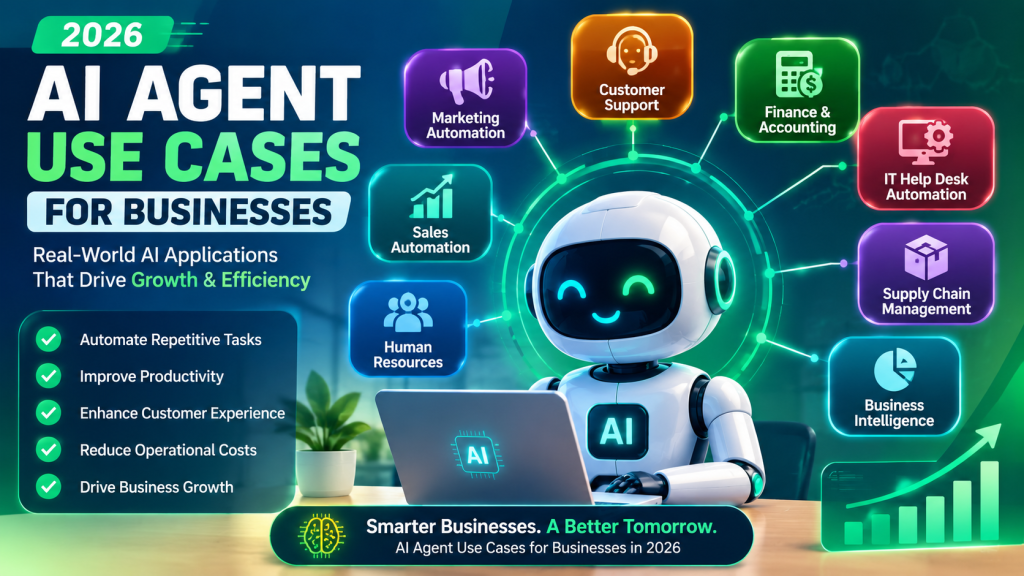
    This modern feature image showcases AI Agent Use Cases for Businesses with a futuristic cyber-themed design in vibrant blue, teal, purple, and orange colors. At the center, a friendly AI-powered robot works on a laptop while connected to glowing digital nodes representing key business functions. Surrounding the AI assistant are colorful panels highlighting real-world applications, including Customer Support, Sales Automation, Marketing Automation, Finance & Accounting, IT Help Desk Automation, Human Resources, Supply Chain Management, and Business Intelligence. The left side features the bold headline "AI Agent Use Cases for Businesses" along with a list of major benefits such as automating repetitive tasks, improving productivity, reducing operational costs, enhancing customer experience, and driving business growth. The sleek neon interface, network connections, and rising growth chart reinforce the theme of intelligent business automation and digital transformation. This feature image is ideal for articles about AI Agent Use Cases for Businesses, enterprise AI, AI automation, workflow optimization, business productivity, artificial intelligence, and AI trends in 2026.

    Benefits of AI Agent Use Cases for Businesses

    Organizations implementing AI Agent Use Cases for Businesses experience measurable advantages.

    Key benefits include:

    • Increased productivity
    • Reduced operating costs
    • Better customer service
    • Faster business decisions
    • Improved workflow automation
    • Enhanced employee efficiency
    • Better data insights
    • Scalable business growth

    These advantages explain why AI adoption continues to grow rapidly across U.S. businesses.


    How to Choose the Right AI Agent

    When evaluating AI Agent Use Cases for Businesses, consider:

    • Business goals
    • Integration capabilities
    • Data security
    • Scalability
    • Ease of deployment
    • Industry requirements
    • Budget
    • Customer support

    Selecting the right AI platform ensures long-term success.


    Future of AI Agent Use Cases for Businesses

    The future of AI Agent Use Cases for Businesses is incredibly promising. By 2026 and beyond, AI agents will become more autonomous, collaborative, and capable of managing increasingly complex workflows. Organizations will use multi-agent systems that work together across departments, enabling smarter decision-making, personalized customer experiences, and greater operational efficiency.

    Businesses that invest in AI agent technology today will be better positioned to innovate, compete, and scale in the years ahead.


    Final Thoughts

    The growing adoption of AI Agent Use Cases for Businesses demonstrates how artificial intelligence is reshaping modern organizations. Whether you’re automating customer service, optimizing marketing campaigns, streamlining HR processes, or improving financial operations, AI agents can deliver significant value.

    As AI technology continues to evolve in 2026, companies that embrace intelligent automation will gain a competitive advantage through higher productivity, lower costs, and better customer experiences.


    Frequently Asked Questions

    What are AI agent use cases for businesses?

    AI agents are used for customer support, sales, marketing, HR, finance, IT support, project management, healthcare, and workflow automation.

    Which industries benefit the most from AI agents?

    Retail, healthcare, finance, manufacturing, technology, logistics, education, and professional services all benefit from AI agents.

    Can small businesses use AI agents?

    Yes. Many affordable AI platforms help small businesses automate customer service, scheduling, marketing, and administrative tasks.

    Are AI agents better than chatbots?

    AI agents can perform complex, multi-step tasks and integrate with business systems, while chatbots primarily focus on conversations and customer interactions.