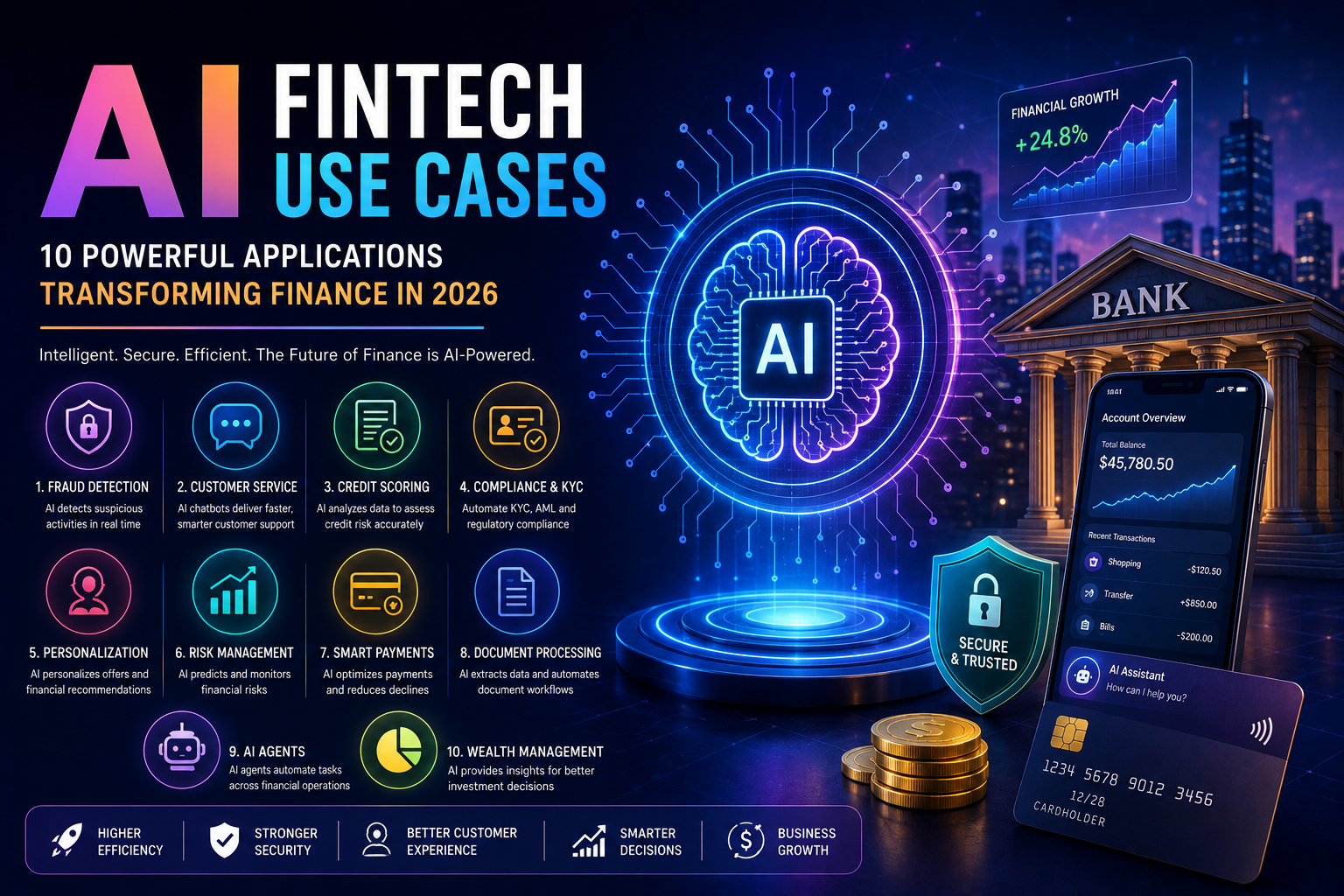
AI FinTech Use Cases: 10 Powerful Applications Transforming Finance in 2026
The financial technology industry is moving beyond basic automation. In 2026, artificial intelligence is being integrated into fraud prevention, customer support, credit decisions, compliance, payments, risk management, and financial operations. AI FinTech Use Cases are becoming increasingly important as financial companies look for faster processes, better customer experiences, stronger security, and more efficient decision-making.
Recent research from Cambridge Judge Business School shows that financial-services organizations are using AI heavily for process automation, data visualization, customer support, fraud detection, and credit-risk modeling.
What Are AI FinTech Use Cases?
AI FinTech Use Cases refer to practical ways artificial intelligence is applied within financial technology products and services. These applications can involve machine learning, generative AI, natural-language processing, predictive analytics, computer vision, and AI agents.
Rather than using AI for only one task, modern financial organizations are connecting AI with existing banking, payment, lending, and compliance systems. This allows companies to automate repetitive work while giving employees better information for important decisions.
1. AI Fraud Detection
One of the most established AI FinTech Use Cases is fraud detection. AI systems can analyze transactions, account activity, device information, and behavioral patterns to identify suspicious activity.
Unlike traditional systems that may rely heavily on fixed rules, machine learning models can recognize unusual patterns across large volumes of transactions. This can help financial institutions detect payment fraud, account takeover attempts, and other suspicious activity more quickly.
Mastercard reported in 2026 that AI-powered tools using real-time data can help financial institutions prevent payment fraud while reducing false positives.
2. AI-Powered Customer Service
Customer support is another major AI FinTech Use Case. Financial companies can use AI chatbots and virtual assistants to answer common questions, explain transactions, help customers navigate applications, and route complex cases to human representatives.
Generative AI can also summarize customer conversations and provide employees with relevant information during support interactions. This can reduce response times while allowing human agents to focus on more complicated issues.
Google Cloud identifies customer engagement and operational efficiency among the major areas where AI is being applied across banking.
3. AI Credit Scoring and Underwriting
Lending is another area where AI FinTech Use Cases can have a significant impact. Machine learning can help analyze financial information, repayment behavior, cash flow patterns, and other permitted data to support credit-risk assessment.
AI-powered underwriting can also automate document processing and reduce repetitive work. Instead of manually reviewing every piece of information, employees can receive structured insights and focus on cases requiring additional attention.
Because lending decisions can significantly affect consumers, organizations need strong model governance, explainability, fairness controls, and human oversight.
4. Automated Compliance and KYC
Compliance teams handle large amounts of documentation, monitoring, and regulatory checks. AI FinTech Use Cases in compliance can help automate parts of Know Your Customer (KYC), Anti-Money Laundering (AML), transaction monitoring, and document review.
AI can identify unusual patterns, extract information from documents, and prioritize cases for investigation. This does not eliminate compliance responsibilities, but it can make workflows more efficient.
5. Personalized Financial Services
Another growing AI FinTech Use Case is personalization. AI can analyze customer behavior and preferences to help financial companies provide more relevant products, educational information, and service experiences.
For example, a digital financial platform could identify spending patterns and provide budgeting insights or personalized financial education. Organizations must still handle personal financial data responsibly and maintain appropriate privacy and security controls.
6. AI-Powered Risk Management
Risk management is essential for banks, lenders, insurers, and fintech companies. AI FinTech Use Cases can help organizations monitor market conditions, customer behavior, transaction activity, and operational risks.
Predictive models can identify patterns that may indicate emerging risks, allowing teams to investigate potential problems earlier.
The value of AI is particularly strong when large volumes of information need to be analyzed continuously rather than periodically.
7. Intelligent Payments and Transaction Monitoring
Payments generate enormous amounts of data, making them a natural application for AI. AI FinTech Use Cases can support payment authorization, transaction monitoring, fraud prevention, and risk scoring.
AI can evaluate transactions in real time and identify activity that differs from expected behavior. This can help financial platforms balance security with a smoother payment experience.
The growing use of real-time payments also makes fast fraud detection increasingly important. Mastercard notes that the expansion of real-time payment networks creates both opportunities and new fraud challenges.
8. Document Processing and Financial Data Extraction
Financial organizations process contracts, statements, applications, invoices, tax documents, and identification records. AI-powered document intelligence can extract information from these documents and organize it automatically.
This is an important AI FinTech Use Case because employees can spend less time entering data manually and more time reviewing exceptions.
Optical character recognition, natural-language processing, and computer vision can work together to convert unstructured documents into useful financial information.
9. AI Agents for Financial Operations
AI agents are becoming an important emerging AI FinTech Use Case in 2026. Unlike basic chatbots, AI agents can potentially perform multi-step tasks using approved tools and systems.
Financial organizations are exploring agents for customer service, fraud investigations, operations, compliance workflows, and internal knowledge management.
However, agentic systems introduce additional security and governance requirements because they may interact with sensitive information and business applications. Financial institutions therefore need strong authorization, monitoring, testing, and human oversight.
10. AI for Investment and Wealth Management
Investment platforms can use AI for portfolio analysis, financial research, market-data summarization, risk analysis, and customer education. AI FinTech Use Cases in wealth management can help investors organize large amounts of information more efficiently.
AI can summarize financial documents and identify relevant information, but investors should not treat AI-generated predictions as guaranteed outcomes. Investment decisions still involve uncertainty and risk.
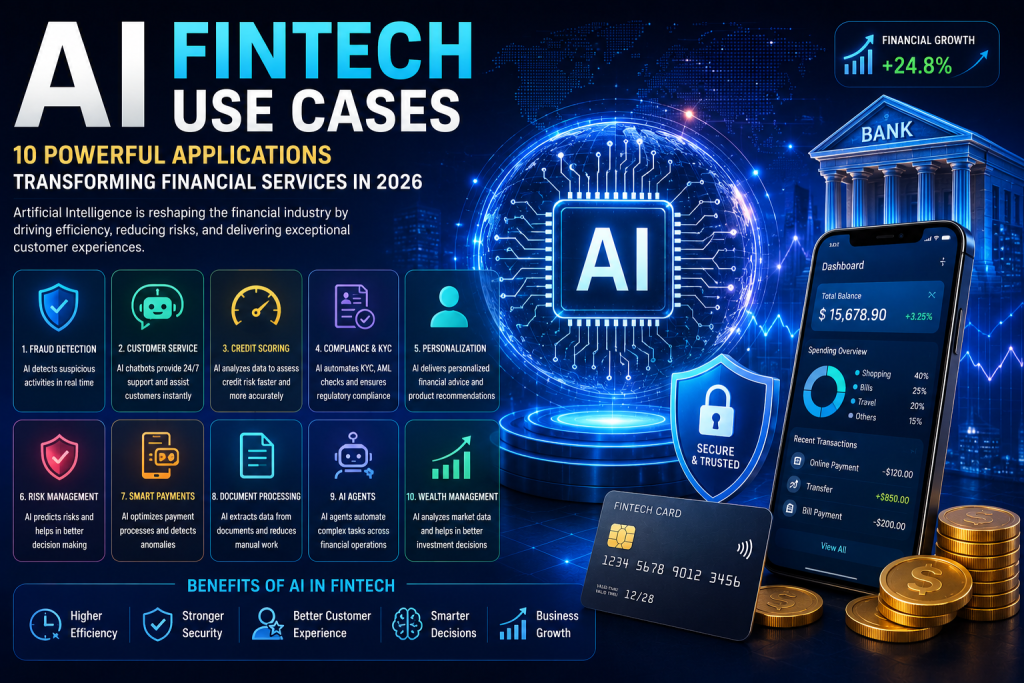
Benefits of AI in FinTech
The growing adoption of AI FinTech Use Cases is driven by several potential benefits:
- Faster financial processes
- Reduced manual workloads
- Improved fraud detection
- More personalized customer experiences
- Faster risk analysis
- Automated document processing
- Better operational efficiency
- More responsive customer support
- Improved data analysis
- Scalable digital services
At the same time, successful implementation depends on high-quality data, system integration, cybersecurity, governance, and responsible AI practices. Current industry research indicates that organizations often face challenges moving from AI experiments to large-scale deployment.
Challenges of AI FinTech Use Cases
AI adoption also creates important challenges. Poor-quality data can produce unreliable results, while biased historical information can influence model outcomes. Complex models may also be difficult to explain.
Cybersecurity is another concern because attackers can target AI systems, data pipelines, APIs, and connected applications. Organizations should therefore use access controls, continuous monitoring, model testing, privacy protections, and human review.
Financial companies also need to consider regulatory requirements when AI affects lending, fraud investigations, customer decisions, or other high-impact financial processes.
The Future of AI FinTech Use Cases
The future of AI FinTech Use Cases will likely involve deeper integration between AI agents, real-time analytics, financial platforms, and automated workflows.
In 2026, the focus is shifting from simply experimenting with AI toward deploying it in practical business processes. Research from the Cambridge Centre for Alternative Finance shows that internal process automation, data management, customer support, fraud detection, and credit-risk modeling are already among the leading areas of financial AI adoption.
The biggest opportunity may not be replacing financial professionals. Instead, AI can augment employees by handling repetitive analysis, identifying patterns, summarizing information, and prioritizing work.
Conclusion
AI FinTech Use Cases are transforming how financial companies operate and serve customers in 2026. From fraud detection and AI underwriting to customer service, compliance, payments, risk management, and investment analysis, artificial intelligence is becoming part of the modern financial technology ecosystem.
The most successful organizations will combine AI capabilities with strong data foundations, cybersecurity, human oversight, transparent governance, and responsible implementation. As the technology continues to mature, practical AI applications can help financial companies become faster, more efficient, and more responsive while maintaining customer trust.