AI Credit Scoring: How Artificial Intelligence Is Transforming Lending in 2026
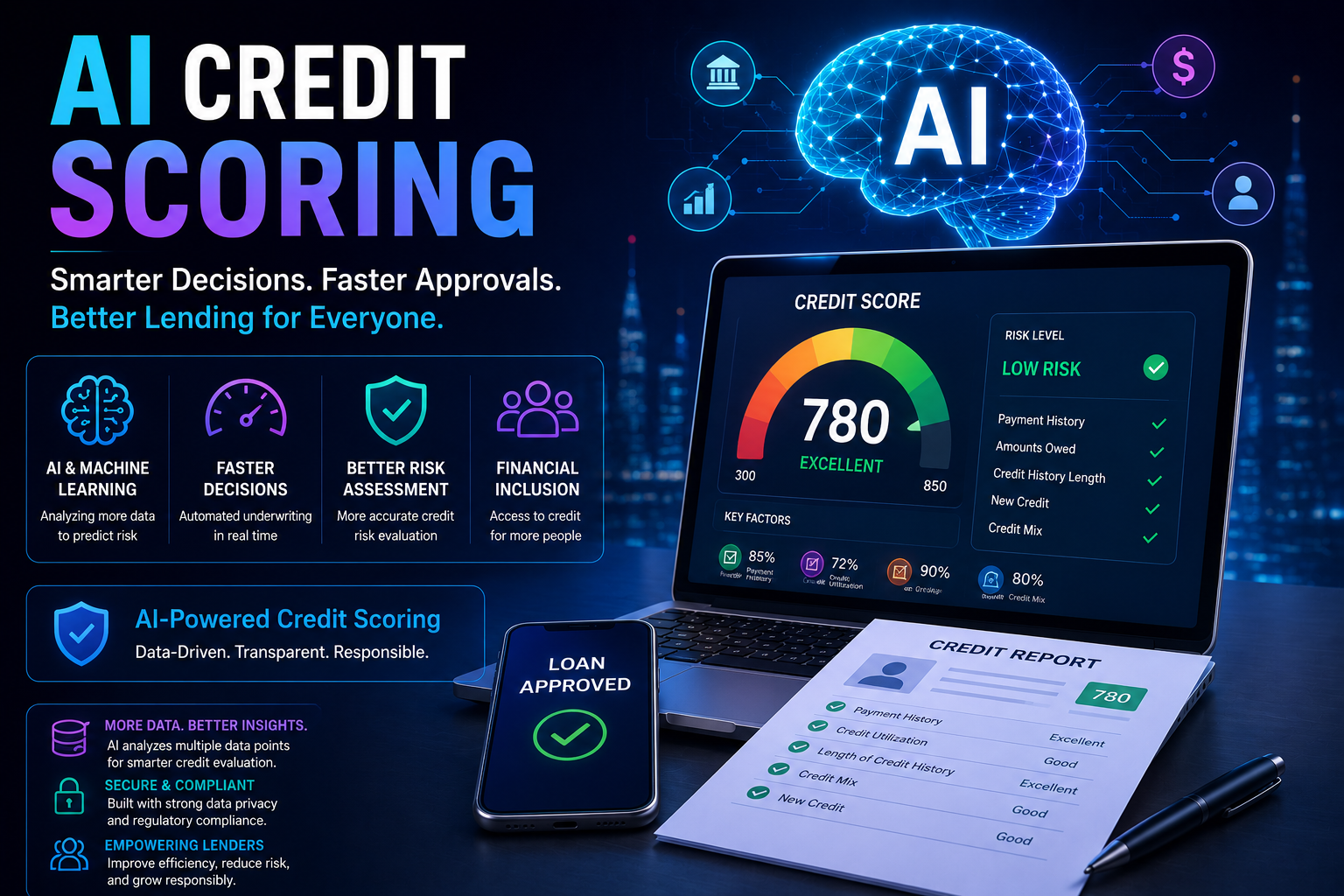
The lending industry is changing rapidly as banks, fintech companies, and digital lenders adopt artificial intelligence to evaluate credit risk. AI Credit Scoring is becoming an important part of modern lending because it can analyze large amounts of financial information, identify patterns, and support faster credit decisions.
In 2026, American lenders are increasingly focused on combining automation with responsible lending. Instead of relying only on traditional credit scores, advanced models can help lenders evaluate broader financial signals while improving the speed and efficiency of underwriting.
What Is AI Credit Scoring?
AI Credit Scoring uses artificial intelligence and machine learning to assess the likelihood that a borrower will repay a loan. Traditional scoring models generally depend on established credit-report information and predefined statistical methods. AI-powered credit models can analyze additional structured data, identify complex relationships, and update risk assessments as new information becomes available.
The objective is not simply to replace a traditional credit score. Instead, artificial intelligence can support credit risk assessment by giving lenders additional insights into an applicant’s financial profile.
How AI Credit Scoring Works
AI Credit Scoring typically combines data collection, machine learning models, risk analysis, and decision-support systems.
A lender may provide a model with information such as payment history, outstanding debt, income-related information, loan characteristics, and other legally permissible data. The model analyzes relationships within the data and produces a risk estimate that can support underwriting.
Machine learning credit scoring can identify patterns that traditional rule-based systems may not capture. For example, an algorithm can evaluate many variables simultaneously and detect relationships between repayment behavior and financial risk.
However, lenders need strong controls around data quality, model validation, monitoring, and human oversight.
Benefits of AI Credit Scoring for Lenders
One of the biggest advantages of AI Credit Scoring is speed. Automated models can process large volumes of applications quickly, helping lenders reduce manual work and shorten underwriting timelines.
AI can also improve consistency by applying the same analytical process across applications. For lenders handling thousands of applications, this can streamline operations and allow employees to focus on more complex cases.
Another advantage is improved credit risk assessment. AI models can evaluate multiple variables simultaneously, potentially helping lenders identify applicants who may have been difficult to evaluate using limited traditional data.
For fintech companies, automated credit decisioning can also reduce operational costs and create faster digital lending experiences.
AI Credit Scoring and Financial Inclusion
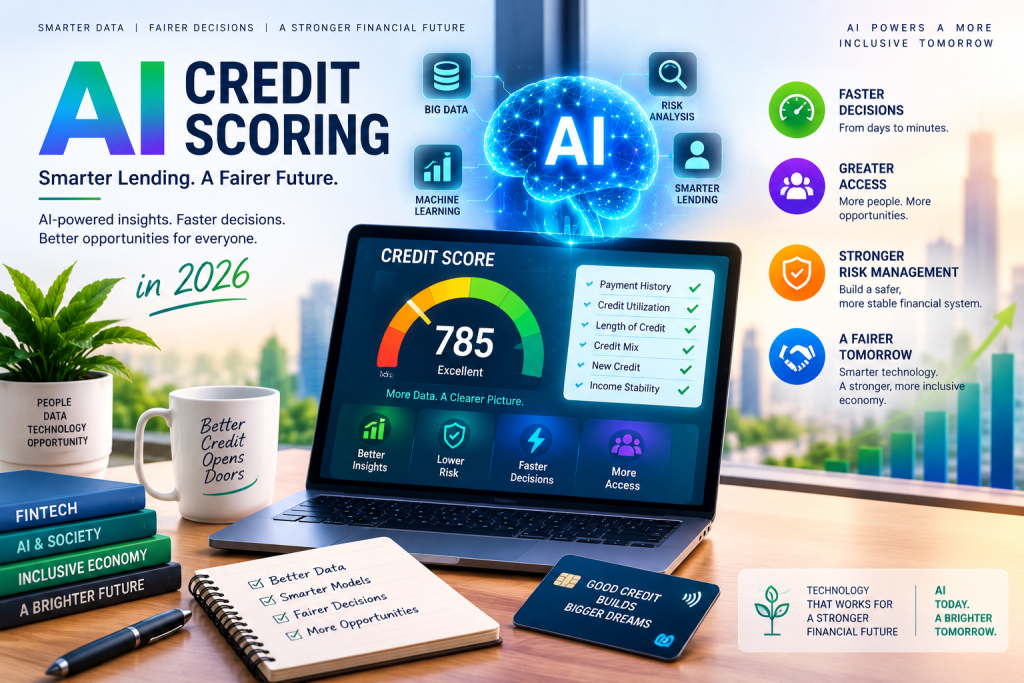
Another important application of AI Credit Scoring is expanding access to credit. Some consumers have limited traditional credit histories, including younger borrowers and people who have had fewer opportunities to use conventional financial products.
Alternative credit scoring models may evaluate additional financial information to create a broader view of creditworthiness. When used responsibly, this approach may help lenders consider applicants who could otherwise receive limited access to financial products.
However, broader data does not automatically mean fairer decisions. Lenders must carefully evaluate whether alternative data creates unintended disadvantages for particular groups.
Fairness, Explainability, and Regulation
AI Credit Scoring introduces important compliance considerations because credit decisions can affect access to mortgages, personal loans, credit cards, and other financial products.
The Consumer Financial Protection Bureau says creditors using complex algorithms must still comply with adverse-action requirements. When credit is denied or terms are changed, applicants generally must receive specific and accurate reasons for the action; using a complex or “black-box” model does not remove that responsibility.
In April 2026, the CFPB issued a final rule amending provisions of Regulation B under the Equal Credit Opportunity Act. Lenders should monitor applicable requirements and obtain appropriate legal and compliance guidance when deploying automated credit decisioning.
Challenges of AI Credit Scoring
Despite its potential, AI Credit Scoring is not risk-free. Poor-quality data can produce unreliable predictions, while historical data may contain patterns that contribute to unfair outcomes.
Complex models can also be difficult to interpret. This makes explainability, model governance, documentation, and human review especially important for lenders.
Model drift is another concern. Borrower behavior and economic conditions can change over time, meaning a model that performs well today may become less accurate later. Regular testing, monitoring, validation, and retraining can help organizations identify performance problems.
AI Credit Scoring vs. Traditional Credit Scoring
Traditional credit scoring remains an important part of lending, but AI Credit Scoring can provide additional analytical capabilities.
Traditional systems are often easier to understand and manage, while machine learning models can identify more complex relationships across large datasets. A modern lender may therefore combine established credit information with AI-driven analysis rather than completely replacing traditional methods.
The strongest approach can involve traditional credit scoring, machine learning, human review, and clear governance working together.
The Future of AI Credit Scoring in 2026 and Beyond
The future of AI Credit Scoring will likely involve more advanced machine learning, explainable AI, real-time financial data, automated underwriting, and stronger model governance.
Generative AI may also assist with underwriting workflows by summarizing documents, organizing financial information, and helping employees review applications. However, generative AI should not automatically be treated as a substitute for validated credit-risk models. Research published in 2025 found limitations in using generative AI directly for credit-risk estimation, reinforcing the need for careful testing before deployment.
For American banks, fintech companies, and lenders, the opportunity is significant. Faster decisions, improved operational efficiency, and better risk insights can create a stronger lending experience when technology is deployed responsibly.
Conclusion
AI Credit Scoring is reshaping how modern lenders evaluate credit risk. By combining machine learning, financial data, automation, and risk analytics, it can help lenders make faster and potentially more informed decisions.
However, successful implementation requires more than sophisticated algorithms. Data quality, fairness, explainability, cybersecurity, regulatory compliance, human oversight, and continuous model monitoring are all essential.
As lending technology evolves throughout 2026, organizations that balance innovation with responsible credit decisioning can be better positioned to build efficient, transparent, and trustworthy financial services.
Leave a Reply